
What Sic Bo is and how a round works
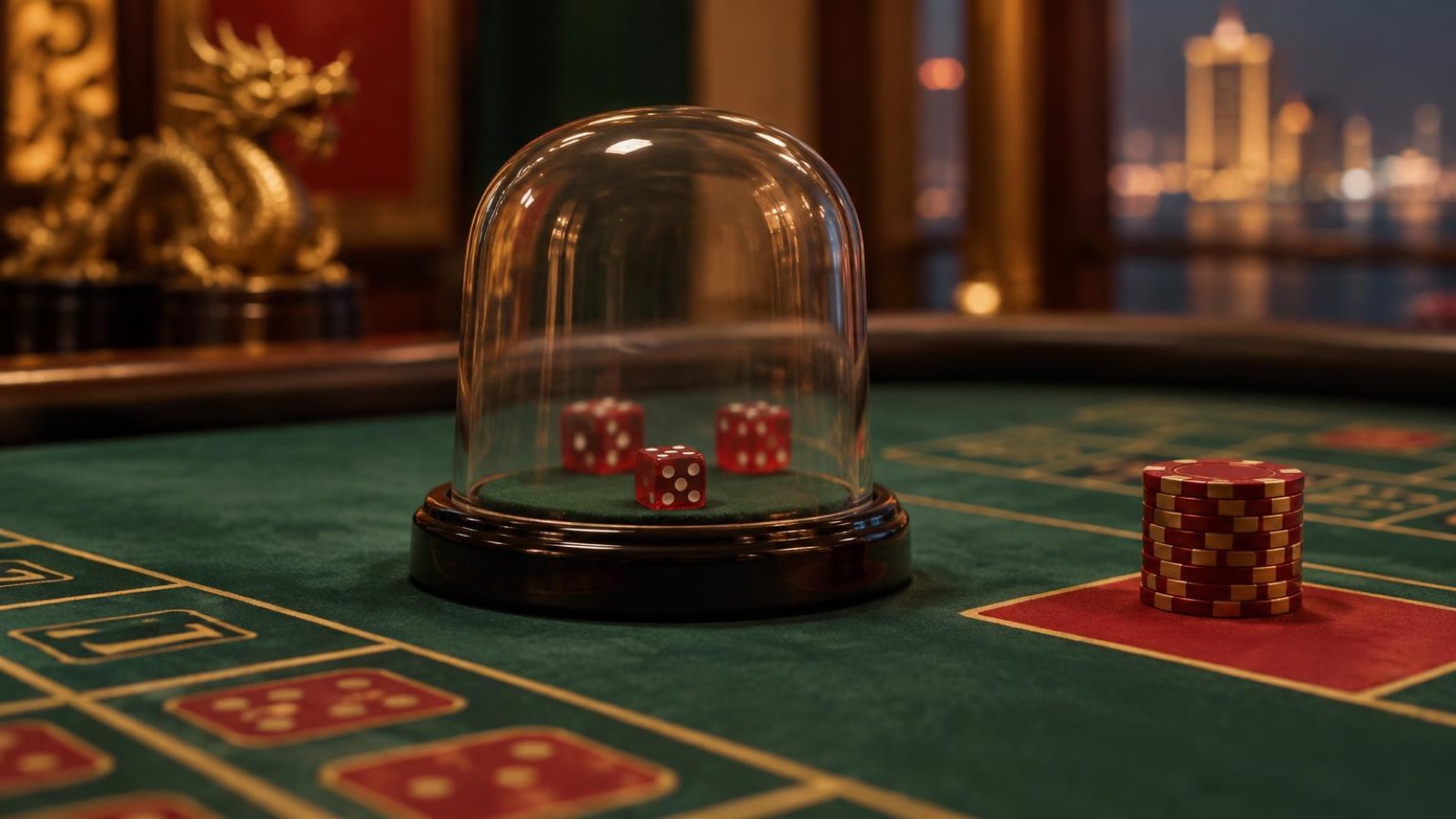
Sic Bo is an ancient Chinese dice game, originally pronounced "SEE-BO," and the name is a Chinese word for a pair of dice, precious dice, or jewel dice1. You will find it on the floor in Macau, the Philippines, Singapore and most of the region's larger casinos, usually near the baccarat tables.
The game is played with three dice, and you bet on the outcome of each roll1. On a modern table the dice are "rolled" using an electronic dice shaker rather than a hand cup, and an electronic board displays the outcomes of recent rounds of play1. Each roll is purely random and independent of the last, so a run of Small results tells you nothing about the next one1.
The betting procedure is straightforward. Players place their bets on the different symbols on the electronic layout4. Once the dealer has called "no more bets," the dealer presses the deal button and removes the cover4. The dealer then announces the winning combination based on the illuminated lights4. Losing bets are collected and all winning bets are paid based on the odds shown on the specific area of the layout4.
One quirk worth knowing before you sit down: if the dice are stacked or leaning unevenly when the lid is lifted, the dealer declares the round void and a new round begins3. You may not cancel your bets, but you may bet again on the new round3.
The 216 possible outcomes
Everything on a Sic Bo layout comes back to one number: 216. Three six-sided dice, each marked 1 to 6 with opposite sides summing to 7, produce 216 ordered outcomes2. That figure is the denominator for every probability in the game.
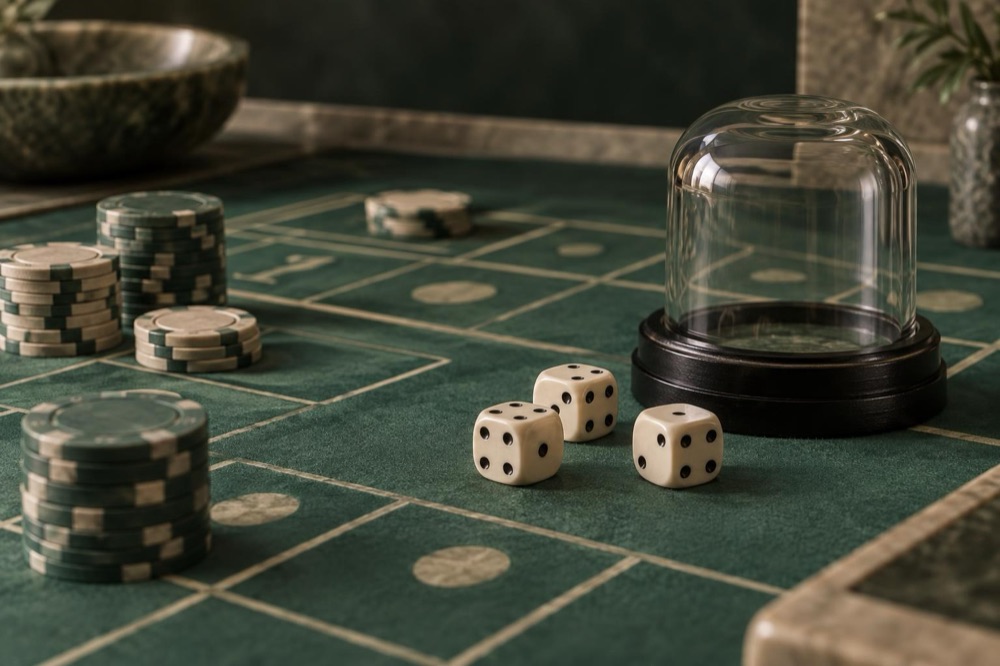
The 216 outcomes break down in a way that explains most of the paytable. Exactly one pair occurs in 90 arrangements, three of a kind in 6, and all different in 1201. Those three counts drive the odds on doubles, triples and combination bets.
A few practical consequences:
- A specific triple (say 4-4-4) appears in exactly 1 of the 216 outcomes, which is why it pays so much.
- Any triple appears in 6 of 216, six times more often than a specific one.
- A specific double appears in a much larger share of outcomes, which is why it pays only 8 to 1 at many tables4.
- Big and Small each cover a large block of outcomes, which is why they pay even money.
The higher the payout odds, the less likely the outcome will occur; lower payout odds mean greater chances of winning1. That single sentence is the whole game in miniature.
Bet types: singles, combinations and triples
There are six main categories of bets that players can make: single number bets, two number combinations, three number total bets, triple bets, pair bets, and big and small bets1.
Single number bets. You pick one number from 1 to 6 and win if it shows on one, two or three dice. In Macau the payout is 1 to 1 if one die shows your number, 1 to 2 if two dice show it, and 1 to 3 if all three do3. At NUSTAR in Cebu the same bet is listed as "Same number on three dice" paying 3 to 14.
Two number combinations. Here you bet on the chance of two specific numbers appearing among the three dice1. When the wager wins, the rules set the return at 6 to 12.
Three number total bets. You bet on the exact sum of the three dice. This is the category with the widest spread of payouts, covered in its own section below.
Triple bets. You bet that all three dice show the same number, either a specific triple or any triple.
Pair bets. You bet that a specific number appears on at least two of the three dice. At NUSTAR, Specific Doubles pay 8 to 14.
Big and Small. You bet on whether the total lands in the low range or the high range, with triples losing.
Big and Small bets: house edge around 2.78%
Big and Small are the bread-and-butter bets, and the ones most players start with. A small bet is a wager that the total sum of the next dice roll will be between 4 and 101. Big is the mirror image, covering the high totals. Both pay 1 to 14.
The catch is the triple. If all three dice land on the same number, both Big and Small lose, regardless of the total. That single exclusion is what creates the house edge. Strip out the triples and the two sides would be a coin flip; with them excluded, the house keeps roughly 2.78% of everything wagered on these bets over time.
That 2.78% figure is the benchmark for the whole game. It is the number to compare every other bet against. If a bet on the layout carries a bigger edge than 2.78%, you are paying more for the privilege of making it.
For context, 2.78% is competitive with the better bets in other Asian table games. It sits above the Banker bet in baccarat but well below most proposition bets in craps. If you want to see how it stacks up against the dice game's Western cousin, the comparison is set out in Sic Bo vs Craps.
Total number bets: payouts from 6 to 1 up to 60 to 1
Total bets are where the paytable gets interesting. You are betting on the exact sum of the three dice, and the payout rises as the total becomes harder to roll. Under the statutory rules, the odds are2:
| Total | Payout |
|---|---|
| 4 or 17 | 60 to 1 |
| 5 or 16 | 30 to 1 |
| 6 or 15 | 18 to 1 |
| 7 or 14 | 12 to 1 |
| 8 or 13 | 8 to 1 |
| 9 or 12 | 7 to 1 |
| 10 or 11 | 6 to 1 |
The pattern is easy to read. Totals near the middle (10 and 11) come up most often and pay least. Totals at the extremes (4 and 17) are rare and pay the most. The 216 outcomes are not evenly distributed across totals: there is only one way to roll a 3 or an 18, and many ways to roll a 10 or 11.
Paytables vary between casinos, and the differences are not trivial. At NUSTAR in Cebu, the published odds are4:
| Total | NUSTAR payout |
|---|---|
| 4 or 17 | 50 to 1 |
| 5 or 16 | 18 to 1 |
| 6 or 15 | 14 to 1 |
| 7 or 14 | 12 to 1 |
| 8 or 13 | 8 to 1 |
| 9 or 12 | 6 to 1 |
| 10 or 11 | 6 to 1 |
Compare the two tables side by side and the point is obvious. A total of 4 or 17 pays 60 to 1 under the Macau rules and 50 to 1 at NUSTAR2. A total of 5 or 16 pays 30 to 1 in one and 18 to 1 in the other2. Same dice, same probabilities, different house edge. The paytable, not the game, is what tells you which table you are sitting at.
Triples, pairs and domino bets: payouts up to 1:180
The long shots are where Sic Bo advertises its biggest numbers, and where the house edge is at its worst.
Specific Triple. You pick a number and win only if all three dice show it. Under the statutory rules the payout is 180 to 12. At NUSTAR it is listed at 150 to 14. In Macau casinos the published payout is 1 to 1503. This is the highest payout on the layout, and it lands once in 216 rolls.
Any Triple. You win if all three dice match, whichever number it is. The statutory payout is 30 to 12. At NUSTAR it is 24 to 14, and in Macau casinos 1 to 243. Six times more likely than a specific triple, and paying roughly a sixth as much.
Specific Double. You pick a number and win if it appears on at least two of the three dice. NUSTAR lists this at 8 to 14.
Specific Double and Single Number Combination. A more precise wager combining a double with a third number, paying 50 to 1 under the statutory rules2.
The pattern across all of these is the same one the game states plainly: the higher the payout odds, the less likely the outcome will occur1. A 180 to 1 payout sounds like a fortune. It is really a 1 in 216 event dressed up in a big number.
Even-money bets: what pays 1:1 and what pays more
Only a handful of Sic Bo bets pay even money, and they are the ones worth knowing.
| Bet | Payout | Notes |
|---|---|---|
| Big | 1 to 1 | Loses on any triple4 |
| Small | 1 to 1 | Loses on any triple4 |
| Single number, one die | 1 to 1 | Macau rules3 |
| Single number, two dice | 1 to 2 | Macau rules3 |
| Single number, three dice | 1 to 3 | Macau rules3 |
The single number bet is the interesting one, because it pays at three different rates depending on how many dice show your number. You get 1 to 1 if one die shows the chosen number, 1 to 2 if two dice show it, and 1 to 3 if all three do3. That structure means a single number bet is really three bets in one, and the effective return depends on which outcome you land.
For a sense of how even-money bets compare across the region's table games, the same 1 to 1 structure appears in baccarat's Banker and Player bets, where the edges are 1.06% and 1.24% respectively. Those figures are set out in Baccarat Odds and House Edge. Sic Bo's Big and Small at 2.78% is a wider edge than either.
House edge and RTP: the 2.78% / 97.22% benchmark
The house edge on Big and Small is about 2.78%, which means the return to player is about 97.22%. Those two numbers are mirror images: whatever the house keeps, the player gets back over the long run.
That 97.22% RTP is the best Sic Bo offers on a standard layout. Every other bet returns less. The reason is structural rather than accidental. The payouts on the layout are set below the true odds of each outcome, and the gap between the two is the house edge. The bigger the gap, the worse the bet.
This is the same mechanism that runs through every casino game. The published payout is not the true odds; it is the true odds minus the house's cut. The general principle is worked through in True Odds vs Payout Odds, and it applies to Sic Bo exactly as it does to roulette or baccarat.
What this means in practice is simple. Over a long session on Big and Small, the expected loss is roughly 2.78% of everything you wager, not everything you bring. The more money you cycle through the Big and Small spots over an evening, the more of it the edge takes. The same money cycled through Specific Triples bleeds far faster.
It is worth being clear about what an RTP figure is and is not. It is a long-run average, not a prediction for your session. Over a few dozen rolls, anything can happen. Over thousands, the 97.22% asserts itself. As the guidance puts it, the odds are that over time you will lose more often than you win5.
Where the odds differ: Manila tables and multiplier versions
Sic Bo is not one game with one paytable. It is a family of games that share the same three dice and the same 216 outcomes, but pay differently depending on where you are sitting.
The clearest example is the total bet table. Macau's statutory rules pay 60 to 1 on a total of 4 or 172. NUSTAR in Cebu pays 50 to 1 on the same outcome4. That is a meaningful difference in house edge on an identical wager, and it exists purely because the operator sets its own paytable within whatever framework applies locally.
The same variation shows up on triples. A Specific Triple pays 180 to 1 under the statutory rules2, 150 to 1 at NUSTAR4, and 1 to 150 in Macau casinos3. An Any Triple pays 30 to 1 under the statutory rules2, 24 to 1 at NUSTAR4, and 1 to 24 in Macau3.
The practical takeaway is to read the layout before you bet, not after. The numbers printed on the felt are the actual odds you are getting, and they can differ from the numbers you read about online. If a table is paying 24 to 1 on Any Triple rather than 30 to 1, the house edge on that bet is wider than the textbook figure.
Some operators also run multiplier or variant versions of the game, where a side element can boost a winning payout. These change the effective odds on the affected bets, and the published paytable on the layout is the only reliable guide to what you are actually being offered.
What the published odds do not tell you
A paytable tells you what a bet pays. It does not tell you how often it wins, and it certainly does not tell you whether the bet is any good. Those are three different things, and only the first is printed on the felt.
The gap between payout and probability is where the house lives. A Specific Triple at 180 to 1 looks like a 180-fold return, but it wins once in 216 rolls. The true odds are 215 to 1 against. The difference between 215 to 1 and 180 to 1 is the house's margin, and it is substantial.
The same arithmetic applies at every level of the layout. Total bets pay less than the true odds of each total.
None of this makes Sic Bo a bad game or a good one. It makes it a game with a published, predictable cost per bet, and the cost varies enormously depending on which spots you cover. Big and Small at 2.78% is one of the cheaper bets on any Asian casino floor. Specific Triples at a much wider edge is one of the more expensive.
The sensible approach, if you are going to play, is to decide what you want from the session. If you want the longest play for a given bankroll, the low-edge bets are the ones that deliver it. If you want the shot at a large payout, you are buying that shot at a price, and the price is printed on the layout.
One last practical note for readers in the region. Sic Bo is listed among the permitted casino games in Japan's casino enforcement rules7, but that only matters once the licensed integrated resort opens, and it has not. Gambling in Japan is basically illegal, though some forms are legal under other laws8. Playing on offshore casino websites is illegal in Japan, and players have been prosecuted6. If you are in Japan and want to play Sic Bo, the legal route is a casino floor abroad, not a website.
Common Questions
What does 'sic bo' mean?
Sic Bo is an ancient Chinese dice game, originally pronounced 'SEE-BO.' The name is a Chinese word for a pair of dice, precious dice, or jewel dice. It spread across Asia and is now a standard table in Macau, the Philippines, Singapore and most regional casinos.
How many dice are used in sic bo?
Three dice, and no more, are thrown on every roll. Each die is marked 1 to 6, with opposite sides summing to 7. Because each die has six faces, the three dice produce 216 possible ordered outcomes, which is the basis for every probability on the table.
What is the house edge on Big and Small bets?
Big and Small pay 1 to 1 and lose on any triple, which gives the house an edge of about 2.78%. That makes them the cheapest bets on the layout and the closest thing Sic Bo has to a baseline. Most other bets carry a noticeably larger edge.
What is the highest payout in sic bo?
A Specific Triple pays 180 to 1 under the statutory Macau rules, and 150 to 1 at some tables such as NUSTAR in Cebu. It wins only when all three dice show the exact number you picked, so it lands once in 216 rolls on average.
What is the RTP of sic bo?
On Big and Small, the return to player is about 97.22%, the mirror of the 2.78% house edge. Other bets return less. The higher the advertised payout, the lower the RTP tends to be, because the outcome is correspondingly rarer.
Is sic bo legal in Japan?
Sic Bo is listed among permitted casino games in Japan's casino enforcement rules, but it is only available inside the licensed integrated resort, which is not open yet. Playing on offshore casino websites is illegal in Japan, and players have been prosecuted.
Sources8 sources
- Sic Bo: How to Play, PlaySmart
- The Casino Games (Dice) Rules 2002, OPSI, May 13, 2002
- Rules for the Operation of Games of Fortune in Casinos, DICJ, May 12, 2004
- Sic Bo, NUSTAR Resort Cebu, June 25, 2026
- Safer Gambling Tips, Responsible Gambling
- Beware of Illegal Betting Sites, JRA
- Casino Enforcement Rules, JCRC, July 2021
- Gambling and Lottery Offenses, Wikipedia















