
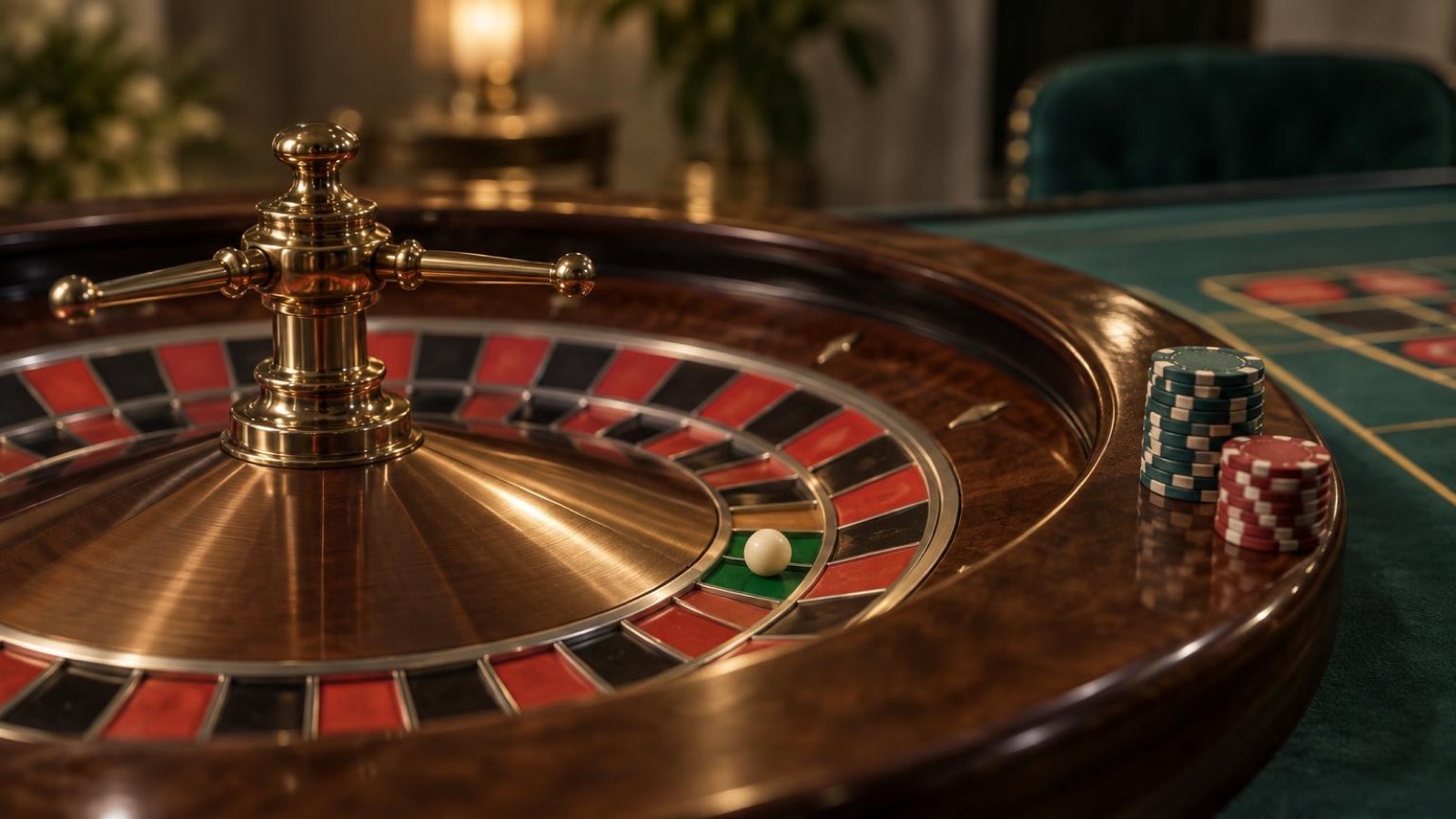
How roulette odds work: true odds vs payout
Roulette odds come in two numbers, and they are not the same number. The first is the true chance of your bet winning. The second is what the casino pays you when it does. The gap between them is the house edge, and it is built into every bet on the table.
Take a straight bet on a single number. On a single-zero wheel there are 37 pockets, so the ball lands on your number once in every 37 spins on average. That is the true odds: 1 in 371. The payout, though, is 35 to 1. You are paid as if there were only 36 pockets. That missing pocket is the zero, and it is the casino's cut5.
The same pattern repeats across the whole layout. The higher the payout, the less likely the outcome. A bet that pays 35 to 1 wins rarely. A bet that pays 1 to 1 wins almost half the time. This relationship between payout size and win frequency is the same in every casino game, and it is worth holding onto: a big payout is not a better bet, it is just a rarer one3.
What matters for your money is not the payout size but the gap between the payout and the true odds. On a single-zero wheel that gap is the same 2.7% whether you are chasing a 35 to 1 long shot or grinding 1 to 1 on red. On a double-zero wheel it is 5.26% on almost everything. That is the whole story of roulette odds in two numbers.
The wheel: European single zero vs American double zero
The single biggest thing that changes your roulette odds is which wheel you sit down at. There are two standard versions, and they differ by exactly one pocket.
The European wheel has 37 pockets: numbers 1 through 36 plus a single green zero. The table layout and the wheel slots both feature only that one zero1. The American wheel has 38 pockets: the same 36 numbers plus both a zero and a double zero, the two green spots you will see marked 0 and 006. That extra pocket is the entire difference, and it is worth more to the casino than it looks.
Because the American wheel has one more pocket, every bet on it wins slightly less often. A straight number is 1 in 37 on the European wheel and 1 in 38 on the American one1. A red bet wins about 48.6% of the time on a single-zero wheel3. The extra pocket also pushes the house edge from 2.7% to 5.26%, which is close to double1.
There are more variants than these two. Triple-zero and quadruple-zero wheels exist, adding three or four green pockets, and they push the edge higher again2. Some tables use a single-zero wheel but run two balls at once, and some are automated or presented by a live dealer on a screen. The pocket count is what you want to check before you sit down, because it sets the odds for everything else on the table.
| Wheel | Pockets | House edge | Straight bet chance |
|---|---|---|---|
| European (single zero) | 37 | 2.7% | 1 in 371 |
| American (double zero) | 38 | 5.26% | 1 in 381 |
| Triple zero | 39 | 7.69% | 1 in 392 |
| Quadruple zero | 40 | 10% | 1 in 402 |
Inside bets: payouts and win rates
Inside bets are the ones placed on the numbers themselves, in the grid in the middle of the layout. They have lower odds of winning but much higher payouts, running as high as 35 to 17. Here is what each one pays and how often it wins on a single-zero wheel.
- A straight bet covers one number and pays 35 to 1. It wins 1 time in 371.
- A split covers two adjacent numbers and pays 17 to 1, winning 2 times in 372.
- A street covers three numbers in a row and pays 11 to 12.
- A corner, also called a square, covers four numbers and pays 8 to 1.
- A six-line covers six numbers across two rows and pays 5 to 14.
The pattern is consistent: as you cover more numbers, the payout drops in proportion. Cover one number and you are paid 35 to 1. Cover six and you are paid 5 to 1. The chance of winning rises by the same factor the payout falls, which is why the house edge does not move. A six-line wins six times as often as a straight bet and pays roughly one sixth as much.
One inside bet is different. The five-number bet, covering 0, 00, 1, 2 and 3, exists only on the American layout. It pays 6 to 1, and it carries a house edge of 7.89% rather than the usual 5.26%2. It is the only bet on a standard double-zero table that is worse than the rest, and it is easy to avoid: it is the bet that straddles the two green pockets and the top row of numbers.
| Inside bet | Numbers covered | Payout | Win chance (single zero) |
|---|---|---|---|
| Straight | 1 | 35 to 1 | 1 in 371 |
| Split | 2 | 17 to 1 | 2 in 372 |
| Street | 3 | 11 to 1 | 3 in 372 |
| Corner | 4 | 8 to 1 | 4 in 374 |
| Six-line | 6 | 5 to 1 | 6 in 374 |
| Five-number (American only) | 5 | 6 to 1 | 5 in 382 |
Outside bets: payouts and the zero rule
Outside bets sit around the edge of the layout and cover large groups of numbers. They pay less but win far more often, which makes them the choice for players who want a slower ride. The payouts are 1 to 1 on even-money bets and 2 to 1 on the dozen and column bets7.
The even-money bets are red or black, odd or even, and high or low (1 to 18 or 19 to 36). Each covers 18 of the 37 numbers on a single-zero wheel, so each wins about 48.6% of the time3. The payout is 1 to 1, meaning you win the same amount you staked3. The dozen bets cover 12 numbers each, as do the three column bets, and they pay 2 to 1.
The catch is the zero. Zero is not red or black, not odd or even, and not high or low. It sits outside every outside bet. When zero comes up, all the even-money bets and all the multiple-chance bets that do not include zero lose4. That is the mechanism that pays for the 1 to 1 and 2 to 1 payouts: 18 winning numbers out of 37 is not quite half, and the missing half is the zero.
Some tables soften this. Under French rules, if you have an even-money bet and the ball lands in zero, you get half your stake back. This is known as "la partage"2. Atlantic City tables run a similar rule on double-zero wheels: if the ball lands in 0 or 00, you lose only half of any even-money bet, which lowers the house edge on those bets to 2.63%2. If you are playing outside bets, it is worth asking whether the table uses a half-back rule, because it changes what zero costs you.
House edge: 2.7% or 5.26% depending on the wheel
The house edge is the average share of every bet the casino keeps over the long run. In roulette it is set entirely by the wheel, not by the bet.
On a single-zero European wheel, the house edge is 2.7% on all bets1. On a double-zero American wheel, it is 5.26% on all bets except the five-number combination, which is 7.89%2. Those two figures cover almost everything you will meet on a standard table. The variants go higher: triple-zero roulette carries 7.69% on every bet, and quadruple-zero roulette carries 10%2.
What the edge means in practice is that the wheel keeps about 2.7 cents of every dollar you wager on a European table, and about 5.26 cents on an American one, averaged over a long session. It does not mean you lose that amount each spin. Individual spins swing wildly. It means that if you played for long enough, that is the share that would go to the house.
This is why the choice of wheel matters more than the choice of bet. A player who sticks to even-money bets on a double-zero wheel is giving up nearly twice as much per dollar wagered as a player making straight bets on a single-zero wheel. If you have both wheels available, the single-zero table is the better game, and it is not close.
What happens when zero comes up
Zero is the pocket that makes roulette profitable for the house, and it behaves differently depending on what you have bet.
If you have bet on zero directly, you win. When 0 comes up, bets placed on 0 are paid and every other bet on the table loses to the house8. A straight bet on zero pays the same 35 to 1 as any other single number.
If you have an outside bet, zero usually takes it. On the American layout, when the zero or double zero comes up, all even-chance bets lose4. The same applies to the dozen and column bets, which do not include zero. Your red bet, your odd bet, your first dozen bet: all of them lose to the green pocket.
Some tables return part of the stake instead. Under French rules, an even-money bet that meets zero gets half the stake back, and the stake is treated as having lost 50% of its value each time zero appears4. Atlantic City tables apply a half-back rule on double-zero wheels, which brings the edge on even-money bets down to 2.63%2. And on at least one regulated double-zero wheel, a spin that lands in the 00 pocket is declared void and the wheel is spun again, effectively turning it into a single-zero game9.
The practical upshot: if you are playing outside bets, zero is the number that beats you. If you are playing inside bets, zero is just one more number, and it pays like any other.
RTP and what it means across variants
RTP, or return to player, is the mirror image of the house edge. It is the share of all money wagered that comes back to players over the long run. If the house edge is 2.7%, the RTP is 97.3%. If the edge is 5.26%, the RTP is 94.7%.
That makes European roulette a 97.3% game and American roulette a 94.7% game. The variants sit below both, because their edges are 7.69% and 10% respectively2. The more green pockets a wheel has, the lower the return.
RTP is a long-run average, not a promise about your session. A hundred spins on a 97.3% game can leave you well ahead or well behind. What RTP tells you is which game is cheaper to play per dollar wagered, and on that measure the single-zero wheel wins every time.
It is also worth knowing that RTP does not change with how you bet. The edge is the same on a straight bet as on red or black, so there is no combination of bets that raises your return. The only lever you have is the wheel itself.
Lightning Roulette and other variant payouts
Modern roulette variants change the payouts rather than the wheel, and it helps to know what you are looking at before you sit down.
Lightning Roulette runs on a single-zero wheel but replaces the standard payouts on some bets with lower base payouts, then adds random multipliers to selected numbers before the spin. A corner bet pays 6.5 to 1 at base rather than the usual 8 to 1, and a street pays 9 to 1 rather than 11 to 110. The multipliers are what make up the difference, and they only apply to straight bets on the numbers that receive them.
Double Ball Roulette uses a single-zero European wheel but puts two balls in play at once, with stakes from $0.20 to $4,00010. Two balls mean two results per spin, which changes the shape of every bet on the table. Speed Roulette is a faster version of the standard game, with stakes from $0.10 up to $10,000 and a house edge of 2.7%10. VIP Roulette is the same single-zero game with higher limits, and its edge is also 2.7% against 5.26% for the American version10.
The pattern across all of them: if the wheel is single-zero, the underlying edge is 2.7%, and any extra payout comes from a rule change rather than a better deal. If a variant adds zeros, the edge rises. If it adds multipliers, they are paid for somewhere, usually in reduced base payouts on the bets that can receive them.
Why no strategy changes the odds
Every spin of a roulette wheel is independent of the last one. The ball has no memory, and the pocket it landed in last time has no effect on where it lands next. That single fact is why no betting system changes the odds.
Systems that raise and lower your stake, like doubling after a loss, change the size of your bets but not the chance of winning any of them. Systems that track past numbers and bet on the ones that have not appeared recently are working from a pattern that is not there. The advice from responsible gambling bodies is blunt on this: do not rely on "lucky" strategies, because they do not increase your chances of winning11. Betting the same numbers every week gives no advantage over betting different ones12.
The same principle applies across casino games. On a slot machine, the odds are fixed and do not change no matter how you play13. The odds always favor the house, and over time the chance of finishing ahead of where you started is low14. Roulette is no different. The wheel is a physical randomizer, and the only thing you control is how much you wager and which wheel you wager it on.
That is not a reason to avoid the game. It is a reason to pick the single-zero table, keep your bets at a level you are comfortable with, and treat the house edge as the price of the entertainment rather than something you can outplay.
Common Questions
What are the odds of hitting a single number in roulette?
On a single-zero wheel there are 37 pockets, so any one number has a 1 in 37 chance. On a double-zero wheel there are 38 pockets, so it is 1 in 38. Either way the bet pays 35 to 1, which is where the house edge comes from.
What does a split bet pay?
A split covers two adjacent numbers and pays 17 to 1. You win when either number comes up. The chance of that is 2 in 37 on a single-zero wheel or 2 in 38 on a double-zero wheel.
Is European or American roulette better for players?
European roulette is better. The single-zero wheel gives a house edge of 2.7% on every bet, while the American double-zero wheel gives 5.26% on all bets except the five-number bet, which is worse at 7.89%.
What is the house edge in roulette?
It depends on the wheel. Single-zero European roulette is 2.7% on all bets. Double-zero American roulette is 5.26% on all bets except the 0-00-1-2-3 combination, which is 7.89%. Triple-zero and quadruple-zero wheels are higher still.
Do outside bets lose on zero?
Yes, on most wheels. When zero comes up, even-money bets like red or black and the dozen and column bets lose. Some European tables use a rule that returns half your even-money stake instead, and Atlantic City tables do the same on double-zero wheels.
What is the payout on red or black?
Red or black pays 1 to 1, meaning you win the same amount as your stake. The chance of winning is about 48.6% on a single-zero wheel, because the zero pocket is neither red nor black.
What is the RTP of European roulette?
European roulette returns about 97.3% of money wagered over the long run, which is the mirror image of the 2.7% house edge. American roulette returns about 94.7%, reflecting its 5.26% edge.
Sources14 sources
- European Roulette, PlaySmart
- Roulette Basics, Wizard of Odds
- Odds and Probability, GameSense
- Arrêté Ministériel 88-384, Legimonaco
- All About Gambling, Responsible Gambling
- How to Play Roulette, GameSense
- How to Play Roulette Details, PlaySmart
- Roleta Rules, DICJ Macau
- New Jersey Casino Regulations Chapter 69E, New Jersey Division of Gaming Enforcement
- Live Roulette, CoinPoker
- Safer Gambling Tips, Responsible Gambling
- Gambling Myths, Responsible Gambling
- Gambling FAQs, Responsible Gambling
- How Slots Work, GameSense















