

What a live casino game show is
A live casino game show is a studio game streamed in real time, hosted by a presenter rather than a dealer sitting at a card table. The result comes from a physical wheel or a random multiplier rather than from cards or dice. You place bets through the game interface, and the host spins the wheel or triggers the multiplier on camera1.
The format sits inside the wider live casino category. Live casino games are hosted by real human dealers and played in real time, with all games using HD streaming from a dedicated studio1. Where a live blackjack table uses cards and a live roulette table uses a wheel and ball, a game show uses a wheel divided into segments or a multiplier mechanic as its outcome source.
The category has grown well beyond a single title. Live casino lobbies now list roulette, blackjack, baccarat and live game shows side by side, all with the immersive feel of a real casino1. Some operators run lower-limit tables aimed at casual players and VIP tables with higher betting limits for high rollers, and the same split often applies to game shows1.
If you have played a live dealer table before, the interface will look familiar. The difference is what decides the result. There are no cards to read, no dealer hand to follow and no decisions to make after you bet. You choose a segment or an outcome, the host runs the mechanic, and the result is settled immediately.
How money wheels work
A money wheel is a large physical wheel divided into segments. Each segment is numbered or colored, and each carries a fixed payout. You bet on one or more segments before the spin, and if the wheel stops on your segment you are paid at that segment's odds.

The wheel is spun by a dealer for a minimum of two revolutions, so the result is not something the host can steer2. The layout and the payouts are fixed in advance and printed on the game guide, so you can see exactly what each segment pays before you bet.
A standard money wheel layout shows how the payouts are structured. One common layout has 24 sections paying 1 to 1, 8 sections paying 5 to 1, 2 sections paying 23 to 1, and 4 individual sections paying 47 to 12. The pattern is the same across most money wheel games: many segments with small payouts, a few segments with large ones.
That structure is what makes the game feel different from a table game. Most spins land on a low-paying segment, so most rounds return roughly your stake plus a little. Occasionally the wheel lands on a rare segment and pays many times your bet. The average return across all spins is set by the segment layout, not by how you bet.
The same principle appears in older wheel games. A big wheel layout paid:
- 40 times the stake for a black joker and 40 times for a yellow joker
- 20 times for two cases
- 10 times for four cases
- 5 times for seven cases
- 2 times for fifteen cases
- 1 time for twenty-four cases5
The shape is identical: a long tail of small payouts and a short head of large ones.
Multiplier games and how payouts are set
Multiplier games work differently. Instead of a wheel with fixed segments, a random multiplier is drawn and applied to your bet. On one live roulette title, multipliers range from 50 to 1,000 times your bet3. The underlying game still runs, but the multiplier is what produces the large payouts.
The multiplier is drawn separately from the base game result. That means two things happen on each round: the base game resolves, and a multiplier may or may not be applied. When it is applied, your return is the base payout multiplied by the drawn figure.
Payouts in live games generally follow the same conventions as their table equivalents. In live blackjack, winning wagers are paid at odds of at least one to one, except blackjack, which is paid at odds of at least three to two6. Insurance pays two to one, and the insurance bet is half the amount staked on your initial wager6. Those figures matter because they show the baseline that multiplier games are layered on top of.
The dealer rules in live blackjack are also standard: the dealer must draw to 16 and stand on 176. If you are comparing a game show with a live table, that is the kind of detail that separates a decision game from a pure chance game. In blackjack you make choices that affect the outcome. In a money wheel or multiplier game you do not.
The way payouts are calculated in other Asian betting products follows the same multiplication logic. In a multiples bet, the prize payout is the stake multiplied by the odds of each individual selection7. In Vietnam's Max 3D two triples play, the payout is the number of entries of the winning number, at one entry of 10,000 VND, multiplied by the corresponding prize value8. The arithmetic is the same idea: stake times a published figure.
Live Casino House: games and platform coverage
Live Casino House is one of the studio brands that supplies game shows and live tables to operators across the region. Its live portfolio covers the standard table games plus the game show formats, and it is licensed and listed on regulator registers in the markets that publish them.
Regulator registers show the range of what a live studio can offer. One licensed live supplier lists Live Gaming Tables as a category9. Another lists Live Casino Hold'em under a specific game ID, showing that individual live titles are registered and versioned rather than offered as a single undifferentiated product10.
The wider live casino category on a major platform covers roulette, blackjack, baccarat, live game shows and more1. That is the practical picture: a game show is one tile in a lobby that also holds live tables, and you can move between them without leaving the live section.
Platform coverage matters for a simple reason. A game show is only available to you if the operator you are using carries the studio that makes it, and if that operator is licensed to serve your market. In the Philippines, the regulator publishes a list of authorized online remote gaming platforms, and only platforms on that list are authorized to operate9. If you are playing from a market with a licensing regime, checking the register is the fastest way to know whether a site is legitimate.
Real-time dealer tables: baccarat and roulette
The live tables that sit alongside game shows are worth knowing, because most players move between the two. Live dealer games do not rely entirely on RNG technology. Professional dealers operate real gaming tables from dedicated studios streamed in high definition, and bets are placed through the game interface11.
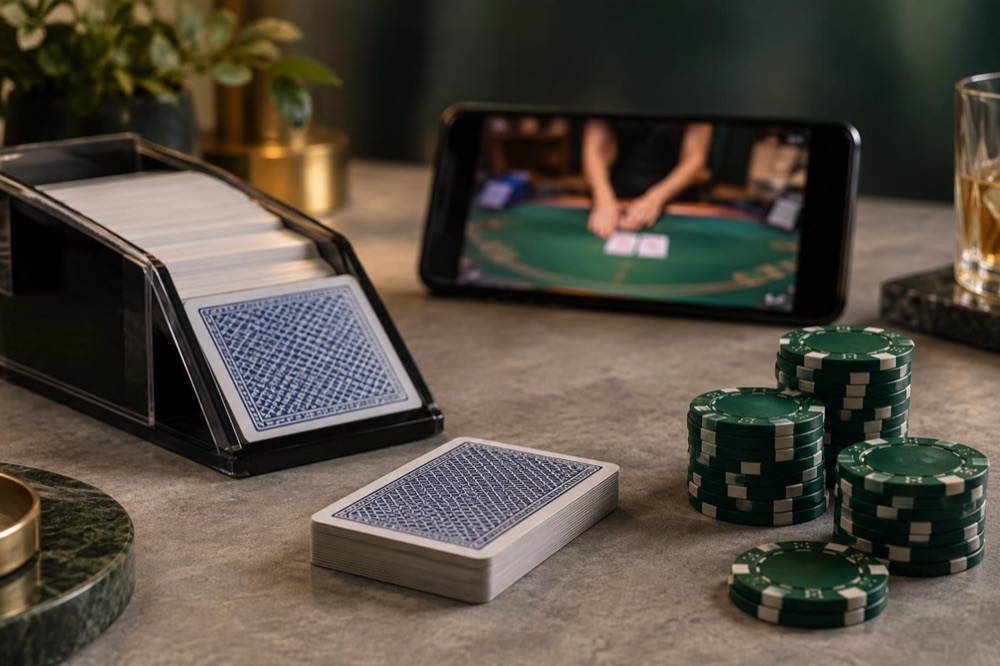
The core live table lineup is consistent across operators. Popular live dealer games include Baccarat, Blackjack, Roulette, Dragon Tiger and Sic Bo11. A licensed register entry for one operator lists Live Baccarat, Live Dealer Roulette and Slots as its live offering9. Another lists Live Baccarat, Live Dealer Roulette, Slots, Virtual Games and Perya Plus Live Color Games9.
For players in Japan, the live dealer lineup available through international operators includes live versions of blackjack, baccarat, roulette, and specialty games like Dragon Tiger and Sic Bo, plus game shows12. For players in South Korea, many international online casinos offer live dealer options including live blackjack, roulette, baccarat, poker, game shows and live bingo13.
Roulette in particular has moved toward faster formats. One live roulette title runs spins at 30-second intervals, with hosts keeping players entertained between results3. That pace is much quicker than a physical casino table, where the dealer has to settle bets, clear the layout and take new wagers between spins.
If you want the detail on how these tables compare with their land-based equivalents, the differences in speed, limits and rules are covered in Live Dealer vs Casino Floor. For the variants that change the pace and the payouts, see Live Dealer Table Games: Speed, Squeeze, Lightning and No-Commission Versions.
Game shows vs traditional live tables
The clearest way to see the difference is to compare what decides the result and what you can do about it.
| Feature | Live game show | Live dealer table |
|---|---|---|
| Outcome source | Wheel segments or a random multiplier2 | Real cards, dice or roulette wheel11 |
| Your decisions after betting | None | Yes, in blackjack and some variants6 |
| Typical payout shape | Many small, few large2 | Standard table odds6 |
| Pace | Set by the host and the mechanic3 | Set by the dealer and the table3 |
| House edge | Predetermined, generally higher2 | Lower on the main bets14 |
The house edge point is the one that matters most for a regular player. All casino games are games of chance with a predetermined house edge, and a skilled player may reduce the house edge but not eliminate it2. Live dealer blackjack sits at the low end of that range. Published figures for live blackjack variants include 0.35% for one unlimited game, 0.40% for a single-hand game, 0.41%, 0.43%, 0.45% and 0.46% for others14.
Game shows do not publish a single comparable figure because the edge depends on the segment layout and how you spread your bets. But the structure of a money wheel, with 24 sections paying 1 to 1 against 4 sections paying 47 to 1, tells you the edge is built into the gap between the true frequency of each segment and the payout it offers2. That gap is wider on game shows than on a blackjack table played with basic strategy.
If you want to understand how that gap is constructed in general, True Odds vs Payout Odds: How the House Edge Is Built Into Every Bet walks through the arithmetic. For the blackjack side, Blackjack Basic Strategy Explained covers the decisions that get you to the low edges quoted above.
Where players in Asia can legally join live game shows
This is where the answer splits sharply by country, and where you are matters more than where the operator is licensed.

In Japan, connecting from within the country to gamble on an online casino is a crime, even if the operator is legally run overseas4. That applies to free versions and free bonuses as well, not just real-money play15. Official guidance is explicit that using an online casino to gamble from within Japan is illegal16, and a government statement confirms that connecting to an online casino website from Japan to gamble is a crime even when the casino is legally operated overseas17. An official research paper adds that a foreign license does not justify the conduct and that a mistake about its illegality does not negate intent18.
It is worth being precise about what that means in practice. It is legal for offshore sites to operate outside Japan and let Japanese players join, but none of them are specifically legal for the operator to deliver or for the players to bet at12. The operator's status and your status are separate questions, and only the second one applies to you.
In Singapore, the position is different in structure. The Gambling Control Act 2022 sets out the rules for gambling services, but Parts 4, 5, 6, 7 and 8 do not apply to gambling carried on within a casino19. Section 22(9) does not extend to engaging in conduct within a casino or to a class licensee providing a gambling service under a class license22. Section 31(7) does not apply to gambling within any casino or to social gambling22. In plain terms, casino gambling in Singapore is carved out of the main online gambling provisions and regulated separately.
In the Philippines, the regulator publishes a list of authorized online remote gaming platforms, and licensed operators appear on it with their live offerings9. If you are playing from the Philippines, that list is the reference point for whether a platform is authorized.
In Thailand, the framework is still being built out. A 2025 regulation decision refers to face-to-face identity verification that may be done in person by an official, which points to an in-person verification step for players23. That is a detail worth knowing if you are planning to register from Thailand, because it means the process is not purely online.
For a country-by-country view of what is allowed where you are, the guides for Japan, Singapore, the Philippines, South Korea, Thailand and Malaysia set out the local position. If you are in Macau or visiting, Macau covers the casino side.
What the law does not cover
Two carve-outs are worth knowing because they explain why land-based casino gambling and online gambling can be treated so differently in the same country.
In Singapore, Parts 4, 5, 6, 7 and 8 of the Gambling Control Act 2022 do not apply to gambling carried on within any casino19. That is a structural exclusion, not a loophole. It means the online gambling provisions and the casino provisions are separate regimes, and a live game show streamed to your phone is not automatically covered by the casino carve-out.
In Japan, the Act on Development of Specified Integrated Resort Areas provides that Penal Code Articles 185, on gambling, and 186, on habitual gambling and keeping a gambling house for profit, do not apply to licensed casino acts in the licensed casino area24. That carve-out applies to licensed operators running licensed casino acts inside the designated area. It does not extend to a player connecting from their home to an offshore site.
The practical takeaway is that a legal casino in your country does not make an offshore live game show legal for you. The carve-outs are written for specific operators in specific places, and they do not travel with the player.
Common Questions
What is a live casino game show?
It is a studio game streamed in real time, hosted by a presenter rather than a dealer at a card table. A physical wheel or a random multiplier decides the result. You bet on segments or outcomes through the game interface, and the host spins or triggers the result on camera.
How do money wheel games pay out?
The wheel is divided into numbered or colored segments, and each segment carries a fixed payout. Common segments pay 1 to 1 or 2 to 1, while rare segments pay far more. Your return is the segment payout multiplied by your stake.
What are multiplier games in live casinos?
These are games where a random multiplier is applied to your bet rather than a wheel segment. Multipliers can range from 50 to 1,000 times your bet on some roulette-style titles. The multiplier is drawn separately from the underlying game result.
Can players in Asia legally play live game shows online?
It depends on where you are. In Japan, connecting from within the country to gamble on an online casino is a crime, even if the operator is licensed abroad. In Singapore, casino gambling sits outside the main online gambling rules. Check your own jurisdiction before you play.
What is the difference between a game show and a live dealer table?
A live dealer table uses real cards, dice or a roulette wheel, with a dealer running the game and bets placed through the interface. A game show uses a wheel or a multiplier mechanic instead. Both are streamed in real time, but the outcome source is different.
Do live game shows have a house edge?
Yes. Every casino game has a predetermined house edge, and a skilled player may reduce it but not remove it. Game shows tend to carry a higher edge than standard table games because of the large top payouts on rare segments.
Sources24 sources
- Live Casino, Stake
- Money Wheel Gaming Guide, City of Dreams Manila
- Live Roulette, CoinPoker
- オンラインカジノ対策, National Police Agency
- Arrêté Ministériel du 26 juillet 1988, Légimonaco
- House Rules, GGPoker
- Football Betting Game Rules, Singapore Pools
- Max 3D, Vietlott
- List of Authorized Online Remote Gaming Platforms, PAGCOR
- Playtech Live, PAGCOR
- Casino Plus, BingoPlus
- Best Online Casinos for Players from Japan, Wizard of Odds
- Best Online Casinos for Players from South Korea, Wizard of Odds
- Blackjack Strategy, Wizard of Odds
- ギャンブル依存症パンフレット, SCGA
- オンラインカジノに関する消費者問題, 国民生活センター
- オンラインカジノに関する注意喚起, 消費者庁
- 競艇, Boat Race
- Gambling Control Act 2022, Historical Version, Singapore Statutes Online
- Gambling Control Bill, Singapore Statutes Online
- 特定複合観光施設区域整備法, Wikipedia
- Gambling Control Act 2022, Singapore Statutes Online
- ราชกิจจานุเบกษา, Royal Gazette
- Instant Money Machine: How to Play, PlaySmart















