
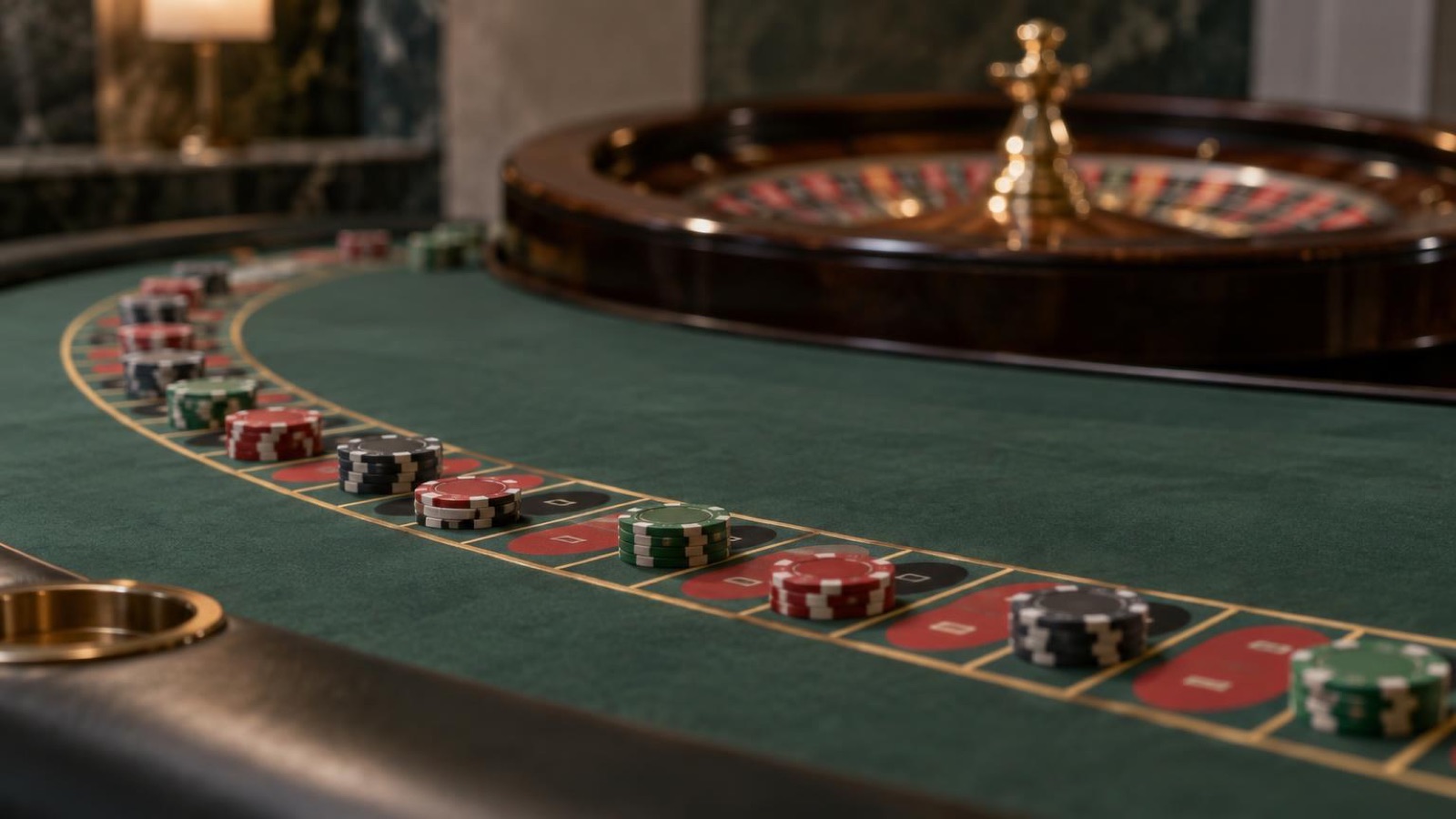
What call bets are: Voisins du Zero, Tiers, Orphelins and Neighbors
A call bet is a single announcement that covers a group of numbers sitting next to each other on the physical wheel. You are not betting on the layout in the usual way. You are betting on a section of the cylinder, and the croupier places the chips for you.
The four you will see most often are Voisins du Zero, Tiers du Cylindre, Orphelins and neighbor bets. Each one maps to a different arc of the wheel, and together they can cover the whole cylinder if you want them to.
Voisins du Zero covers the seventeen numbers closest to 0 on the single-0 wheel1. That is the largest of the standard call bets, and it is the one most players ask for first because it includes the zero itself. Because it covers seventeen numbers, it takes more chips than the others, and the chips are not spread evenly. Some numbers in the section get a single chip, others get two, because the bet is built from a mix of splits and straight-ups rather than one flat wager per number.
Tiers du Cylindre covers the twelve numbers on the wheel opposite to the voisins bet1. If voisins is one half of the cylinder, tiers is the other. It is a smaller bet than voisins and takes fewer chips.
Orphelins covers the two slices of the wheel between the voisins and tiers bets1. The name means "orphans" in French, and it refers to the numbers that fall outside the two big sections. Orphelins is split into two separate groups of numbers on the wheel, which is why it is sometimes placed as two announcements rather than one.
Neighbor bets work differently from the other three. A neighbor bet bookends any chosen number with its two neighbors on each side1. So if you ask for a number with two neighbors, you are covering five numbers in total: your chosen number, the two sitting immediately to its left on the wheel, and the two sitting immediately to its right. You can ask for more neighbors if you want a wider spread, and the croupier will place the chips accordingly.
The reason these bets exist at all is practical. On a real wheel, the numbers are not laid out in numerical order. They are arranged so that high and low numbers, red and black, alternate around the cylinder. A call bet lets you bet on a physical section of that arrangement without having to find and cover each number on the layout yourself.
The wheel you are betting on: European, American and other variants
Call bets are built around the single-zero wheel. That is the wheel with 37 slots, numbered 0 through 36, with one green zero2. The number order on that wheel is what defines where voisins, tiers and orphelins begin and end.

European roulette is still offered in many casinos as an alternative to the American version3. If you sit down at a single-zero table, the call bets will map to the standard European wheel order. If you sit down at a double-zero table, the wheel order is different, and the standard call bets do not line up the same way.
American Roulette features a double zero1. That extra pocket changes the wheel layout, so the classic French call bets are not usually offered on American tables. You may still find neighbor bets, because those are defined relative to whatever number you name rather than to a fixed section.
There are also variants with more than two zeros, which we cover further down. Those wheels have their own layouts, and the standard call bets do not apply to them.
If you want the full comparison of wheel types and what the extra zero does to your odds, see European vs American Roulette.
Inside and outside bets and what each pays
Every call bet is made up of ordinary inside bets. Inside bets are wagers on specific numbers or small groups of numbers on the inside of the table4. The roulette layout has two main areas: an inside area for betting on numbers, and an outside area for betting on outcomes like odd or even, or red or black3.
Inside bets have lower odds of winning but much higher payouts, as high as 35 to 15. Outside bets have better odds of winning but lower payouts, at 1 to 1 or 2 to 15. Outside bets cover things like whether the winning number is high or low, odd or even, red or black, or part of the first, second or third dozen5.
Here is what the standard roulette wagers pay, which is what each component of a call bet pays:
| Bet type | Covers | Payout |
|---|---|---|
| Straight up | One specific number | 35 to 16 |
| Split | Two numbers | 17 to 1 |
| Street | Three specific numbers | 11 to 16 |
| Corner | Four numbers | 8 to 1 |
| Six line | Six specific numbers | 5 to 16 |
| Dozen or column | Twelve specific numbers | 2 to 16 |
| Even money | Red, black, odd, even, 1 to 18, 19 to 36 | 1 to 1 |
A call bet is not a new bet type with its own payout. It is a bundle of the wagers above, placed in one announcement. If your voisins bet includes a straight-up on 0 and a split on 0 and 32, each of those pays exactly what it would pay if you had leaned over and placed the chips yourself.
That is also why the chip count matters. Voisins du Zero covers seventeen numbers, so it takes more chips than a neighbor bet covering five. The croupier will tell you the total before placing it.
For the full breakdown of every bet on the layout, see Roulette Odds.
House edge: 2.7% to 5.3% depending on the wheel
The house edge on roulette depends entirely on which wheel you are playing, not on which bet you place.
European roulette carries a house edge of 2.7%1. That figure applies to all bets under European rules, because every bet on a single-zero wheel has the same edge of 1 in 37, or 2.70%2. It does not matter whether you are betting a straight-up number, a dozen, or a call bet covering seventeen numbers. The edge is the same.
American roulette carries a house edge of 5.26%1. That applies to all bets under U.S. rules except the 0-00-1-2-3 combination, which carries a house edge of 7.89%2. The extra zero is what doubles the edge.
Triple-zero roulette carries a house edge of 7.69% on every bet2. That is 1 in 13.
One widely cited figure puts roulette at 5.3% with optimal play7. That number reflects the American wheel, where the edge is highest among the standard variants.
The practical takeaway is simple. If you have a choice between a single-zero and a double-zero table, the single-zero table costs you less per bet over time. Call bets do not change that. They change how many numbers you cover and how much you have riding on each spin, not the underlying edge.
What happens when zero comes up
Zero is the pocket that makes roulette profitable for the house, and what happens when it hits depends on the rules at your table.
Under French rules, if you make any even money bet such as red, black, odd, even, 1 to 18 or 19 to 36, and the ball lands in zero, you get half your bet back2. This is known as "la partage." You do not lose the full stake, but you do not win either.
In Atlantic City, if the ball lands in 0 or 00, you lose only half of any even money bet2. That rule applies to even money bets in Atlantic City and not on single-zero wheels.
On a standard European table without la partage, an even money bet loses in full when zero comes up. On an American table, the same applies when either 0 or 00 hits.
For call bets, the picture is different because most call bets include zero or sit right next to it. Voisins du Zero includes the zero itself, so when zero comes up, part of your voisins bet wins and part of it loses. The straight-up portion on 0 pays 35 to 1, while the splits and corners that do not include 0 lose. Whether the spin is a net win or a net loss depends on how the chips were distributed across the section.
This is worth understanding before you place a call bet for the first time. A call bet is not a single wager with a single outcome. It is a collection of wagers, and a spin can pay some of them while wiping out others.
Where roulette is played in Asia's casinos
Roulette is available in several Asian jurisdictions, and the rules for who can play differ by country.
In South Korea, roulette is one of the chance-based gambling games offered alongside lotteries, slot machines, video poker and baccarat8. Casinos, horse racing, cycling, boat racing, lotteries, sports promotion voting tickets and bullfighting are all legal forms of gambling in the country8. On Jeju, the Jeju Oriental Hotel Casino offers blackjack, roulette, Daisai, baccarat and other games9, and the Jeju Shilla Hotel Casino offers roulette, blackjack, baccarat, slot machines and other games10.
Korean casino floors have a betting limit rule worth knowing. Table game maximum bets are capped at KRW 100,000 per person per round, set per table, and up to half of the tables may allow up to KRW 300,000 per person per round11. That cap applies to table games on the general casino floor of closed mining area casinos.
For country-by-country detail on who can enter a casino and what is legal, see Can I Gamble in South Korea?, Can I Gamble in Japan?, Can I Gamble in Macau?, Can I Gamble in Singapore?, Can I Gamble in the Philippines?, Can I Gamble in Cambodia?, Can I Gamble in Malaysia?, Can I Gamble in Vietnam?, Can I Gamble in Thailand?, Can I Gamble in China?, Can I Gamble in Hong Kong? and Can I Gamble in India?.
Can the wheel be predicted? What the research says
The object of roulette is to guess where the ball will land on the wheel by placing bets on the table3. In practice, that is a guess. But a small body of research has looked at whether the guess can be improved with physics.
A 2012 paper by Michael Small and Chi Kong Tse concluded that deterministic in-situ prediction of roulette outcomes is feasible, while the margin for profit is quite slim. The paper was submitted to arXiv on April 28, 2012, revised on July 13, 2012, and published in the journal Chaos in September 2012. The model showed an expected return of at least 18% on a European roulette wheel using measurements of the ball's initial position, velocity and acceleration.
That is a research result, not a practical method. It requires measuring the ball as it spins, which is not something you can do from a seat at the table. Casinos also watch for it. The historical example is Dr. Richard Jarecki, who won at roulette in European casinos using a system and died at his home in Manila on July 25, 2018, at the age of 86.
For most players, the honest answer is that the wheel cannot be predicted in any way that changes the house edge. The edge is built into the payout structure, and no amount of observation changes the odds on a fair wheel.
Variants with extra zeros: Triple-Zero and Quadruple-Zero Roulette
Some casinos have added wheels with more than two zeros, and these change the math significantly.
These variants are worth knowing about because they look like ordinary roulette tables from a distance. If you sit down without checking the wheel, you may be playing a game with a house edge nearly three times that of European roulette. The zero count is the single most important thing to check before you buy in.
For more on these and other wheel types, see Roulette Variants.
Betting limits and table procedure
Roulette tables have a minimum bet rule that catches some players out. You must place the full minimum bet on either the inside or the outside, and you cannot split it between the two3. On outside bets, you must put the table minimum on one individual wager, while on the inside you can spread bets across different numbers3.
That distinction matters for call bets. A call bet is an inside bet, so it can be made up of many small chips spread across numbers, as long as the total meets the table minimum for the inside.
Timing is the other thing to get right. Once the croupier removes the clear plastic piece called a dolly from the table, you can begin to place bets5. In most casinos, you can only place bets once all players' bets are paid out and the dolly is removed, which is the signal that the table is open for the next spin5. Some casinos allow betting in specific areas once the dolly is down.
Players usually place their own bets, but the croupier can do it for you if you cannot reach the spot on the table5. That is exactly how call bets work in practice. You announce the bet, and the croupier places the chips on your behalf. The croupier also announces "no more bets" and places the dolly on the winning number5.
If you are new to a live table, the sequence is:
- Wait for the dolly to come off.
- Place your chips or announce your call bet.
- Wait for "no more bets."
- Watch the spin.
- Collect if you win.
If you are unsure how to announce a call bet, ask the croupier before the spin. They will tell you the chip count and place it for you.
For the wider picture of how table games work in the region, see Casino Table Games in Asia and Casino Table Etiquette.
Common Questions
What is the difference between Voisins du Zero and Tiers du Cylindre?
Voisins du Zero covers the seventeen numbers closest to zero on a single-zero wheel, including 22, 18, 29, 7, 28, 12, 35, 3, 26, 0, 32, 15, 19, 4, 21, 2 and 25. Tiers du Cylindre covers the twelve numbers on the opposite side of the wheel, from 27 through 33. The two bets sit on opposite halves of the cylinder.
Are call bets available in online roulette?
Some online roulette tables include a racetrack graphic that lets you place Voisins, Tiers, Orphelins and neighbor bets with one click. Others only offer the standard inside and outside layout. If you do not see a racetrack or an announced-bets panel, the table does not support call bets.
What does 'neighbors' mean on a roulette racetrack?
A neighbor bet takes any number you choose and adds the two numbers sitting on either side of it on the physical wheel, for five numbers in total. If you ask for 0 with two neighbors, you are covering 32, 15, 0, 26 and 3. The croupier places the chips for you.
Do call bets pay differently from regular roulette bets?
No. A call bet is simply a bundle of ordinary inside bets placed at once. Each number in the bundle pays the same as it would if you had placed the chips yourself, so a straight-up number still pays 35 to 1 and a split still pays 17 to 1. The house edge is unchanged.
Is roulette legal in Asian countries?
It depends where you are. Roulette is offered in casinos in Macau, Singapore, the Philippines, Cambodia, South Korea and Malaysia. In Japan, casino gambling is not yet open to the public. In China and Thailand, most casino gambling is illegal. Check the rules for the specific country before you travel.
What is the minimum bet for roulette in Asian casinos?
Table minimums vary widely by casino and by table. On a Korean casino floor, table game limits are capped at KRW 100,000 per person per round, with up to half of tables allowed to set a KRW 300,000 cap. Elsewhere, minimums are set by the individual casino.
What is the RTP of European roulette?
European roulette returns about 97.3% to players over time, which is the same as a 2.7% house edge. That figure applies to every standard bet on a single-zero wheel. American roulette, with its extra double zero, returns about 94.74%.
Sources11 sources
- European Roulette, PlaySmart
- Roulette Basics, Wizard of Odds
- How to Play Roulette, PlaySmart
- Get to Know Roulette, GameSense
- How to Play Roulette: Details, PlaySmart
- Roulette Wager Odds, UK Statutory Instruments
- Baccarat, GameSense
- Legal Gambling in Korea, KBOAT
- Jeju Oriental Hotel Casino, Visit Korea
- Jeju Shilla Hotel Casino, Visit Korea
- Table Game Betting Limits Regulation, Korean Law Information Center















