Where casino games fit in Hong Kong
Hong Kong itself has no casinos. Regulated gambling in the city is limited to a small number of channels: horse racing, football betting and the Mark Six lottery run by the Hong Kong Jockey Club, plus licensed activities such as mahjong parlors4. Everything else, including land-based casinos, online casino games and live dealer casinos, is generally not legal in Hong Kong6.
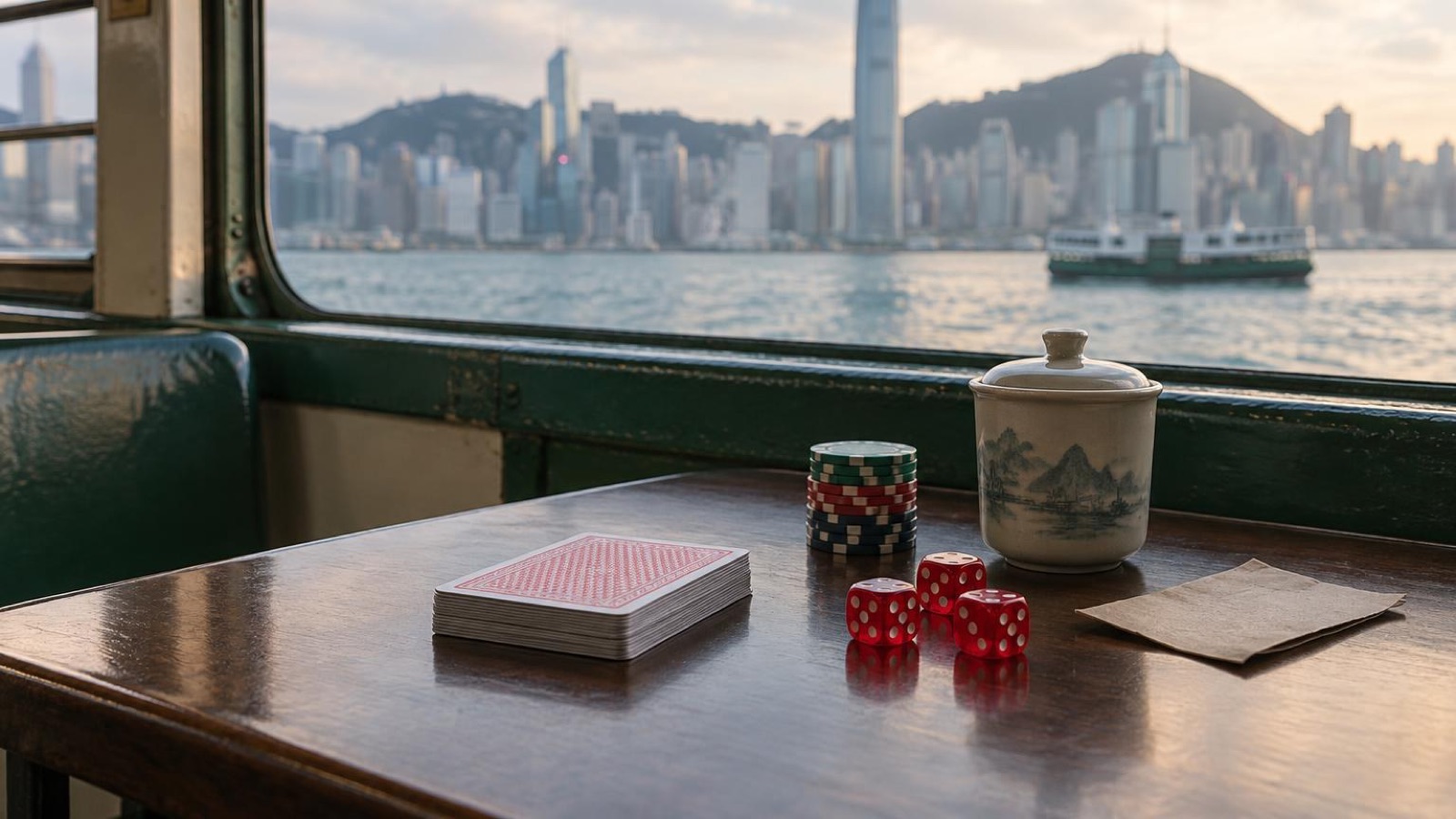
So why read about casino games at all? Because these are the games of the region. Hop on a ferry to Macau and baccarat is what you will find, table after table. Sic Bo and Fan Tan are Chinese games with centuries of history. And many Hong Kong residents do play casino games online, which carries its own practical risks covered in the last section of this page.
This page explains the games themselves: how baccarat works, what each bet pays, what the house edge means for your money, how Sic Bo and Fan Tan are played, and what betting systems can and cannot do. For the wider picture of what you can legally do in the city, see gambling in Hong Kong and casinos in Hong Kong.
Baccarat: the game that dominates Asian casino floors
Baccarat, also known as punto banco, is one of the oldest and most popular games in casinos all over the world, and it is especially popular among high-rollers and Asian gamblers7. In Macau, baccarat is extremely dominant8. Regardless of how extensive and personalized the services are, baccarat is typically the only game offered in VIP rooms, and it is the preferred game among Chinese players1.
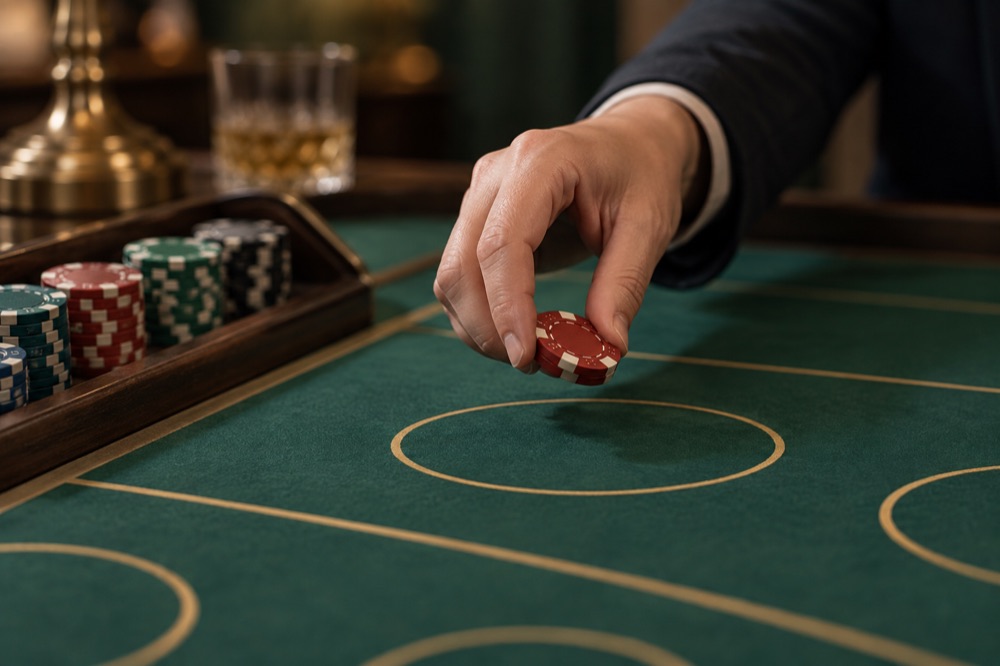
Part of the appeal is simplicity. Baccarat is a straightforward game of pure chance9: you make one decision, which hand to back, and the rules do the rest. There is no skill involved in playing, and the house edge on the best bets is low by casino standards, about 1.06 percent on Banker bets1. That combination of low edge, fast play and big-money culture made baccarat the game of Macau.
How a baccarat hand is played and scored
In essence, baccarat is a simple guessing game. It is just about betting which of two hands that are dealt, the Banker's or the Player's, will win, and the winning hand is the one closest to a total of 9 points10. No matter how many players are seated, only two hands of cards are dealt: the Player's and the Banker's11.
All bets have to be placed before the cards are dealt12. Once the bets are placed, a total of four cards are dealt on the table: two for the Player box and two for the Banker box10.
Card values are simple8:
- Ace = 1
- 2 through 9 = face value
- 10, jack, queen and king = 0
If a hand's total reaches a double digit, only the rightmost digit counts. A total of 10 is worth 0, 11 is worth 1, and 12 is worth 210. So a queen and a 7 is worth 7, and a 9 and a 6 is worth 5. The maximum number of points in both hands is 98.
One ritual worth knowing: in squeeze baccarat, the players with the highest wagers on each of the Player and Banker hands are given the cards dealt to that side to squeeze, touch or hold, slowly revealing them. It is pure theater, but in Macau it is a big part of the game's appeal10.
What is a natural?
If the points total is 8 or 9 for either the Player's or the Banker's hand on the first two cards dealt, this is called a natural, and the game is over: no more cards are dealt and all bets are paid out13. A natural is simply a hand made out of two cards with a total value of 8 or 912.
If both hands have a natural, the higher total wins. If both are equal, the hand is a tie: Tie bets win and Player and Banker bets are pushed back. Naturals are why many baccarat rounds last only a few seconds.
Betting on Player, Banker or Tie: payouts and commission
Each round of baccarat has three possible outcomes: player win, banker win, and tie8. You may only place a bet on either the Banker or the Player, but you may bet on a Tie outcome at any time, even if you have an existing bet on one of the sides12.
| Bet | Payout | Notes |
|---|---|---|
| Player | 1 to 1 | Even money, no commission13 |
| Banker | 1 to 1 less 5% commission | Often quoted as 19 to 202 |
| Tie | 8 to 1 | Paid if both hands are equal13 |
A winning bet on the Player hand pays even money. If you bet $10 on Player and it wins, you win $10 with nothing deducted13. A winning bet on the Banker hand also pays even money, but the dealer collects a 5 percent commission, so a $10 bet returns $10 minus the 5% commission13. The Banker payout is sometimes written as odds of 19 to 20, which is the same thing2.
The Tie wager is a bet, payable if won at odds of 8 to 1, that the banker's hand and the player's hand shall be equal at the end of the game2. If you bet on Player or Banker and the hands tie, your bet is not lost: it is returned.
Why the commission on Banker? Because the Banker hand wins slightly more often than the Player hand under the drawing rules. Without the commission, everyone would simply bet Banker every time. Most casinos charge 5% on all winnings from the Banker bet14, though a few tables have historically charged less; the Horseshoe in Las Vegas offered a 4% commission on its big table game for years3.
Side bets: Player Pair, Banker Pair and Perfect Pair
Beyond the three main bets, most tables offer side bets. Depending on the tables you choose, you may be required to place a main bet before you can place a side bet12. Common options let you bet on Player Pair, Banker Pair, Either Pair or Perfect Pair, and some tables add further bonus bets12.
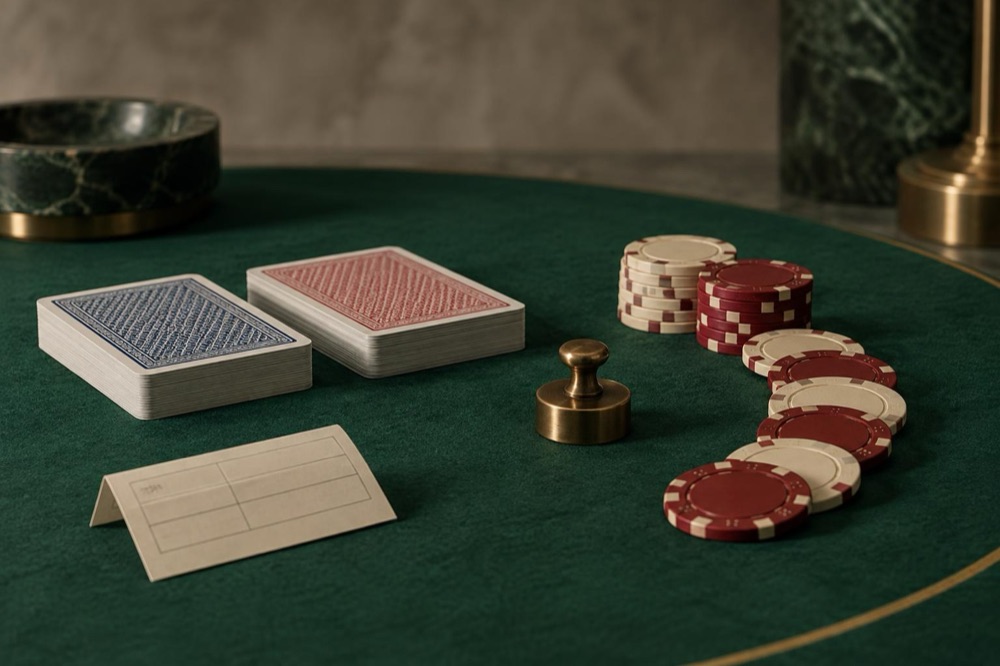
A Player Pair or Banker Pair side bet is a wager that the first two cards dealt to that hand are a pair, such as two kings or two sevens13. Wins pay 10 to 1 on both Player Pair and Banker Pair8, though some tables pay 11:1 if the hand you bet on contains a pair14.
Perfect Pair is a stricter version: the pair must be identical in rank and suit, such as two queens of hearts. In blackjack's Perfect Pairs side bet, perfect pairs pay 25 times the stake, colored pairs 12 times and mixed pairs 6 times15, and baccarat tables with a Perfect Pair option follow a similar tiered structure.
Side bets look attractive because of the bigger payouts, but they carry a much higher house edge than the main game. Player Pair and Banker Pair pay 10 to 1 if the hand you bet on contains a pair, and Perfect Pair pays 25:18. Some tables also require a main bet before you can place any side bet8. Treat them as occasional fun, not as the core of your play.
House edge by bet type
The house edge is the share of each bet the casino expects to keep over the long run. Baccarat's main bets are among the best value in the casino. In an eight-deck game, the house edge is 1.06% on the Banker bet, 1.24% on the Player bet, and 14.36% on the Tie3. In a single-deck game the figures shift to 1.01% on Banker, 1.29% on Player, and 15.75% on the Tie8.
For comparison, blackjack has a house advantage of around 0.5 percent if you know the ideal move in every scenario16, while slot machines are less favorable than table games such as fortune pai gow poker, blackjack and roulette in terms of return to player17. Baccarat sits in between: worse than perfect blackjack, far better than slots, and it requires no decisions at all.
The practical reading of these numbers: for every HKD 100 you put on Banker, the house expects to keep about HKD 1.06 over the long run. On Tie, it expects to keep about HKD 14.36. The Tie bet's 8 to 1 payout looks tempting, but it wins rarely enough that it is the worst regular bet on the table. The smart player will bet on the banker every time and leave the scorecards alone3.
Third card rules for Player and Banker hands
If neither hand has a natural, the drawing rules take over. Baccarat rules call for the Player to always go first, and the Banker's hand depends on the Player's hand10.
The Player's side is simple11:
- The Player's hand always stands on point totals of 6 or 7.
- On any total from 0 to 5, the Player draws a third card, unless the Banker has 8 or 9, in which case the Banker has already won with a natural.
The third card is never dealt to a hand with a total of 7 or higher14.
The Banker's rules depend on the Banker's own total and, when the Player has drawn, on the value of the Player's third card14:
| Banker's first two cards | Banker draws when the Player's third card is | Banker stands when the Player's third card is |
|---|---|---|
| 0 to 2 | Any card | Never stands14 |
| 3 | Any card except 8 | 811 |
| 4 | 2 to 7 | 0, 1, 8 or 911 |
| 5 | 4 to 7 | 0 to 3, 8 or 911 |
| 6 | 6 or 7 | 0 to 5, 8 or 911 |
| 7 | Never draws | Always stands14 |
If the Player stood on 6 or 7, the Banker receives a card if its total is 0 to 5, and stands on 6 or 713.
You do not need to memorize any of this. The dealer runs the whole procedure and the rules are fixed: no player decision affects the outcome at any point. But knowing the table helps you follow the game, and it explains why the Banker wins more often, which is the whole reason for the commission.
How many decks, and what the shoe looks like
Baccarat is usually played with eight decks of cards shuffled together in a shoe8. Some games use six decks, particularly where a card shuffling machine is used15. One variant, 21st Century Baccarat, is played with a shoe that contains eight standard 52-card decks plus eight jokers, a total of 424 cards18.
Two small rituals mark the shoe. At the start of a new shoe, the dealer turns over one card to determine how many cards to burn, except that a 10 or face card results in 10 cards burned8. The cut card is placed 16 cards from the bottom of the shoe; when it appears, the shoe ends and a new one is prepared8.
The number of decks matters only at the margins: it slightly shifts the house edge on each bet, as the table above shows, and it changes the odds of the pair side bets. Eight decks is what you will almost always meet in Macau.
Sic Bo: the three-dice game of Macau and its bets
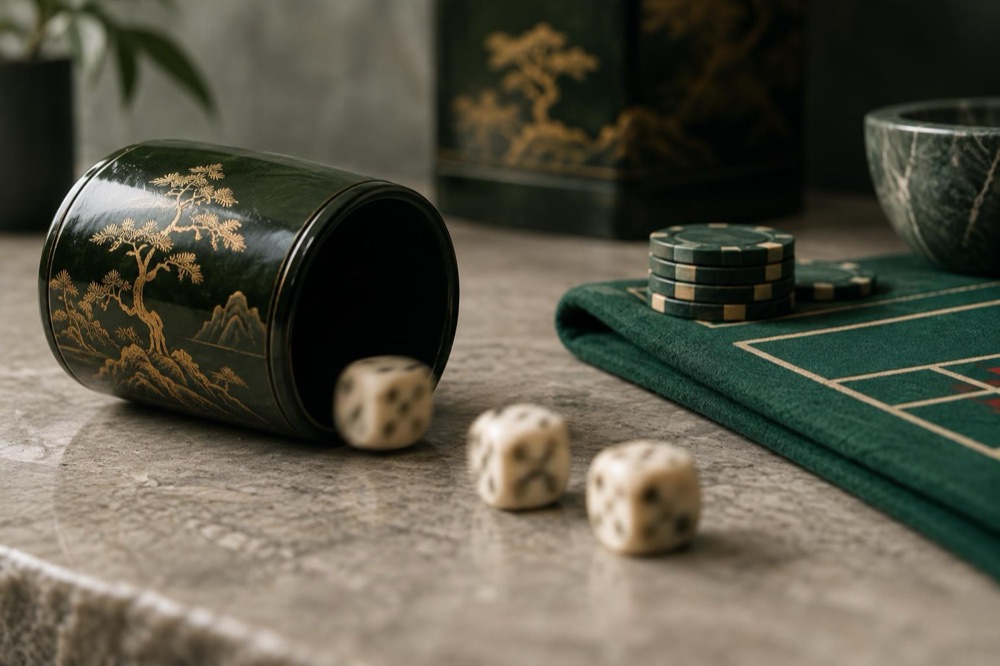
Sic Bo, originally pronounced "SEE-BO", is an ancient Chinese dice game19. Three dice, and no more, are thrown at every throw, each marked 1 to 6 with opposite sides summing to 720. You are betting on the outcome of a single roll, and the layout offers bets ranging from near-certainties to long shots.
The main bet types19:
- Single number bets: bets on any of the numbers 1 through 6 coming up on the next roll of the three dice. The payout depends on how many of the three dice show your number.
- Small and Big: a Small bet wagers that the total score will be 4 to 10 except a triple, and pays 1 to 120. Big is the mirror image, 11 to 17 except a triple.
- Any Triple: a bet that all three dice show the same number, any number. The odds payable if the wager is won shall be 30 to 120.
- Specific Double and Single Number Combination: a bet on one specific double plus one specific single, for example two 4s and a 2. This pays 50 to 120.
The guiding principle is simple: the higher the payout odds, the less likely the outcome will occur, and lower payout odds mean greater chances of winning19. Three six-sided dice give 216 ordered outcomes in total, so a specific double-and-single combination has very few ways to happen, which is why it pays 50 to 1.
Sic Bo is entirely a game of chance with one roll per decision. It moves fast, the table layout looks busier than it is, and the Small and Big bets offer roughly even-money play similar in spirit to baccarat's Player bet.
Fan Tan: how the counting game works
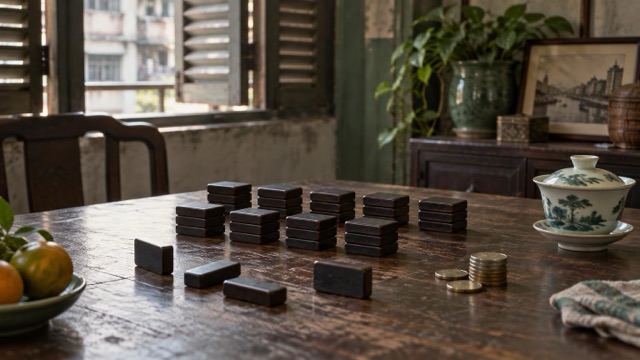
Fan Tan is the old Chinese bank game that predates every modern casino table in the region. The play is minimal and hypnotic. A quantity of small tokens, traditionally buttons or beads, is heaped on the table, and gamblers bet on the remainder of the total number of tokens divided by four: the croupier removes four tokens at a time until one, two, three, or four remain21. If you bet on the number that matches the final remainder, you win.
That is the whole game. Four betting options, one outcome, and a payout structure built around even money with the house taking its share when the remainder is four. Fan Tan was once the dominant game in Chinese gambling houses; the game and its cousins appear in historical accounts of Chinese games of chance going back well over a century, alongside other counting and domino games22. It survives today in a few Macau casinos and some live-dealer studios online, and it is worth watching a few rounds before joining, because the pace and the table etiquette are unlike anything else on the floor.
Blackjack
Blackjack is the one widely available casino game where your decisions genuinely matter. You are not betting on an outcome; you are playing your hand against the dealer's, choosing to hit, stand, double or split, and the quality of those choices changes the math. For comparison, baccarat, a pure guessing game, gives the house about a 1.06 percent edge on banker bets3. Blackjack played well is a better deal than that, but only for players who learn basic strategy; casual play gives back several times that edge.
Blackjack is far less prominent in Macau than baccarat, and tables can be scarce, but it is a fixture in most full-size casinos in the region. House rules vary, and the details, how many decks, whether the dealer hits soft 17, what doubles and splits are allowed, shift the edge by fractions of a percent that add up over a session. If you play, learn the basic strategy chart for the specific rules of your table before you sit down.
Betting limits and table minimums
Baccarat is the game that dominates Macau's casino floors, and it is especially popular among high-rollers and Asian gamblers2. Minimums are posted on a sign at each table, and they vary widely between mass-market rooms and high-limit areas. Winning banker bets pay even money minus a 5% commission, while a winning tie bet pays 8 to 111. Sic Bo and Fan Tan tables usually sit at the lower end of the range.
In Hong Kong itself, the betting that exists is run by the Hong Kong Jockey Club, and no person under 18 is allowed to bet or enter premises where bets are accepted5. The same 18 threshold applies to casino floors in Macau. Bring cash or a debit arrangement suited to your budget; set your table by the minimum, not the maximum, and remember that a baccarat shoe plays a round every minute or so, so a session is many more decisions than it feels.
Betting systems like Martingale and Paroli: what they can and cannot do
Every baccarat table attracts system players. The Martingale doubles the stake after every loss, so the first win recovers all previous losses plus a small profit. The Paroli does the opposite: it doubles after wins, aiming to ride a streak of three before banking the profit and starting over.
Here is what the math says. Baccarat is a game of pure chance9: each round is independent, the house edge is fixed, and no pattern of staking changes it. A 1.06% edge on Banker applies to every bet you place, however you size it. Martingale produces many small winning sessions and occasional catastrophic ones, because table limits and your own bankroll cut the doubling chain short. Paroli produces frequent small losses and rare large wins. Averaged out, both return exactly what flat betting returns: the house edge times total money wagered.
The scorecards the casinos supply, where players track Player and Banker streaks looking for patterns, change nothing either. The smart player will bet on the banker every time and leave the scorecards alone3. Systems can structure your session and cap your losses if you set a stop point, and that is all they can do. They cannot turn a negative-expectation game into a winning one.
Playing online from Hong Kong
Both online casinos and online e-sports gambling platforms are not licensed nor exempted in Hong Kong, so betting with them is illegal23. Casino-style gambling in Hong Kong is generally not legal, whether land-based, online casino games or live dealer casinos6. The practical risk is straightforward: no legal protection if a site refuses to pay, and exposure under local law.
If you want the full picture of what is and is not permitted, see gambling laws in Hong Kong and online gambling in Hong Kong. For the legal options inside the city, the Hong Kong Jockey Club's racing, football and Mark Six products are covered in horse racing in Hong Kong, football betting in Hong Kong and the Hong Kong lottery. Many residents who want casino games take the ferry to Macau instead; see gambling trips abroad from Hong Kong.
Common Questions
What is punto banco?
Punto banco is the most common form of baccarat, and the version you will find across Asian casino floors. Punto means player and banco means banker. You bet on which of the two dealt hands gets closer to nine, and the house banks the game.
Why is there a 5% commission on Banker bets?
The Banker hand wins slightly more often than the Player hand, so without an adjustment it would be the better bet every time. Most casinos charge a 5% commission on Banker winnings, which brings the house edge on that bet down to about 1.06%.
What happens if both hands total 8 or 9 on the first two cards?
A two-card total of 8 or 9 is called a natural, and the round ends immediately with no further cards drawn. If both hands have a natural, the higher one wins; if they are equal, Tie bets win and Player and Banker bets are returned.
How many decks are used in baccarat?
Usually eight standard 52-card decks are shuffled together in a shoe. Some games use six decks, especially where a shuffling machine is used, and single-deck tables exist but are rare.
Can you bet on both Player and Banker at the same time?
No. At a standard table you may bet on either the Banker or the Player, not both. You can, however, add a Tie bet at any time alongside your main bet, and side bets are also allowed.
What is Super Sic Bo?
Super Sic Bo is a live-dealer online version of the three-dice game, where random multipliers are applied to some bets before the dice are rolled, boosting the payout on winning wagers.
Sources23 sources
- The Transformation of Macao's Gaming Industry, University of Macau, 2026-02
- The Gaming Tables (Regulations) 2000, OPSI, 2000-03-10
- Baccarat (archived), Wizard of Odds, 2011-03-01
- Home Affairs Bureau: Gambling Policy, Home and Youth Affairs Bureau, 2026
- Events and Betting Rules, Hong Kong Jockey Club, 2026-09-27
- Hong Kong Slot Machine Payouts, Wizard of Odds, 2026-09-26
- Baccarat, Wizard of Odds, 2026-09-27
- Baccarat Basics (archived), Wizard of Odds, 2017-02-23
- Table Games, GameSense, 2020
- How to Play Baccarat, PlaySmart, 2026-09-25
- Baccarat How to Play, PlaySmart, 2026-09-25
- Baccarat, Natural8, 2026-09-26
- Baccarat, GameSense, 2025
- Baccarat Guide, CoinPoker, 2025-10-10
- Arrete Ministeriel 88-384, Journal de Monaco, 1988-07-26
- How to Play Blackjack, GameSense, 2020
- How Do Slot Machines Work?, GameSense, 2021
- Hustler Casino Game Rules, California Attorney General, 2021
- How to Play Sic Bo, PlaySmart, 2026-09-25
- The Gaming Tables (Amendment) Regulations 2002, OPSI, 2002-05-13
- Gambling in China: Fan Tan, PMC, 2024-05-31
- Chinese Games with Dice and Dominoes, Smithsonian Institution, 1893
- Myth: Online Betting, Hong Kong Jockey Club, 2026-09-26