Why baccarat dominates Macau's casinos
Walk into any casino in Macau, from the mass-market floors at The Venetian Macao to the high-limit rooms, and baccarat will take up more tables than everything else combined. It is extremely dominant in Macau, and it is especially popular among high-rollers and Asian gamblers8. In the VIP rooms that historically drove Macau's biggest play, baccarat is typically the only game offered, no matter how extensive and personalized the services around it are9.
There are good reasons for that. Baccarat is fast, the rules are fixed so there is nothing to learn beyond where to put your chips, and the house edge on the main bets is among the lowest of any table game. It also suits the way the game is played in Macau: high-stakes players squeeze the cards slowly, and a single coup can carry enormous money. The game is one of the 24 games of fortune officially permitted in Macau casinos, listed alongside blackjack, sic bo, fan tan, pai gow and roulette10. And since the casinos themselves are open 24 hours5, the baccarat tables never close.
If you are new to Macau's casinos generally, start with our guide to gambling in Macau, and see casinos in Macau for where to play.
The aim of the game: closest to nine wins
Baccarat is a simple guessing game. Two hands are dealt, one called Player and one called Banker, and you bet on which hand will end up closer to a total of 9 points11. Nine is the highest possible point total for a hand4. You are not playing the Player hand yourself, and the casino is not really playing the Banker hand either: both hands are dealt and played according to fixed rules, and your only decision is which of the three bets to place before the cards come out2.
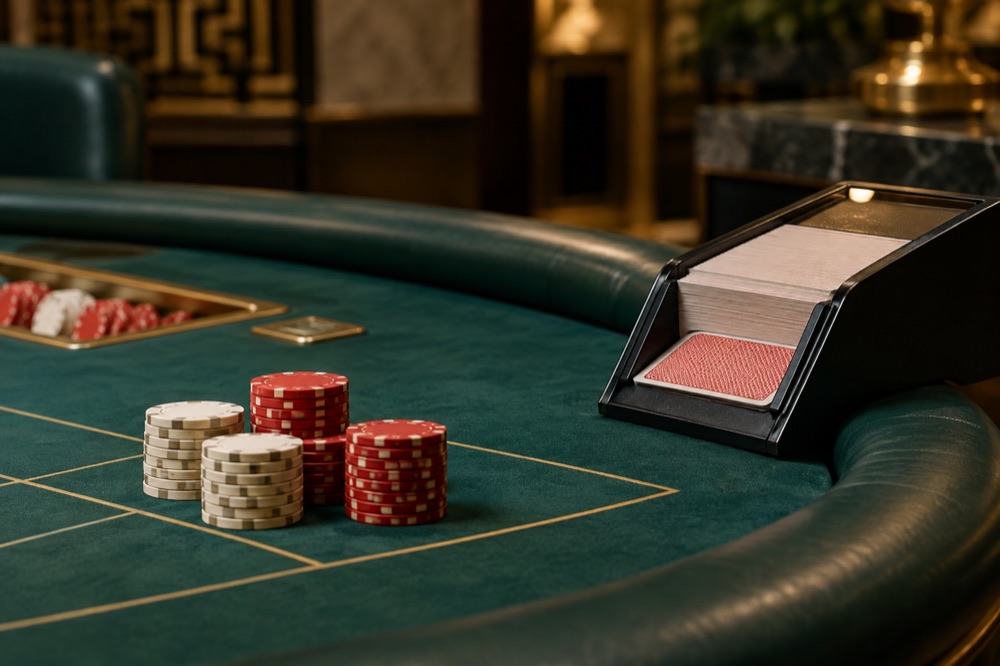
That is the whole game. Everything after you place your bet, the deal, the drawing decisions, the settlement, is handled by the dealer according to rules that never change. This is why baccarat tables move so quickly and why complete beginners can sit down and play immediately.
Card values and how hands are scored
Card values are simple:
- Aces count as 1
- Cards 2 through 9 count at face value
- 10, jack, queen and king count as 04
The only twist is what happens when a hand goes past nine: only the rightmost digit counts. If the cards total 10, the hand is worth 0; a total of 11 is worth 1, and 12 is worth 212. So a 7 and an 8, which add to 15, make a baccarat hand of 5. Once the points value reaches a double digit, the second digit automatically becomes the value of the hand12. Macau's official rules say the same thing: face cards, 10s and two-card totals of ten all count as zero, with 9 the highest1.
A worked example: the Player hand is dealt a 4 and a 9. That is 13, so the hand is worth 3. The Banker is dealt a king and a 6, which is 0 plus 6, so 6. Banker currently leads 6 to 3, and the drawing rules below decide what happens next.
How a coup is dealt: naturals and the third-card rules
A round of baccarat is called a coup. Two cards are dealt to each side, dealt alternately starting from the Player, and the Player's hand is revealed first13. At tables with an automatic shuffling machine, the cards are dealt face up and returned to the machine after each coup13.
Naturals. If either hand totals 8 or 9 on its first two cards, that is a natural. The coup ends immediately, no more cards are dealt, and all bets are paid11. A natural 9 beats a natural 8, and if both sides have the same natural, the coup is a tie.
The Player's third-card rule. If there is no natural, the Player hand acts first. On any total from 0 to 5, the Player draws a third card, unless the Banker has a natural 8 or 9. The Player always stands on 6 or 712. Put simply: 0 to 5 draws, 6 or 7 stands, and the third card is never dealt to a hand totaling 7 or higher14.
The Banker's third-card rule. The Banker's move depends on the Banker's total and, if the Player drew, on what the Player's third card was14:
| Banker total | Banker action |
|---|---|
| 0, 1 or 2 | Draws, unless the Player has a natural 8 or 9 |
| 3 | Draws against any Player third card except an 8 |
| 4 | Draws if the Player's third card is 2 to 7 |
| 5 | Draws if the Player's third card is 4 to 7 |
| 6 | Draws if the Player's third card is 6 or 7 |
| 7 | Stands |
| 8 or 9 | Natural; no more cards for either hand |
If the Player stood on 6 or 7, the Banker draws on 0 to 5 and stands on 6 or 74. You never need to memorize any of this: the dealer runs the table and applies the rules, and at most tables the casino's own staff will simply announce the result. Macau's official rules also cover what happens when things go wrong: dealing errors or illegal draws are corrected immediately, and if correction is impossible the coup is canceled and void13. A card accidentally exposed from the shoe mid-coup does not invalidate it; the coup continues13.
The shoe runs until a cut card, inserted at least about 12 cards from the end of the shuffled shoe, is reached. That coup is the last one, or one more may be dealt, and then the cards are reshuffled1.
The three bets: Player, Banker and Tie
Each seat at the table has three bet boxes: one each for Player, Banker and Tie11. Before the cards are dealt, you place your chips in one of them. All bets must be placed before the deal; there is no betting after the first two cards2.
A few things to know about how the bets work:
- You may bet on either Banker or Player, but not both on the same coup. You can, however, bet on Tie at any time, even alongside a main bet2.
- Macau's official rules also allow the optional side bets Banker Pair and/or Player Pair, which we cover below1.
- The three possible outcomes are simply a Player win, a Banker win, or a tie2.
If the two hands finish level, the coup counts as a tie. On most standard tables, Player and Banker bets have the original stake returned and the coup is not counted as a win or a loss15. Macau's rules go a step further: after a tie, a new coup decides the outcome, and existing bets may be canceled, maintained, changed with or without reducing the stake, or switched between Player and Banker13. In practice, most players just leave their bet where it is.
Payouts and the 5% commission on Banker bets
The payouts are straightforward:
| Bet | Payout |
|---|---|
| Player | 1 to 1 |
| Banker | 1 to 1, minus 5% commission |
| Tie | 8 to 1 |
A winning Player bet pays even money with no deductions: bet 20 and you win 202. A winning Banker bet also pays even money, but the house charges a 5% commission on any winning Banker bet, collected by the dealer at payout7. So a 20 bet on Banker wins 20 minus the commission2. Macau's own rules fix this: the house takes 5% of the amount won by the Banker in each coup3, and the statutory rules set the payout odds at 1 to 1 for Banker and Player, and 8 to 1 for Tie16.
A winning Tie bet pays 8 to 1, so a 100 bet returns 800 in profit15. Some casinos pay ties at 9 to 1 instead, which improves the odds on that bet considerably14.
Why the commission on Banker only? Because the drawing rules give the Banker hand a slight probability advantage over the Player hand, the house deducts 5% from Banker winnings to balance it15. Without that fee, Banker would be the better bet every single coup.
House edge by bet: 1.06% on Banker, 14.36% on Tie
The house edge is the casino's average take on each bet over the long run, and in baccarat it varies enormously depending on which of the three bets you choose4:
| Bet | House edge | Chance of winning |
|---|---|---|
| Banker | 1.06% | 45.86% |
| Player | 1.24% | 44.62% |
| Tie | 14.36% | 9.52% |
Those Banker and Player figures are for the standard eight-deck game. The exact edge shifts slightly with the number of decks: in a six-deck game the edge is 1.06% on Banker, 1.24% on Player and 14.44% on Tie, while a single-deck game runs 1.01%, 1.29% and 15.75%8. The Banker bet wins most often, at 45.86% against 44.62% for Player, because the drawing rules favor that hand, and that frequent winning is what keeps its edge lowest even after the 5% commission17.
The one to be careful with is the Tie bet. The 8 to 1 payout looks attractive, but the house edge is 14.36%, more than ten times the Banker edge, and the win rate is only 9.52%18. If a table pays ties at 9 to 1, the edge drops to 4.85%14. For comparison, baccarat's main bets sit close to blackjack's edge, while the Tie bet is closer to the worst bets on the casino floor.
No-Commission Baccarat and other table variations
Many Macau floors also run No-Commission Baccarat, sometimes labeled EZ Baccarat or Dragon Baccarat. As the name suggests, non-commission versions of baccarat do not charge the 5% fee on winning Banker bets7. The catch: if the winning Banker hand totals exactly 6, Banker wagers are paid at 1 to 2 instead of even money4. Macau's rules codify the same trade-off, allowing the house not to take commission provided that when the Banker wins with 6 points, the payout is 50% of the bet3.
Whether that is better for you depends on how often Banker wins with a 6, but the practical point is simple: read the table plaque before you sit down, because it tells you whether the table is a commission table or a no-commission one, and what the Banker-win-with-6 rule is.
Macau's regulator has also approved several baccarat relatives you might spot on the floor. Makccarat, authorized in 2007, is a game of fortune with Player, Banker, draw, and pair bets, and its own commission structure20. Three Card Baccarat deals three cards to a hand, ranks three court cards as the best hand, and counts nine as the highest point total21. Mahjong Baccarat plays the same idea with tiles. These are niche tables compared with standard baccarat, but they are part of the same family, and the regulator's approved-games list includes baccarat, "railway" baccarat, mahjong baccarat and san gong baccarat as separate games10.
Side bets and pair bets
Beyond the three main bets, Macau tables offer a menu of side bets. The statutory rules list the approved extras: Banker Pair and/or Player Pair, Dragon Seven, and progressive jackpot categories A, B and C16. A later rule change added the Lucky Six (幸運六點) side bet22.
Pair bets. A Player Pair or Banker Pair bet wins if the first two cards dealt to that hand are a pair. The statutory payout is 1 to 1116. Some tables also offer Either Pair, Perfect Pair and other bonus bets depending on the table2. Perfect Pair has its own payout ladder: a mixed pair pays 1 to 5, a same-color pair 1 to 12, and a perfect pair, same color and same suit, pays 1 to 256.
Dragon Seven. This is the signature side bet of no-commission baccarat: it wins when the Banker beats the Player with a three-card total of 7, and the statutory payout is 1 to 4016.
Progressive jackpot. The jackpot side bets are additional wagers, and only a player seated at the table may place them16. Category A and B jackpots pay the full accumulated amount, shared equally among winning bettors per hand16.
Other side bets. Around the wider baccarat world you will also find Dragon Bonus, 4-5-6, Lucky Bonus, 3-Card Six, Panda 8, Royal Match, Bellagio Match and Matching Dragon23. One classic table also offers Big and Small bets on the total number of cards dealt: four cards on the table means Small, five or six means Big24, and a mixed pair-odds bet paying up to 40 to 1 for a tie with pairs on both sides24.
Two practical notes. First, depending on the table, you may be required to place a main bet before you can place a side bet2. Second, side bets universally carry a much higher house edge than the main bets, so treat them as occasional fun rather than the core of your play.
Mini baccarat versus the big table
Baccarat comes in two main formats on a Macau floor, and the difference is mostly about size, speed and price.
The big table is the classic full-size baccarat table with the high minimums, where players handle and squeeze the cards. This is where the game's rituals live, and where the serious money plays.
Mini baccarat is played at a table of 7 players, with midi versions seating 9, and table minimums are often much lower than for other versions7. The dealer turns over all the cards, dealing them face up in front of themselves into the two hands4. The rules are exactly the same as big-table baccarat, and the odds are exactly the same assuming the same number of decks25. Because the dealer does all the handling and there is no squeezing, the general expectation is for play to move faster than at the big tables7.
For a first-time visitor, mini baccarat is the easy entry point: lower minimums, a faster pace suited to smaller bankrolls26, no card-handling etiquette to learn, and identical odds. If you want the full Macau experience of squeezing cards at a big table, watch a few coups first, and remember that the etiquette around card handling at big tables is its own ritual.
One last practical point: entry to Macau's casinos is limited to people aged 21 and over27, and the rules on entry, dress and identification are covered in our page on casino entry rules in Macau. For what else is on the floor besides baccarat, see casino games in Macau.
Common Questions
What is baccarat called in Macau?
In Cantonese it is baak ga lok (百家樂). The version played in Macau is punto banco, where the casino banks the game and all drawing decisions follow fixed rules. You will see it written as baccarat on English table signs.
How many decks are used in Macau baccarat?
Macau's official rules allow 6 to 12 decks of 52 cards per shoe. In practice most tables use eight decks, and the cards are reshuffled when the cut card near the end of the shoe is reached.
Why is there a commission on Banker bets?
The drawing rules give the Banker hand a slightly better chance of winning, so the house takes 5% of your winnings to keep its edge. Without the commission, betting Banker every time would favor the player.
What happens if Player and Banker tie?
The coup is a push. Player and Banker bets are returned and neither wins nor loses. Tie bets are paid, usually at 8 to 1. In Macau, the rules also let you cancel, keep, reduce or switch your bet for the next coup.
What is a natural in baccarat?
A natural is a two-card hand totaling 8 or 9 on the deal. If either side has one, no more cards are drawn, the coup ends immediately and all bets are settled.
Is baccarat a game of skill or luck?
Pure luck. Your only decision is which of three bets to place, and every drawing move after that is forced by fixed rules. Unlike blackjack, there is no playing strategy that changes the odds.
What is the minimum bet at Macau casinos?
There is no single figure: minimums vary by casino, table and time of day, and high-limit rooms run far higher. Mini baccarat tables generally carry much lower minimums than the big tables, so they suit smaller bankrolls.
Which bet wins most often in baccarat?
The Banker bet, which wins about 45.86% of coups against 44.62% for Player, with ties taking the remaining 9.52%. That small edge is why the house charges 5% commission on Banker wins.
Sources27 sources
- Baccarat rules, DICJ Macau, 2004
- Baccarat, Natural8, 2026
- Baccarat Rules Article 18, DICJ Macau, 2005
- Baccarat, GameSense, 2025
- Gaming, Macao Government Tourism Office, 2021
- Perfect Pair payout rules, Boletim Oficial de Macau, 2009
- How to Play Baccarat, details, PlaySmart, 2026
- Baccarat Basics, Wizard of Odds, 2017
- The Transformation of Macao's Gaming Industry, University of Macau, 2026
- Law 16/2001, games of fortune, DICJ Macau, 2001
- How to Play Baccarat, PlaySmart, 2026
- How to Play Baccarat, PlaySmart, 2026
- Baccarat rules, DICJ Macau, 2004
- Baccarat Guide, CoinPoker, 2025
- Banker and Player odds and rebates, GSBET88, 2026
- Baccarat rules, Article 13 and 17 amendments, DICJ Macau, 2009
- Baccarat, Roobet, 2026
- Baccarat, CoinPoker, 2026
- 百家樂, Natural8, 2026
- Makccarat authorization, DICJ Macau, 2007
- Three Card Baccarat rules, DICJ Macau, 1996
- Baccarat Rules, Lucky Six amendment, DICJ Macau, 2018
- Baccarat, Wizard of Odds, 2026
- Baccarat (classic) rules, FB88, 2026
- Baccarat, Wizard of Odds, 2011
- How to play baccarat with small capital, V9Bet, 2024
- Law 12/010, casino entry, DICJ Macau, 2012