
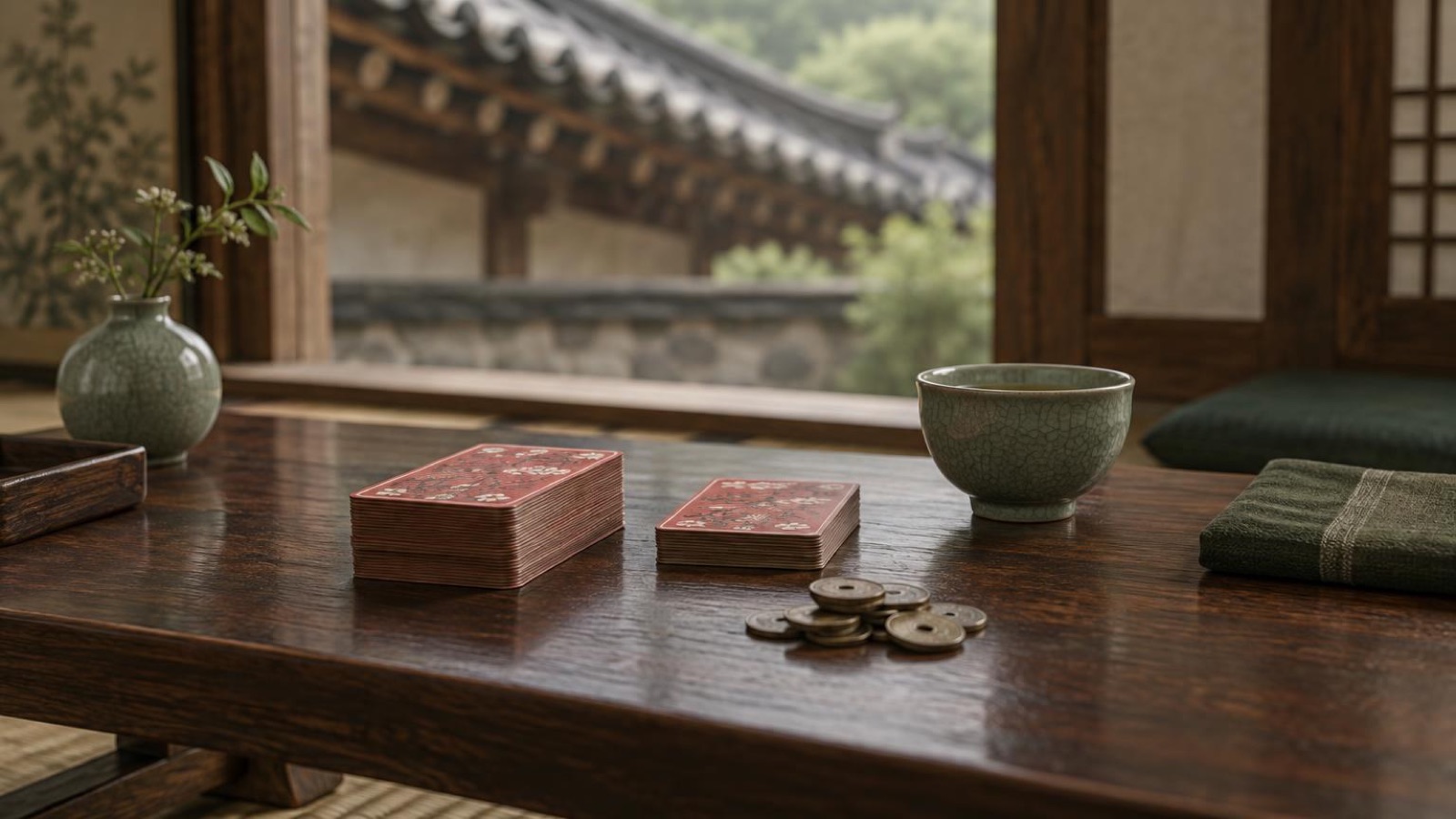
Go-Stop and Matgo: what they are and where they fit in South Korea
Hwatu, the Korean flower card deck, sits behind both games. The deck is small, the rounds are fast, and the two games share most of their furniture: the same cards, the same month matching, the same idea that you collect sets and score them at the end of a hand. What separates them is the decision that gives Go-Stop its name.
In Go-Stop you can stop when you are ahead. You take the points you have, the hand ends, and you bank them. Or you can call "go" and keep playing for a bigger total, with the risk that another player takes the hand away from you first. That single choice is the whole personality of the game, and it is why Go-Stop is the version most people in Korea actually play.
Matgo strips that choice out. There is no stopping and no calling go. You play the hand to its end and the points fall where they fall. That makes Matgo simpler to teach and faster to finish, which is why it turns up in family settings and among newer players, while Go-Stop is the game you see in the small back rooms and the one that carries the stakes.
Both are usually played for money, and the money is usually small: a few thousand won a point, settled at the end of the session. That detail matters more than anything else on this page, because it is what moves the game from a pastime into something the law treats differently.
If you want the wider picture of how hwatu games sit alongside hanafuda and the Japanese cousins, Hanafuda and Hwatu Games: Go-Stop, Matgo and Koi-Koi Compared walks through the deck and the family tree.
Legal status of card games under Korean gaming law
Playing hwatu for money is illegal in South Korea. The official support material on illegal gambling names internet gambling, hwatu, poker and adult arcades in the same breath, and that is the list a player needs to know1. A second official page repeats the same grouping, so there is no ambiguity about where flower cards sit2.
The legal side of the ledger is just as specific. Casinos, horse racing, cycling, boat racing, lottery, sports promotion voting tickets and bullfighting are the lawful forms of gambling in Korea2. Hwatu is not on that list, and neither is poker, which is why the two are named together on the illegal side.
The practical risk is straightforward. A friendly game at home with no money changing hands is a different thing from a game with a point value attached, and it is the point value that creates the exposure. If you are a visitor or an expat and someone invites you into a hwatu game with stakes, understand that you are in the illegal column, not a gray area.
For contrast, the same leisure-versus-profit line shows up elsewhere in Asia. Chinese guidance on chess and card rooms states that normal chess and card games played for leisure, without a profit motive, are lawful entertainment protected by law6. Korea's treatment of hwatu is stricter, and the money is the dividing line.
Online play is illegal for Korean citizens
This is the part that catches people out. Korean nationals are prohibited from gambling under domestic law, and that prohibition follows them across a border. Official guidance is explicit that a Korean national who takes part in online or offline gambling in a country where it is legal can still be punished under Korean law5.
So the question "is the site licensed?" does not settle anything for a Korean passport holder. A licensed operator in another jurisdiction is still an illegal venue for a Korean national to use, and the fact that the operator holds a valid license abroad does not change the domestic position5.
The same logic appears in neighboring Japan, where official guidance states that even an online casino legally operated overseas is a crime to gamble on from within Japan7. The two countries arrive at the same place from different statutes: the operator's paperwork is not your defense.
For a foreign resident or a visitor in Korea, the picture is different. The prohibition described in the official guidance is framed around Korean nationals5. That does not make an offshore site a sensible place to play, and it does not create a licensed local option, but the specific rule that follows a citizen abroad is not the rule that applies to you.
If you want to understand how these online versions work and where the risk sits across the region, Mahjong, Teen Patti, Rummy and Niu Niu Online: Apps, Live Dealer Games and Legal Risk covers the app side in detail.
Resident or visitor: which rules apply to you
The cleanest way to think about Korea is that the rules split by passport, not by where you live.
Korean citizens face the full prohibition. They cannot play hwatu for money, they cannot use offshore gambling sites, and they cannot enter 16 of the country's 17 casinos. The one exception is Kangwon Land, which is open to Korean nationals and overseas visitors alike and is the largest casino in South Korea4.
Foreign visitors and foreign residents have a much wider door. Sixteen of the 17 casinos are foreigner-only venues, and a non-Korean passport is what gets you through the door. The Jeju properties are the clearest examples:
- the Hyatt Regency casino is for foreigners only3
- the Jeju KAL Hotel casino is a foreigners-only casino8
- Paradise Casino Jeju Grand is a foreigner-only casino facility9, and the same property is described again as a foreigner-only casino inside the MAISON GLAD hotel10
- The Jeju Oriental Hotel casino on the first floor is a foreigners-only casino11
- Majesta Jeju Casino is a foreigners-only casino12
The pattern is national policy, not a quirk of one operator. Where a casino sits in a closed mining area, the rule is written into the operating decision: a foreigners-only floor may be run separately to attract foreign visitors, and Korean nationals must not be allowed into that foreigners-only floor13. That is the same principle you see on Jeju, applied to a different kind of site.
One structural limit is worth knowing if you are watching the market rather than playing today. Casino facilities are limited to one per integrated resort district14. That caps how many new venues can appear in any given zone.
If you are weighing a trip, Can I Gamble in South Korea? sets out the country picture, and Playing Local Games as a Visitor or Expat: Mahjong Tables, Pachinko Halls and Cockpits covers the etiquette side of walking into a local room.
Casino entry: 17 venues, 16 foreigner-only
The headline number is 17 casinos, of which 16 are foreigner-only3. For a foreign visitor that means almost every door is open. For a Korean citizen it means one door.
Kangwon Land is that door. It is described as the first casino-style hotel in Korea open to both Korean nationals and overseas visitors4, and separately as the largest casino in South Korea4. It is also the venue that states plainly that both Koreans and foreigners may enter4.
The foreigner-only venues are not a single chain. They include the Hyatt Regency casino3, the Jeju KAL Hotel casino8, Paradise Casino Jeju Grand9, the Jeju Oriental Hotel casino11, Majesta Jeju Casino12 and Paradise Casino Busan16. Jeju carries a large share of them, which is why the island is the usual first stop for a visitor who wants to play.
The minimum age is 19 across the board. Persons under 19 are prohibited from entry in South Korea15, Kangwon Land states 19 years or older4, and Seven Luck Casino Gangnam COEX states that entry is possible from 19 years old17. Bring photo ID. Passport is the safest document for a foreigner, since the venue has to establish that you are not a Korean national.
| Type of venue | Who can enter | Minimum age | Where |
|---|---|---|---|
| Kangwon Land | Korean nationals and foreign visitors | 19 | Gangwon |
| Foreigner-only casinos (16) | Foreign passport holders only | 19 | Jeju, Busan, Seoul and others |
Seven Luck Casino Gangnam COEX is a useful example of how the foreigner-only rule reads in practice: the operator page states that Korean citizens are prohibited from entering17. That is the sentence a Korean national will meet at the door of any of the 16.
Entry levies for citizens in Singapore, Japan and Thailand
Korea is not the only place in Asia where citizens pay more to walk in than visitors do, and the comparison is instructive if you are planning a trip that touches more than one country.
Singapore runs the clearest version of the model. A casino operator must not allow a Singapore citizen or permanent resident to enter or remain on the premises unless that person has paid the entry levy18. The levy is not a small charge: an annual pass costs S$2,000, which is about JPY 150,00015. Visit limits in Singapore are available only to Singaporeans and permanent residents19, and the voluntary visit limit service is likewise restricted to Singaporeans and permanent residents20.
Japan has legislated its own entry charge for the integrated resorts it is preparing. The entry fee is JPY 6,000 per entry for Japanese customers21, and entry is restricted to up to three days within any seven-day period, though 24-hour operation means a guest could in principle stay 72 hours continuously21. The model text for the local ordinance leaves the special admission charge amount blank, to be filled in later15.
Thailand's draft casino fee schedule shows how finely these charges can be tiered. A Thai national under 20 would pay 500 baht per entry22, a foreigner under 20 would pay 5,000 baht per entry22, and a person under 20 in a stated category would pay 5,000 baht per entry22. Students and accompanying persons aged 20 and over would pay 1,000 baht22. One line of the schedule is left blank for later specification, with a stated limit of not more than 10 baht per entry in one clause22.
For Korea, the practical point for a visitor is simpler: the foreigner-only venues are built around foreign passports, and the entry levy structure that Singapore and Japan use to charge their own citizens is not the thing standing between you and the door. Your passport is.
Tax on winnings: 20% withheld at source
If you play at a casino in the region, expect the house to take tax out before the money reaches you. The clearest published figure comes from the Philippine casino regulatory manual, which states that a 20 percent withholding tax is deducted from individual jackpot payouts exceeding P10,00023.

That is a Philippine rule, not a Korean one, but it is the shape of the thing across Asia: a threshold, a percentage, and a deduction made at source rather than declared later. If you are planning a session at a casino in the region, the payout you are quoted may not be the payout you receive.
For Korean nationals the tax question is secondary to the legality question. Since gambling by Korean nationals is prohibited under domestic law, including in countries where it is legal5, there is no clean route to declaring a casino win as ordinary income. The prohibition comes first.
What the law does not cover
Two things sit outside the gambling rules and are worth separating out.
The first is the game itself. Nothing about hwatu cards, the flower deck, or the rules of Go-Stop and Matgo is illegal. The cards are sold openly, the games are taught in family settings, and the deck is part of ordinary Korean life. What the law reaches is the money, and specifically the point value that turns a hand into a wager1.
The second is the legal betting channels, which are narrow and specific. Sports promotion voting tickets are the lawful route for sports betting, and the games offered are soccer toto, baseball toto, basketball toto, volleyball toto, golf toto and Toto UO24. The betting windows are defined match by match: for soccer, from kick-off to the end of the second half, excluding extra time and penalty shootouts25, and for basketball, from game start to the final end including overtime25. Baseball runs from game start to the final end including extra innings and the tiebreaker25.
There are limits inside those channels too. A fixed-odds ticket sale is restricted if the expected winning odds multiplied by the individual bet amount exceeds KRW 100 million25. Duplicate purchase is not allowed on Soccer Toto Match24.
The legal list also includes horse racing, cycling, boat racing, lottery and bullfighting2. If you want to see how the pari-mutuel side works in the region, Keirin Betting Explained: Bet Types, Odds and Mark Cards in Japan and Korea and Boat Race Betting Explained: Kyotei and Kyungjeong Bet Types and Odds cover the mechanics.
For a visitor, the practical summary is this. Hwatu for money is out. The 16 foreigner-only casinos are in, at 19 and over with a passport. Kangwon Land is the one venue a Korean friend can join you at. And if you are a Korean national, the offshore sites are not a workaround, because the prohibition travels with you5.
Common Questions
What is the minimum age to enter a casino in South Korea?
You must be 19 or older to enter a casino in South Korea. Kangwon Land states 19 and over, and Seven Luck Casino Gangnam COEX states the same. Anyone under 19 is refused entry, and photo ID is checked at the door.
Can foreigners enter every casino in South Korea?
Foreign visitors can enter all 17 casinos. Sixteen of them are foreigner-only venues, so a non-Korean passport gets you in. Korean citizens are turned away from those 16 and may only use Kangwon Land.
Which casino can Korean citizens enter?
Kangwon Land is the only one. It is the country's first casino-style hotel open to both Korean nationals and overseas visitors, and it is also the largest casino in South Korea. Every other venue is closed to Korean passport holders.
Are winnings from overseas gambling sites treated as legal income?
No. Korean nationals are prohibited from gambling under domestic law, and that applies even when the site is legally licensed in another country. Playing online from Korea, or while abroad in a place where it is legal, can still be punished under Korean law.
Is betting outside Sports Toto legal?
No. Sports promotion voting tickets are the legal channel, sold through Sports Toto, and they cover soccer, baseball, basketball, volleyball, golf and Toto UO. Betting with an unlicensed bookmaker is not part of the legal list.
Are banks in South Korea allowed to block gambling payments?
Banks and payment providers routinely block transfers to gambling merchants, and the legal gambling list is narrow: casinos, horse racing, cycling, boat racing, lottery, sports promotion voting tickets and bullfighting. Anything outside that list has no legal payment route.
Sources25 sources
- KBOAT clinic FAQ, KBOAT
- KCycle clinic FAQ, KCycle
- Hyatt Regency 카지노, Visit Korea
- 강원랜드 카지노, Visit Korea
- 재외국민 도박 관련 안내, Ministry of Foreign Affairs, January 12, 2026
- 棋牌室娱乐活动提示, Beijing Municipal Government, June 29, 2020
- オンラインカジノに関する注意喚起, National Police Agency
- Jeju KAL Hotel 카지노, Visit Korea
- Paradise Casino Jeju Grand, Visit Korea
- Paradise Casino Jeju Grand, Visit Korea
- Jeju Oriental Hotel 카지노, Visit Korea
- Majesta Jeju Casino, Visit Korea
- 폐광지역 카지노 운영 관련 결정, Korean Law Information Center, May 30, 2025
- Casino regulation, Japan Casino Regulatory Commission, 2026
- カジノをめぐる規制, Osaka Prefectural Government, 2025
- Paradise Casino Busan, Visit Korea
- Seven Luck Casino Gangnam COEX, Visit Korea
- Casino Control Act 2006, section 116, Singapore Statutes Online
- Overview of exclusions and visit limits, Ministry of Social and Family Development
- Apply for a voluntary visit limit, Ministry of Social and Family Development
- カジノ実施法に関する請願, House of Councillors, 2026
- Casino entry fee schedule, Royal Gazette, September 16, 2026
- Casino Regulatory Manual for Licensed Land-Based Casinos, PAGCOR, August 13, 2025
- Soccer Toto match rules, Sports Toto
- Sports Toto fixed-odds voting ticket rules, Sports Toto, March 13, 2026















