
Go-Stop vs Koi-Koi: what this comparison covers
If you have seen a deck of small cards with flowers on them and heard two different names for the game, this page sorts it out. The deck is the same. The rules branch.
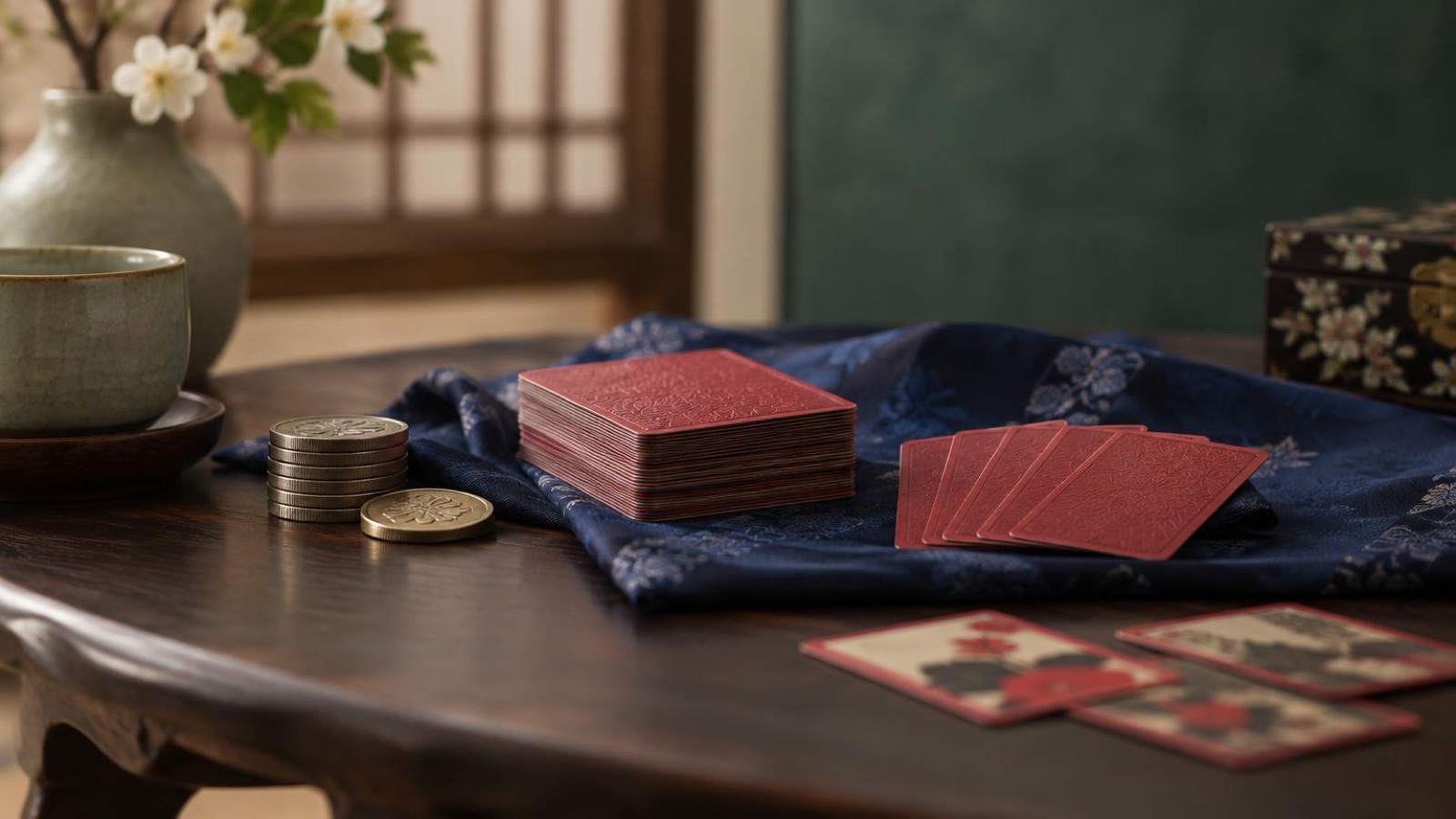
Hanafuda is a 48-card deck, twelve months of four cards each. Each month has a flower: pine in January, plum in February, cherry in March, wisteria in April, iris in May, peony in June, bush clover in July, pampas grass in August, chrysanthemum in September, maple in October, willow in November and paulownia in December. The cards are not numbered. You match them by month.
Koi-Koi is the Japanese game. You collect sets called yaku, and when you complete one you choose: stop and take the points, or call "koi-koi" and keep going for a bigger hand1. Go-Stop is the Korean game, and it works the same way with a different scoring table and a different name for the call. In Go-Stop you say "go" to continue and "stop" to bank your points.
The two-player Korean form is called matgo. It uses the same deck and the same sets, but the target score is higher because two players can build hands faster. If you want the two-player scoring detail on its own, there is a separate page on Go-Stop vs Matgo winning scores.
This page covers how a hand is dealt, what the sets pay, how the go and koi-koi calls change the money, the edge cases like drawn hands and bombs, and where the legal line sits in Korea and Japan. It does not cover mahjong, pachinko or the other card games in the region; those live on the Asian gambling games overview.
How a Go-Stop hand is dealt
The deal is quick and the same in both countries. In Koi-Koi, eight cards go face up on the table, eight go to each player's hand, and the rest form a face-down draw pile1. Go-Stop uses the same shape: ten cards to each player in the three-player game, eight on the table, the remainder as the draw pile.
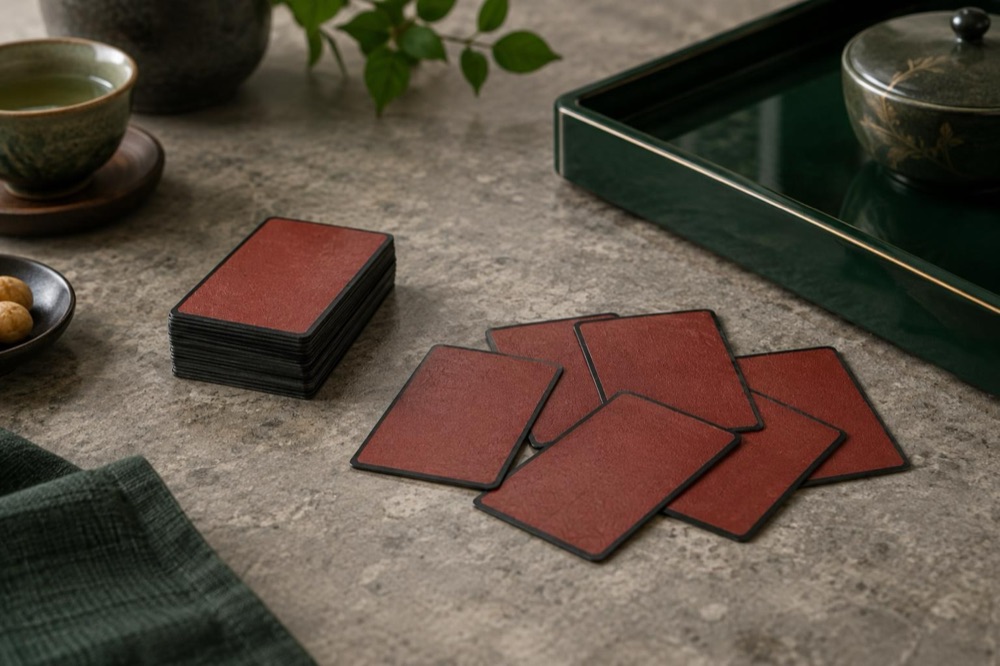
Play goes around the table. On your turn you play one card from your hand. If it matches the month of a card on the table, you take both and put them in your scoring pile. If it does not match, your card stays on the table as a new face-up card. Then you draw one card from the pile and do the same thing with it.
That is the whole turn. Match, take, draw, match, take. The skill is in what you leave on the table and what you feed your opponents.
A few practical points for a first game:
- Sort your hand by month before the first turn. It takes ten seconds and saves you the rest of the hand.
- Watch what your opponents pick up. If someone is collecting ribbons, they are chasing a ribbon set.
- The table cards are shared. A card you leave face up can be taken by anyone.
- The draw pile is random. You cannot plan around it, only around what is already visible.
If you have played mahjong, the rhythm will feel familiar: draw, discard, claim. The difference is that there are no melds to declare and no discards to read in the same way. Everything you take is face up in your pile, so everyone can see what you are building. That is why bluffing matters less here and card counting matters more.
Target score: 3 points with three players, 5 or 7 with two
Go-Stop is played to a target. In the standard three-player game the target is 3 points. In the two-player game, matgo, the target is usually 5 or 7 points, because two players can build sets faster and the hands run longer.
Koi-Koi does not use a running target in the same way. You play hand by hand, and each hand is scored on its own. A player who completes a yaku either stops and takes the points or calls koi-koi and continues1.
The target matters because it changes how you play. In a three-player game to 3 points, a single good hand can end it. In matgo to 7, you have room to take a small set and keep going. If you are learning, start with the three-player game to 3 points. It is the shortest and the least punishing.
One more thing about the target: it is a running total across hands, not a per-hand score. You add up what you win each hand until someone crosses the line. That is why a player who is one point short will call go on a thin hand. They are not being reckless. They are trying to close it out.
Scoring: bright, animal, ribbon and junk card sets
The scoring table is where the two games diverge most. Koi-Koi has a published set of yaku with fixed values, and the values are well documented1. Go-Stop uses the same card groups with Korean names and slightly different numbers.
The card groups are the same in both games:
- Bright cards (kwang in Korean, hikari in Japanese): the five special cards with a figure or a strong image.
- Animal cards (yeolkkut in Korean, tane in Japanese): the nine cards with a bird, animal or object.
- Ribbon cards (tti in Korean, tanzaku in Japanese): the ten cards with a strip of paper.
- Junk cards (pi in Korean, kasu in Japanese): everything else.
In Koi-Koi, the published values are:
| Set | Cards | Points |
|---|---|---|
| Sankou | Three bright cards, excluding the willow card | 5 points1 |
| Shikou | Four bright cards, excluding the willow card | 8 points1 |
| Gokou | All five bright cards | 10 points1 |
| Ameshikou | Four bright cards including the willow card | 7 points1 |
| Inoshikachou | Boar, deer and butterfly | 5 points1 |
| Tane | Any five animal cards | 1 point1 |
| Tan | Any five ribbon cards | 1 point1 |
| Tsukimi de Ippai | Moon and sake cup | 5 points1 |
| Hanami de Ippai | Cherry blossom and sake cup | 5 points1 |
| Nomi | Cherry blossom, moon and sake cup together | 10 points1 |
Some rules add a point for each extra card of the same type. Tane, tan and kasu each score one extra point per additional card of that type1. So a sixth animal card is worth one more point on top of the base set.
Go-Stop uses the same groups with Korean names. Three bright cards score 3 points, four bright cards score 4 points, and all five bright cards score 15 points. The rain man, the willow card, changes the four-card set: four bright cards including the rain man score 2 points instead of 4. Godori, the three bird cards, is a fixed set worth 5 points.
The practical takeaway: learn the bright cards first. They are the biggest single set in both games, and they are the easiest to spot on the table.
Special combinations: godori and the three ribbon sets
Godori is the set that decides most Go-Stop hands. It is the three bird cards: the bush warbler on the plum, the cuckoo on the wisteria and the geese on the moon. It is worth 5 points, and it is the set players chase hardest because the three cards are spread across three different months.
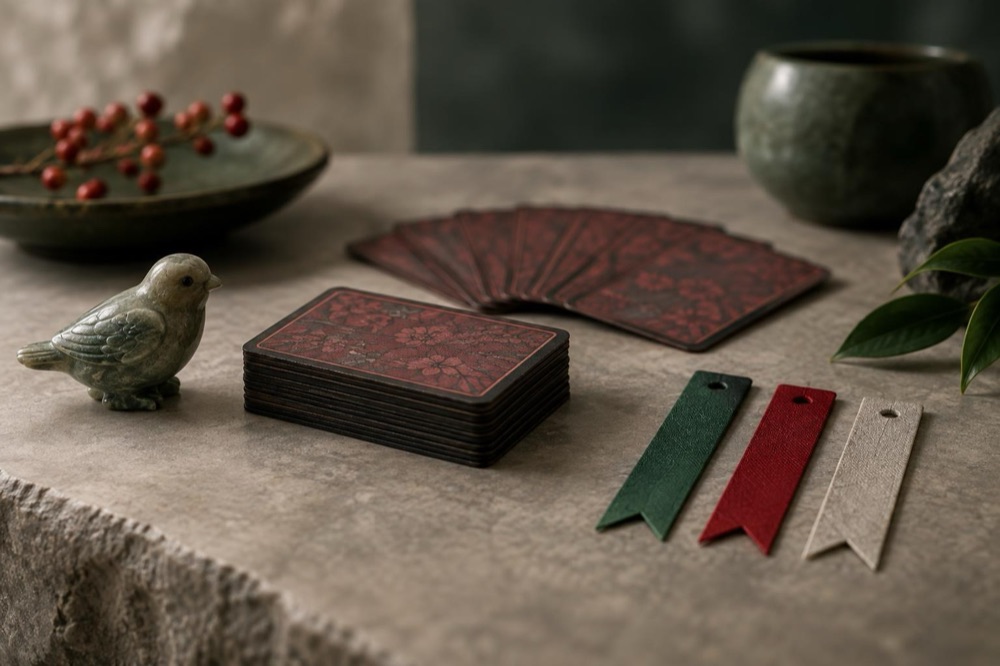
The three ribbon sets are the other fixed combinations:
- Hongdan, the three red ribbons with poetry. Worth 3 points.
- Cheongdan, the three blue ribbons. Worth 3 points.
- Chodan, the three plain red ribbons. Worth 3 points.
In Koi-Koi the equivalent sets are Akatan (the three red poetry ribbons) and Aotan (the three blue ribbons), and they score 5 points each under standard rules1. The plain red ribbon set is not a standard Koi-Koi yaku, which is one of the small differences between the two games.
Why this matters in practice: if you are holding two of the three godori cards, you are committed. You either complete the set or you feed your opponent. The same is true of the ribbon sets. A player who picks up two red poetry ribbons early will spend the rest of the hand hunting the third, and everyone at the table knows it.
Payment rules: go bonus, bak penalties and ppuk
This is the part that turns a card game into a money game, and it is the part most beginners get wrong.
When you complete a scoring set in Go-Stop, you have a choice. You can stop and take the points, or you can call go and keep playing. Each go raises the multiplier on the hand. If you call go once and then finish, you score double. Call go twice and finish, and you score more. The multiplier climbs with each call.
The risk is the ppuk. If you call go and then another player finishes the hand first, you pay a penalty. In standard house rules the losing caller pays double the value of the winner's hand. That is the ppuk. It is the reason experienced players do not call go on a thin hand.
Koi-Koi has the same structure with different names. A player who completes a yaku either stops and declares "shoubu" or "agari", or continues by declaring "koi-koi"1. The score doubles when the total yaku score is 7 points or more, and it doubles again when the opponent has declared koi-koi. Both conditions together give four times the score1. Some rules also use a koi-bai multiplier: one koi-koi declaration doubles the score, two quadruples it, three multiplies it by eight1.
The practical version: agree the multiplier rules before the first deal. The difference between a hand that pays double and a hand that pays eight times is the difference between a friendly game and an argument.
Nagari, bombs and jokers: the edge cases
A nagari is a drawn hand. Nobody reaches the target, nobody completes a set, and no money changes hands. In most house rules the same dealer deals again. Some groups carry the pot forward into the next hand instead. Either way, a nagari is a reset, not a loss.
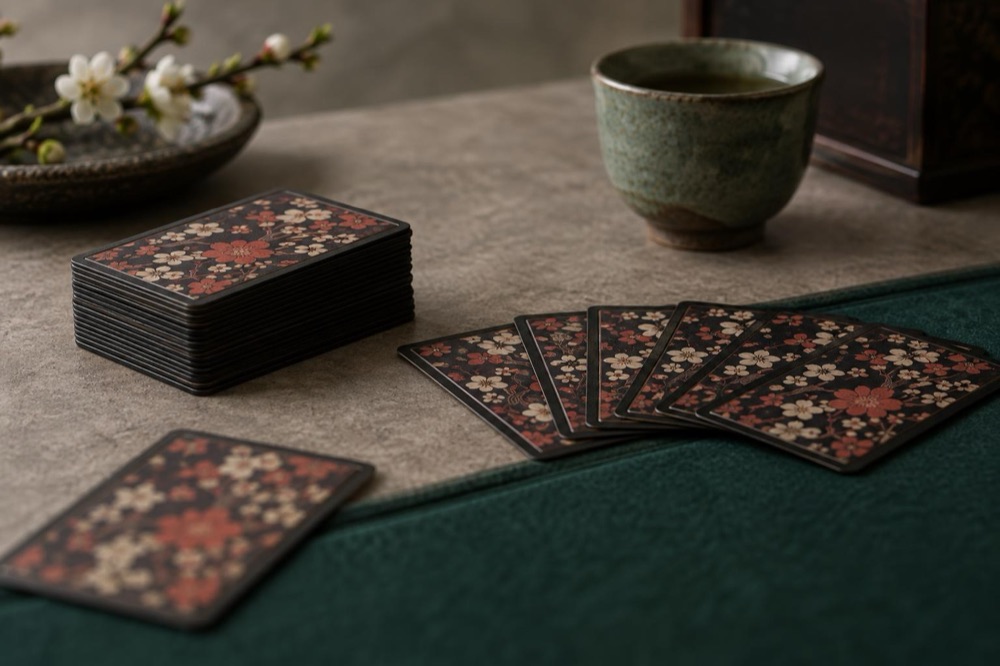
Bombs are a house rule, not a standard part of either game. In some Korean groups a player holding four cards of the same month in the opening hand can declare a bomb and take the hand immediately. The same idea appears in Koi-Koi as the hand yaku: four cards of the same month in the initial hand score 6 points, and four pairs of the same month score 6 points1. Neither is adopted in every ruleset1.
Jokers are not part of the standard hanafuda deck. If your group plays with a joker, agree what it substitutes before the deal. In other card games a joker is treated as semi-wild and can substitute for an ace or complete a hand3, but hanafuda has no ace, so the substitution rule has to be a house rule.
The September card is the other common disagreement. The chrysanthemum with the sake cup is the September card, and in most Go-Stop rules it counts as an animal card. Some groups treat it as two junk cards instead. It changes the animal set, so settle it before the first deal.
The September card: animal or two junk cards
The September card deserves its own note because it is the single most common rules argument in Go-Stop.
The card shows a chrysanthemum with a sake cup. In the standard animal count it is one of the nine animal cards. If you are chasing the five-animal set, it counts toward it. In the alternative rule it counts as two junk cards, which changes both the animal set and the junk pile.
The reason the rule exists is balance. Treating the September card as two junk cards gives players a reason to pick it up even when they are not chasing animals. Treating it as an animal makes the animal set easier to complete.
In Koi-Koi the same card appears in two yaku: Tsukimi de Ippai (moon and sake cup) and Hanami de Ippai (cherry blossom and sake cup), each worth 5 points1. The combined Nomi set, with cherry blossom, moon and sake cup together, is worth 10 points1. So the Japanese game gives the sake cup card a clear role, while the Korean game leaves it to house rules.
If you are playing with people you do not know, ask. It takes one sentence and saves the hand.
Online Go-Stop: missions and multipliers from 2x to 9x
Online Go-Stop apps are popular in South Korea, and they work differently from the table game. Most are free-to-play with virtual currency, daily missions and multipliers that climb from 2x to 9x depending on the hand and the streak.
The structure is familiar if you have played any mobile card game. You log in, collect a daily bonus, play hands against bots or other players, and build a virtual bankroll. The multipliers are the hook: a good hand with a high multiplier pays far more than the base score.
Two things to keep in mind. First, virtual currency in a free app is not money, and the app is not a casino. Second, if an app lets you buy in with real money and cash out, that is gambling, and in South Korea cash gambling is illegal. The legal list is casino, horse racing, cycling, boat racing, lottery, sports promotion voting tickets and bullfighting2. Go-Stop is not on it.
For the wider picture on app-based games and where the line sits, see playing Asian games online.
Go-Stop in South Korea: widely played, but cash play is illegal
Go-Stop is everywhere in South Korea. You will see it in homes, in cafes, in the back rooms of restaurants and on every phone. It is a national pastime in the same way that mahjong is in China and pachinko is in Japan.
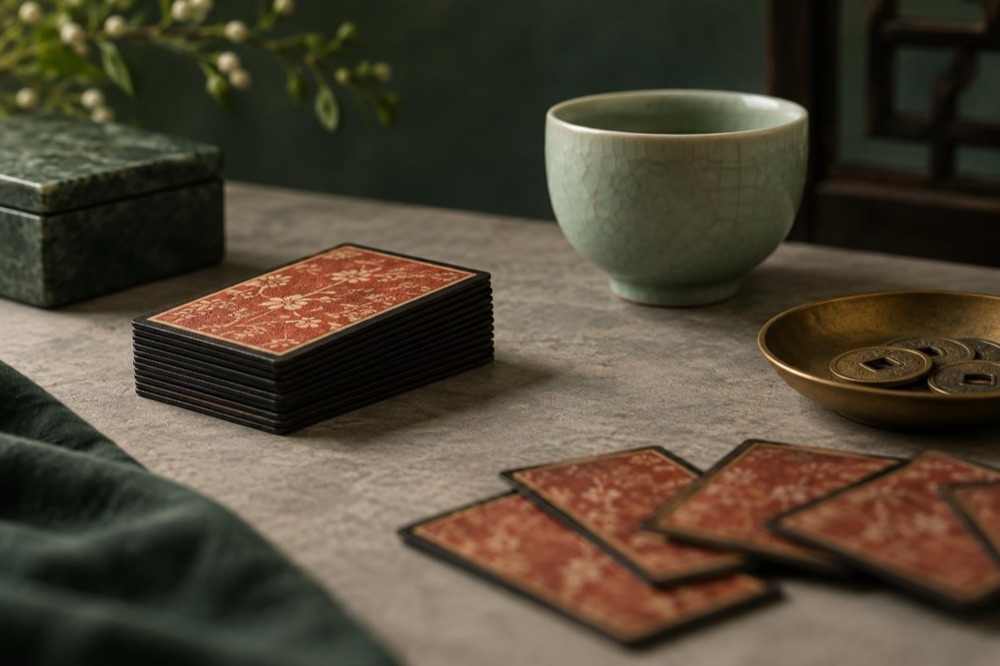
Playing for points is fine. Playing for cash is not. Cash gambling is illegal in South Korea, and the legal list is short: casino, horse racing, cycling, boat racing, lottery, sports promotion voting tickets and bullfighting2. Go-Stop is not on that list, which means a cash game is illegal whether it is in a home or online.
The practical risk is real. Small home games are rarely pursued, but online money games and organized cash games carry genuine legal exposure. If you are a visitor or a foreign resident, the same rules apply to you. There is no tourist exemption for card games.
For the full picture on what is legal and what is not, see can I gamble in South Korea. For Japan, where Koi-Koi is played, the same principle applies: social play is fine, cash play is not. See can I gamble in Japan.
Buying a pack: KRW 2,000 to 5,000 at local marts
A hanafuda pack is cheap and easy to find.
In South Korea, a standard hwatu pack costs KRW 2,000 to 5,000 at local marts, convenience stores and stationery shops. The cards are small, stiff and brightly printed, and they come in a plastic case. You do not need anything else to play.
In Japan, a hanafuda pack costs about JPY 1,000 to 2,000 at toy shops, department stores and online. Nintendo still makes them, and has done since the company started as a card maker in the 1880s.
What to look for when you buy:
- A full 48-card deck, twelve months of four cards.
- A printed rules sheet, which most packs include.
- A spare card or two, because the small cards get lost.
If you are buying online, check that the listing says 48 cards. Some cheap packs are missing cards or substitute a joker for one of the months.
Once you have a pack, the fastest way to learn is to deal a hand and play it out with the scoring table in front of you. The rules are short. The depth is in the reading.
Common Questions
What does 'Go' mean in Go-Stop?
It is the Korean call to keep playing. When you complete a scoring set you can either stop and take the points, or shout 'go' and continue the hand to build a bigger total. Each go raises the multiplier, but if another player finishes first you pay a penalty instead.
What is godori and how much is it worth?
Godori is the three bird cards: the bush warbler on the plum, the cuckoo on the wisteria and the geese on the moon. It is a fixed set worth 5 points in standard Go-Stop scoring, and it is one of the sets players chase hardest.
How many cards do you get in Go-Stop?
Each player is dealt 10 cards in the three-player game, or 10 each in the two-player form, with 8 cards placed face up on the table and the rest left as a draw pile. You play one card from your hand each turn and match it by month.
What happens in a nagari (drawn hand)?
A nagari is a drawn hand where nobody reaches the target score. No money changes hands and the deal passes. In most house rules the same dealer deals again, and some groups carry the pot forward into the next hand instead.
Can you play Go-Stop for money in South Korea?
Playing for small stakes at home is common, but cash gambling is illegal in South Korea. The only legal gambling is casino, horse racing, cycling, boat racing, lottery, sports promotion voting tickets and bullfighting. Online money games carry real legal risk.
What is the September card worth in Go-Stop?
The September card, the chrysanthemum with the sake cup, counts as an animal card in most Go-Stop rules. Some groups treat it as two junk cards instead. Agree which version you are playing before the first deal, because it changes the animal set.
What is a ppuk and what does it pay?
A ppuk is a penalty paid when a player calls go and then loses the hand to someone else. The losing caller pays double the value of the winner's hand. It is the main reason players think twice before calling go on a thin hand.
How much do the bright cards (kwang) score?
Three bright cards score 3 points, and all five bright cards score 15 points in standard Go-Stop. Four bright cards score 4 points, or 2 points if the rain man is among them. The rain man is the odd card that changes the set.
Sources3 sources
- こいこい, Wikipedia
- 합법도박 안내, KCycle
- How to Play Pai Gow Poker, PlaySmart















