What Go-Stop is and how it fits in Korea
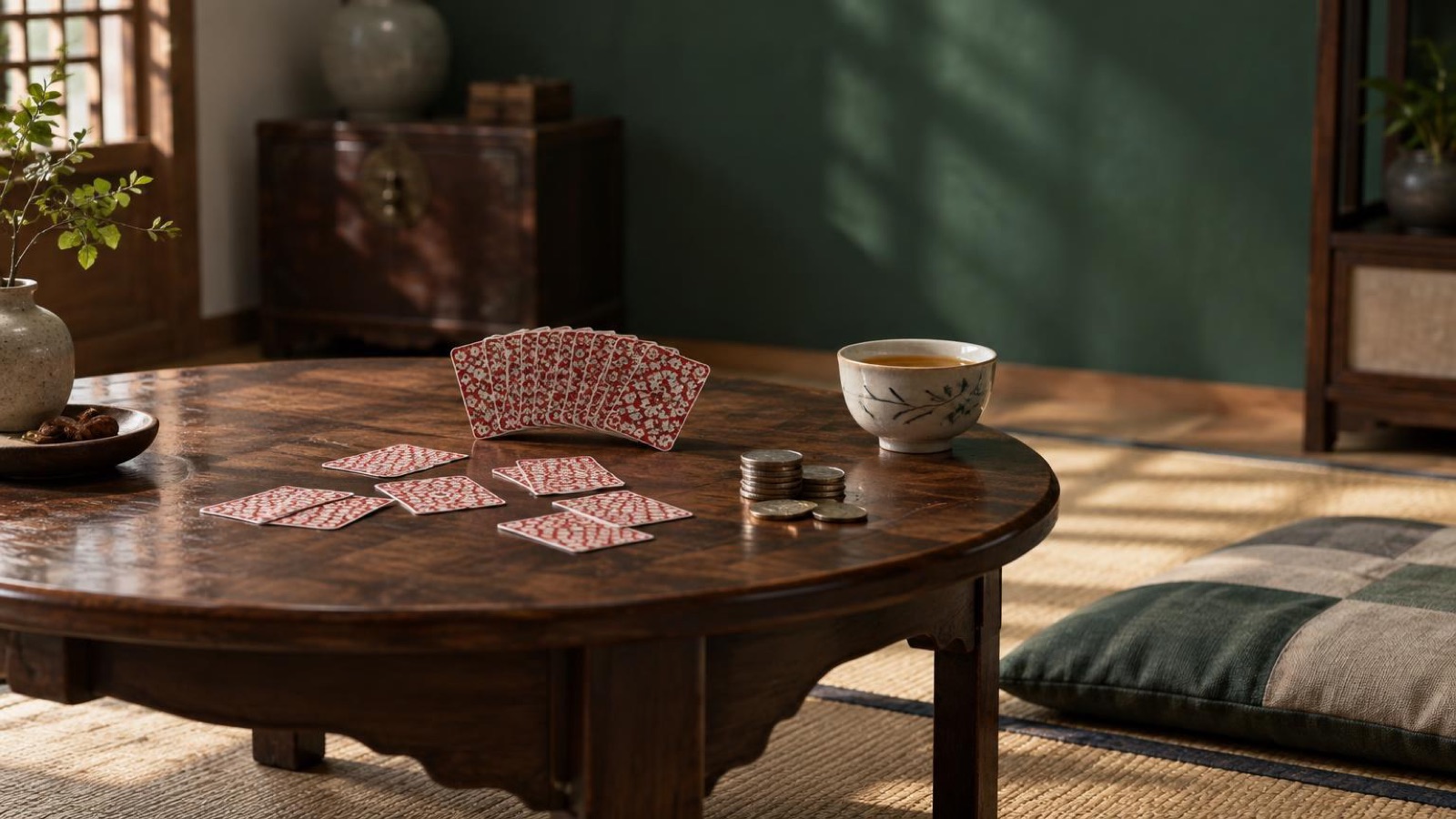
Go-Stop (고스톱) is the card game most Koreans grow up with. It is played with hwa-tu (화투), the small flower cards that came to Korea from Japan, where the same deck is used for the game Kachikachi2. In Korea the deck and the game built around it became a national pastime, played at family gatherings, holidays and neighborhood tables, and later adapted for online play.
The name comes from the two words you say at the decisive moment of each hand. When you have enough points to win you can call "stop" and take the money, or call "go" and keep playing for a bigger score. That single choice, press your luck or cash out, is the heart of the game.
Go-Stop is mainly played for small stakes between friends and family, and it is also the basis for a large world of online versions, each with its own house rules. It sits alongside Korea's other gambling options, from the lottery to casinos in South Korea, but unlike casino games it is something Koreans play with each other, in homes and cafes, with a deck that costs almost nothing. Kangwon Land, the only casino in the country open to Korean nationals as well as foreigners, is the exception rather than the rule for legal gambling3, while Go-Stop is a game anyone can play at a kitchen table.
The hwa-tu deck: card categories and special cards
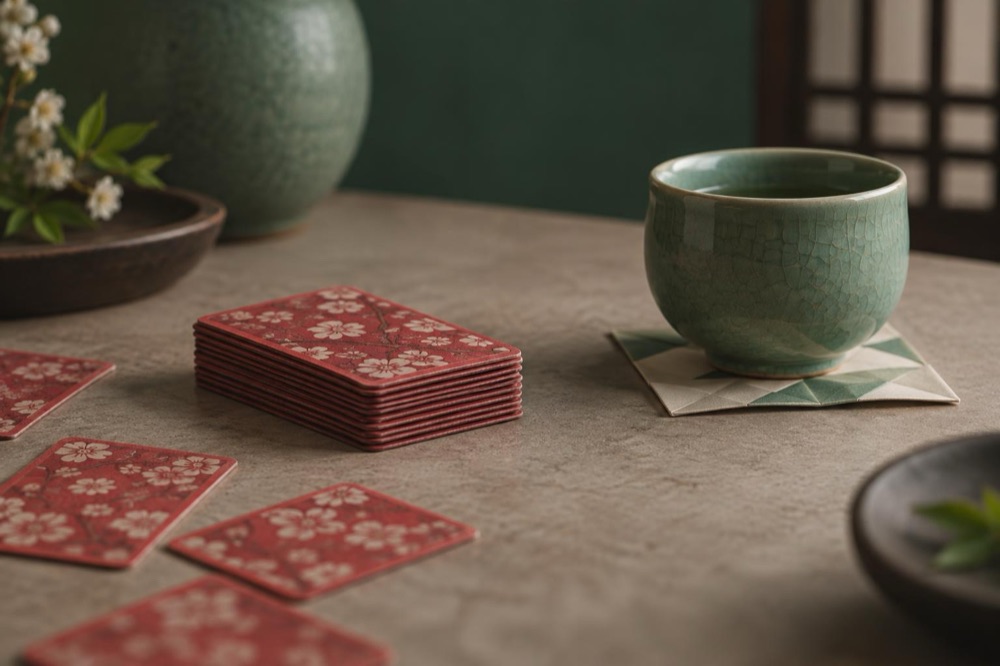
A hwa-tu deck has 48 cards, one for each month of the year across four suits of twelve cards, with each month represented by a flower or plant. Every card belongs to one of five scoring categories, and knowing them is the first thing any new player learns.
Gwang (광), bright cards. There are five gwang cards in the deck. They are the most valuable cards in the game. Three gwang score 3 points, four score 4 points, and all five together score 15 points. There is one exception: if your three gwang include the December card, which shows rain, the set counts as only 2 points1.
Kkut (끗), animal or ribbon-bearing cards. Five kkut cards score 1 point, and each card after the fifth adds 1 more. Three of the kkut cards show birds: February (plum), April (wisteria) and August (mountain). Collect all three and you have Godori, worth 5 extra points1.
Tti (띠), ribbon cards. Five tti cards score 1 point, with each further card adding 1 point. Ribbons come in colors and writings, and collecting three of the same kind, the red ribbons (hongdan), blue ribbons (cheongdan) or plain ribbons (chodan), scores 3 points each1.
Pi (피), junk cards. Pi are the plain cards that make up most of the deck. Ten of them score 1 point, and each card after the tenth adds 1 more1.
Ssangpi (쌍피), double junk cards. A few cards count as two pi instead of one. There is also a threepi card worth three pi, though many games do not use it1.
The categories are what give the game its texture. A hand is not just about winning fast but about which cards you collect along the way, since gwang, ribbons, animals and junk each build toward separate point totals.
Deals and number of players
Go-Stop is mainly a three-player game, but two, four or more people can take part1. The deal depends on the number of players.
In the standard three-player game, each player is dealt 7 cards and 6 cards are laid face down on the table1. Players hold their cards in a fan, as in most card games, and take turns playing from their hand onto the table.
In Matgo, the two-player version, each player receives 10 cards and 8 cards are laid face down on the table1. The larger hands change the feel of the game considerably, since you see more of the deck and matches come up more often.
With four or more players the deal and the flow adjust again, and this is one of the areas where regional variation is strongest. Because detailed rules differ by region and by each online Go-Stop service provider1, the practical habit among Korean players is to settle the house rules before the first card is played.
How a hand is played and how you win
A hand of Go-Stop is a race to collect scoring cards from the table. On your turn you do two things in order.
First, you play one card from your hand onto the table. If it matches a card of the same month already lying there, you pick up both and add them to your collected pile. Second, you flip the top card of the face-down stock and lay it on the table; if it matches a card there, you pick that pair up too. A single turn can therefore net you nothing, one pair or two pairs, and the swings from a lucky flip are a big part of the game's fun.
Every card you collect goes into your pile and counts toward the category scores described above: gwang sets, ribbon sets, Godori, and pi totals. As your piles grow, your score grows, and you announce your points as you go.
The first player to reach 3 or more points usually wins1. But reaching the target does not end the hand automatically. This is where the game gets its name. When you reach a winning score you face a choice:
- Call "stop" and the hand ends immediately, with you collecting from the other players based on your point total.
- Call "go" and play continues, giving you a chance to build a bigger score.
Each go declaration adds 1 point to your score, and from the third go onward each additional go doubles the score1. That escalation is why players say go at all: the payoff for pushing on can be several times what a safe stop would bring.
The risk is the nagari rule. If someone declares go and no one reaches the required score to end the hand, the hand is void, and the next hand starts at double stakes1. The go caller gets nothing for the abandoned hand, and everyone's exposure doubles going forward.
Special hands and bonuses: Godori, Chongtong, ppuk and shaking
Beyond the ordinary category scoring, Go-Stop has a set of special hands and events that pay bonuses or change the stakes. These are the moments players talk about afterward.
Godori (고도리). The three bird cards, February, April and August, together count as 5 points1. Because each of the three cards is also a kkut card that counts toward your kkut total, Godori is pure profit on top of what you already have, which makes the bird cards hotly contested.
Chongtong (총통). If you hold all four cards of one month in your hand, or all five gwang, you can end the hand immediately. A player who does this usually receives money equal to 10 or 20 points, or a score agreed in advance, from each participant. If the player refuses the win and continues, the game is almost always played at four times the stakes1.
Ppuk (뻑). A ppuk happens when you play a card that matches one on the table, but the flipped stock card leaves you unable to complete the pickup, leaving the matched pair stuck on the table. Ppuks carry their own payouts. A ppuk on the very first play of the hand, called cheotppeuk, earns money equal to 5 points. A ppuk on the turn immediately after a previous ppuk, yeonppeuk, earns 10 points, and a rare triple ppuk earns 20 points1. Most dramatically, three ppuks win the game outright regardless of the score so far, counted as 3 points in standard Go-Stop and 7 points in Matgo1.
Shaking (흔들기). Shaking is declared when you are dealt three cards of the same month in your hand1. If you then go on to win the hand, your score is doubled, and shaking twice makes it four times1. Like calling go, shaking is a way to raise the stakes on the strength of your own hand.
These bonuses stack in ways that produce the game's famous swings. A player who shakes, collects Godori and then calls go twice can multiply a modest point total into a score that dwarfs anything a cautious player would have taken.
Payment rules between opponents
Go-Stop is scored in points, and money changes hands on the basis of those points. The standard arrangement is that each losing player pays the winner an amount per point, agreed before the game starts. The winner's score is compared with each opponent's score separately in some house rules, or taken as a flat total in others.
The bonuses described above are what turn a simple per-point payment into something more dramatic. The practical effects are:
- Each go you call adds 1 point, and from the third go onward each go doubles the score, so a winner who called go three times is paid on a much larger figure1.
- Shaking doubles the winner's score, and shaking twice makes it four times1.
- A Chongtong winner who ends the hand immediately collects 10 or 20 points, or the agreed amount, from each participant, and a refused Chongtong usually makes the game fourfold1.
- Ppuk payouts of 5, 10 and 20 points are paid by the player who caused the ppuk1.
- If a hand goes nagari, nobody is paid for it, and the next hand is played at double stakes1.
Because the payment side of the game is where house rules diverge most, Korean players typically settle the per-point value and the treatment of special hands before dealing. Among family and friends the stakes are usually token, a few hundred won a point, with the real prize being bragging rights.
Variations: Matgo, two-player rules and house rules
The two-player version of Go-Stop is called Matgo (맞고), and it is popular enough to be a game in its own right, with its own online services. Hangame, one of Korea's big game portals, runs Sinmatgo, which it describes as the original national Matgo game2.
The main differences from three-player Go-Stop are structural.
| Feature | Three-player Go-Stop | Matgo |
|---|---|---|
| Cards dealt to each player | 71 | 101 |
| Cards laid face down on the table | 61 | 81 |
| Winning target | 3 or more points1 | 7 or more points1 |
| Stop declaration | from 3 or more points | from 7 points1 |
| Three ppuks counted as | 3 points1 | 7 points1 |
Beyond Matgo, the game is famously flexible. Detailed rules differ by region and by each online Go-Stop service provider1. Common areas of variation include which special hands are in play, whether the threepi card is used, how Chongtong is paid, and the treatment of individual cards whose category is ambiguous. If you sit down at a table with Koreans you have not played with before, expect a short negotiation of the house rules before the deal.
Online Go-Stop and missions
Go-Stop was an early hit of Korean online gaming and remains a staple of the big game portals. Hangame's Go-Stop service, one of the oldest and best known, offers several versions of the game with guides to their specific rules2. These services play with virtual chips rather than cash between players.
Online versions are where the "missions" concept comes in. Because each provider runs its own rule set1, online Go-Stop games typically publish detailed guides explaining their specific scoring, special hands and bonus events, so that players moving between services know what changes. Sinmatgo on Hangame, for example, comes with its own rules documentation2.
For a visitor or new resident, online Go-Stop is a low-stakes way to learn the game. The computer handles the matching and scoring, which teaches you the flow of a hand much faster than reading rules does, and the pace is faster than a kitchen-table game. Playing a few hundred hands online is how many Koreans themselves learned.
One practical note: online Go-Stop services in Korea operate with virtual currency for entertainment. Cash gambling online is a separate matter with its own rules, covered on our page about online gambling in South Korea. The game portals themselves are ordinary gaming sites, played by millions of Koreans as a pastime rather than a wager.
If you want to see how Go-Stop fits into the wider Korean gambling landscape, from horse racing in South Korea to the South Korea lottery, our main guide to gambling in South Korea has the full picture.
Common Questions
How many cards does each player get in Go-Stop?
In the standard three-player game, each player is dealt 7 cards and 6 cards are laid face down on the table. In the two-player version, Matgo, each player gets 10 cards and 8 are laid on the table.
What is the difference between Go-Stop and Matgo?
Matgo is the two-player version of Go-Stop. Each player holds 10 cards instead of 7, and the winning target is usually 7 points rather than 3. Some rules, such as when you may declare a stop, also differ.
How much does a hwa-tu deck cost?
Hwa-tu decks are inexpensive everyday items in Korea, sold in stationery shops, convenience stores and online marketplaces. Prices vary by maker, but a standard deck is cheap enough that most households own one.
What does 'go' mean in Go-Stop?
When you reach enough points to win, you can say 'go' instead of 'stop' and keep playing. Each go adds 1 point to your score, and from the third go onward each additional go doubles it, but if nobody stops the hand is void.
What is Godori?
Godori, meaning five birds, is a bonus hand made from the bird cards of February, April and August. Collect all three cards and you score 5 extra points.
How many points do you need to win?
In standard Go-Stop the first player to reach 3 or more points usually wins. In Matgo, the two-player version, the target is usually 7 or more points.
What is a ppuk?
A ppuk happens when you play a card matching one on the table but there is no matching card left to pick up. It usually costs you a small penalty, and three ppuks in one hand win the game outright.
Can the September card be used as an animal card or junk card?
The September card is one of the cards whose treatment varies between regions and providers. Detailed rules differ by region and by each online Go-Stop service, so agree on it before you start playing.
Sources3 sources
- 고스톱 (Go-Stop), Wikipedia, 2026
- 신맞고 게임 가이드, Hangame, 2026
- 강원랜드 (Kangwon Land), Kangwon Land, 2026