
The quick picture by country
| Country | Festival games at home | Licensed venues | Who the rules differ for |
|---|---|---|---|
| Hong Kong | Social gambling between friends is exempt | Racing, football, Mark Six, mahjong parlors | No nationality split; the channel decides |
| China | Family mahjong is a domestic matter; profit is not | State lotteries only | Citizens barred from all gambling, including overseas |
| Vietnam | Family card games for small stakes | Licensed casinos and electronic gaming venues | Vietnamese players face family exclusion rules |
| Singapore | Social gambling is legal | Two casinos, Singapore Pools, private-club jackpots | Citizens and PRs pay a casino entry levy |
| Thailand | Not legal | Government lottery and state-run horse racing | No split; the activity decides |
| India | Depends on the state | Varies by state | State-by-state patchwork |
| South Korea | Not legal | Foreigner-only casinos; horse, cycle, boat racing | Korean nationals barred from foreigner-only casinos |
| Japan | Not legal | Local year-end draws | No split; the activity decides |
Chinese New Year: the house-gambling tradition and where it is tolerated
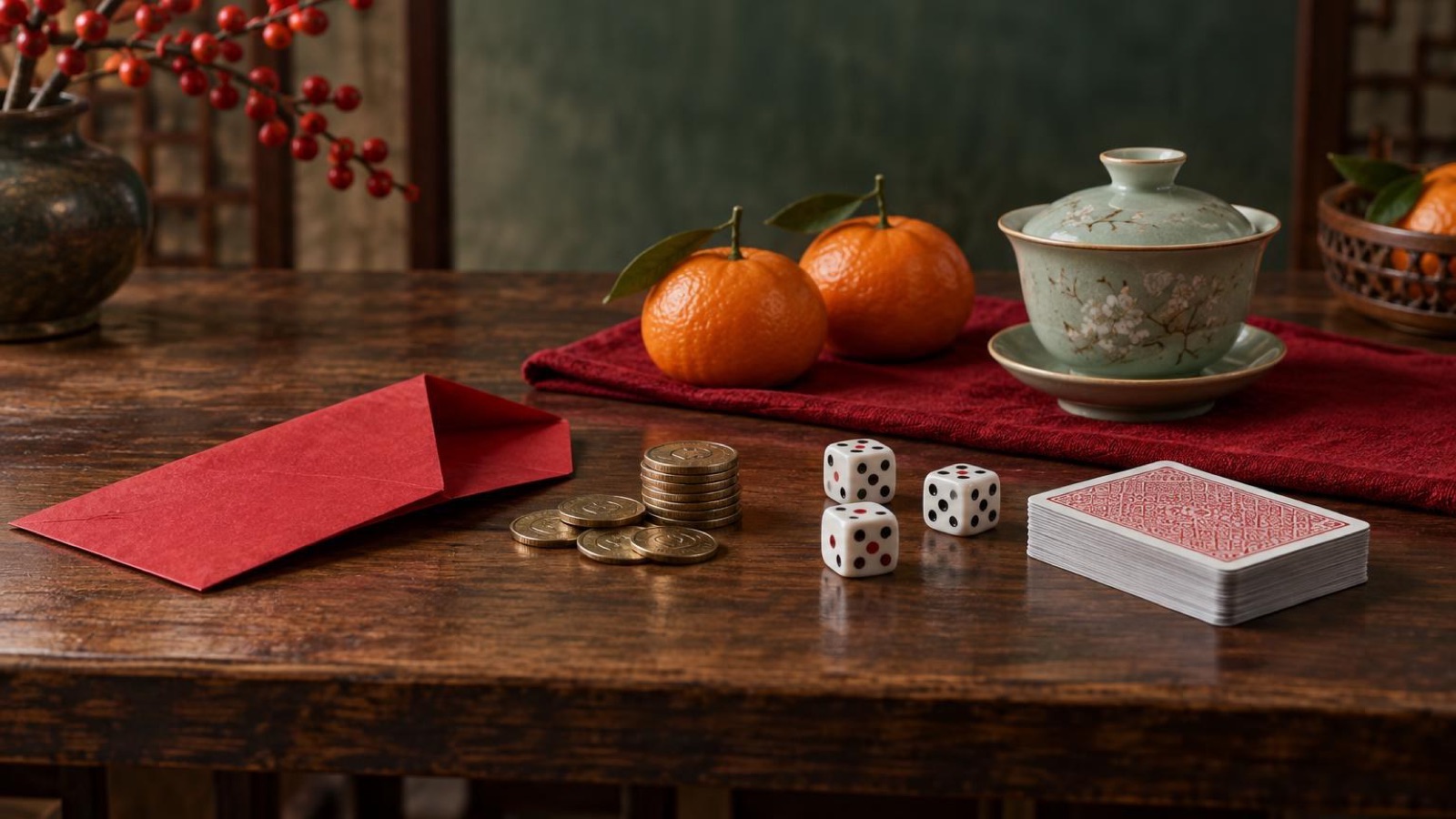
Lunar New Year is the one time of year when card tables come out in living rooms from Hong Kong to Manila. The games are usually the same ones played all year: mahjong, Big Two, Niu Niu, pai gow tiles. What changes is who is sitting at the table and whether anyone is taking a cut.
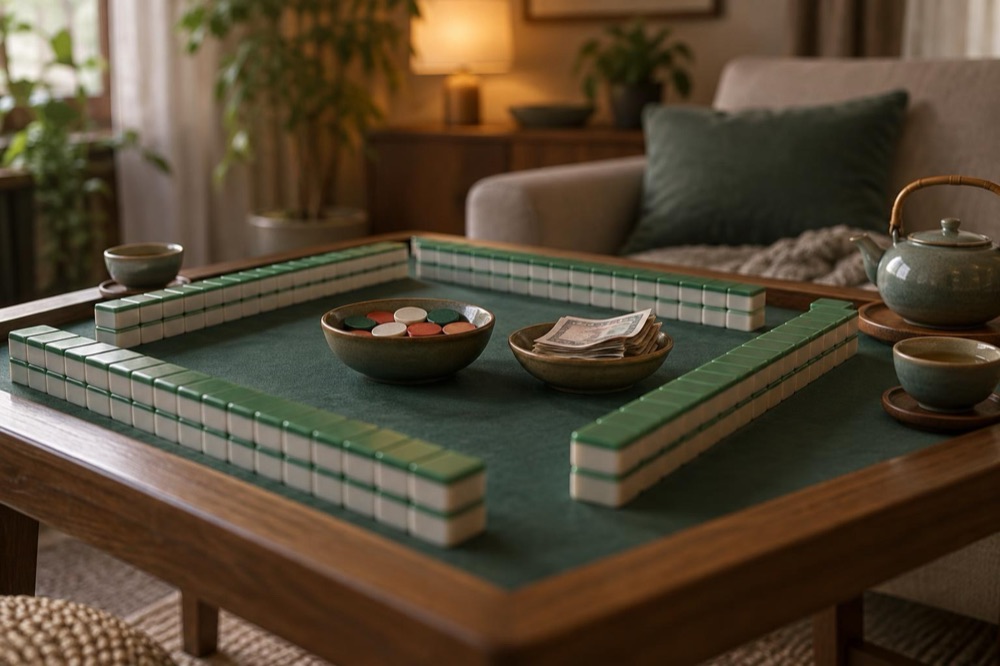
In Hong Kong, the rule that covers the family table is the social gambling exemption. Gambling is illegal in the territory except for three things: horse racing, football betting and the Mark Six lottery, all approved under the Betting Tax Ordinance; licensed activities such as mahjong parlors; and gambling that is exempted because it is social in nature2. A private game at home, with no operator profiting from the stakes, sits in that third category. The moment someone is running the game as a business, or you are betting with an illegal bookmaker, the exemption is gone.
That distinction matters more at New Year than at any other time, because New Year is when informal games get bigger. A CNY gathering where relatives play mahjong for small stakes is one thing. A CNY gathering where a friend of a friend is dealing banked games and keeping a percentage is another, and it is the second one that gets people charged. If you are a visitor and someone invites you to a "New Year game" in a back room with a dealer and a rake, that is not the house exception. That is an illegal gambling operation.
For Chinese citizens, the picture is much simpler and much stricter. Any form of gambling by Chinese citizens is illegal, including online gambling and gambling overseas, and that includes opening casinos overseas aimed mainly at Chinese customers4. Participating in cross-border gambling, whether inside or outside the border, is treated as a criminal act that public security organs will pursue3. Cross-border gambling is explicitly prohibited by Chinese law9. There is no New Year window in any of this. A trip to Macau or Singapore over the holiday does not change the rule for a mainland passport holder.
If you are in mainland China for the holiday, the practical answer is that the mahjong table at home is a family matter, and anything organized for profit is not. Beijing's local gambling regulation treats providing conditions for gambling for profit, or participating in gambling with relatively large stakes that does not rise to criminal punishment, as punishable under the Public Security Administration Punishments Law10. The line is drawn at profit and at stake size, not at the date on the calendar.
Tet: card games, family stakes and Vietnam's strict rules for players
Tet in Vietnam looks like Lunar New Year elsewhere: family, food, and cards on the floor after the meal. The games are usually climbing card games rather than casino games, played between relatives for small stakes. That is a private family activity, and it is not what Vietnam's gambling rules are aimed at.
What Vietnam does regulate closely is licensed gambling, and the rules there are specific. Vietnamese players at casino business points must not be subject to a request from a family member with full civil capacity, such as a father, adoptive father, mother, adoptive mother, husband, wife or biological child, asking the casino to bar them from playing5. The same exclusion applies if the player has asked to be barred themselves6. In other words, if a relative has written to the casino to keep you out, the casino has to keep you out, and that applies to Vietnamese nationals at licensed venues.
There are also rules aimed at the people running betting businesses.
- Managers, executives and employees of a betting business, along with their parents, spouses and biological children, may not bet on that same business's betting.
- Members of a race supervision council and their close relatives may not bet on races they supervise.
- Jockeys, players and referees, along with their close relatives, may not bet on events they take part in or officiate11.
These are conflict-of-interest rules rather than festival rules, but they apply year round, Tet included.
For foreign players and overseas Vietnamese at electronic gaming with prizes venues, the obligations are practical. You have to carry documents proving you are eligible to play, follow the game rules, house rules and internal management rules, meet your tax obligations in full, and not use the results of the games to bet directly with each other12. That last point is worth reading twice: using the outcome of a licensed electronic game as the basis for a side bet between players is prohibited12. If you are a visitor planning a Tet trip that includes a licensed venue, bring your passport, expect to show it, and do not organize side bets with the people at your table.
Vietnam also polices gambling that dresses itself up as something else. Prize fishing for money, advertised on personal Facebook accounts with times, location, prize structure and entry fee, has been treated as gambling in the form of prize fishing13. If a Tet outing is advertised that way, it is not a fishing trip.
Diwali: dice, cards and India's state-by-state patchwork
Diwali is the festival most associated with card games in India, and Teen Patti is the game most people picture. The legal position is not one answer but many, because gambling in India is regulated state by state. Some states permit games of skill and treat private festival card games at home as a domestic matter. Others restrict or prohibit gambling for money. There is no single national rule you can rely on.
The practical consequence is that the same Diwali Teen Patti table can be fine in one state and a problem in the next. If you are visiting family for the festival, the question to ask is not "is Teen Patti legal" but "what does this state say about playing cards for money." If you are an expat or a visitor and you are invited to a Diwali game, the safest reading is the same as anywhere else in Asia: a private game between friends with no house taking a cut is one thing, and a game run for profit is another.
If you want to understand the games themselves before you sit down, the rules and hand rankings for Teen Patti are worth ten minutes, and Indian Rummy covers the other card game that turns up at Indian festival tables. Neither page is about legality; they are about how the games work, which is the part most people get wrong when they are learning at a festival table with relatives watching.
Mid-Autumn: lotteries, draws and mooncake-season promotions
Mid-Autumn is less about card tables and more about draws, lotteries and promotions. In Hong Kong, the Mark Six lottery runs through the season, and the Mid-Autumn Golden Treasure draw on Saturday, September 26, 2026 produced no first prize winner, so about HKD 74 million in jackpot carryover moved to the October 3, 2026 draw. If you are in Hong Kong for the festival, that is a legal, regulated way to take part in a mooncake-season draw.
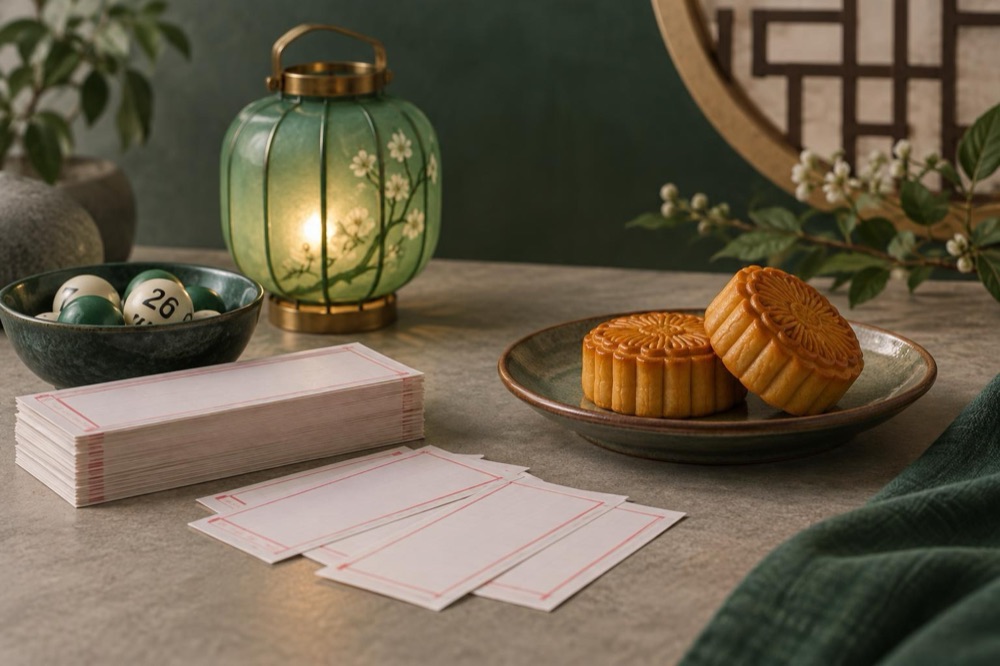
Mainland China runs its own lottery products, and the range is wider than most visitors expect: lotto, numbers, sports guessing, traditional, instant, video, keno and other types14. The China Welfare Lottery's game list includes Double Color Ball, Kuaile 8, Qilecai, FC 3D and Guaguale15. Bet ranges on some of these products have been tightened over the years: video lottery games moved from a 2 to 99 range to 2 to 20, and quiz lottery games moved from 2 to 99 to 2 to 5016. China Basketball Lottery single-match games share a prize pool and adjustment fund with other China basketball lottery single-match games17.
One rule that applies to all of these, and that matters if you are buying tickets as a gift during the festival: the sale of tickets or payment of prizes to minors is prohibited17. If you are buying lottery tickets for a family gathering, the buyer and the winner both need to be adults.
Japan's year-end and New Year draws are a different tradition with the same shape. At BTS Nichinan, the year-end draw prizes were travel vouchers and local specialty products, with no blank tickets18. That "no blank tickets" detail is the appeal: every ticket wins something, even if it is small. If you are in Japan over the New Year period, these local draws are a legal, low-stakes way to join in.
Traditional festival games and where you see them: Thai HiLo, Sic Bo and Fish Prawn Crab
The games that turn up at festival fairs across Asia are mostly dice and tile games, and they are worth knowing by name because the legal status of each depends entirely on where you are standing.
Thai HiLo is a dice game in the Sic Bo family, played with three dice and a board of high, low and specific number bets. It shows up at Thai festival fairs and in border casinos. In Thailand itself, only one type of gambling is legal: the government lottery and state-run horse racing8. Everything else, including HiLo at a fair, is not.
Sic Bo and Fish Prawn Crab are the other two you will see. Fish Prawn Crab is a three-dice game with animal symbols, and it is a fixture at Chinese New Year fairs and temple festivals. Pai Gow tiles, the 32-tile domino game, is the Lunar New Year table game in Chinese communities19. If you want the full comparison of how these dice games differ, Asian dice games covers Xoc Dia, Bau Cua, Cho-Han, Chinchirorin and Bo Bing side by side.
In the Philippines, licensed casinos run the full range of table games. Newport World Resorts lists blackjack, roulette, baccarat, craps, pai gow, poker, slot machines, electronic table games and daily bingo20. PAGCOR's register of accredited gaming system administrators includes sports betting among the licensed offerings21. If you are in Manila over a festival period and want a legal table, that is where it is.
Thailand's underground lottery: what it was and when it ran
Thailand's underground lottery, known as huay tai din, is the classic example of a festival-adjacent gambling tradition that the state tried to absorb rather than stamp out. It was illegal22, and it ran on the same draw numbers as the government lottery, which is why it was so hard to kill.
The payouts explain the appeal. In some southern provinces such as Phuket, the underground lottery paid THB 500 per THB 1 bet on the last three digits, and THB 70 per THB 1 bet on the last two digits22. Bookmakers also gave discounts to players and to yipua intermediaries, and those discounts were higher in the South than in other regions22.
Penalties for players during festival periods
The penalties that apply to players do not change because it is a holiday. In Hong Kong, participating in illegal gambling, for example betting with an illegal bookmaker, carries a maximum on conviction of a HKD 50,000 fine and nine months in prison1. Betting with online casinos or online e-sports gambling platforms is illegal in Hong Kong, because neither is licensed or exempted, and any person who bets with an online gambling platform not offered by the Hong Kong Jockey Club would breach the Gambling Ordinance23.
In Singapore, the penalty that catches people out during festival periods is the age rule. Under the Gambling Control Act 2022, an underage individual who enters an approved gambling venue during a restricted period can be fined up to S$1,50025. If you are bringing younger family members along on a festival outing that passes through a casino, that is the rule to know.
In mainland China, online football betting is a criminal offense26, and cross-border gambling is pursued as a criminal act3. Beijing's local regulation routes gambling that does not reach criminal punishment, including providing conditions for gambling for profit or playing with relatively large stakes, to the Public Security Administration Punishments Law10.
Resident or visitor: which rules apply to you
This is where festival gambling questions usually get their real answer, because the rules often differ by who you are rather than by what date it is.
In Singapore, a casino operator must not allow a Singapore citizen or permanent resident to enter or remain on casino premises unless that person has paid the entry levy24. Foreign visitors are not subject to the levy. Singapore's legalized gambling is social gambling, betting with Singapore Pools, casino gambling at Marina Bay Sands and Resorts World Sentosa, and jackpot gambling in private clubs7. If you are a citizen or PR planning a festival visit to the casinos, budget for the levy.
In South Korea, the foreigner-only casino rule is the one that matters. The Hyatt Regency casino is for foreigners only27. Korean nationals are directed to the legal channels instead: horse racing, cycling, boat racing, poker and blackjack on the skill side, and lotteries, slot machines, roulette, video poker and baccarat on the chance side28. If you are a visitor, the foreigner-only casino is open to you; if you hold a Korean passport, it is not.
In Vietnam, the split is between eligible Vietnamese players and foreign passport holders at licensed venues, with the family exclusion rules applying to Vietnamese players5. Foreign players and overseas Vietnamese at electronic gaming venues have their own obligations, including carrying proof of eligibility and not making side bets with each other12.
In Hong Kong, the split is not by nationality but by channel. Anyone, resident or visitor, can bet with the Hong Kong Jockey Club on racing, football and Mark Six. Anyone, resident or visitor, who bets with an illegal bookmaker or an unlicensed online platform is breaking the law23.
If you are planning a festival trip and want the country-level picture rather than the festival-level one, the jurisdiction guides cover the ground in more detail: Hong Kong, Vietnam, Singapore, Thailand, India, China, South Korea and Japan. For the games themselves, Asian gambling games is the starting point, and where Asian games are legal compares twelve jurisdictions side by side.
Common Questions
Is gambling during Chinese New Year legal in Hong Kong?
Only if it stays social. Private games at home with no house taking a cut fall under the social gambling exemption. Betting with an illegal bookmaker or an online casino is not covered, and the maximum penalty on conviction is a HKD 50,000 fine and nine months in prison.
What is the house exception for Lunar New Year gambling?
There is no general holiday exception. What people call the house exception is the social gambling exemption: games played privately, with no operator profiting from the stakes. Once someone takes a rake or runs the game as a business, the exemption no longer applies.
What games do families play at Tet?
Tet gatherings in Vietnam usually mean card games rather than casino games. Climbing games such as Tien Len are the common family choice, played for small stakes between relatives at home. Betting at licensed venues is a separate activity with its own age and eligibility rules.
Is playing cards for money during Diwali illegal in India?
It depends on the state, because gambling is a state subject in India. Some states permit games of skill and treat festival card games at home as private, while others restrict or prohibit gambling for money. Check the rules where you are before you sit down.
What is Thai HiLo and how is it played?
HiLo is a dice game in the Sic Bo family, played with three dice and a board of high, low and specific number bets. It appears at Thai festival fairs and in border casinos. In Thailand itself, only the government lottery and state-run horse racing are legal.
When did Thailand's above-ground lottery start and end?
The cabinet approved a legal three-digit and two-digit lottery on July 8, 2003, and the first tickets went on sale on August 1, 2003. It was ruled contrary to the Government Lottery Office Act and ceased on November 16, 2006.
Sources29 sources
- LCQ3: Illegal gambling activities, Government of Hong Kong SAR, June 4, 2025
- Gambling policy, Home and Youth Affairs Bureau, 2026
- Cross-border gambling crackdown, Ministry of Public Security, October 1, 2020
- Chinese law on gambling by citizens, Chinese Embassy in the Philippines, August 8, 2019
- Casino Ho Tram and Vietnamese player conditions, Thu Vien Phap Luat, November 28, 2025
- New rules on legal casino locations for eligible Vietnamese players, Thu Vien Phap Luat, November 26, 2025
- About problem gambling, Ministry of Social and Family Development Singapore, September 25, 2026
- Legal gambling in Thailand, Wikipedia Thai, 2026
- Cross-border gambling prohibition, Chifeng Public Security Bureau, January 12, 2026
- Beijing Municipal Regulation on Prohibiting Gambling, Beijing Municipal Government, November 3, 2023
- Betting age and eligibility rules in Vietnam, Thu Vien Phap Luat, November 20, 2024
- New regulations on electronic gaming with prizes for foreigners, Bao Chinh Phu, December 29, 2021
- Prize fishing gambling den dismantled, Ministry of Public Security Vietnam, March 31, 2026
- Lottery game types, State Council, August 16, 2018
- China Welfare Lottery game index, China Welfare Lottery, May 25, 2021
- Adjustment of lottery bet ranges, Ministry of Finance, February 11, 2019
- China Basketball Lottery Single-Match Winning Margin Game rules, Shanghai Sports Lottery, June 9, 2021
- Year-end draw at BTS Nichinan, Boat Race, December 10, 2018
- How to play Pai Gow Poker, PlaySmart, 2026
- Newport World Resorts gaming areas, Newport World Resorts, 2026
- PAGCOR accredited gaming system administrators, PAGCOR, September 17, 2026
- Study of the underground lottery in Thailand, Gambling Study Thailand, August 2011
- Anti-illegal gambling myths, Hong Kong Jockey Club, 2026
- Casino Control Act 2006 section 116, Singapore Statutes Online, 2026
- Gambling Control Act 2022 section 32(3), Singapore Statutes Online, June 17, 2024
- Online football betting is a criminal offense, Xizang Cyberspace Administration, August 18, 2026
- Hyatt Regency casino, Visit Korea, 2026
- Chance and skill gambling games, KBOAT, September 25, 2026
- Games of chance and skill, KCycle, September 26, 2026















