
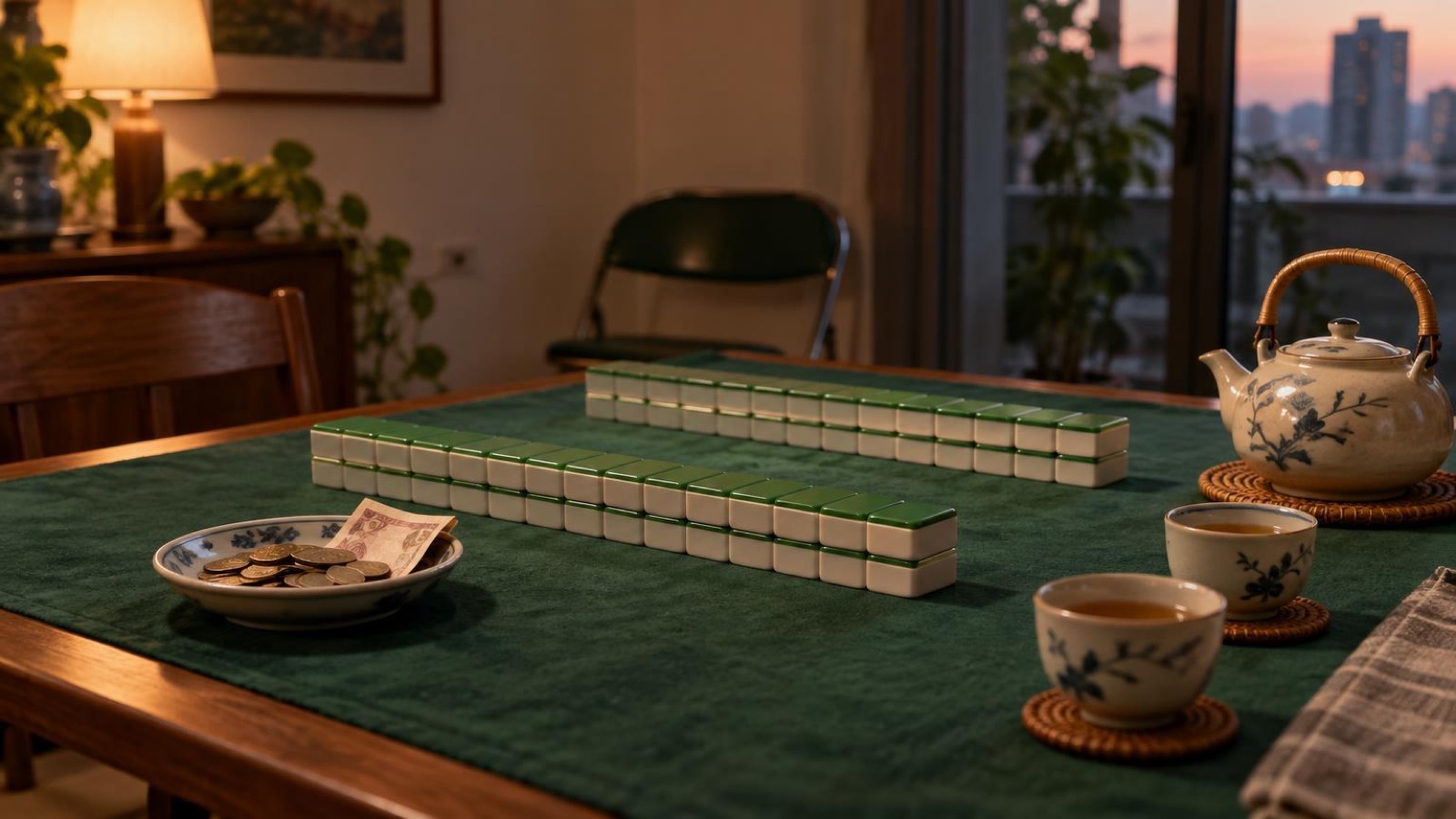
Playing mahjong or poker for money with family or friends is one of the most common gambling activities in Asia, and also one of the most unevenly treated in law. A game that is perfectly legal at a kitchen table in Singapore can be an offense the moment it moves to a hotel room, an office or an app. This page compares the main jurisdictions, explains the conditions each one attaches to private play, and sets out what players actually face where the activity is not allowed. For the wider picture across the region, see gambling laws in Asia.
How the main places compare
The five jurisdictions covered here sit at very different points on the spectrum.
| Jurisdiction | Home game among family and friends | Key condition | Practical risk if it goes wrong |
|---|---|---|---|
| Singapore | Legal | Must be in an individual's home, in person, no rake or fee1 | Gambling in a public place is illegal even among family and friends1 |
| Hong Kong | Exempted | Gambling of a private nature is exempted under section 3 of the Gambling Ordinance2 | Betting with illegal bookmakers: up to HKD 50,000 fine and 9 months6 |
| Mainland China | Not treated as gambling | Family games not for profit; small-stakes games among non-relatives not punished3 | Online betting and cross-border gambling are criminal matters7 |
| Malaysia | No home-game exemption | Gaming houses are criminalized; Sharia forbids gambling for Muslims4 | Up to RM100,000 fine and six years in jail4 |
| Thailand | Illegal | Most gambling is illegal under the Gambling Act B.E. 24785 | No licensed alternative for casino-style play |
The pattern to notice is that the law rarely targets the game itself. It targets the setting, the money flow and the organizer. Where a game stays inside a private home, among people who genuinely know each other, with nobody taking a cut, most northern jurisdictions leave it alone. Where a venue charges, a host profits, or the game moves online, the same activity becomes unlawful gambling almost everywhere.
Where home gambling with family and friends is legal: Singapore's rules
Singapore is the clearest case in Asia because the law spells out the exemption in plain terms. Under the Gambling Control Act 2022, physical social gambling among family and friends is permitted, and the statute defines exactly what counts1. The starting point is that gambling activities are prohibited unless they are exempted or licensed, so the social gambling exemption is what makes the home game lawful rather than merely tolerated8.
The conditions come from section 12(1) of the Act. Social gambling is not unlawful if it meets all of these conditions9:
- it is conducted in a home in Singapore
- it is among family members or personal acquaintances
- it is substantially spontaneous
- it is not conducted for the private gain of a non-participant or in the course of any business
- no participant can obtain a benefit other than winning
In everyday language: your cousin's Chinese New Year mahjong session qualifies. A weekly card game where the host charges a seat fee or takes a percentage of each pot does not.
The exemption regime was created deliberately when the Act was passed. The Gambling Control Bill specifically provided an exemption for social gambling among family and friends conducted in homes, while declining to extend it online10. The government's reasoning was that it would be difficult to establish whether individuals online are sufficiently connected to one another to count as genuine social gamblers10.
Singapore's legalized gambling otherwise consists of betting with Singapore Pools, casino gambling at Marina Bay Sands and Resorts World Sentosa, and jackpot machine rooms at private clubs, alongside the social gambling exemption11. So the home game sits in a small, defined space, and the rest of this page explains where its edges are.
Social gambling in Singapore: only in a private home
The location test is the one that catches people out. The gambling activity must take place in person and in an individual's home1. That word "home" does the heavy lifting.
A hotel room does not qualify. Neither does a chalet, a serviced apartment booked for the weekend, a club function room, an office after hours, or a rented event space. It is illegal to gamble in any public place in Singapore, even among family and friends1. The distinction is not about who is playing or how much is at stake; it is about where the table is.
The participant test is the second condition. Participants must be family members, or individuals who know each other personally1. A game where strangers are invited in, or where a regular commercial crowd rotates through, fails this test even if it is held in a real home.
The money test is the third. The activity must not be conducted for the private gain of a non-participant or in the course of any business, and no participant should be able to obtain a benefit other than winning. No commission, charges or fee should be sought from the participants1. This is the provision that separates a friendly game from an unlicensed gambling den: the moment the house takes a cut, the exemption is gone.
One further point on age. The general minimum gambling age in Singapore is 21, with 18 applying at Singapore Pools' physical outlets10. The Act's section 31, which makes it an offense for an underage individual to gamble, does not apply to social gambling12. So the exemption does not carry its own age door, but every other condition still has to be met.
What makes it illegal: business, offices and online play
Three things reliably push a private game over the line in Singapore.
The first is business. The Act defines unlawful gambling as gambling that is not social gambling but is unlawful betting, an unlawful gaming activity, unlawful participation in a lottery, or an offense under section 3113. Once a game fails any of the social gambling conditions, it falls into the unlawful category by default, not into a gray zone.
The second is the venue. As covered above, only an individual's home qualifies. Offices, public places and rented premises are all outside the exemption, and the penalties for being found in an unlawful gambling place include a fine of up to SGD 10,000 or up to six months, or both14. Playing on a prohibited or unapproved gaming machine carries a fine of up to SGD 10,000 or up to six months, or both15.
The third is the internet. Social gambling is not permitted on online platforms1. This is not a loophole that has simply not been closed; it was considered and rejected when the law was drafted, precisely because online it is hard to verify that players really know each other10. A private poker group that moves from a living room to a video call and an app is no longer within the exemption, even if the same four friends are playing. For the wider regional picture on this, see is online gambling legal in Asia.
Hong Kong: gambling illegal except licensed racing, football betting and Mark Six
Hong Kong takes the opposite drafting approach: everything is illegal unless it is listed. All gambling is illegal except horse racing, football betting and the Mark Six lottery approved under the Betting Duty Ordinance, activities licensed by the relevant public officer such as mahjong parlors, and activities exempted under section 3 of the Gambling Ordinance, which are mainly gambling of a social or private nature2.
The Hong Kong Jockey Club is the sole operator authorized by the government to provide horse racing and football betting, and it administers the Mark Six lottery on behalf of the government17. The Club has limited its betting services to horse racing, Mark Six and football in accordance with its licensing conditions17. Licensed mahjong parlors, authorized under the Gambling Ordinance (Cap. 148), are the other notable legal outlet18.
The section 3 exemption is what covers the home game. The Gambling Ordinance clearly stipulates that all unauthorized gambling activities, except those of a private nature, are illegal19. So a mahjong session in your own flat with relatives, with nobody profiting beyond the tiles, falls on the exempt side of the line. The government's own policy materials describe the exempted activities as mainly social in nature2.
Two practical cautions from Hong Kong's enforcement history. First, it is unlawful to play mahjong for money in non-bona fide establishments, including mahjong clubs or associations operating on unlicensed private premises where rental or commission is charged20. Second, the police have publicly countered the misconception that playing mahjong for money does not contravene the law; players cannot assume the game is exempt just because it is mahjong20. The exemption turns on the private nature of the setting, not on the game being mahjong.
Online gambling in Hong Kong is illegal except online betting offered by the Hong Kong Jockey Club21. The minimum age for gambling is 18: operators are prohibited by law from accepting or allowing persons under 18 to take part in gambling activities, and the Jockey Club restricts all betting to those aged 18 or above16.
Penalties for players in Hong Kong: HKD 50,000 fine and 9 months
Where gambling in Hong Kong is not exempt or licensed, the player penalties are set out in the Gambling Ordinance. Anyone who bets with a bookmaker commits an offense and, on conviction, faces a maximum fine of HKD 50,000 and nine months' imprisonment22. The Jockey Club's responsible gambling materials state the same maximum for betting with illegal bookmakers6.
Participating in illegal gambling more broadly, including illegal online betting, carries imprisonment of nine months and a fine on conviction23. The police have repeated this in public messaging: anyone participating in illegal gambling, including illegal online betting, can be sentenced to nine months in jail and a fine23.
One wrinkle worth knowing: the police's own crime prevention materials cite a maximum fine of HKD 30,000 and nine months under section 8 of the Ordinance for betting with illegal bookmakers24. The figures cited in government news releases and the Ordinance itself are HKD 50,000 and nine months25. Either way, the realistic exposure for a player caught in unlawful gambling in Hong Kong is a fine measured in tens of thousands of dollars and up to nine months.
For a player in a genuinely private home game, this penalty regime should never be reached, because the section 3 exemption applies. It becomes relevant when the game leaves the private setting: an office game with a rake, a rented venue, or a bet placed with an unlicensed bookmaker. For more detail across the region, see penalties for gambling in Asia.
Mainland China: family games are treated differently
Mainland China's enforcement guidance draws a line that will feel familiar to anyone who has read the Singapore rules. Mahjong or card games with money stakes among family members or relatives, not for profit, are not treated as gambling; games with small stakes among non-relatives are not punished3.
That is a policy statement about how the rules are applied, not a license for organized play. The picture changes sharply outside the family setting. Gambling abroad, online gambling, and providing funds or technical support for gambling all violate the Criminal Law and the Public Security Administration Punishment Law for Chinese citizens7. Online football betting is treated as an illegal criminal offense26. The authorities have also run sustained campaigns against cross-border gambling aimed at Chinese citizens; see what happens to Chinese citizens who gamble on cross-border sites.
The practical takeaway is the same as in Singapore and Hong Kong: the family table is one thing, and anything with a venue, a rake, an organizer or a screen is another. The state enterprise that manufactures playing cards in Thailand, discussed below, is a reminder of how differently the region has historically treated even the tools of the game.
Malaysia: the gaming house rule
Malaysia has no home-game exemption of the Singapore type. The central statute is the Common Gaming Houses Act 1953, which criminalizes operating a gaming house and being caught in one4. The Act's reach is defined by the concept of the gaming house rather than by the game or the stakes, so the question in any given case is whether the premises have become a gaming house.
There is one major licensed exception: the casino resort at Genting, which operates as the country's sole legal casino complex. Everything else, including private card games once they take on the features of a gaming house, sits outside the licensed space.
A further layer applies to Muslims. Sharia law forbids gambling for Muslims in Malaysia4, which means the same game can carry religious as well as criminal consequences depending on who is playing. This is covered in more detail at gambling laws for Muslims in Asia.
So is a poker night at home legal in Malaysia? There is no exemption that says it is. The realistic position is that a small, genuinely private game among friends carries low practical risk, but the statute contains no safe harbor for it, and anything that looks like a regular venue, an organized session or a profit for the host can be treated as a gaming house.
Penalties in Malaysia: RM100,000 fine and six years in jail
The Common Gaming Houses Act 1953 penalizes anyone caught gaming in an illegal gaming house with an RM100,000 fine and six years of jail time4. That figure is the one most commonly cited for the offense of being found in a gaming house.
The Act's own penalty provision has also been set out in official guidance as a fine not exceeding RM3,000 or imprisonment not exceeding two years, or both, for any person who gambles or is found in a gambling house27. The two figures reflect different provisions and different sources; what matters practically is that being present in a gaming house is itself an offense, not just running one.
Compare that with the player penalties in Singapore and Hong Kong, which are measured in fines of up to SGD 10,000 or HKD 50,000 and jail terms of six to nine months14. Malaysia's exposure for the same conduct is in a different league, which is why the question of whether a home game has drifted into gaming house territory matters more there than anywhere else on this page.
Thailand: most gambling is illegal
Thailand is the strictest of the jurisdictions here. Under the Gambling Act B.E. 2478, most gambling is illegal in Thailand5. There is no exemption for social gambling among family and friends comparable to Singapore's, and no licensed casino on the mainland.
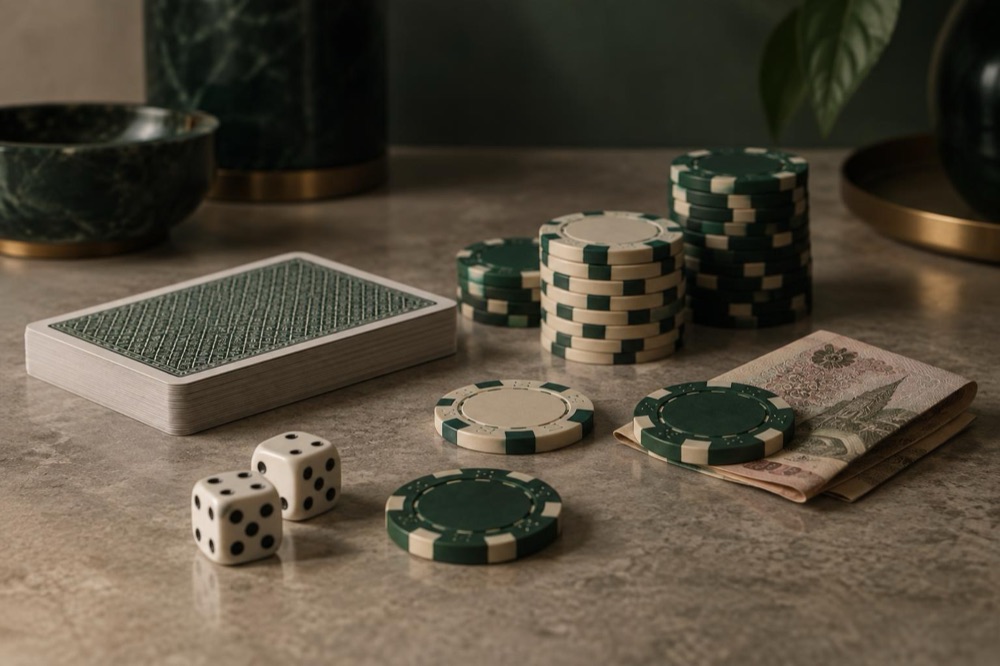
The Act dates from 1935 by the common calendar and replaced an earlier 1930 law, modernizing and consolidating the country's gambling rules and adding more game types to its schedules. Its long history explains some of its quirks, including the state's monopoly over playing card manufacture through a factory established under the Playing Card Act B.E. 2481, a reminder that Thailand has controlled even the physical tools of card play for generations.
For visitors and residents alike, the practical position is simple: a card game for money at home in Thailand is not covered by any exemption, and the licensed alternatives are limited to a small number of government products such as the lottery and horse racing. See gambling in Thailand for the full picture.
Questions first-timers ask
Can I play mahjong for money at Chinese New Year in Singapore? Yes, if it is in someone's home, among family or friends who know each other, and nobody takes a cut or fee. The Act was drafted with exactly this kind of occasion in mind1.
Does the Singapore exemption cover a game in my condo's function room? No. The exemption requires the game to take place in an individual's home, and gambling in a public place is illegal even among family and friends1. A communal function room is not your home.
What if we all just move the game to a group video call? That takes you outside the exemption everywhere on this page. Singapore expressly does not permit social gambling on online platforms1, and Hong Kong treats online gambling as illegal except the Jockey Club's own betting21.
Does someone taking a rake really change things? Yes, and it is the single clearest line in the region. In Singapore, no commission, charge or fee may be sought from participants1; in Hong Kong, mahjong played where rental or commission is charged is unlawful20. The rake is what turns a private game into a business.
Are the rules different for visitors? In Singapore and Hong Kong, the social gambling rules apply to anyone physically present, citizen or visitor alike. In Malaysia, Sharia prohibitions apply to Muslims regardless of nationality4, and in mainland China the cross-border gambling warnings are directed at Chinese citizens7. See gambling law for visitors and expats in Asia.
Where can I read about the age rules in detail? The minimum ages are covered above for each place; for a full regional comparison, see legal gambling age in Asia.
Common Questions
Is playing mahjong for money at home legal in Singapore?
Yes, if it meets the conditions of the Gambling Control Act 2022. The game must take place in person, in an individual's home, among family members or people who know each other personally, be substantially spontaneous, and no one may take a cut, commission or fee.
Can social gambling take place in a hotel or chalet in Singapore?
No. The exemption only covers gambling in an individual's home. A hotel room, chalet, office or any public place does not qualify, and gambling in a public place is illegal even among family and friends.
Is online social gambling legal in Singapore?
No. The exemption for social gambling applies only to physical, in-person games in a home. Social gambling on online platforms is not permitted, even if all the players know each other.
Is there an age limit for social gambling in Singapore?
The general minimum gambling age in Singapore is 21, with 18 applying only at Singapore Pools' physical outlets. The Act's ban on underage gambling does not apply to social gambling, but the other conditions of the exemption still must be met.
What is the penalty for being caught in an illegal gaming house in Malaysia?
Under the Common Gaming Houses Act 1953, a person caught gaming in an illegal gaming house can face a fine of up to RM100,000 and six years in jail. The Act's own penalty provision also sets out a fine of up to RM3,000 or up to two years, or both.
What is the minimum age at gambling establishments in Hong Kong?
The minimum age is 18. Operators of gambling establishments are prohibited by law from accepting or allowing anyone under 18 to take part in gambling activities, and the Hong Kong Jockey Club restricts all betting to those aged 18 or above.
Sources27 sources
- Ask.MHA: Social gambling in Singapore, Ministry of Home Affairs, Singapore, 2026
- Gambling policy, Home and Youth Affairs Bureau, Hong Kong, 2026
- Guidance on gambling under public security law, Jiangsu Provincial Government, China, 2019
- Betting legally in Malaysia, 88ProAsia, 2022
- Gambling Act B.E. 2478, Wikipedia (Thai), 2026
- Myths about illegal gambling, Hong Kong Jockey Club, 2026
- Statement on cross-border gambling, National Immigration Administration, China, 2021
- Regulating the casino and gambling industry, Ministry of Home Affairs, Singapore, 2026
- Gambling Control Act 2022, Singapore Statutes Online, 2026
- First Reading of the Gambling Regulatory Authority of Singapore Bill and Gambling Control Bill, Ministry of Home Affairs, Singapore, 2022
- About problem gambling, National Council on Problem Gambling, Singapore, 2026
- Gambling Control Act 2022, Act 15 of 2022, Singapore Statutes Online, 2022
- Gambling Control Act 2022 (current version), Singapore Statutes Online, 2024
- Gambling Control Act 2022 (historical version, June 17, 2024), Singapore Statutes Online, 2024
- Gambling Control Act 2022 (PDF), Singapore Statutes Online, 2025
- Gambling policy (archived), Home Affairs Bureau, Hong Kong, 2010
- Responsible gambling, Hong Kong Jockey Club, 2026
- Gambling policy (English), Home and Youth Affairs Bureau, Hong Kong, 2026
- Press release on gambling, November 22, 2000, Information Services Department, Hong Kong, 2000
- Police notice on mahjong gambling, April 26, 1999, Information Services Department, Hong Kong, 1999
- Gambling report 2011, Home Affairs Bureau, Hong Kong, 2011
- Press release on illegal bookmaking, July 21, 2026, Information Services Department, Hong Kong, 2026
- Press release on illegal gambling, September 11, 2025, Information Services Department, Hong Kong, 2025
- Junior Police Corps crime prevention materials, Hong Kong Police Force, 2026
- Press release on gambling ordinance amendments, June 4, 2025, Information Services Department, Hong Kong, 2025
- News item on online football betting, Jiangsu Provincial Authorities, China, 2026
- Bayan Linnas on gambling under Act 559, Federal Territory Mufti's Office, Malaysia, 2019















