
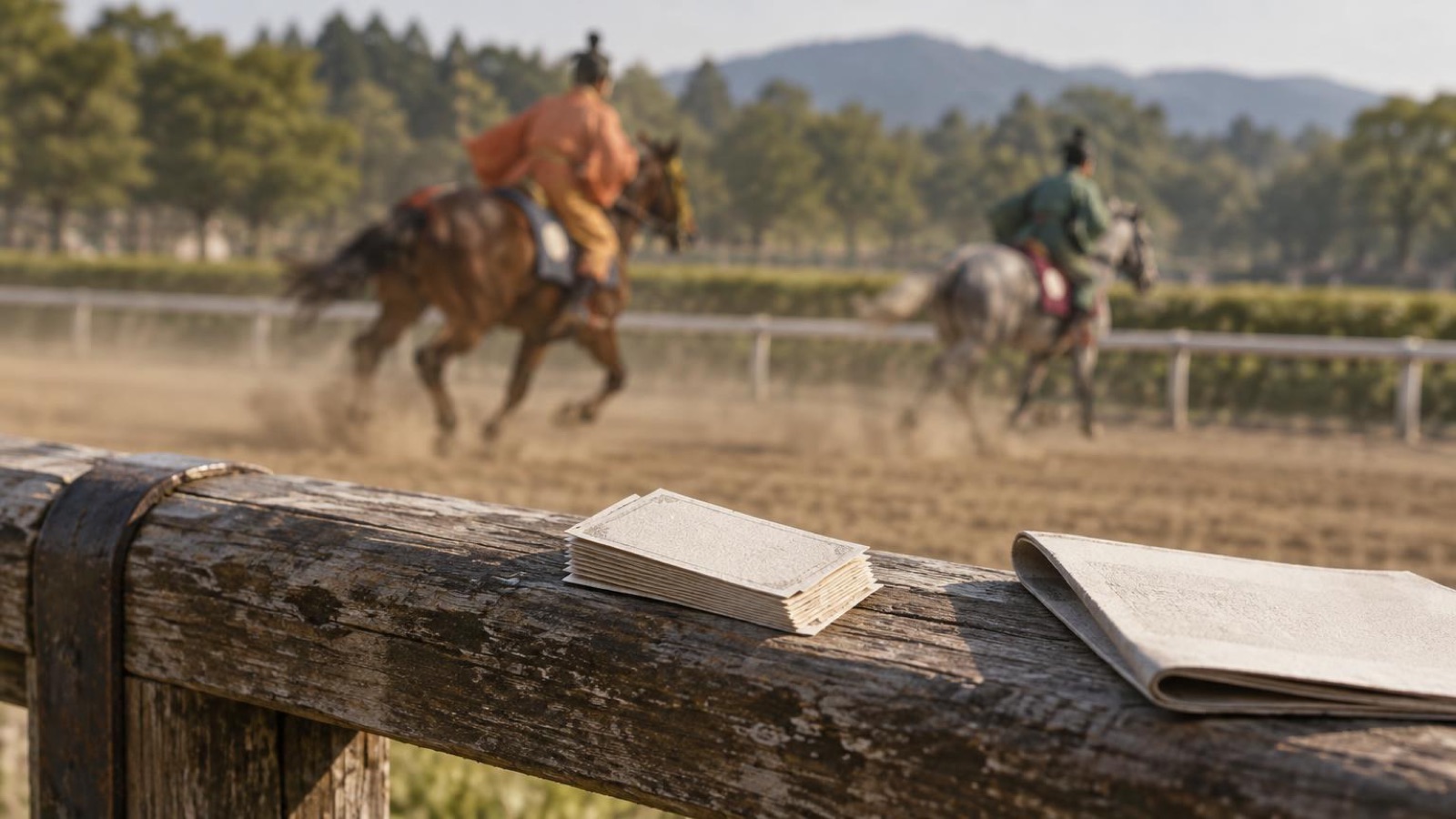
What the Kamo Kurabeuma festival is
Kamo Kurabeuma is a horse racing ceremony held at Kamigamo Shrine in Kyoto. The name breaks down simply: kurabe means contest or comparison, and uma means horse. It is a religious and cultural event, staged on the shrine's own ground, and it belongs to the same seasonal calendar as Kyoto's better known spring festivals.
The important thing for a visitor is what it is not. It is not a race meeting in the commercial sense. There is no tote window, no betting ticket, no payout. You go to watch horses run, not to have a bet. If you are looking for a day at the races with a wager, this is the wrong event, and the sections below explain where the real betting happens instead.
The ceremony is short by racecourse standards. Horses run in heats along a straight or gently curving course inside the shrine precinct, watched by a crowd that stands along the rails. Because it is a shrine event, the atmosphere is closer to a procession than to a sports fixture. Expect formal dress on the riders, ritual elements before the running, and a crowd that includes local families as well as visitors.
Racing's ceremonial roots and the modern betting law
Horse racing in Japan has a long ceremonial history, and shrine racing is the older strand of it. The court and shrine tradition of running horse as an offering long predates anything commercial. Kamo Kurabeuma sits in that tradition: the point is the ritual, and the racing is the offering.
The modern, betting side of the sport is much younger. Japan's current racing law dates from 1948, when the Japan Racing Society was abolished and racing was brought under a new framework with government involvement2. The Horse Racing Act itself is Act No. 158 of July 13, 19481. That is the law that governs the racecourses you can visit today, and it is the reason betting exists at some venues and not at others.
So there are two things called horse racing in Japan, and they are not the same. One is the shrine ceremony, which is free, ceremonial and unbetting. The other is the authorized racing industry, which is regulated, pari-mutuel and open to anyone aged 20 or over. Kamo Kurabeuma belongs firmly to the first category.
If the ceremonial side interests you, it is worth reading more about horse racing at shrine festivals and about armored horse racing at Soma Nomaoi, which are close cousins of what you see at Kamigamo.
Betting at the festival and at Japanese racecourses
There is no betting at Kamo Kurabeuma. If you want to place a wager on horses in Japan, you do it at an authorized venue, and the mechanics are straightforward once you know them.
At a JRA racecourse you buy a betting ticket, then watch the race, then cash the ticket if it wins. Tickets can be bought at the 10 JRA racecourses and at the off-track betting facilities around the country6. The JRA publishes a step-by-step how-to-bet guide in English, which is the simplest way to learn the ticket types before you go7.
The bet types are not complicated. You are picking horses to finish in a certain order, or picking a combination, and the payout depends on how much money went into the pool. All wagers in Japan are pari-mutuel, meaning the pool is shared among the winning tickets rather than set by a bookmaker2.
To see how a payout works in practice, boat racing publishes a worked example: a 1,500 yen bet multiplied by 15.3 returns 22,950 yen8. Horse racing works on the same pool principle, so the shape of the arithmetic is familiar even though the odds differ race to race.
A few practical points for a first visit:
- Buy your ticket before the race closes. Windows shut a few minutes before the start.
- Keep your ticket. You need it to collect, and there is no way to reconstruct it.
- Check the payout board after the race rather than trying to work it out yourself.
- Bring small notes. It keeps the window transaction quick.
If you want a reserved seat rather than standing, some racecourses take bookings in advance. Nakayama Racecourse, for example, offers reserved seats bookable through its seat reservation service9.
Legal gambling in Japan: what is allowed and what is not
Japan allows a defined set of gambling, and everything outside that set is illegal. The allowed list is racing and a few related pools, all run by authorized bodies. Under the racing law, wagering cannot be conducted by anyone other than the racing authorities, and those authorities must offer it pari-mutuel2.
What that means in practice: horse racing, boat racing, keirin and a few similar pools are legal at their authorized venues. Mahjong for money is not. Mahjong gambling is a crime regardless of the place or the name of the venue, including mahjong parlors, teaching facilities, homes and inns10.
Online casino play is the other clear line. Gambling at an online casino by connecting from within Japan is a crime, even if the casino is legally operated overseas5. This is not a technicality: players have been prosecuted. Offshore operators may say they welcome players from Japan, but that does not change the position of the player sitting in Japan11.
Casino gambling in the physical sense is not available in Japan either. If table games are what you want, you need to leave the country. Macau requires you to be 21 to enter a casino8. South Korea's foreigner-facing casinos require 19, including Seven Luck Casino Gangnam COEX, Kangwon Land and the Busan Lotte branch12. In Hong Kong, you must be 18 to bet or enter a betting branch, and anyone in school uniform is refused15.
For the fuller picture of what is and is not available in the country, see Can I Gamble in Japan?.
Minimum ages for betting and entry
Age rules in Japan are simple and strictly applied at the window. You must be 20 to buy or cash a betting ticket, and anyone under 20 may not buy or cash one3. That applies to visitors and foreign residents exactly as it applies to Japanese citizens. There is no tourist exemption.
Bring photo ID. Staff can ask, and if you cannot show it you will not be served. This matters most for anyone who looks young, and it is worth carrying your passport or residence card on a race day even if you usually leave it at home.
Watching is different from betting. There is no age restriction on watching a shrine ceremony such as Kamo Kurabeuma, and children are commonly present at shrine events. The age rule bites at the betting window, not at the rail.
For comparison, the region's other betting ages vary: 18 in Hong Kong for betting and betting branches15, 19 at South Korea's foreigner casinos12, and 21 for casino entry in Macau8. Japan's 20 sits in the middle of that range.
Japan's racecourses and where racing happens
If you want a race day with betting, Japan has plenty of venues. There are 10 JRA racecourses, running from Hokkaido in the north to Kyushu in the south4. The central racecourses named in the legislation are Sapporo, Hakodate, Fukushima, Niigata, Nakayama, Tokyo, Chukyo, Kyoto, Hanshin and Kokura16.
Alongside the JRA tracks there are local government racecourses, which run their own meetings under different schedules. Urawa Racecourse, for example, charges an admission fee of 100 yen17. Mombetsu Racecourse offers free parking for visitors arriving by car18. Local tracks also run themed race days: Iwate Keiba publishes a pattern race schedule19, and Kasamatsu Keiba lists race days with gates opening at 10:0020.
Boat racing is the other big legal pool, and it is often easier to reach on a short trip. There are 24 boat race racetracks across Japan, many of them close to popular tourist spots21. In Kyushu alone you have Fukuoka, Ashiya and Wakamatsu in Fukuoka Prefecture, Karatsu in Saga Prefecture and Omura in Nagasaki Prefecture22. Tickets at these venues are pari-mutuel in the same way as horse racing, and the same age rule applies.
A simple way to see the split:
| Type of gambling | Legal in Japan? | Where | Minimum age |
|---|---|---|---|
| Shrine ceremony racing (Kamo Kurabeuma) | Yes, to watch | Kamigamo Shrine, Kyoto | No restriction on watching |
| Horse race betting | Yes | 10 JRA racecourses and off-track betting sites6 | 203 |
| Local government horse racing | Yes | Local tracks such as Urawa and Mombetsu17 | 203 |
| Boat racing | Yes | 24 racetracks nationwide21 | 203 |
| Mahjong for money | No | Anywhere, including parlors and homes10 | Not applicable |
| Online casino play from Japan | No | Anywhere you connect from inside Japan5 | Not applicable |
| Land-based casino | Not available | Travel to Macau, Singapore or South Korea8 | 21 in Macau, 19 in South Korea8 |
If you are planning a trip around a race day, the practical sequence is: pick a venue, check its race calendar, arrive before the first race, buy your ticket at the window with ID ready, watch, then cash any winning ticket before you leave. Everything else at the track, from food to seating, is ordinary and unhurried.
Common Questions
When is the Kamo Kurabeuma festival held?
It is held in May at Kamigamo Shrine in Kyoto, as part of the shrine's Aoi Matsuri season. The exact date is set by the shrine each year, so check the shrine's own schedule before you travel. It is a daytime event and lasts a few hours.
Where does the festival take place?
At Kamigamo Shrine in northern Kyoto, on the shrine's own horse track. It is a short bus or taxi ride from central Kyoto and can be reached by city bus from Kyoto Station. The course is inside the shrine grounds.
Is there an entrance fee for the festival?
No. Watching the ceremony is free and open to the public. You do not need a ticket, and there is no betting on the races. Arrive early if you want a spot near the track, because the crowd builds before the first race.
Can tourists attend Kamo Kurabeuma?
Yes. Visitors, foreign residents and Japanese citizens can all watch. There is no age restriction on watching a shrine ceremony. Bring water, sun protection and comfortable shoes, and expect to stand for most of it.
Is betting legal at Japanese horse races?
Yes, at authorized meetings. Betting is legal at the 10 JRA racecourses, at local government racecourses and at off-track betting facilities. All wagers are pari-mutuel, meaning the payout pool is shared among winning tickets. You must be 20 to buy or cash a ticket.
How old do you have to be to buy a betting ticket in Japan?
You must be 20. Anyone under 20 may not buy or cash a betting ticket at a Japanese racecourse. Bring photo ID, because staff can ask for it. This applies to visitors and residents alike, not just Japanese citizens.
Are there casinos in Japan?
No. Casino gambling is not available in Japan, and playing on offshore casino websites from inside the country is illegal. Players have been prosecuted. If you want table games, you need to travel to a place such as Macau, Singapore or South Korea.
Sources22 sources
- Horsemen: Law, Japan Racing Association
- Japanese Racing Guidebook 2026, Japan Racing Association
- Betting tickets, Japan Racing Association
- Go Racing guide, Japan Racing Association
- Caution about online casino gambling, Consumer Affairs Agency
- Go Racing FAQ, Japan Racing Association
- How to Bet, Japan Racing Association
- Shows and entertainment: gaming, Macao Government Tourism Office
- Nakayama Racecourse seats, Japan Racing Association
- Gambling and amusement business guidance, National Police Agency
- Online casinos for players from Japan, Wizard of Odds
- Seven Luck Casino Gangnam COEX, Visit Korea
- Kangwon Land Casino, Visit Korea
- Seven Luck Casino Busan Lotte, Visit Korea
- Horse race betting rules, Chapter 2, Hong Kong Jockey Club
- Ministerial ordinance on racecourses, e-Gov
- Urawa Racecourse, Japan Racing Association
- Access guide, Hokkaido Keiba
- Pattern race schedule, Iwate Keiba
- Race schedule October 2026, Kasamatsu Keiba
- Boat race plan, Boat Race
- Boat race locations and schedule: Kyushu, Boat Race















