
What saiten keiba is
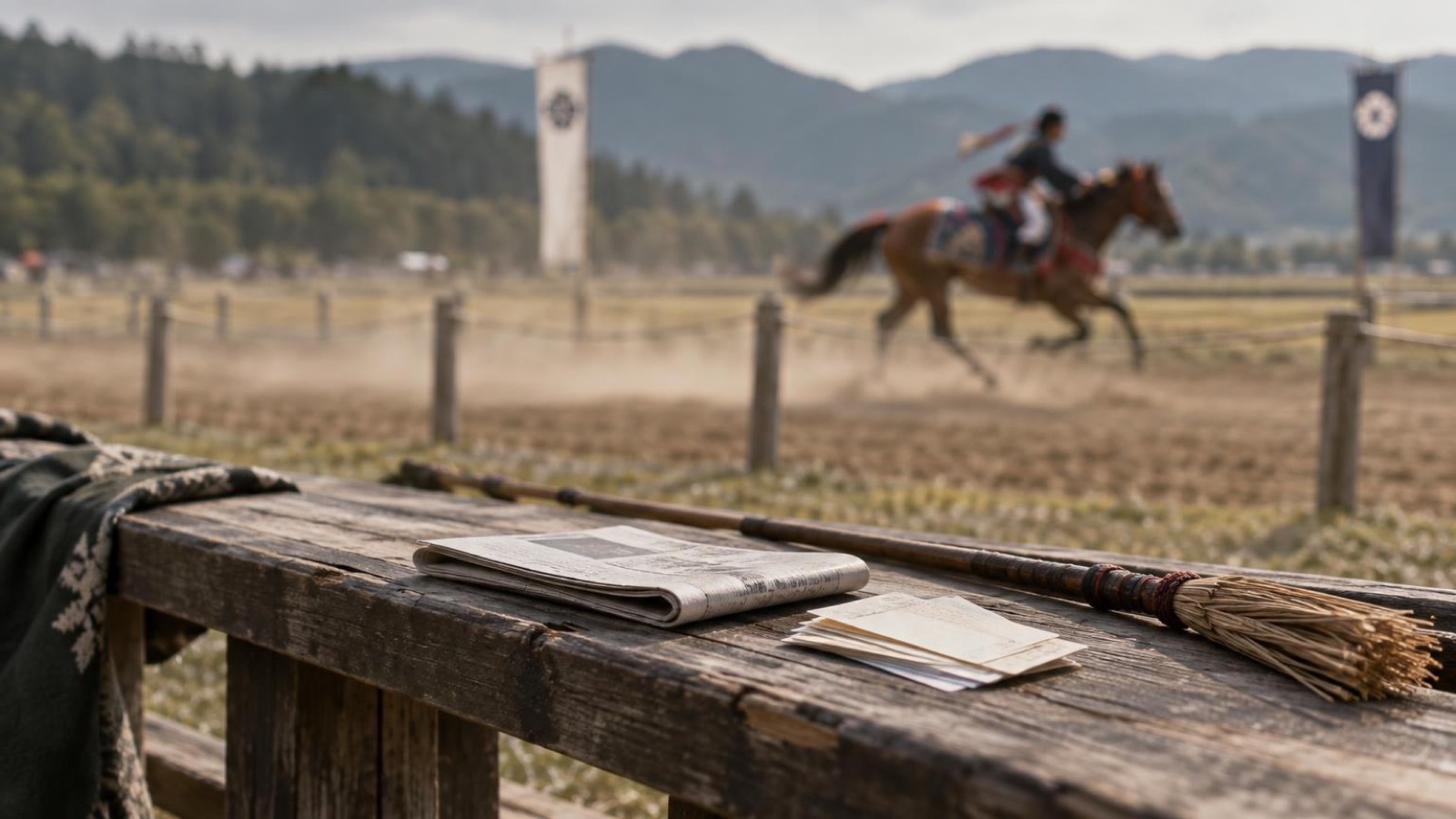
Saiten keiba is horse racing held as part of a shrine or temple festival. The word breaks down simply: saiten means a festival or ceremonial occasion, and keiba means horse racing. The racing is the point of the event, not a side attraction, and it is staged as an offering or a display rather than as a commercial product.
That distinction matters more than it sounds. At a modern racecourse, the race exists so that people can bet on it. At a shrine festival, the race exists because the ceremony calls for it. Nobody is selling you a ticket, nobody is quoting you odds, and there is no tote board. You stand at the edge of the course, often on a dirt or grass strip beside the shrine grounds, and you watch.
The horses are usually ridden hard and fast over a short straight, sometimes by riders in traditional dress. The crowd is local, the atmosphere is closer to a parade than a race meeting, and the whole thing may last a few minutes. If you have seen the armored horse race at a Japanese festival, you have seen the shape of it.
For a visitor, the practical takeaway is this: saiten keiba is something you attend, photograph and enjoy. It is not something you place a bet on. If you turn up expecting a betting window, you will not find one.
Religious roots: racing at Japanese shrines since 701
Racing at shrines in Japan goes back well over a thousand years, with records from the early eighth century. The form varied by region and by shrine, but the underlying idea was consistent: horses were raced as part of religious observance, often to mark a harvest, a purification or a dedication.
Over the centuries this produced a wide family of festival races across the country. Some were run by shrine priests, some by local horse breeders, and some by samurai households as a display of horsemanship. The common thread was that the racing belonged to the calendar of the shrine, not to a betting market.
That is why the tradition survived even in periods when gambling was tightly restricted. A ceremony is not a wager. When authorities cracked down on betting, they were not cracking down on a shrine racing its horses on festival day.
You can still see this today. Festival racing continues at shrines and local events around Japan, and it is generally free to attend. The horses, the riders and the crowd are the whole show.
If you are interested in how these traditions sit alongside Japan's other gambling history, our guide to gambling culture and history in Asia covers the wider picture, and the armored horse racing at Soma Nomaoi is a good example of a festival race that draws visitors from outside the region.
From shrine ritual to legal betting: the 1908 cabinet order
The turning point came with Japan's first cabinet order on horse racing, issued in Meiji 41, which corresponds to 1908. It was promulgated on November 16, 1908. That order permitted only two kinds of racing: government-approved race meetings run by race clubs, and festival racing1.
So festival racing was explicitly recognized. But the same order also banned the sale of betting tickets that had previously been tolerated under an earlier cabinet resolution, while encouraging race meetings to be held1. In other words, the government approved the racing and shut down the informal betting that had grown up around it.
That is the origin of the split you still see today. Ceremonial and festival racing continued as a cultural event. Betting on horse racing moved into a separate, regulated system, and it stayed there.
The modern framework took shape much later. The current Horse Racing Act dates from 1948, when the Japan Racing Society was abolished and racing was brought under government control5. The Act is formally cited as Act No. 158 of July 13, 19486.
The Act sets out why racing is permitted at all: to contribute to horse improvement and livestock promotion, and to improve local finances, with racing run properly and fairly by a neutral body7. That is the legal purpose behind the sport you can bet on today. It is a long way from a shrine ceremony, but the two share a lineage.
Where saiten keiba fits among Japan's legal gambling
Here is the clean version. Betting on horse racing in Japan would ordinarily be the crime of gambling, but the Horse Racing Act authorizes it as a special law. Betting by any method other than the ones that special law prescribes is still the crime of gambling2.
So the legal betting channels are specific. You can bet at a racecourse, at an authorized off-course betting facility, or through the official online and telephone services. You cannot bet on Japanese horse racing through an offshore website, and playing on offshore casino sites from inside Japan is illegal, with players having been prosecuted8.
For a visitor, the practical question is usually simpler: where do I go, and what do I need? The answer is a racecourse or an off-course betting shop. Japan has 25 racecourses in total, made up of 15 local government tracks and 10 JRA tracks4. The JRA also runs 38 off-course betting facilities called WINS5.
Local racing, sometimes called nariyo keiba, is sold on race days by delegation from prefectures or designated municipalities under the racing law9. In practice that means the local tracks and their betting shops operate on their own schedules, and the cards differ from the JRA's.
| Type of racing | Legal to bet? | Where | Minimum age |
|---|---|---|---|
| Saiten keiba (shrine festival) | No betting offered | Shrines and festival grounds | No age rule for spectators |
| JRA national racing | Yes | 10 racecourses, 38 WINS shops | 20 |
| Local government racing | Yes | 15 local tracks, off-course shops | 20 |
| Offshore betting sites | No | Online, from inside Japan | Not applicable |
If you want the full picture of what is and is not legal in the country, our Japan gambling guide sets it out country by country.
Horse racing today: 25 racecourses and graded races
Modern Japanese racing is a big, well-run sport. The JRA operates 10 racecourses, from Hokkaido in the north to Kyushu in the south10. Those 10 are Chukyo, Sapporo, Hakodate, Fukushima, Niigata, Tokyo, Nakayama, Kyoto, Hanshin and Kokura3.

A typical JRA race day has around 12 races10. That is a full afternoon or evening of racing, and it is the format most visitors picture when they think of Japanese horse racing.
The local tracks are a different experience. They are smaller, often more relaxed, and they run their own meetings with their own names. Tokyo City Keiba, for example, describes itself as the pioneer of night racing in Japan11. Night meetings are held at four racecourses in the country4, and they are the closest thing in modern Japan to the atmosphere of a festival race under lights.
Local tracks also put on special events. Oi Racecourse has hosted the Armored Horse Race, one of the events of Soma Nomaoi, on a Sunday in October11. That is a direct link between the festival tradition and the commercial track: the ceremony comes to the racecourse, and the crowd gets both.
Kochi Racecourse runs a night meeting under the name Yosakoi Nighter12. Kanazawa Racecourse publishes its own schedule of race days13. If you are planning around a specific track, check that track's schedule directly, because local meetings do not follow the JRA calendar.
One more practical note: local racing is available through official online services as well as on track. The official local racing site lists races on sale, including meetings at Mizusawa, Kochi and Saga on the same day14. Off-course betting on Kanazawa races is also available through Rakuten Keiba15.
Minimum age and betting rules for spectators
The age rule is the one thing every visitor needs to know before they go. You must be 20 to buy or cash a betting ticket in Japan. The Horse Racing Act states that persons under 20 must not purchase or receive winning horse betting tickets16. The JRA states the same rule plainly: you must be 20, and persons under 20 may not buy or cash betting tickets17.
This applies to everyone. Tokyo City Keiba states that betting is for anyone 20 years old and older18. It does not matter whether you are a Japanese citizen, a foreign resident or a visitor on a short trip. The age is the same.
Entering the racecourse is a separate matter from betting. You can go in as a spectator, watch the races, eat, and enjoy the atmosphere. What you cannot do is put money down or collect winnings. If you are traveling with someone under 20, plan for them to watch rather than bet.
Bring photo ID. Staff can ask for it, and if you are buying a ticket at a window or cashing one, you may be asked to show it. A passport is the simplest document for a visitor to carry.
A few other practical points for a first visit:
- Betting windows and machines are clearly marked, and staff will help you if you are unsure how to fill in a ticket.
- Minimum bets are small, so you can try a single race without spending much.
- Racecards are sold at the track, and local tracks publish their own cards. Hokkaido Keiba, for example, publishes racecards for two races in eight sports newspapers across the Kanto, Tokai and Kansai areas19.
- Night meetings run late. Tokyo City Keiba lists a 17:45 post time for its race day, the Tokyo Daishoten20.
- If you want to bet before you arrive, official online and telephone services are the legal route, not offshore sites14.
One last thing worth saying plainly, because it catches visitors out: the age rules in neighboring countries are not the same as Japan's. Hong Kong allows betting from 1821, and some other jurisdictions set their own limits. Do not assume that because you can bet at home at 18, you can bet in Japan at 18. In Japan, the number is 20.
If you are planning a trip around racing, the shrine festivals and the racecourses are two different days out. Go to a festival for the ceremony, and go to a track for the betting. Both are worth your time, and neither one is a substitute for the other.
Common Questions
Is betting allowed at shrine festival horse racing?
No. Saiten keiba is a religious and cultural ceremony, not a betting product. You watch it as a spectator. If you want to place a bet on horse racing in Japan, you do that at a racecourse or an authorized off-course betting shop, not at a shrine festival.
When did the Japanese government first approve betting on ceremonial horse racing?
The first cabinet order on horse racing, issued in Meiji 41, permitted only government-approved race meetings and festival racing. It also banned the sale of betting tickets that had previously been allowed informally, so approval of the racing did not mean approval of betting on it.
How old is horse racing in Japan?
Racing at shrines and festivals goes back well over a thousand years, with records from the early eighth century. The modern legal framework is much newer: the current Horse Racing Act dates from 1948, and the first cabinet order on racing came in Meiji 41.
Can visitors under 20 enter racecourses in Japan?
You can enter a racecourse as a spectator, but you cannot buy or cash a betting ticket if you are under 20. The same age applies to Japanese citizens, foreign residents and visitors. Bring photo ID, since staff may ask for it.
What is the difference between saiten keiba and modern JRA racing?
Saiten keiba is a shrine or festival ceremony, often with traditional costume and no betting. Modern JRA racing is a commercial sport run at 10 racecourses, with around 12 races a day and legal betting on every race.
Sources21 sources
- 競馬規程, Wikipedia
- Research paper on gambling and special laws, National Tax Agency
- Horse Racing Act, House of Representatives
- Local racing, Japan Racing Association
- Japan racing guidebook 2026, Japan Racing Association
- Horse racing law, Japan Racing Association
- Public racing policy document, National Police Agency
- Warning about online casinos, Consumer Affairs Agency
- 勝馬投票券に関する約款, JRA
- Go racing guide, Japan Racing Association
- TOKYO CITY KEIBA, Tokyo City Keiba
- Keiba Diary, Keiba.or.jp
- Beginner's guide to local racing, Sonoda-Himeji
- IPAT, Keiba.go.jp
- Kanazawa Keiba schedule, Kanazawa Keiba
- Horse Racing Act, e-Gov
- About Tokyo City Keiba, Tokyo City Keiba
- Nagoya Keiba betting, Nagoya Keiba
- JRA betting tickets, JRA
- Tokyo City Keiba schedule, Tokyo City Keiba
- Responsible gambling, Hong Kong Jockey Club















