
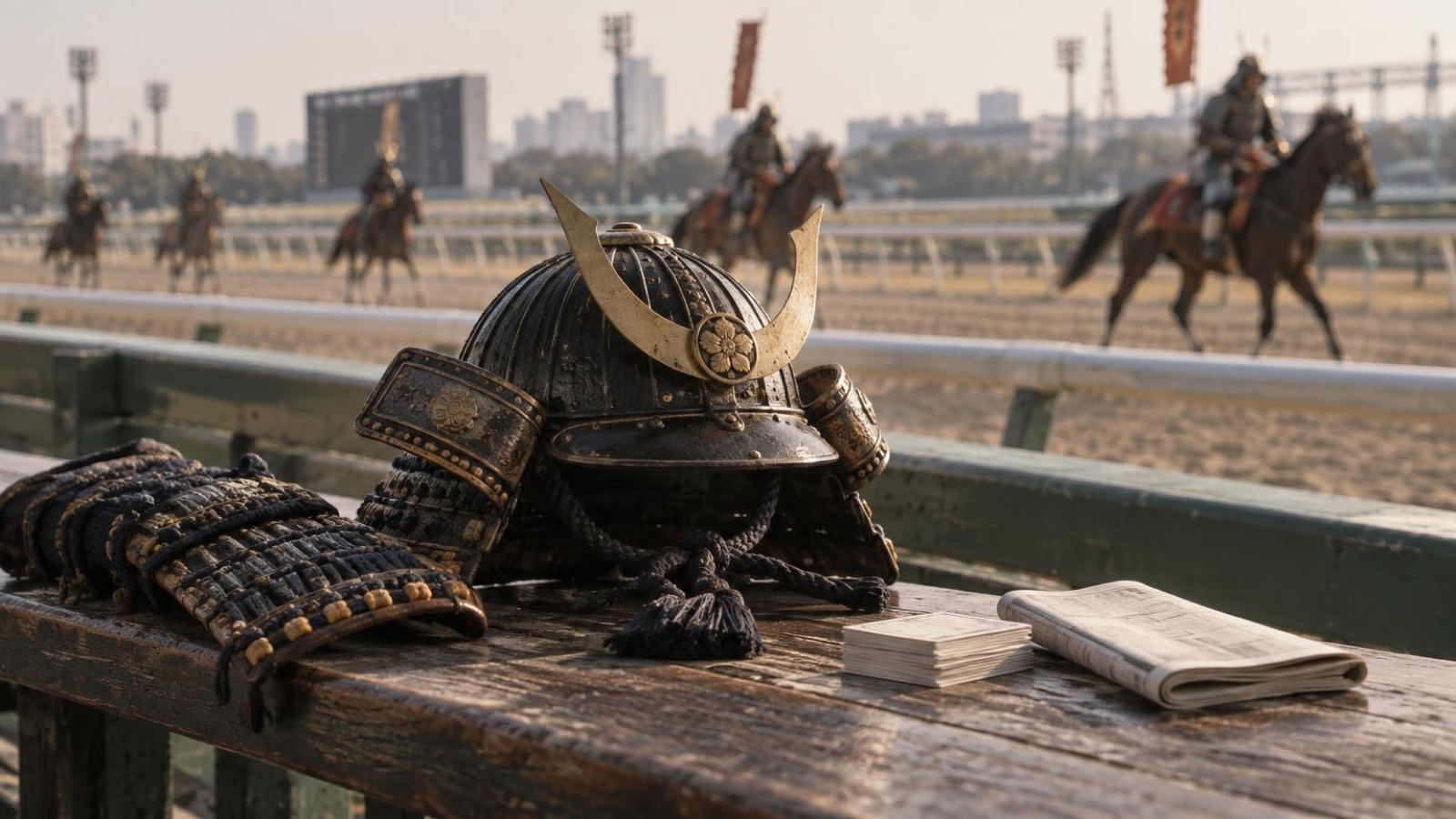
What Soma Nomaoi is
Soma Nomaoi is a traditional festival from the Soma region of Fukushima Prefecture, built around horsemanship, armor and shrine ritual. Its best-known element for visitors is the armored horse race, called Kacchu Keiba, in which riders in samurai armor ride in a formal, ceremonial style rather than a modern sporting one1.
The important thing to understand before you plan a trip is what kind of event this is. It is not a race meeting in the commercial sense. There is no tote board, no betting windows, no form guide and no pari-mutuel pool. It is a display of heritage: the point is the armor, the horses, the shrine connection and the continuity of a local tradition, not a result you can back.
That distinction matters because Japan does have a large, legal, heavily regulated horse racing industry, and it is easy to assume a famous horse event must be part of it. It is not. The two things share horses and a love of horsemanship and almost nothing else.
A racing tradition with roots going back over 1,300 years
Soma Nomaoi is usually described as having roots going back well over a thousand years, which puts it in a different category from anything you would call a sport in the modern sense. It belongs to the same family of events as shrine festivals and local horse traditions that predate organized, commercial racing by centuries.
For context on how young commercial racing is by comparison, consider the region:
- Horse racing in Macao has a history of more than 40 years, and its appeal to local residents and tourists has declined in recent years4.
- In the Philippines, betting was introduced in 1903, which is what extended the sport's mass appeal there5.
- Macau's jockey club drew its horses from Australia, New Zealand, the United Kingdom, Ireland, France, the United States and Japan6.
- Boat racing in Japan, a completely separate sport, has over 70 years of history7.
Set against those numbers, a festival tradition running for more than 1,300 years is not a sporting event with a long history. It is a piece of living heritage that happens to involve horses running.
Where and when the festival takes place
Soma Nomaoi belongs to the Soma area of Fukushima Prefecture and is held annually. If you are planning around it, treat it as a regional festival with a fixed seasonal slot rather than a race meeting with a published card.
The festival also travels in part. In 2026, Oi Racecourse in Tokyo hosted the Armored Horse Race, one of the events of Soma Nomaoi, on Sunday, October 41. That is a useful option if you are based in Tokyo and cannot get to Fukushima: you get the armored race itself, staged at a racecourse, without the full festival around it.
If you are going to a racecourse for any reason, it helps to know how Japanese racecourses work as venues. There are 25 racecourses in Japan in total, 15 operated by local governments and 10 run by the Japan Racing Association2. Night races are conducted at four racecourses in Japan2. So a racecourse hosting a festival event is a normal, working venue, not a special-purpose arena.
What visitors will see at the armored horse races
The armored horse race is the centerpiece for most visitors. Riders in samurai armor, horses moving in formation or in a formal race, and a strong sense of ceremony rather than competition. The name Kacchu Keiba refers directly to the armor1.
What you will not see is the apparatus of betting. No odds, no tickets, no results board tied to payouts. If you have been to a Japanese racecourse before, the contrast will be obvious: at a racecourse, the whole venue is organized around the betting product, from the paddock parade to the monitors to the ticket windows.
At a racecourse, for example, special viewing seats come with dedicated monitors on the tables and overlook the whole course, giving a close view of the gate start at the 1400m starting point and of the horses from the final straight to the goal8. That is a venue built for following a race you have a stake in. Soma Nomaoi is built for watching a tradition.
How it fits into Japan's wider horse racing history
Japan's legal racing world is a separate universe, and it is worth knowing its shape so you do not confuse the two.
The Japan Racing Association is a public enterprise established by the national government under the oversight of the Ministry of Agriculture, Forestry and Fisheries9. Under Japanese law, all authorized racing must be conducted by the JRA and local government entities, and all wagers must be pari-mutuel9. Only the Japan Racing Association and prefectures or designated municipalities may hold horse races2. National racing is run at 10 licensed venues: Chukyo, Sapporo, Hakodate, Fukushima, Niigata, Tokyo, Nakayama, Kyoto, Hanshin and Kokura2.
The current legal framework dates to 1948, when a new Horse racing Law was introduced, abolishing the Japan Racing Society and placing the sport under government control9. Prize money for national racing runs from JPY 500,000 or more up to JPY 50,000,000 or less per race2.
Local racing, run by prefectures and municipalities, has its own character. It includes series such as Grandame-Japan, a series of races for fillies and mares in which the most outstanding from each age group compete over a period of time9. Local racecourses put on their own feature cards: Nagoya Racecourse, for instance, ran the 26th Umezuki Sho, a 1500 m race for Thoroughbreds aged four and up10. Hokkaido Keiba marked its 70th anniversary in 2018, the same year as the 150th anniversary of the naming of Hokkaido11.
None of this is Soma Nomaoi. It is the industry that grew up alongside a much older festival culture, and the two coexist without overlapping.
Spectator or participant: what to expect on the ground
If you go to the festival itself, expect a public, outdoor, community event. Dress for weather, expect crowds, and expect the schedule to be about ceremony rather than a published race card.
If you go to a racecourse to see the Armored Horse Race, you are at a working venue with its own rules. At Nagoya Racecourse, groups of 15 or more people must consult the racecourse in advance to occupy seating or viewing areas3. The same venue bans a long list of behaviors3:
- Throwing objects onto the course or paddock
- Throwing or dropping items
- Picking up betting tickets
- Standing on stepladders to watch
- Sitting or lying on floors and stairs (allowed on the lawn)
- Bringing outdoor chairs or mats
- Making noise or shouting
- Harassing horses and staff
- Displaying banners without permission
- Damaging or defacing property
- Feeding wildlife
- Smoking outside designated areas including e-cigarettes
- Reselling or using resold admission and seat tickets
- Entering restricted areas
- Unauthorized selling, advertising or leafleting
The minimum age to buy betting tickets, or to hand tickets to someone else, at Nagoya Racecourse is 203. That rule applies to betting, not to watching, but it tells you the general tone of Japanese racecourses: orderly, family-friendly and strictly regulated.
Practical details if you are combining a racecourse visit with your trip. Sonoda Racecourse runs four free buses a day from JR Amagasaki Station to the racecourse, with the first departure at 10:0512. Admission at Sonoda is 100 yen13. The racecourse sits near Osaka (Itami) Airport, with passenger planes taking off and landing very close by13. Sonoda is owned by the Hyogo Prefecture Racing Association14, and its feature races include staying contests such as the 22nd Hyogo Queen Cup over 1870 m for fillies and mares aged three and up14.
If you want to understand how betting actually works at a Japanese racecourse, the mechanics are worth knowing even if you never place a bet. Formation betting, for example, is a method where you select one or more horses for each finishing position and buy all possible combinations15. At boat race venues, an exhibition run lets spectators see the condition of the boats and motors and use it as a reference for predictions16. That is the culture of Japanese public racing: transparent, documented and built around the punter.
Soma Nomaoi sits outside all of it. Go for the armor, the horses and the ritual. If you want a bet, go to a racecourse, where the rules are clear and the minimum age is 20.
Common Questions
Is Soma Nomaoi the same as regular horse racing at Japan's racecourses?
No. Soma Nomaoi is a traditional festival event with ceremonial races and displays. Regular Japanese horse racing is run by the Japan Racing Association and by local government bodies at licensed racecourses, under a separate legal framework, and it is the only horse racing you can legally bet on.
Can visitors bet on the races at Soma Nomaoi?
No. There is no betting at Soma Nomaoi. It is a cultural and religious festival, not a wagering event. If you want to bet on horses in Japan, you do that at a licensed racecourse, not at a shrine festival.
How old is horse racing in Japan?
Horse racing in Japan has a very long history, and the modern legal framework dates to 1948, when a new Horse racing Law placed the sport under government control. Today authorized racing is conducted by the Japan Racing Association and by local government entities.
Is the festival held every year?
Soma Nomaoi is an annual tradition in the Soma region of Fukushima Prefecture. Individual elements of it also travel: in 2026, Oi Racecourse in Tokyo hosted the Armored Horse Race as one of the festival's events, on Sunday, October 4.
Do the riders really wear samurai armor?
Yes. The armored horse race, known as Kacchu Keiba, is named for the armor the riders wear. It is a reenactment-style display rooted in the region's samurai heritage rather than a modern sporting competition.
Is there an entry fee for spectators?
Festival viewing in Soma is generally a public event rather than a ticketed racecourse product. If you watch the Armored Horse Race at a racecourse such as Oi, normal racecourse arrangements apply, and admission at Japanese racecourses is typically inexpensive.
Sources16 sources
- Tokyo City Keiba, Tokyo City Keiba, 2026
- Local Racing, Japan Racing Association, 2026
- Nagoya Racecourse visitor rules, Nagoya Racecourse, 2026
- Macao horse racing concession news, Macao SAR Government, January 15, 2024
- Philippines racing profile, Asian Racing Federation, 2016
- Macau Jockey Club race information, Macau Jockey Club, 2017
- Boat Race official English site, Boat Race, 2026
- Nagoya Racecourse facility information, Nagoya Racecourse, 2026
- Japan Racing Guidebook 2026, Japan Racing Association, 2026
- Heavy prize race schedule, January 2025, Keiba.go.jp, 2025
- Hokkaido Keiba business report 2018, Hokkaido Keiba, 2018
- Sonoda Racecourse access, Sonoda Racecourse, 2026
- Sonoda Racecourse schedule, Sonoda Racecourse, 2026
- Heavy prize race schedule, October 2025, Keiba.go.jp, 2025
- Sonoda Racecourse beginner betting guide, Sonoda Racecourse, 2026
- Boat Race beginner guide, Boat Race, 2026















