
What Tien Len is and where it came from
Tien Len, often written Tiến lên, means "advance forward." It is a shedding game in the same family as Big Two, Dou Dizhu and Guandan: everyone races to get rid of their cards first, and the last player holding cards loses. In Vietnam it is the default card game, played at family gatherings, in cafes and during Tet, usually for tiny stakes or none at all.
The deck is the standard 52 cards, dealt out among the players. The ranking runs from 3 (lowest) up to 2 (highest), and suits break ties in the usual order. The first lead is normally the 3 of spades, though in the Binh Tri Thien provinces around Hue the 3 of clubs is played first instead1. That single local difference trips up a lot of visitors who learned the game elsewhere.
The southern version, Tien Len mien Nam, is the one most people mean when they say "Tien Len rules." It allows a run of three or more consecutive pairs, a combination that does not exist in the northern game1. If you sit down at a table in Ho Chi Minh City, expect that rule to be in play.
Vietnam has other card games with similar mechanics, and if you enjoy Tien Len it is worth knowing how they compare. Our guide to Asia's climbing card games puts Big Two, Tien Len, Dou Dizhu and Guandan side by side. There is also a nine-point family of Vietnamese card games, including Xì Dách, where lower points win ties, a rule unique to Vietnam6. You can read about those in nine-point card games.
Tien Len as a home game
Tien Len is a card game played in Vietnamese homes, where it is often played in its traditional form with flexible rules1. That matters if you are trying to place the game culturally: it sits alongside other home card games rather than the folk games tied to festivals.
Because it is cheap to play and needs nothing but a deck, it moved easily between the north and south and picked up regional variants along the way. The southern rules became the most widely known, partly because they are the most permissive and the most fun to play with a big group.
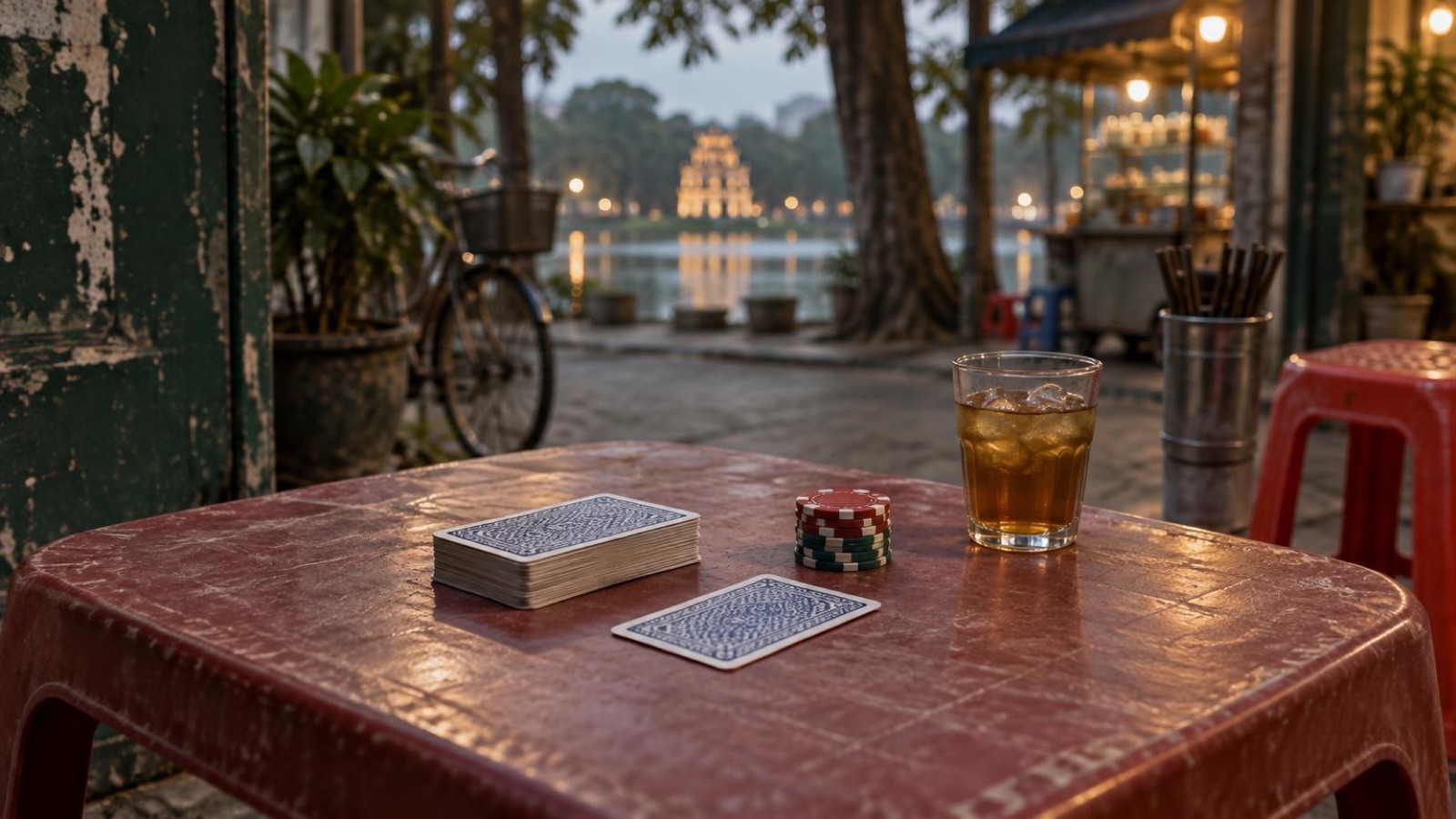
Today you will see it played in homes, on plastic stools outside shops, and in the back rooms of cafes. None of that is licensed gambling. It is a social game, and the money on the table, when there is any, is usually small.
Is playing Tien Len for money legal in Vietnam?
This is the part visitors and new residents most often get wrong. Legal cash play in Vietnam is found exclusively in licensed casinos2. Home games and unlicensed games are illegal, and traditional cash games are strictly prohibited in city clubs2. So a friendly Tien Len session in your apartment with cash on the table sits on the wrong side of the line, however small the stakes.
Vietnam prohibits most forms of gambling, with limited exceptions such as state-run lotteries and licensed casinos for eligible patrons7. That is the whole shape of it: a narrow set of legal options, and everything else outside them.
In practice, the risk for a casual home game is low, and Tien Len for bragging rights is obviously fine. But if you are organizing a regular game with real money, or playing in a club that takes a cut, you are in the territory that gets shut down. The practical answer is simple: keep Tien Len as a social game, and if you want to gamble legally, do it in a licensed venue.
Rules for locals: pilot casinos, age and income conditions
Vietnamese citizens are allowed to gamble only at pilot-scheme casinos, and only if they meet age and income conditions4. The pilot currently covers the Phu Quoc project and the Van Don project in Quang Ninh Province, the latter running for five years from the date a certificate of eligibility for casino business operations is issued8.
To enter under the pilot, a Vietnamese citizen must be 21 or older with full civil capacity5. They must also meet minimum income conditions, buy an entry ticket under each casino's own rules, and not be subject to a family-requested exclusion order4. That last condition is unusual and worth spelling out: a relative can ask for someone to be barred from the casino, and the casino has to enforce it.
Once inside, Vietnamese players may not use the results of casino games to bet directly with each other, and may not cause insecurity, disorder or social safety problems on the premises9. In other words, the casino floor is for playing the house, not for running your own side action.
For everyone else, the position is unchanged: gambling is illegal for Vietnamese citizens outside those designated pilot venues3. If you are a Vietnamese citizen and a casino is not one of the pilot projects, you will not be admitted, whatever you are willing to pay at the door.
Rules for foreigners: what casinos require at the door
Foreign passport holders have a much wider set of options. Vietnam has 9 licensed land-based casinos plus approximately 60 electronic gaming clubs3, and the licensed casinos are open to foreign visitors. The legal casino gambling age for foreign visitors is 184.

At the door, expect an ID check. Casinos admit foreign passport holders only, and staff may ask to see your passport and visa10. This is not a formality you can talk your way around; without the passport, you are not getting in. Some border properties apply the neighboring country's gambling regulations as well, so the paperwork check can be stricter than you expect11.
The practical checklist for a first visit:
- Bring your passport, and your visa if you are not visa-exempt.
- Be 18 or older as a foreign visitor.
- Expect a security check and a bag scan at the entrance.
- If you carry more than USD 5,000 or the equivalent, or more than VND 15 million, declare it to customs when you enter or leave Vietnam12.
- Check the specific venue's hours before you travel; some operate around the clock, others do not10.
Electronic gaming clubs are the other legal option, and they are a different experience from a full casino floor. They run slot-style and electronic table games rather than live dealer tables13. If you want a live table game, you want one of the licensed casinos.
If you are comparing Vietnam with the rest of the region, our country guides cover what is legal where, and the Asian games hub explains the games themselves, from mahjong to fan-tan to sabong.
Online gambling: blocked sites and legal risks
Online gambling is not regulated in Vietnam, and locals are not allowed to gamble online4. Many gambling sites have been blocked at the ISP level since 20183, so a site that loads on your home connection may simply fail on a Vietnamese one.
Online poker sits in a legal gray area rather than being clearly legal or clearly banned2. That is not the same as being allowed. If you are a visitor or an expat playing on an offshore site, you are doing something the authorities have shown they will act on: Ho Chi Minh City police have broken up online football betting rings7.
The practical points:
- Many gambling sites are blocked at the network level in Vietnam3.
- Online gambling is not regulated, and locals are not permitted to gamble online4.
- Online poker is a gray area, not a licensed activity2.
- Offshore sites do not become legal because they are registered abroad; the location of the player is what matters.
If you want to play Tien Len online, play it for free. There are plenty of apps and sites that run the game with no money involved, and that keeps you clear of the whole question. If you want to gamble, do it in a licensed venue with your passport in your pocket.
Common Questions
What is the minimum age to enter a casino in Vietnam?
Foreign visitors can generally enter a licensed Vietnamese casino at 18. Vietnamese citizens playing under the pilot scheme must be 21 or older and have full civil capacity. Casinos check ID at the door, so bring your passport.
Can Vietnamese citizens gamble in Vietnamese casinos?
Only at the pilot-scheme casinos, currently Phu Quoc and Van Don in Quang Ninh Province. They must be 21 or older, meet an income threshold, buy an entry ticket, and not be on a family-requested exclusion list. Everywhere else, Vietnamese citizens are not admitted.
How many licensed casinos are there in Vietnam?
Vietnam has 9 licensed land-based casinos, plus roughly 60 electronic gaming clubs. Only the pilot venues admit eligible Vietnamese citizens; the rest are for foreign passport holders.
Do foreigners need to show a passport to enter a Vietnamese casino?
Yes. Casinos admit foreign passport holders only, and staff may ask to see your passport and visa. Some border casinos, such as Ha Tien Vegas, apply the neighboring country's gambling rules as well.
Are online gambling sites blocked in Vietnam?
Many are. Vietnamese ISPs have blocked gambling sites at the network level since 2018, and online gambling is not regulated for locals. Online poker sits in a legal gray area rather than being clearly permitted.
How much foreign currency must be declared when entering Vietnam?
If you carry more than USD 5,000 or the equivalent, or more than VND 15 million, you must declare it to customs on arrival or departure. This applies to all travelers, including visitors and residents.
Sources13 sources
- Bài Tiến lên, Wikipedia
- Viet Nam poker guide, So Much Poker
- Gambling in Vietnam, Casino Corona
- Best online casinos for players from Vietnam, Wizard of Odds
- Từ 26/11/2025, mở các địa điểm casino hợp pháp cho phép người Việt Nam đủ điều kiện vào chơi, Thu Vien Phap Luat
- Xi Dach history, Xoviet Poker
- HCMC police bust online football betting rings worth over $132m, Vietnam News
- Vietnamese citizens are allowed to play in casinos at certain projects, Vietnam News
- Casino Hồ Tràm có cho người Việt Nam vào chơi không?, Thu Vien Phap Luat
- Casino Ha Tien Vegas 24/7, Ha Tien Vegas
- Master E-Roulette at Ha Tien Vegas, Ha Tien Vegas
- Casino regulations, Hoiana
- Electronic games, Ha Tien Vegas















