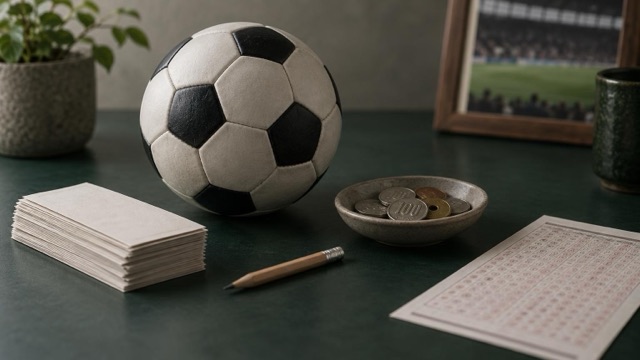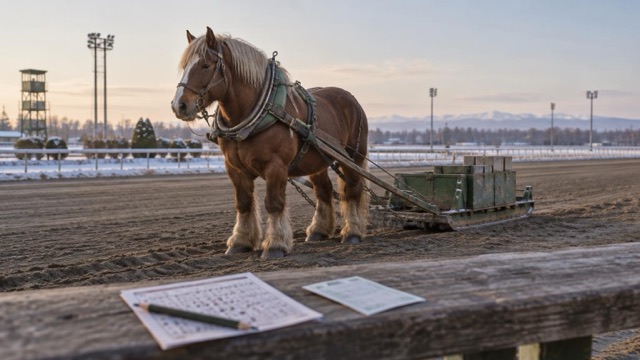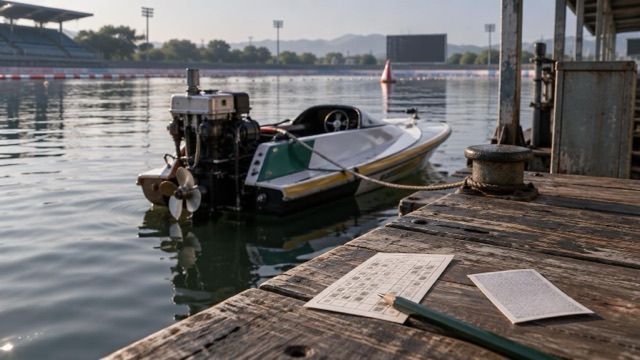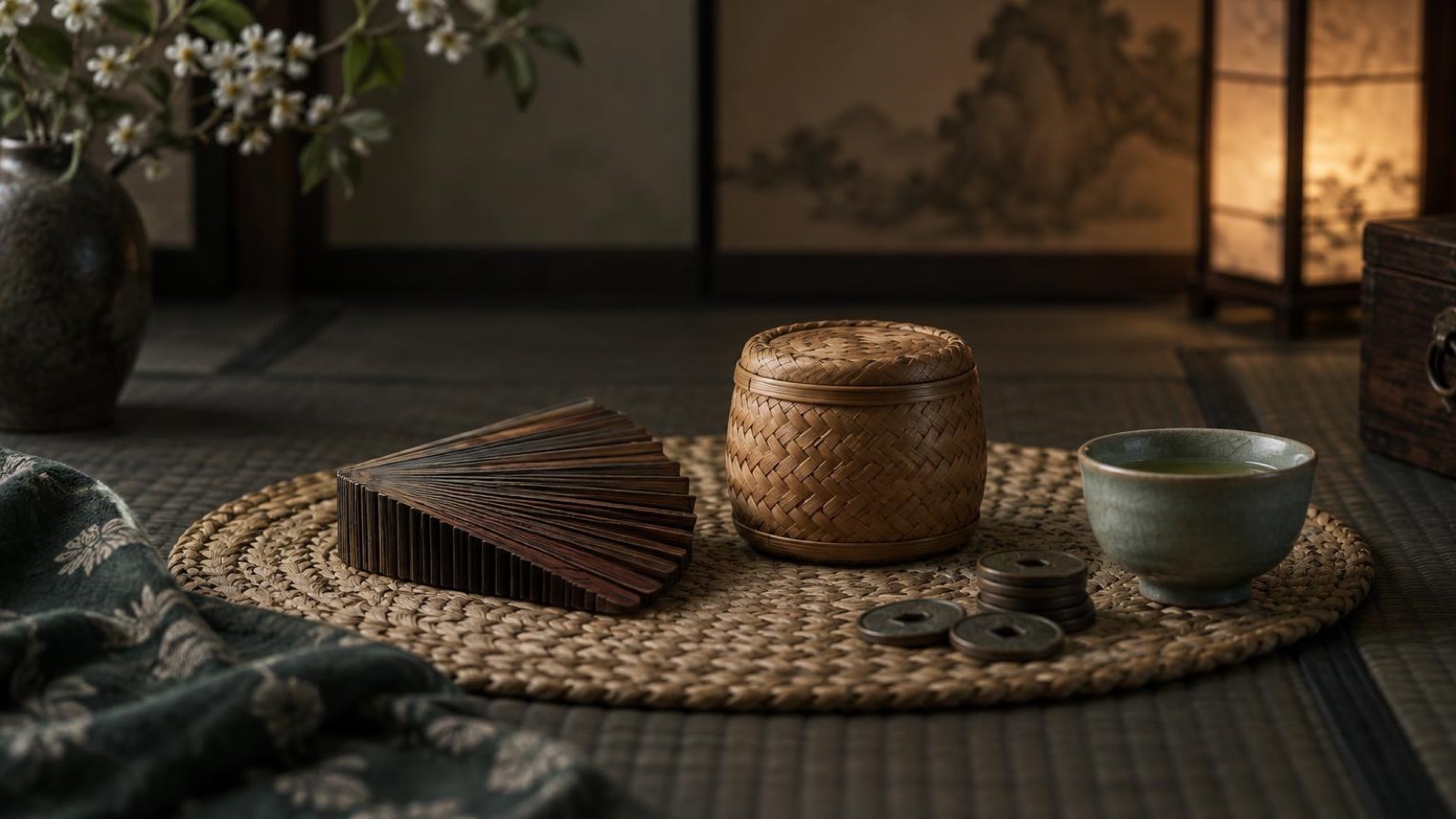
Japan is one of the world's most interesting gambling paradoxes. On paper, the Penal Code prohibits almost all private wagering, and playing at an unlicensed casino, online or off, is a crime. Yet walk down any street in a Japanese city and you will pass pachinko parlors glowing with neon, betting shops for horse races, and convenience stores selling lottery tickets. The story of how this came to be is really the story of modern Japan itself: a country that decided gambling was harmful, then carved out exceptions whenever the state, or everyday culture, wanted them.
Why most gambling is prohibited in Japan
The starting point is simple: gambling is prohibited under the Penal Code, on the grounds that it worsens public order3. The prohibition is broad. Courts have found that even games of pure skill, such as betting on matches of Igo or Shogi, Japanese chess, fall within the ban4. Wagering for money has been strictly and unambiguously illegal since 1908 legislation1.
But the ban has never been absolute. Japanese law treats gambling as illegal in principle while allowing certain legal forms, justified either as everyday entertainment or as a way to return proceeds to social welfare5. The pattern repeats throughout Japanese history: the state prohibits gambling, then reopens it when it needs money or when a pastime is too embedded in daily life to suppress.
That is exactly what happened after the Second World War. Gambling was completely prohibited and severely punished during the wartime austerity1, but once the war ended, public gambling was started to secure funding for national and local governments, with postwar reconstruction as the stated reason3. A measure introduced in 1948 that became law before the end of the year created state-supervised gambling on horse and bicycle races6. The legal framework that exists today, five legal forms of gambling consisting of horse racing, auto racing, boat racing, velodrome cycling and the lottery, was built in that period7.
The 1908 prohibition itself was a reaction to excess. It followed a public and media outcry against the betting frenzy and the overt involvement of bakuchiuchi, professional gamblers1. An earlier crackdown law was nicknamed Ōgarikomi, "the great roundup," and was feared because it made people prisoners merely for being gamblers8. This tension between moral disapproval and practical tolerance has defined Japanese gambling culture ever since.
Games with deep roots: hanafuda, pachinko and public lotteries
Gambling in Japan is far older than any modern law. The earliest recorded game took place on September 18, 685, when Emperor Tenmu invited high-ranking aristocrats to play hakugi, a dice game of Chinese origin, awarding them clothes as winnings1. Dice remained central to Japanese gambling for over a thousand years, most famously in chō-han, which you can read about in our guide to traditional Japanese gambling games.
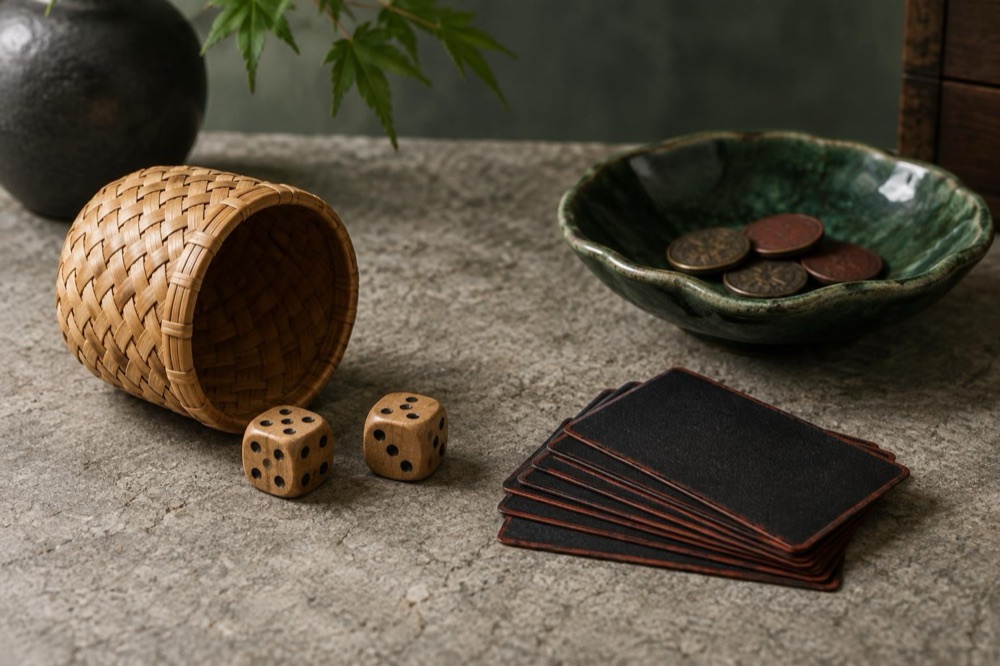
Card games arrived later and took on distinctly Japanese forms:
| Game | Deck or equipment | How it is played |
|---|---|---|
| Koi-Koi | Hanafuda "flower cards" | Players capture cards from a field and try to complete scoring combinations9 |
| Kachikachi | Kabufuda numerical cards | Players try to get a hand close to nine10 |
| Chō-han | Two dice and a bamboo cup | Players bet on even (chō) or odd (han)11 |
These games are still played at home for fun, and their gambling heritage survives in the scoring and the stakes structure.
Public lotteries have an equally long pedigree. Today's lotteries are issued under the Act on Public Lottery Tickets, enacted in 194812, and remain hugely popular despite taking a cut of more than 50 percent of the stakes13. One researcher asked exactly the question every player eventually asks: why do people gamble when the take is over half? The answer, in Japanese culture, has less to do with expected value than with the ritual, the dream and the occasion. You can find the current games and prizes in our guide to the Japan lottery.
The sports lottery sits between the lottery and sports betting. Games such as toto, BIG, WINNER and DUNK, operated under the Sports Promotion Voting Act, direct their revenue to developing regional sports facilities, holding sports classes and competitions, and discovering and developing future top athletes14. See our pages on toto soccer pools and BIG and MEGA BIG for how they work.
Pachinko, the third pillar, grew from a children's toy into the country's most ubiquitous and lucrative form of gambling-like play. It is not officially classified as gambling-for-money1, a distinction that matters enormously, as we will see below. Its history and mechanics are covered in detail in our pachinko guide.
Betting on horses, boats and bicycles: the public sports exceptions
The four public sports, known collectively as kōei kyōgi, are the clearest example of Japan's exception-based approach. Public racing sports are prohibited by law in principle but permitted as an exception on the premise of social contribution15. Each is organized by government agencies or municipal bodies, and the proceeds fund public services.
| Public sport | What you watch | Where it is run |
|---|---|---|
| Horse racing | Thoroughbreds at racecourses such as Tokyo and Nakayama | Government and racing associations16 |
| Boat racing (kyōtei) | Six boats racing around a water course | Municipal bodies across the country17 |
| Keirin | Bicycle racing at steeply banked velodromes | Local governments, since 19486 |
| Auto race | Motorcycle racing on paved ovals | Municipal bodies7 |
Horse racing came first. The first official betting ticket was introduced by the Nihon Racing Club in 1888, at the cost of one dollar per ticket, roughly half the monthly salary of a college graduate at the time1. The government granted unofficial permission to sell betting tickets in 19041, then banned them again in 1908 amid the public backlash1. Legal betting returned with the postwar reforms, and telephone betting arrived in 19761. Today betting on horse racing would normally constitute the crime of gambling, but it is authorized by the Horse Racing Act as a special law; bet by any method outside that law and you are committing a crime16. Our guides cover horse racing in Japan, the bet types and betting online.
Boat racing, or kyōtei, is officially described as publicly managed sports betting17, with six boats racing around a course and bettors picking finishers. Boat racing venues sit in cities across the country, and the sport has a devoted following. Keirin, bicycle racing at steeply banked velodromes, was created in 1948 explicitly to raise local funds, and auto race, motorcycle racing on paved ovals, completes the set. Online wagering is only allowed on these four sports when operated and self-regulated by the Japanese government or municipal bodies18.
The public sports also lead the way on player protection. Racecourses and off-course betting shops operate an entry restriction system based on self-declaration or family declaration, so a gambler or their family can ask to be barred19. All other sports betting is strictly forbidden20, which is why Japan has no legal betting on baseball, soccer leagues or any professional sport beyond the toto pools.
Pachinko parlors: the three-store system
Pachinko is where Japan's legal creativity is most visible. The game itself is a mechanical ball game resembling pinball, played with small steel balls that you rent from the parlor21. You feed balls into a vertical machine, aim them with a spring-loaded lever, and hope they land in winning holes that trigger a payout of more balls. Modern variations include hanemono, deji-pachi, kenrimono and pachi-suro, a slot machine using tokens exchanged for prizes1. Pachislot has its own culture, covered in our pachislot guide.
The legal trick is in how you get paid. Balls you win are traded in for prizes, or sometimes illegal cash, at the parlor22. Under the system known as santen hoshiki, the "three-store method," you take your prize, for example two mechanical pencils, to a separate kiosk outside the parlor, where a woman opens the window, takes your pencils and hands you cash. One visiting player received 5,000 yen for two mechanical pencils this way23. The system developed to circumvent legislation prohibiting direct cash payouts1, and pachinko is allowed to operate through these transaction workarounds and a cultural carve-out18. Because the parlor itself never hands you money, the whole activity is categorized as gaming rather than gambling2.
The scale is extraordinary. At its peak, Japan's 16,000 plus pachinko parlors took in an astonishing 30 trillion yen, nearly 300 billion dollars, in bets1. A 1994 police survey found that North Koreans controlled 30 percent of pachinko parlors1, a legacy of the ethnic-Korean community's historical role in the industry. Parlors range from huge chains like Maruhan, whose Kanuma location offers a 4-yen pachinko corner and a 1-yen pachinko corner alongside standard 320-ball rental rates24, to small local halls. Inside, the atmosphere is intense: the gaming hall is fairly smoky and the sound of excitement is in the air22. Note that online pachinko, by contrast, is illegal25.
If you want to try it, our guides to pachinko parlors in Japan and specific chains like Maruhan cover what to expect on your first visit.
Gambling in folklore, festivals and popular media
Gambling runs deep in Japanese storytelling. The professional gamblers of the Edo period, the bakuto, ran games with a strict hierarchy: ranks were ordered as sanshita, dekata, daigashira and kashimoto, an apprenticeship ladder from lowest runner to the boss who banked the game11. These figures became stock characters in samurai films and yakuza movies, romanticized as outlaws with their own code of honor.
Chō-han is the game most often shown on screen. Two dice are shaken in a bowl-sized bamboo basket called a tsubo, and players shout bets on chō (even) or han (odd)11. The form in which gamblers gathered customers at gambling dens was established from the mid to late Edo period11. The language of the game entered everyday Japanese:
- Opening a gambling den is customarily called "spreading the bon," because chō-han was played on a bon mat spread on the floor of the den11
- A small den was called a tekka-ba and a big match was called a tobaku11
- The house cut had a name too: a 10 percent tera fee went into the pot when certain rolls appeared, and this was the underling's income11
Other traditional games carry their own lore. Tabu, a full-fledged form of gambling thought to have been born in Kyushu, differs from friendly dice games like chinchirorin because yakuza are usually involved in opening the den or participate as players26. Riichi mahjong remains a passion; see our riichi mahjong guide.
In popular media, gambling stories are a whole genre, from the Lupin the Third franchise, which even has pachinko machines themed on it with 3-coin bets27, to manga and films about mahjong hustlers and horse-racing dreamers. The culture treats gambling as both vice and spectacle, which is precisely how the law treats it too.
Casinos and integrated resorts: what exists today
For most of the modern era there were no casinos in Japan at all. Proposals for their introduction were hotly debated from 2001 onward, led by Tokyo Governor Shintaro Ishihara, but the 1908 law prohibiting gambling was the main obstacle1. That changed in December 2016, when the legalization of casinos paved the way for tremendous business opportunities28, and legislators passed a law that legalizes casino gambling in the country29.
The catch is that land-based casino gambling was legalized only in very specific circumstances: inside Integrated Resorts, which must combine casino operations with hotels, conference and exhibition facilities, entertainment venues and other tourist infrastructure30. The law allows the establishment of casinos in up to three locations2. Nine games will be permitted inside Japan's casinos, including table games and the money wheel31, though specific restrictions may limit players or play time on some games31.
As of now, there are no casinos yet7. The flagship project is MGM Osaka, and our casinos in Japan page tracks the timeline. Online, there are no licensed and regulated online casinos inside Japan18, and online gambling remains very much illegal7; see our online gambling in Japan guide for the details.
What visitors should know before they play
If you are visiting Japan, the practical picture is straightforward. You can legally play pachinko, buy lottery tickets, and bet on the four public sports at racecourses, betting shops or official online platforms. You cannot legally play at private casinos or online casinos, and connecting to online casinos from Japan and gambling there is a crime, with police instructed to thoroughly enforce against operators including payment agents and affiliates19. Poker is a special case: cash prizes for tournament winners are not legally possible, so events like the Japan Open Poker Tour operate under restrictions33.
One point of law surprises many Japanese travelers: gambling at casinos abroad, in a country where it is legal, is not punishable under Japanese law, since the acts occur entirely abroad and no Japanese legal interest is harmed32. Our page on gambling trips abroad from Japan covers this.
When the integrated resorts open, the rules will differ by who you are:
| Who | Entry to the casino |
|---|---|
| Foreign visitors | Free of charge2 |
| Japanese nationals and foreign residents | Entry limits, an entry fee levy, and restrictions on operator lending; up to three visits per week and 10 per month, counted via My Number identity cards with IC chips2 |
Buying lotteries sold overseas while in Japan is prohibited and punishable as a crime35.
For everyday play, the culture is your best guide. Pachinko parlors welcome walk-ins, racecourses are family-friendly outings with restaurants and lawns, and lottery tickets are sold at convenience stores with seasonal lines forming for the big year-end draws. If gambling stops being fun, support exists, including services listed in our gambling help in Japan page. And if you want the full practical rundown on what you can play as a visitor, see gambling in Japan as a visitor.
Common Questions
Is gambling illegal for tourists in Japan?
Yes, mostly. Tourists face the same rules as locals: private gambling is prohibited, but you can legally bet on horse, boat, bicycle and auto races, buy lottery tickets, and play pachinko. When integrated resorts open, foreign visitors will enter casinos free of charge.
What is the Japanese word for gambling?
The everyday word is toba or kakegō, written 賭博 or ギャンブル. The legal term in the Penal Code is tobaku (賭博), and the crime of gambling is called tobaku-zai. Bakuto refers to professional gamblers from the Edo period.
Why is pachinko legal if gambling is banned?
Pachinko is officially categorized as gaming rather than gambling. You rent steel balls, win more balls, and exchange them for prizes inside the parlor. A separate shop outside then buys those prizes for cash, a workaround known as the three-store system.
Can Japanese people play the lottery?
Yes. Public lotteries issued under the 1948 Act on Public Lottery Tickets are legal nationwide, and online lottery purchases from government bodies are permitted. Buying overseas lotteries while in Japan, however, is a crime.
What traditional Japanese card games involve gambling?
Hanafuda games such as Koi-Koi, kabufuda games such as Kachikachi, and the dice game chō-han all have gambling roots going back centuries. Mahjong, imported from China, also became a popular gambling game in Japan.
Are there casinos in Japan?
Not yet. A 2016 law legalized casinos inside integrated resorts, and up to three locations will be licensed. MGM Osaka is the flagship project. Until resorts open, there are no legal casinos in Japan.
What is chō-han?
A dice game from the Edo period. A dealer shakes two dice in a bamboo cup, and players bet on whether the total will be chō (even) or han (odd). It appears in samurai films and is still played at festivals.
Sources35 sources
- Gambling in Japan, Oxford Brookes University, 2007
- Japan casino resort bill coverage, Mainichi Shimbun, 2018
- Kōchi keiba and public gambling, Huffington Post Japan, 2014
- Japanese gambling law and games of skill, Lexology, 2022
- Crimes of gambling and enrichment, Wikipedia (Japanese), 2026
- A profitable day at the races, The Japan Times, 1948
- Japan's online casino blocking plans, Unseen Japan, 2025
- Kachikachi, Wikipedia (Japanese), 2026
- Tabu (gambling)), Wikipedia (Japanese), 2026
- Melco Group annual report, Melco Group, 2016
- Gambling offense processing rules, Wikipedia (Japanese), 2026
- Lottery report, NLI Research Institute, 2021
- House of Representatives question on online casinos, House of Representatives, 2020
- Sports lottery integrity, toto-dream.com, 2026
- Public racing and gambling research paper, National Diet Library, 2004
- Research paper on gambling and taxation, National Tax College, 2025
- Boat Race official site, Boat Race Promotion Association, 2026
- Best online casinos for players from Japan, Wizard of Odds, 2026
- Basic plan on gambling and addiction countermeasures, Cabinet Office, 2025
- Esports and gaming regulations in Japan, Nishimura & Asahi via ALO Japan, 2026
- Maruhan pachinko business overview, Maruhan, 2023
- Pachinko and the Japanese economy, Fortune, 2017
- Koi-Koi, Wikipedia (Japanese), 2026
- Maruhan Kanuma pachinko parlor, P-WORLD, 2026
- Recovery Support Network, Recovery Support Network, 2026
- ZETTA KYO-ICHI pachinko and slots, Matsubara Kosan, 2026
- Casino game types enforcement rules, Japan Casino Regulatory Commission, 2021
- Pachinko game description, Community College of Philadelphia, 2008
- Pachinko prize redemption account, Community College of Philadelphia, 1994
- Japan gambling law and online casinos, MediaNama, 2025
- The 9 games permitted inside Japan's casinos, European Gaming Media, 2021
- NPA research paper on gambling abroad, National Police Agency, 2026
- JOPT 2025 Tokyo English guide, Japan Open Poker Tour, 2025
- House of Councillors response on the IR Development Act, House of Councillors, 2018
- Act on Public Lottery Tickets, Wikipedia (Japanese), 2026