What there is
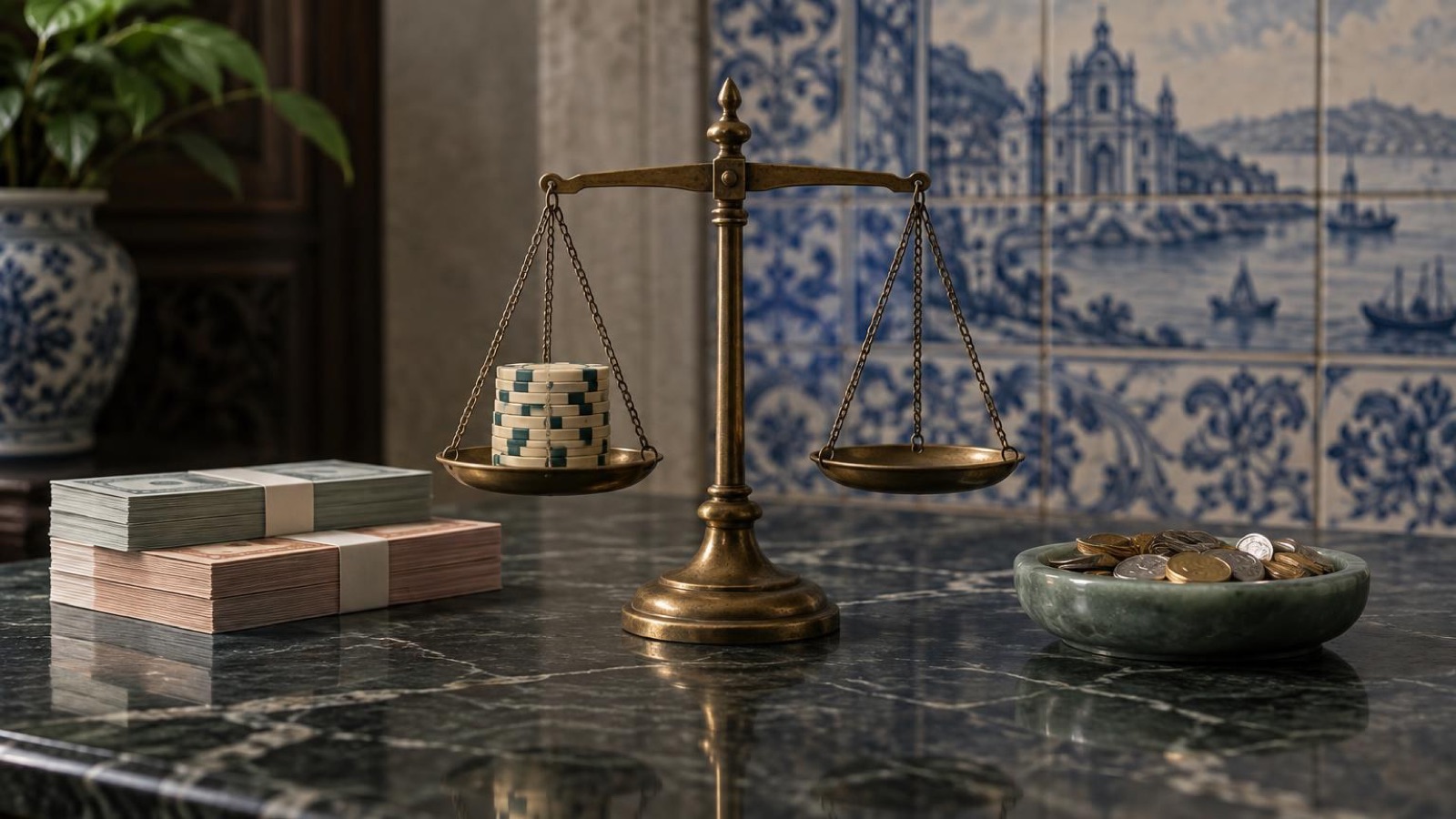
Macau is one of the easiest places in the world to win money and keep all of it. If you play baccarat, blackjack, sic bo, slots or poker at a licensed casino on the Cotai Strip or downtown, or buy a lottery ticket, no tax is taken out of your winnings. There is no form to fill in, no declaration to make to the Macau authorities and no withholding at the cage when you cash out. What the dealer pushes across the table is what goes in your pocket1.
The reason is simple: Macau taxes gambling at the source, not at the player. The casinos themselves pay a special gaming tax on their gross gaming revenue, and that tax is where the government's money comes from.
| Component of the operator's tax burden | Rate |
|---|---|
| Special gaming tax3 | 35 percent |
| Earmarked for cultural, tourism and urban development projects3 | about 5 percent |
| Total burden on operators, as a share of what the house wins3 | roughly 40 percent |
| Rate under the current gaming law4 | 40 percent, up from the previous 39 percent |
In other words, the tax is built into the economics of running a casino, and it is one of the main reasons Macau's gaming industry is so valuable to the government budget.
For poker players the position is the same: winnings from both cash games and tournaments are generally tax-free2. The same principle covers the average recreational punter at any licensed venue, where the tax burden falls on the operator rather than on you as an individual6.
Where to play
The tax-free treatment applies at every licensed casino in Macau, and all of them are open 24 hours a day5. That means you can walk into a casino in Macau at any time, on any day, and the rules on winnings are the same.
The main concentrations of play are:
- The Cotai Strip, home to The Venetian Macao, The Londoner Macao, Galaxy Macau, City of Dreams Macau, Studio City Macau, The Parisian Macao, MGM Cotai and Grand Lisboa Palace
- The downtown peninsula area around Grand Lisboa, Wynn Macau, MGM Macau and Sands Macao
- Smaller properties such as Altira Macau and the remaining satellite casinos
All of these operate under concessions held by Macau's six casino operators, and it is those operators, not you, who settle the gaming tax with the government. Whether you play at a mega-resort or a small side hall, the player-side position is identical: no tax on what you win.
How it works
Macau's system works by taxing the house, not the bettor. Each casino operator keeps a record of its gross gaming revenue, meaning the total amount players wager minus the amount paid out in winnings. The special gaming tax is assessed on that figure at about 39 to 40 percent7. The current gaming law set the rate at 40 percent, up from 39 percent previously4.
The mechanics of collection are handled entirely between the operator and the government. Under the gaming legislation, the special gaming tax is paid in twelfths, monthly, at the Recebedoria da Repartição de Finanças de Macau, by the tenth day of the month following the month to which it relates8. So a casino settles its January tax by February 10, its February tax by March 10, and so on through the year. None of this involves the player at any point.
For you, this means the transaction at the table or the cage is the end of the story. If you win MOP 10,000 at baccarat, you are paid MOP 10,000. If you take down a poker tournament, the prize listed is the prize paid. The operator has already built its tax obligations into its business model, and the government collects from the house.
Games and products
The no-tax position on winnings covers the full range of gambling products available in Macau:
- Baccarat. The game that dominates Macau's floors, dealt in every major casino. Winnings are paid in full, with nothing withheld. See baccarat in Macau for how the game is played here.
- Other table games. Blackjack, sic bo, and traditional Chinese games such as fan tan and pai gow, covered in our page on traditional games, all pay out tax-free to the player.
- Slots. Machine jackpots at slot machines and the Mocha Clubs are yours in full.
- Poker. Cash game and tournament winnings are generally tax-free2. See poker in Macau and poker tournaments.
- Lottery and racing. Prizes from the Macau lottery, including pacapio and the New Macau Mark Six, plus payouts from sports betting and horse racing, follow the same principle: the player is not taxed on the prize.
Across all of these products, the pattern is the same one described above. The operator pays tax on its revenue; the player keeps the winnings. There is no category of gambling in Macau where the individual winner owes a share to the tax authority.
Costs, prizes and payouts
Because nothing is withheld from winnings, the payout you see is the payout you get. A few practical points follow from this:
- Table payouts are quoted in full. A winning banker bet at baccarat pays the standard odds, and the casino does not deduct anything extra for tax when it pays you.
- Tournament prizes are advertised net. When a poker room in Macau posts a tournament prize pool, the figures are what winners actually receive, since poker winnings are generally tax-free2.
- Jackpot payments are not reduced. Slot and table game jackpots are paid at the full amount. There is no Macau equivalent of the automatic withholding some countries apply to large wins.
The cost side of the equation sits with the house. The special gaming tax of 35 percent, plus roughly 5 percent directed to cultural, tourism and urban development support projects, is one of the largest operating costs a Macau casino faces3. Research on the industry notes that the gaming tax is assessed at about 39 percent of gross gaming revenue7, and the current law raised the rate to 40 percent4. This is also why Macau's minimum bets tend to be higher than in some other Asian jurisdictions: the operators need to generate revenue that can carry a tax burden of that size.
For a sense of scale, this tax is the single biggest source of government revenue in Macau, which is why the system is designed around the operators rather than around millions of individual players. Tracking and taxing every winner would be far harder than taxing six concessionaires, and the government has chosen the simpler model.
Who can take part
The tax-free treatment of winnings applies to everyone who is allowed to play: Macau residents, foreign residents living in the city, and visitors from anywhere in the world. There is no distinction between locals and tourists when it comes to keeping your winnings.
The one exception concerns people who are banned from gaming. Under Macau's gaming legislation, winnings or other lucky gaming gains obtained by a person banned from gaming, after deducting their losses, vest in the Macau SAR rather than in the player, and the revenue a concessionaire obtains from that person's gaming, again after deducting losses, also goes to the government9. Earlier legislation on the same theme provided that amounts wagered and prizes won by persons interdicted from gambling revert to the Macau SAR10. In plain terms: if you are on a gaming exclusion list, such as through self-exclusion, you cannot legally keep what you win, and the money is forfeited to the government. For everyone else, the rule is unchanged: winnings are not taxable1.
If you are planning a visit, see casino entry rules in Macau for identification requirements and gambling in Macau as a visitor for the practical details.
Practical tips
A few things worth knowing before you play:
- Keep your payout as you get it. Since Macau does not tax winnings, there is no paperwork at the cage. If you win big, the casino pays you; there is no Macau tax form to complete.
- Check your home country's rules. Macau not taxing your win does not mean your home tax authority ignores it. Some countries tax gambling income or worldwide winnings of their residents, so if you are a resident elsewhere, check how your jurisdiction treats foreign gambling winnings before you assume the money is tax-free everywhere.
- Large cash movements are a separate matter. Carrying substantial cash across borders is subject to customs rules that have nothing to do with gambling tax. If you win a large amount and plan to take it out of Macau, look at the cash declaration limits for your route. Our page on money and payments at Macau casinos covers how to handle winnings on the ground.
- Play at licensed venues. The tax-free position described here applies to play at licensed casinos and authorized lottery products. Unlicensed or offshore options, discussed in our page on online gambling in Macau, sit outside this system.
- The 24-hour rule works in your favor. Casinos never close5, so there is no window or timing to worry about; the treatment of winnings is the same whenever you play.
- If you win at poker, the same applies. Cash out your tournament win or your cash game session without expecting any deduction2.
The short version: Macau is built on the idea that the house pays the tax and the player keeps the prize. Play at any licensed venue, at any hour, and what you win is what you take home, as far as Macau is concerned.
Common Questions
Do I pay tax on casino winnings in Macau?
No. Winnings from gambling in Macau are not taxable for the player, whether you are a visitor, a foreign resident or a local. The tax burden falls on the casino operator, which pays a special gaming tax on its gross gaming revenue to the government.
Are poker winnings taxed in Macau?
No. Poker winnings, both from cash games and tournaments, are generally tax-free for players in Macau. The same rule applies to other casino games: what you win at the table or in a tournament is yours to keep.
How much gaming tax do Macau casinos pay?
Casino operators pay a special gaming tax of 35 percent of gross gaming revenue, plus roughly 5 percent earmarked for cultural, tourism and urban development projects. The combined rate is about 40 percent, raised from 39 percent under the current gaming law.
Is there a tax on Macau lottery winnings?
No. Like casino and poker winnings, lottery prizes in Macau are not taxed on the player. The taxation in Macau's gambling industry is levied on the operators' revenue, not on individual prizes.
Do I need to declare Macau winnings in my home country?
Macau does not tax your winnings, but your home country may treat them differently. Some countries tax gambling income or worldwide winnings of their residents, so check the rules where you file your taxes before assuming the prize is tax-free everywhere.
Sources10 sources
- Taxation of gambling winnings in Macau, Lexology, August 1, 2019
- Poker in Macao guide, SoMuchPoker, May 25, 2026
- Public consultation report on the amendment of the legal framework for gaming in Macau, Gaming Inspection and Coordination Bureau (DICJ), December 23, 2021
- Covid closedown: Macau casinos take billion-dollar hit holding out for new licences, Reuters, July 14, 2022
- Gaming in Macau, Macao Government Tourism Office, October 27, 2021
- Macau gambling and tax guide, Taobao shopping guide, August 4, 2026
- The Transformation of Macao's Gaming Industry, University of Macau repository, February 2026
- Law No. 16/2001, legal framework for the concession of games of fortune, Imprensa Oficial / Official legislation, September 24, 2001
- Law No. 10/2012, regime for the limitation of access to gaming venues, Gaming Inspection and Coordination Bureau (DICJ), December 2018
- Proposta de Lei on raising the casino entry age to 21, Official legislation, June 2015