Macau's casinos are open 24 hours, and for someone whose gambling has stopped being fun, the city makes it possible to put a hard barrier between yourself and the gaming floors. The scheme is called "self-exclusion" (自我隔離, literally "self-isolation"), and it is run by the DICJ, Macau's gaming regulator. Once an exclusion order is in force, you are barred from entering or staying at the casinos it covers, and breaking that bar is a criminal offense, not just a house rule. This page explains who can apply, how to do it, what it costs, how long it lasts, and how to get it lifted or extended.
Who can apply for exclusion in Macau
Anyone may apply to exclude themselves from Macau's casinos, and the scheme is open to tourists as well as local residents1. Applicants must be at least 21 years old, which matches the minimum age for entering casinos in Macau in the first place5.
There are two routes into the scheme:
- Self-exclusion. You apply on your own behalf to bar yourself from all or some of Macau's casinos6.
- Third-party exclusion. A spouse, parent, son or daughter, or brother or sister of the person to be excluded can submit the application1. In legal terms, the law names the spouse, ascendants, descendants and second-degree collateral blood relatives, which in practice means the sibling category on the form7.
The catch with the third-party route is that it is not truly involuntary. The person to be excluded must sign the application form to confirm the exclusion before it can proceed1. Macau law is explicit on this point: the exclusion is granted either on the person's own request or on their confirmation of a relative's request7. So a family member can start the paperwork and push a reluctant relative toward it, but they cannot have someone banned against their will.
Participation in the program is voluntary throughout1. You choose the scope too: you can ask to be excluded from all of Macau's casinos, or only from some of them, naming the operators that are not covered by the exclusion8.
How to apply: in person at DICJ, by kiosk, or through a casino
There are three practical ways to get an application in.

| Route | How to apply | What happens next |
|---|---|---|
| In person at the DICJ office | Fill in the application form and submit it at the DICJ office on the 12th Floor A of China Plaza, 762-804 Avenida da Praia Grande, Macau1. Forms are available at the DICJ office itself, at the Resilience Centre of the Social Welfare Bureau, and at all casinos in Macau, and you can also download the form from the DICJ website3. | If someone helps you complete the form, a witness from an institution or a DICJ staff member attests to that assistance on the form, giving their name, ID or staff number, entity and the date9. |
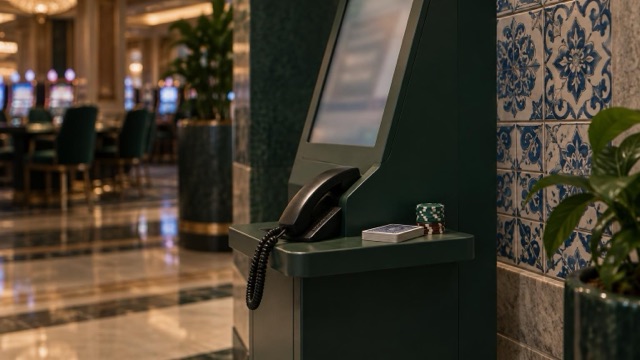
| At a self-service kiosk | Submit a self-exclusion application electronically through the Responsible Gambling Information Kiosks, which sit in the casino areas of the major operating casinos in Macau and at community locations5. The electronic route is open to holders of a Macao ID card, whether permanent or non-permanent residents, and holders of national passports2. An online appointment service for self-exclusion is also available10. | You are issued a receipt stating that DICJ will contact you within two working days to verify the details2. |
| Through a casino | The casino operators themselves take part in the scheme. Galaxy Entertainment, for example, provides exclusion application forms and assistance at its casinos, with applications handled via casino security officers or directly through DICJ11. | If your application is submitted to DICJ through one of the casinos, DICJ will contact you to verify your personal details, and you must then attend the DICJ office in person3. |
Whichever route you use, the outcome is citywide in effect if you ask for it to be: on the application you may request exclusion from all casinos of games of fortune or chance, or only from certain casinos, naming the operators not covered by the exclusion10. The exclusion order itself is issued by the Director of DICJ, who has the power to bar a person from all or some of the casinos12.
Documents you need and the application fee
The application is free of charge2. What you need depends on the route:
- Written application at the DICJ office: a completed self-exclusion application form, valid identification documents, and a recent ID photo2.
- Third-party application: bring the ID card of the applicant and of the person to be excluded for verification, plus a recent photo of the person to be excluded1. Both the applicant and the excluded person must sign, and the signatures must match the specimen on the identity document8.
- Kiosk application: your Macao ID card or national passport, read by the kiosk2.
Be aware of what happens to your data. DICJ reads your identity document to obtain your ID number, name, sex and date of birth, stores this in its administrative system, and sends it to all or some of the casinos in Macau, solely for the purpose of running the exclusion9. The third-party form spells this out and asks for your consent to that processing8.
Exclusion periods and how the timeline works
The maximum exclusion period is two years3. On the application form you can choose from set options: six months, one year, eighteen months, two years, or another period you specify8.
The timeline after you submit works like this:
- You submit the application, in person, by kiosk or through a casino.
- DICJ verifies your details, contacting you within two working days for a kiosk application2.
- Within five working days of submission, DICJ notifies you of the start date and the end date of the approved exclusion period3.
- You sign a notification letter about the enforced exclusion period, in person at the DICJ office2.
The exclusion period is continuous: it runs from the start date until it expires, with no pauses or breaks, unless you file a revocation request with DICJ during the period9.
Once the order is in force, you are prohibited from entering or staying at the casinos it covers, whether or not you intend to gamble2.
Penalties for entering a casino while excluded
This is the part that gives the Macau scheme its teeth. Entering or remaining in a casino covered by your exclusion order during the exclusion period is a crime, not a civil matter or a simple trespass. The law treats it as the crime of disobedience under the Penal Code, punishable with up to one year of imprisonment or a fine of up to 120 days, and it applies whether or not you actually gamble7. DICJ's own guidance states the same in plain terms: violation of the order constitutes the crime of disobedience9.
The practical effect is that once your details are in the system and distributed to the casinos, walking onto a gaming floor is a criminal act for you, even if the casino does not stop you at the door.
Revoking an exclusion and the 30-day delay
You are not locked in for the full period if you change your mind. The excluded person may request revocation of the exclusion at any time during the exclusion period1. The request must be made by the excluded person themselves, in person at the DICJ office on Avenida da Praia Grande1.
But there is a deliberate cooling-off delay built into the law: the revocation only takes effect 30 days after the request is made1. The design is intentional. The waiting period exists so that a momentary urge to gamble does not immediately translate into access to the casino floor; you have a month in which the order still stands and in which you can still be stopped. Until those 30 days pass, you remain excluded and remain subject to the penalties above.
Extending the exclusion after it expires
When the exclusion period ends, it simply lapses; it does not renew itself. If you want to keep the barrier in place, the period may be extended only after a new self-exclusion application is made, or after you confirm a new third-party exclusion application, once the order has expired or been revoked1. In other words, you go back to the start of the process: a fresh form, fresh verification, and a new order from the DICJ Director7.

Many people who use exclusion schemes treat renewal as part of the plan: as one period ends, they file the next application so there is no gap in coverage. Because the maximum single period is two years, anyone wanting a longer break needs to renew at least once.
Counseling and support services
Exclusion is a barrier, not a treatment, and Macau's scheme acknowledges that. The person to be excluded has the right to choose whether or not to receive counseling from problem gambling prevention and treatment agencies1. On the third-party application form, this appears as an explicit consent box: you can agree to accept counseling from a problem gambling prevention institution and allow DICJ to pass your personal data to it solely for that purpose, or decline8.
Beyond the scheme itself, support is available in Macau:
- The Sheng Kung Hui Macau youth services run a 24-hour gambling counseling hotline and an online gambling counseling platform, offering professional and immediate counseling, information on gambling disorder, and guidance on self-exclusion13.
- The Social Welfare Bureau's Resilience Centre (志毅軒) is where the exclusion forms are also stocked, and it is the government's problem gambling service point3.
- On the casino side, gaming concessionaires are required by law to set up responsible gambling task forces that provide assistance and counseling to those in need14.
If you want to talk to someone before deciding whether to apply, the hotline is a sensible first call, and the DICJ exclusion team can answer procedural questions at (853) 8397 3286 or exclusion@dicj.gov.mo1. For a broader picture of the help available, see gambling help in Macau.
One last practical note: the exclusion covers Macau's casinos only. It does not stop you gambling online, betting with Macau SLOT, or visiting casinos elsewhere, so if your goal is a wider break, those need separate arrangements.
Common Questions
Is self-exclusion in Macau free of charge?
Yes. The DICJ exclusion application is free of charge, whether you submit it in person at the DICJ office, at a Responsible Gambling Information Kiosk, or through a casino.
Can a family member exclude someone from Macau casinos without their consent?
No. A spouse, parent, child or sibling can start a third-party exclusion application, but the person to be excluded must sign the form to confirm it. Without that signature the exclusion cannot go ahead.
Where is the DICJ office for exclusion applications?
The DICJ office is on the 12th Floor A of China Plaza, 762-804 Avenida da Praia Grande, Macau. You submit the written application there in person.
How long does DICJ take to approve an exclusion application?
DICJ notifies the applicant of the start and end dates of the exclusion period within five working days after the application is submitted. The applicant then signs a notification letter in person at the DICJ office.
How do I contact DICJ about an exclusion application?
Call (853) 8397 3286, fax (853) 2871 2331, or email exclusion@dicj.gov.mo. The office address is 12th Floor A, China Plaza, 762-804 Avenida da Praia Grande, Macau.
Can tourists apply for Macau casino self-exclusion?
Yes. Both Macau residents and tourists can apply, including through the self-service Responsible Gambling Information Kiosks. Applicants must be at least 21 years old.
What happens if I enter a casino during my exclusion period?
Entering or staying at a casino covered by your exclusion order is a crime of disobedience under Macau law, punishable with up to one year in prison or a fine of up to 120 days.
Sources14 sources
- DICJ Self-Exclusion and Third-Party Exclusion Program, Gaming Inspection and Coordination Bureau, Macao SAR Government
- Self-Exclusion Application (Service PS-1408), Government of the Macao Special Administrative Region
- Exclusion Measures, Gaming Inspection and Coordination Bureau, Macao SAR Government
- Casino entry bill, Law No. 10/2012 (Chinese text), Imprensa Oficial, Macao SAR Government
- Responsible Gambling Information Kiosks (Chinese), Gaming Inspection and Coordination Bureau, Macao SAR Government
- Exclusion Measures (Chinese), Gaming Inspection and Coordination Bureau, Macao SAR Government
- Law No. 10/2012, Article 6 (Chinese text), Imprensa Oficial, Macao SAR Government
- Third-party casino exclusion application form (Chinese), Gaming Inspection and Coordination Bureau, Macao SAR Government
- Self-exclusion application form (Chinese), Gaming Inspection and Coordination Bureau, Macao SAR Government
- Macau self-exclusion information (Chinese), Sunshine CCG
- Responsible gaming (Chinese), Galaxy Entertainment Group
- DICJ Macao casino self-exclusion, Tung Wah Group of Hospitals Even Centre
- 24-hour gambling counselling hotline and online counselling (Chinese), Sheng Kung Hui Youth Services, Macau
- Chief Executive Dispatch No. 22/121 (Chinese), Gaming Inspection and Coordination Bureau, Macao SAR Government