Macau is the biggest casino market on earth, and the city has built a real support system around the risks that come with that. If gambling has stopped being fun for you, or you are worried about someone close to you, there are concrete things you can do: sign yourself out of the casinos, talk to a counselor at any hour, or walk up to a self-service kiosk inside a casino and file an exclusion application on the spot. This page walks through each of those options, what they cost, how long they last, and what happens if you break them.
Self-exclusion from Macau casinos: how it works
Self-exclusion is a voluntary program: you decide to sign up, and once the order is in force you are barred from entering or staying in the casinos it covers1. The point is simple. It puts a legal wall between you and the gaming floor, so the impulse to chase losses has a hard barrier in front of it. Support organizations describe it as an effective tool to support your commitment to stay away from gambling, and Macau's version is one of the more formalized schemes in Asia6.
Two things make the Macau scheme distinctive. First, it is genuinely voluntary in the legal sense: the application must be signed by the person being excluded, even when a family member is the one pushing for it. Second, it is not all-or-nothing. You can ask to be barred from every casino in the city or only from the ones where you tend to play2.
The program covers the licensed casinos run by the city's concessionaires, the same venues described in our guide to casinos in Macau. If you want the full detail on the scheme, including the application form and the data the regulator keeps, our in-depth page on self-exclusion from Macau casinos covers it step by step.
Exclusion order: maximum of two years
The DICJ director issues the exclusion order, and the maximum period is two years2. You can ask for a shorter period if you prefer; two years is the ceiling, not the standard term.
The order can cover all of Macau's casinos or only part of them, depending on what you request1. During the exclusion period you are prohibited from entering or staying at the casinos named in the order, whether or not you intend to gamble7.
The legal basis is Law 10/2012, which sets the conditions for entering casinos, working in them and gambling in them. Its Article 6 says that when a person applies on their own behalf, or confirms an application made by a spouse, an ascendant, a descendant or a relative within the second degree of kinship, the DICJ director may bar that person from all or part of the casinos for up to two years8.
When the period ends, the order lapses. You can apply again if you want to renew it, and there is nothing stopping you from applying for a fresh exclusion before the old one runs out.
How to apply: casino, DICJ or self-service kiosk
There are four ways to get the form, and the application itself is free of charge9.
| Where to apply | What it involves |
|---|---|
| At the DICJ | The Gaming Inspection and Coordination Bureau, the regulator described in our page on the DICJ, Macau's gaming regulator, accepts applications directly. |
| At any Macau casino | Hand the form in at a casino and it is forwarded to the DICJ for processing. |
| At the Resilience Centre | The Social Welfare Bureau's Resilience Centre (志毅軒) also stocks the forms. |
| Online or at a kiosk | The form can be downloaded from the DICJ website, and Macao ID card holders, including permanent and non-permanent residents, and passport holders can file electronically at a Responsible Gambling Information Kiosk9. |
Any person may apply, and participation is entirely voluntary1. If a family member is the one making the request, the application must first be signed and confirmed by the person being excluded; nobody can be signed out of the casinos against their will1.
When you apply, the DICJ reads your identity document and takes your document number, name, sex and date of birth. That data is stored in the DICJ's administrative system and sent to all or some of the casinos in Macau, but only for the purpose of running the self-exclusion program. The casinos use it to recognize you at the door.
Verification when you apply through a casino
If you submit the application through one of the casinos rather than directly, there is an extra step. The DICJ will contact you to verify your personal details, and you must attend the DICJ office in person to confirm them1. This is a safeguard: since the order carries real consequences, the regulator wants to be sure the right person is being excluded and that you understand what you are signing.
The English-language guidance from the DICJ describes the same procedure: applications routed through a casino trigger a verification contact from the bureau before the order is issued3. Applications filed directly at the DICJ or electronically at a kiosk do not need this extra round trip, since your identity is captured at the point of application. At the kiosks, you scan your resident identity card or passport and scan your fingerprints to submit the service application4.
Penalties for entering during the exclusion period
Once the order is approved, entering or remaining in a covered casino during the exclusion period is a crime. Macau law treats it as the crime of disobedience, punishable with up to one year of imprisonment or a fine of up to 120 days, and it applies whether or not you actually gamble10.
This is not a rule the casinos enforce with a polite escort to the door. It is a criminal offense on the books, and the exclusion order is circulated to the casinos precisely so that staff can identify excluded persons who walk in.
Separately, the general casino entry law carries fines of MOP 1,000 to MOP 10,000 for a range of violations, including entering when barred, refusing to identify yourself, re-entering after being expelled, and causing disturbances on the gaming floor; an offender can also be barred from one or more casinos for a further six months to two years11.
Counseling and support services
Exclusion is a barrier, not a treatment, and Macau pairs it with counseling options you can take up at any point, whether or not you are excluded.
The main service is the 24 Hours Hotline and Online Gambling Counselling Services, commissioned by the Social Welfare Bureau and run by the S.K.H. Macau Social Service Coordination Office. It offers professional and immediate gambling counseling, an online counseling platform, information on gambling disorder, and guidance on self-exclusion12. The hotline number is (853) 2823 010113.
Counseling is entirely your choice. The person being excluded has the right to accept or decline counseling from problem gambling prevention and treatment agencies, and on the application form you can tick whether you agree to the DICJ passing your personal data to one of those agencies, solely for counseling purposes. Declining counseling does not affect the exclusion order itself.
If you are in Hong Kong rather than Macau, a separate problem gambling helpline there, 183 4633, offers immediate initial counseling for gamblers and their families14.
Where to get help: kiosks, hotline and task forces
The Responsible Gambling Information Kiosks are the most visible piece of Macau's support network. The gaming-area versions sit inside the major operating casinos: Studio City, Wynn Palace, Galaxy Macau, The Parisian, MGM Cotai, The Venetian Macao and Grand Lisboa Palace4. Community versions are installed at Social Welfare Bureau offices and counseling centers across the city, including the Problem Gambling Prevention and Treatment Division, the district social service centers, the Sheng Kung Hui Gambling Counseling and Family Wellness Centre, the Yat On Responsible Gambling Counselling Centre and several family service centers15.
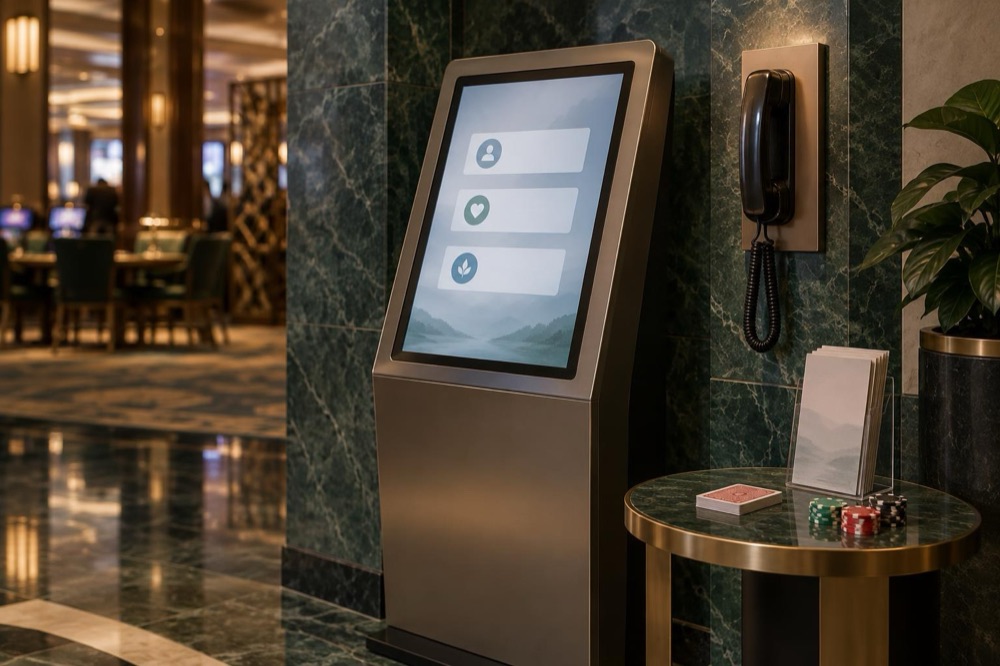
Both Macau residents and tourists can use the kiosks, and you can submit a self-exclusion application at one on your own16. Beyond applications, the kiosks offer responsible gambling information, electronic applications for problem gambling family counseling, a gambling disorder assessment with a printable behavior report, interactive games, and a 24-hour help phone inside the kiosk that connects you straight to a gambling disorder prevention and treatment organization4. Seven of the kiosks have an RG KIOSK ambassador on site who can explain the functions, help with applications and introduce Macau's prevention and treatment organizations4.
Behind the kiosks sits a broader structure. Each casino operator must set up a responsible gambling task force providing assistance and counseling to those in need, and must run a responsible gambling plan that gives the public, including tourists, enough information to gamble in a controlled way17. Operators also publish their own support contacts; Mocha Clubs, for instance, lists the 24-hour gambling counseling hotline and the Macau Gaming Workers Home Integrated Service Centre at (853) 2871 6622 alongside the main hotline13.
Who cannot enter casinos anyway
Separate from self-exclusion, Macau law already bars whole categories of people from the gaming floor, and it is worth knowing where you stand before you plan a visit. The full detail is in our page on casino entry rules in Macau, but the essentials are these.
The minimum age is 21. Anyone under 21 is not allowed to enter a casino, and the tourism authority states this plainly in its official guidance5. Casino staff supervising entry can ask for proof of age and refuse entry to anyone who will not show it11.
Beyond age, the law bars incapacitated and quasi-incapacitated persons, culpable undischarged bankrupts, public administration workers including security forces personnel unless permitted by the Chief Executive or on duty, and off-duty casino employees in their own employer's gaming areas18. The same provisions exclude anyone who is drunk or under the influence of drugs, and anyone carrying weapons, explosives or recording devices into the gaming areas19. Concessionaires can also refuse entry to anyone they consider unsuitable, as long as they do not discriminate on grounds of sex, race, nationality, residence, language or religion10.
One practical note for visitors: the casinos are open around the clock. Concessionaires must keep their casinos open twenty-four hours a day, every day of the year, without interruption20, so the support services are built to match, with the hotline and the kiosk help phones running 24 hours too.
Common Questions
Can a family member apply to have someone excluded from Macau casinos?
Yes. A spouse, parent, child, or relative within the second degree of kinship can request an exclusion, but the person to be excluded must sign and confirm the application themselves before the DICJ director will grant it.
Do I have to accept counseling if I am excluded?
No. Counseling is optional. The person being excluded can choose whether or not to receive counseling from problem gambling prevention and treatment agencies, and can decide whether the DICJ may pass their details to one.
Where are the Responsible Gambling Information Kiosks located?
Gaming-area kiosks sit inside the major operating casinos, including Studio City, Wynn Palace, Galaxy Macau, The Parisian, MGM Cotai, The Venetian and Grand Lisboa Palace. Community versions are at Social Welfare Bureau offices and counseling centers.
Are Macau casinos open 24 hours?
Yes. Concessionaires must keep their casinos open twenty-four hours a day, every day of the year, without interruption. The only recent exception was a government-mandated 15-day closure in February 2020 during the pandemic.
Can I choose to be excluded from only some casinos?
Yes. You can ask to be barred from all of Macau's casinos or only some of them. The DICJ director issues the order for the scope you request, and it applies for up to two years.
Who cannot enter Macau casinos under other entry rules?
Anyone under 21, plus incapacitated persons, undischarged culpable bankrupts, public administration workers and security forces personnel unless authorized by the Chief Executive, off-duty casino employees in their own gaming areas, and anyone drunk, drugged or carrying weapons or recording devices.
Is the self-exclusion application free to sign myself?
Yes. The application is free of charge and voluntary. Any person may apply, and Macao ID card holders and passport holders can also file it electronically at a Responsible Gambling Information Kiosk.
Sources20 sources
- DICJ self-exclusion scheme (Chinese), Direcção dos Serviços de Inspecção e Coordenação de Jogos, 2026
- DICJ exclusion program (English), Gaming Inspection and Coordination Bureau, 2026
- DICJ exclusion program (English), Gaming Inspection and Coordination Bureau, 2026
- Responsible Gambling Information Kiosks (Chinese), Gaming Inspection and Coordination Bureau, 2026
- Gaming (simplified Chinese), Macao Government Tourism Office, October 27, 2021
- Self-exclusion, Responsible Gambling Council, September 25, 2026
- Self-Exclusion Application, service PS-1408a, Government of Macao, March 4, 2025
- Law 10/2012 (Chinese), DICJ, December 2018
- DICJ services: isolation, Gaming Inspection and Coordination Bureau, 2026
- Law 10/2012 (Chinese PDF), Imprensa Oficial, June 2015
- Law 10/2012 (Portuguese PDF), Imprensa Oficial, June 2015
- 24 Hours Hotline and Online Gambling Counselling Services, S.K.H. Macau Social Service Coordination Office, May 18, 2026
- Responsible gaming (Chinese), Mocha Clubs, September 26, 2026
- Problem gambling counselling services (Chinese), Hong Kong Government, March 29, 2017
- Responsible Gambling Information Kiosks (English), DICJ, 2026
- Responsible Gaming Information Kiosk (Chinese), DICJ, 2026
- Chief Executive Dispatch 22/121 (Chinese), DICJ, July 2022
- Law 12/010 (Chinese), DICJ, August 6, 2012
- Law 16/2001 Article 24 (Portuguese PDF), Imprensa Oficial, September 24, 2001
- Macau gaming concession contract, U.S. Securities and Exchange Commission, December 16, 2022