
Gambling in Japan: what is legal and what is not
Japan still has racecourses, boat stadiums, lottery counters and a national soccer lottery. The law bans gambling as a starting position, but it carves out exceptions so that everyday entertainment is not criminalized and so that the proceeds of some betting go back into public funds and social welfare1.
For a visitor or a new resident, the practical picture is short. There are four things you can legally bet on without any special status:
- Horse racing
- Boat Race
- The takarakuji lottery
- toto
Everything else, including casino table games, slot machines for cash, private card games for money and online casinos, sits on the illegal side.
The line between legal and illegal is not about the game. It is about who runs it. When a public body or a state-authorized operator runs the betting, it is legal. When a private person or company runs it for profit, it is not.
Bakuto: the gambling roots of the yakuza
The bakuto were professional gamblers, and they are one of the two main streams that fed into what we now call the yakuza. They were not simply players. They ran gambling dens, organized games, lent money and settled disputes, which gave them the same mix of income, territory and personal loyalty that later organized crime groups built on.
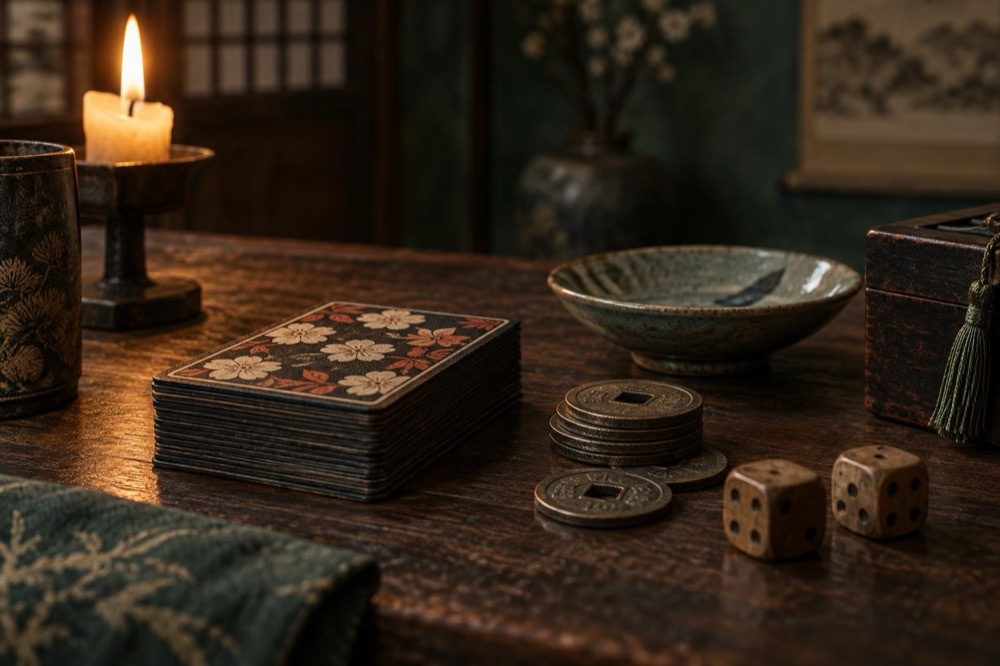
The clearest link is in the name itself. Oicho-Kabu, a card game played in these gambling parlors, is where the word "yakuza" comes from. The game was a mainstay of yakuza gambling parlors, and the very word "yakuza" derives from its terminology2. The name is not a metaphor borrowed later. It comes straight out of the cards.
Oicho-Kabu is a kabufuda card game, played with Japanese cards rather than the Western deck. In the parlors, the game was the business. The house took its cut, the players staked money, and the men who controlled the room controlled the income.
A second game, Ceki, is said to be rooted in an ancient card game created in ancient China and is also the ancestor of mahjong8. It shows the difference between a friendly game and an organized one. In Chō-Han, the form in which gamblers gathered customers at gambling dens was established from the mid to late Edo period9. That is the pattern: the same games ordinary people played for fun became, in the hands of the bakuto, an organized trade with a house, a cut and a hierarchy.
If you want the wider regional picture, our page on triads, yakuza and syndicates covers how these groups compare across Asia, and historic gambling bans in Asia shows how often governments tried to shut them down.
A history of betting in Japan: from the Edo period to the Racecourse Law
Betting in Japan is old. The takarakuji lottery is said to have originated roughly 400 years ago in the early Edo period5, which puts organized public lottery play well before the modern state took an interest in it.
Horse racing had a rougher path. It was officially illegal from 19089. That ban did not end the sport, but it pushed betting outside the law, which is exactly the space the bakuto and their successors operated in.
The modern settlement came in 1948. A new horse racing law was enacted, dissolving the Japan Racing Society and entrusting the management of horse racing to the government under the Ministry of Agriculture and Forestry9. The current law dates from that year, replacing the old society with government control10. The Horse Racing Act is Act No. 158 of July 13, 194811, and it came into force on July 19, 194812.
The 1948 law did two things that still shape the market. It said that all authorized racing must be conducted by the JRA and local government entities, and that all wagers must be pari-mutuel10. In plain terms: only the state and local governments can run it, and the payout comes out of a shared pool rather than from fixed odds set by a bookmaker.
That pool is not paid out in full. The payout rate for horse racing is 70 to 80 percent of the betting pool target amount13. The rest goes to the operator, the state and public purposes. It is worth knowing before you bet, because it tells you what the game is designed to return over time.
The five legal forms of gambling and who can play
Here is what an ordinary person in Japan can actually do, and where.
| Type of gambling | Legal? | Where | Minimum age |
|---|---|---|---|
| Horse racing (JRA and local tracks) | Yes | Racecourses and off-track betting windows | 20 |
| Boat Race (kyotei) | Yes | Boat Race stadiums and off-track windows | 20 |
| Takarakuji lottery | Yes | Authorized lottery counters and kiosks | 20 |
| toto (sports lottery) | Yes | Online and retail channels | 20 |
| Casino table games | No | None operating | n/a |
| Online casinos | No | Nowhere | n/a |
Horse racing. You buy a betting ticket, called a kakeken, at a racecourse or an off-track window. The minimum age is 20, and the rule is strict: persons under 20 may not buy or cash betting tickets3. Betting on horse races is prohibited by law for those under 2014. If you are new to it, the simplest bet types to start with are fukusho or wide15, which pay out on a horse finishing in the top places rather than only on a win.
Boat Race. This is publicly managed sports betting4. In Japan, you must be at least 20 years old to bet on Boat Race4. Racing runs at stadiums around the country, and you can also bet at off-track windows. The mechanics are similar to horse racing: you pick a combination, and the payout comes from the pool.
Takarakuji. The national lottery. Tickets are sold at authorized counters, and the lottery is one of the oldest forms of legal betting in the country, with roots going back roughly 400 years to the early Edo period5. It is the easiest legal product for a visitor to try, because you do not need to understand form or odds.
toto. The sports lottery, including soccer. You can buy tickets through partner channels, including the Jibun Bank toto site6. It is a pool-based bet on match results rather than a fixed-odds product.
Who can play. The age of 20 applies to everyone, citizens, foreign residents and visitors alike. There is no separate tourist product and no lower age for foreigners. Bring photo identification, because counters and venues check.
Online casinos are illegal for players in Japan
This is the part where people most often get it wrong, so it is worth being blunt. Gambling at online casinos by connecting from within Japan is a crime, even if the casino is legally operated overseas7. The same rule is stated by the consumer affairs agency: even for an online casino legally run abroad, connecting from inside Japan to gamble is a crime16.
It does not matter that the operator holds a foreign license. The player's act happens in Japan. Connecting from Japan to gamble on an online casino is a crime even when the operator is legally run overseas17. The national police agency's guidance says the same thing7.
Two details catch people out. First, free versions count. The rule covers gambling from Japan on online casinos including free versions and free bonuses in points17. Second, the advertising is illegal too. Online casino advertising and promotion in Japan is illegal18.
The practical risk is real, not theoretical. People who used online casinos as customers have been arrested for the crime of gambling16. If you are in Japan, treat the offshore sites as off limits, however they are marketed.
Penalties for players and enforcement in practice
The offense for a player is the gambling crime, and if you repeat it, it becomes the heavier crime of habitual gambling19. Habitual gambling carries imprisonment of up to 3 years20.
Japan has a long history of treating this seriously. The old gambling offender disposal rules were nicknamed Oogarikomi, feared as a law that made people prisoners merely for being gamblers21. The modern system is less sweeping, but the direction has not changed.
There is also a specific warning for racing bets. The horse racing law provides severe punishment for anyone who purchases bets from illegal sellers, including overseas internet operators10. So a bet placed through an unauthorized online seller is not a gray area.
One important exception applies to travel. Gambling at casinos abroad is not punishable under Japanese law, since the acts occur entirely abroad and no Japanese social legal interest is harmed17. In other words, if you fly to a country where casinos are legal and play there in person, Japanese law does not reach you. That is different from sitting in Japan and connecting to a site.
If you want to see how a neighboring market handles this, our guide to gambling in South Korea explains the foreigners-only casino model, and can I gamble in Japan covers the practical side for visitors.
Casino resorts: the three-license plan and its hurdles
Japan has passed a law to allow integrated resort casinos, but none has opened. The plan is small and tightly controlled.
The law limits the number of entries, levies an entry fee and restricts lending by casino operators, and it applies those limits specifically to Japanese nationals and foreign residents in Japan8. Visitors on a short trip would not face the same entry restrictions as residents. That is the standard Asian model: keep the locals out or make them pay to enter, and let tourists in freely.
The rules also contemplate an exclusion mechanism. The policy calls for use restrictions based on self-declaration and, with fair procedures guaranteed, family declaration, plus study of third-party or statutory entry restrictions following Singapore's example22. In practice that means a resident who wants to be barred, or whose family asks for it, could be kept out.
The games themselves have been defined. The enforcement rules list permitted casino game types, and casino war is among them23. So the table menu is already set on paper.
For comparison, the foreigners-only model already runs next door. Paradise Casino Jeju Grand is a foreigners-only casino facility24, which is how South Korea keeps its own citizens out of the casinos while still earning from visitors. Japan's plan borrows from that thinking.
Until a resort actually opens, the answer for anyone in Japan today is simple: there is no legal casino to visit. The legal options remain horse racing, Boat Race, takarakuji and toto, all at 20 and over.
Common Questions
Are there any legal casinos in Japan today?
No. There are no legal casinos operating in Japan right now. The country has passed a law allowing a small number of integrated resort casinos, but none has opened. Until one does, casino gambling inside Japan remains illegal, and the only legal betting is on publicly run racing, lotteries and toto.
What is the minimum age for betting on horse racing in Japan?
You must be 20. Buying a horse racing betting ticket under 20 is prohibited by law, and anyone under 20 cannot buy or cash a ticket. The same age applies to Boat Race betting. Bring photo identification, since venues check age at the counter.
Can foreigners gamble in Japan?
Yes, on the same legal products as residents, and the minimum age of 20 applies to everyone. Foreign visitors can buy horse racing, Boat Race and lottery tickets. Gambling at a casino abroad while on a trip is not punishable under Japanese law, but connecting to an online casino from inside Japan is.
What were bakuto and how are they connected to the yakuza?
Bakuto were professional gamblers who ran and played in gambling dens, often itinerant and organized into their own groups. The word yakuza itself comes from the terminology of Oicho-Kabu, the card game that was a mainstay of their parlors. Modern yakuza groups trace part of their structure to these gambling organizations.
When was betting on horse racing banned and legalized again in Japan?
Horse racing was officially illegal from 1908. In 1948 a new horse racing law was enacted, dissolving the Japan Racing Society and putting the sport under government management. That 1948 law, Act No. 158 of July 13, 1948, is the basis for today's legal pari-mutuel betting.
Can Japanese players be arrested for using online gambling sites?
Yes. People who used online casinos as customers have been arrested for the crime of gambling. Connecting from Japan to gamble is a crime even when the operator is legally licensed overseas, and a foreign license does not make it legal for the player. Free versions and free bonuses are covered too.
Sources24 sources
- 賭博及び富くじに関する罪, Wikipedia
- Oicho-Kabu, Fuda Wiki, November 12, 2025
- 馬券の購入, Japan Racing Association
- How to enjoy Boat Race, Boat Race
- Takarakuji for inbound visitors, Takarakuji Official
- totoの購入, toto Official
- オンラインカジノ対策, National Police Agency
- 特定複合観光施設区域整備法に関する答弁, House of Councillors, July 27, 2018
- Gambling in Japan, Oxford Brookes University, September 2007
- Japan Racing Guidebook 2026, Japan Racing Association
- Horse Racing Law, Japan Racing Association
- 競馬法, Wikipedia
- 競馬の払戻率, National Tax Agency
- 馬券購入のご案内, Tokyo City Keiba
- 競馬ビギナーズブック, Japan Racing Association, 2024
- オンラインカジノに関する注意喚起, Consumer Affairs Agency
- オンラインカジノの違法性について, National Police Agency
- オンラインカジノの広告・宣伝は違法です, Cabinet Secretariat, August 4, 2025
- ギャンブル依存症パンフレット, SCGA
- 賭博と刑法, Ministry of Internal Affairs and Communications, July 7, 2010
- 賭博犯処分規則, Wikipedia
- カジノを含むIRに関する政策, Osaka Prefecture, July 20, 2017
- カジノゲームの種類, Japan Casino Regulatory Commission, July 2021
- Paradise Casino Jeju Grand, Visit Korea















