
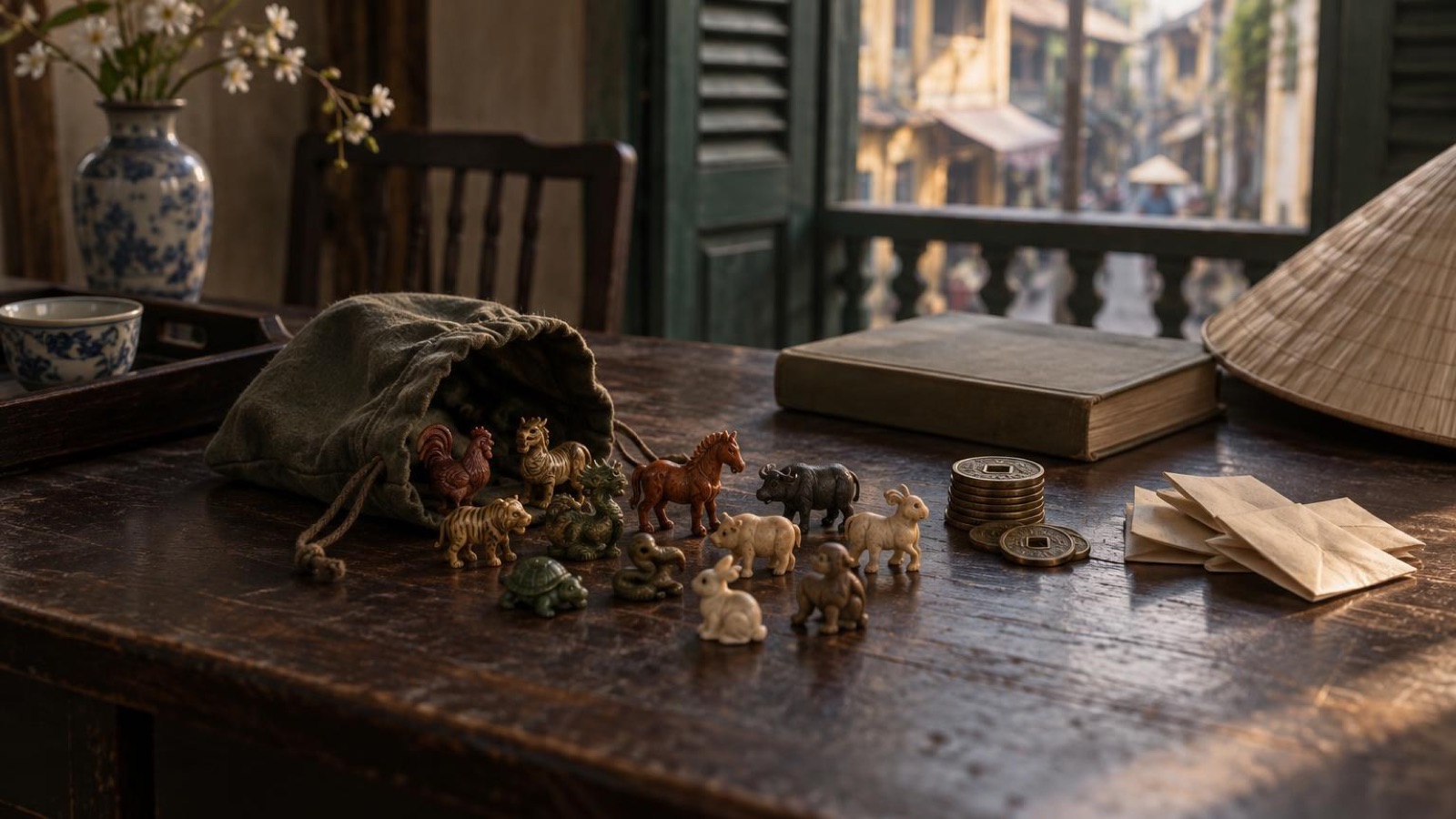
The game in André Demaison's 1935 novel Le Jeu des 36 Bétes
The clearest window into the jeu des 36 bêtes is a work of fiction. André Demaison's 1935 novel about colonial Vietnam, Le Jeu des 36 Bêtes, takes its title from the game and features it as a popular pastime of the period1. The book is one of the few places where the game appears by name in a French-language source, which is why the title has stuck as the way English readers refer to it.
The name translates simply as "the game of the 36 animals." The structure is the same one that runs through Chinese-influenced Asia: 36 creatures, each tied to a number, with players staking money on the animal they believe will come up. A draw or reveal decides the result. The appeal is the same as any numbers game, a small stake, a quick result, and a story attached to every creature on the board.
If you want the wider family this game belongs to, the 36 Animals lottery page traces how huahui, the jeu des 36 bêtes and the region's flower lotteries connect. The Vietnamese version sits inside that same tradition rather than standing apart from it.
Traditional games of chance in Vietnam: bai choi and tam cuc
Long before casinos, Vietnam had its own games of chance, and two of them still matter today.
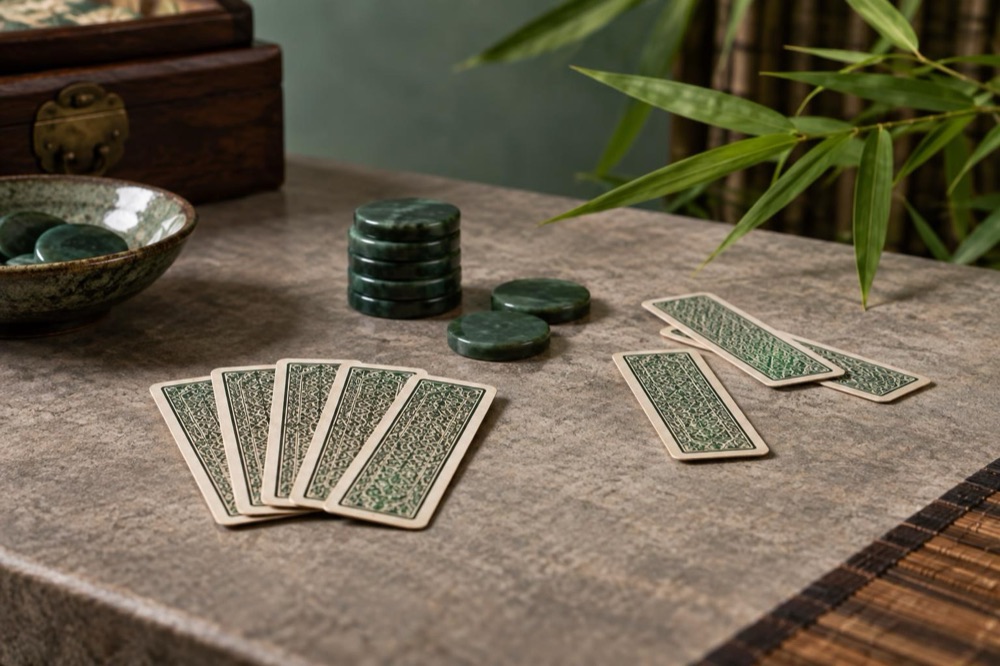
Tam cúc is a folk card game from northern Vietnam2. It is played with a small deck of picture cards rather than the 52-card Western pack, and it turns up most often around Tet, when families gather and the game becomes part of the holiday. It is a game of skill and bluff as much as luck, which is why it has survived as a social pastime rather than a betting product.
Bai choi is the more public tradition. The game and its songs were developed by the Mandarin Dao Duy Tu (1572-1634) to help locals protect their crops, and the sung performance grew around that practical purpose3. Players sit around a hut-like structure and place their bets on cards while a performer sings riddles and verses that hint at the answer. It is part gambling, part theater, and it belongs to central Vietnam in particular.
UNESCO inscribed bai choi of central Vietnam on its Representative List of the Intangible Cultural Heritage of Humanity in December 2017, at the committee's 12th session in Jeju, South Korea. The recognition covers the art form as a whole, songs and game together. If you want the full story of that listing, the bai choi UNESCO page covers it, and Bai Choi vs Tam Cúc compares the two games side by side.
Both games show the pattern that runs through Vietnamese gambling history: chance wrapped in community, played at festivals and family gatherings rather than in dedicated halls. The colonial-era animal game sat at the other end of that spectrum, a commercial numbers product that anyone could buy into.
Gambling in Vietnam today: what is legal and for whom
Modern Vietnam prohibits most forms of gambling, with limited exceptions such as state-run lotteries and licensed casinos for eligible patrons8. That single sentence covers a lot of ground, so it is worth unpacking what is actually available and to whom.
The venues. Vietnam has nine licensed land-based casinos, made up of six small-scale and three large projects, plus roughly 60 electronic gaming clubs9. The nine are the ones that matter for a visitor: they are the legal, regulated venues, and they are where the country's casino industry actually operates.
Who can walk in. Foreign visitors and overseas Vietnamese holding valid passports can play at any of the nine licensed casinos4. The practical requirements are an original passport and an age of 21 or older at the time of entry4. There is no entry fee for foreign passport holders at these venues4.
Vietnamese citizens. This is where the rules tighten. Vietnamese citizens may enter casinos only at designated pilot-scheme projects, and only if they meet the conditions attached to that scheme10. The pilot covers specific projects, and the government has issued a resolution allowing eligible Vietnamese citizens to enter casinos at several casino business projects5. The conditions are age and income related, and the entry levy has been a moving target: authorities have sought higher fees for locals entering a casino as a way of simplifying the verification of financial eligibility7.
Money inside. For Vietnamese citizens playing under the pilot, only VND may be used to buy gaming chips, and winnings or leftover chips are exchanged back into VND10. That keeps the currency loop closed and the transaction traceable.
The pilot's future. The pilot program allowing Vietnamese citizens to gamble in casinos has been extended, but the extension came with a condition: businesses must stop allowing Vietnamese citizens to gamble until the government issues a decree either ending or continuing the permission11. In other words, the arrangement is not permanent, and anyone planning around it should check the current position before traveling.
Age. Twenty-one is the floor for casino entry in Vietnam, and it applies to all visitors4. Vietnamese citizens entering under the pilot must additionally show full civil act capacity under Vietnamese law6. The draft decree on casino business keeps the same threshold, requiring Vietnamese nationals to be at least 21 years old and to possess full legal capacity9. For comparison, Vietlott's Keno draw game sets its own minimum of 18 years old10.
Online. Online gambling is not regulated for local players, and locals are not allowed to gamble online in the country7. Authorities treat all gambling and football betting, including online, as prohibited and strictly punished13. Many gambling sites have been blocked at the ISP level since 20184. The practical risk is straightforward: online betting from Vietnam sits outside any legal framework, and the enforcement record is not theoretical.
Sports betting. Betting is defined in Vietnamese rules as a paid entertainment game in which participants predict the outcome of sports or entertainment events, with prizes paid in money or goods convertible to money14. Under the current framework, betting on international football is limited to tournaments announced and approved by FIFA15. Horse and dog racing betting is narrower still: enterprises may only take bets based on results of races at racetracks organized by the betting enterprise itself15. A draft decree would widen this, allowing enterprises to use horse races organized abroad by the IFHA or its members, and Greyhound races abroad, for betting in addition to their own races15. The same draft would let enterprises decide their own betting products based on the finishing positions of horses and dogs and events during the race, set out in betting rules filed with the state agency16.
The direction of travel. Average income per person in Vietnam rose from USD 2,580 in 2016, when the sports betting decree was issued, to USD 4,700 in 202416. That growth is the backdrop to every proposal to widen legal gambling, and it explains why the pilot scheme and the racing drafts keep resurfacing.
What a first visit to a Vietnamese casino looks like
If you hold a foreign passport and want to see one of the licensed venues, the process is simple.

| Requirement | Detail |
|---|---|
| Document | Bring your original passport, not a copy, not a photo on your phone; it is the document that establishes your eligibility4 |
| Age | Be 21 or older; this is checked at entry and applies to everyone4 |
| Entry fee | Expect no entry fee as a foreign passport holder at the licensed venues4 |
| Currency | Most casinos accept USD, VND, and major credit cards for chip purchase4 |
The nine licensed casinos are the legal venues. Anything else advertising itself as a casino in Vietnam, or any online operator taking bets from inside the country, sits outside that list.
Racing and the draft rules that may change the picture
Horse and dog racing have their own track in Vietnamese gambling law, and the rules are being actively redrafted.
Under the current framework, an enterprise may only take bets on races held at its own racetrack15. That is a narrow permission, and it explains why racing betting has not grown the way casino gaming has. The draft decree under discussion would change that by allowing enterprises to use races organized abroad by the IFHA or IFHA members, and Greyhound races abroad, alongside their own fixtures15.
The draft also hands more control to operators. Enterprises would decide their own betting products, based on the finishing positions of the horses or dogs and on events during the race, with the rules filed with the state agency16. That is a significant shift from the current position, where the product set is tightly defined.
For football, the constraint is different. Betting on international football is limited to tournaments announced and approved by FIFA15. That rules out most of the club and friendly fixtures a casual bettor might look for, and it is why illegal football betting remains the enforcement priority it is. Authorities have repeatedly urged the public not to participate in football betting or any other form of illegal gambling, and to report suspected violations17. Illegal sports betting is prohibited in all forms, including on World Cup 2026 matches17.
Common Questions
What does 'jeu des 36 bêtes' mean in English?
It translates as 'the game of the 36 animals.' Players bet on one of 36 creatures, each linked to a number, and the winning animal is drawn or revealed. It is the French name for a numbers game that circulated widely in colonial Vietnam and across Chinese-influenced Asia.
When was bai choi added to the UNESCO intangible cultural heritage list?
Bai choi of central Vietnam was inscribed on UNESCO's Representative List of the Intangible Cultural Heritage of Humanity in December 2017, at the committee's 12th session held in Jeju, South Korea. The recognition covers the sung game and its performance tradition.
How many licensed casinos are there in Vietnam?
Vietnam has nine licensed land-based casinos, made up of six small-scale and three large projects, plus roughly 60 electronic gaming clubs. Foreign passport holders can play at any of the nine; Vietnamese citizens face additional conditions.
Can Vietnamese citizens gamble in casinos in Vietnam?
Only at designated pilot-scheme casinos, and only if they meet the age and income conditions. Elsewhere, casino gambling is closed to Vietnamese citizens. Foreign visitors and overseas Vietnamese with valid passports can enter the licensed venues.
What is the minimum age to gamble in a Vietnamese casino?
Twenty-one. That applies to all casino visitors, and Vietnamese citizens entering under the pilot scheme must also show full civil act capacity. Vietlott's Keno draw game sets its own minimum of 18.
Is online gambling legal in Vietnam?
No. Online gambling is not regulated for local players, and authorities treat online betting, including football betting, as prohibited. Many gambling sites have been blocked at the internet service provider level since 2018.
Sources17 sources
- Gambling and Globalization in Old Saigon: A Brief History of Số Đề in Vietnam
- Tam cúc
- Quang Nam welcomes UNESCO status for bai choi singing
- Gambling in Vietnam
- Vietnamese citizens are allowed to play in casinos at certain projects
- Người Việt có được chơi casino không?
- Finance ministry proposes higher casino entry fees for Vietnamese citizens
- Casino hợp pháp tại Việt Nam
- Casino Hồ Tràm có cho người Việt Nam vào chơi không? Điều kiện người Việt Nam được phép vào chơi tại
- Cách chơi Keno
- Pilot programme allowing Vietnamese to gamble in casinos extended
- Dự kiến 2 nhóm đối tượng được ra vào điểm kinh doanh casino
- Best Online Casinos for Players from Vietnam
- Bet thủ là gì? Bet thủ phải dự báo nhiều tuổi thì được tham gia các loại hình cá cược ở Việt Nam?
- Đề xuất quy định mới về kinh doanh đặt cược đua ngựa, đua chó, bóng đá quốc tế
- Toàn văn dự thảo nghị định kinh doanh đặt cược đua ngựa, đua chó và bóng đá quốc tế
- Nhận diện và chủ động đấu tranh với hành vi cá độ bóng đá trong mùa World Cup 2026















