
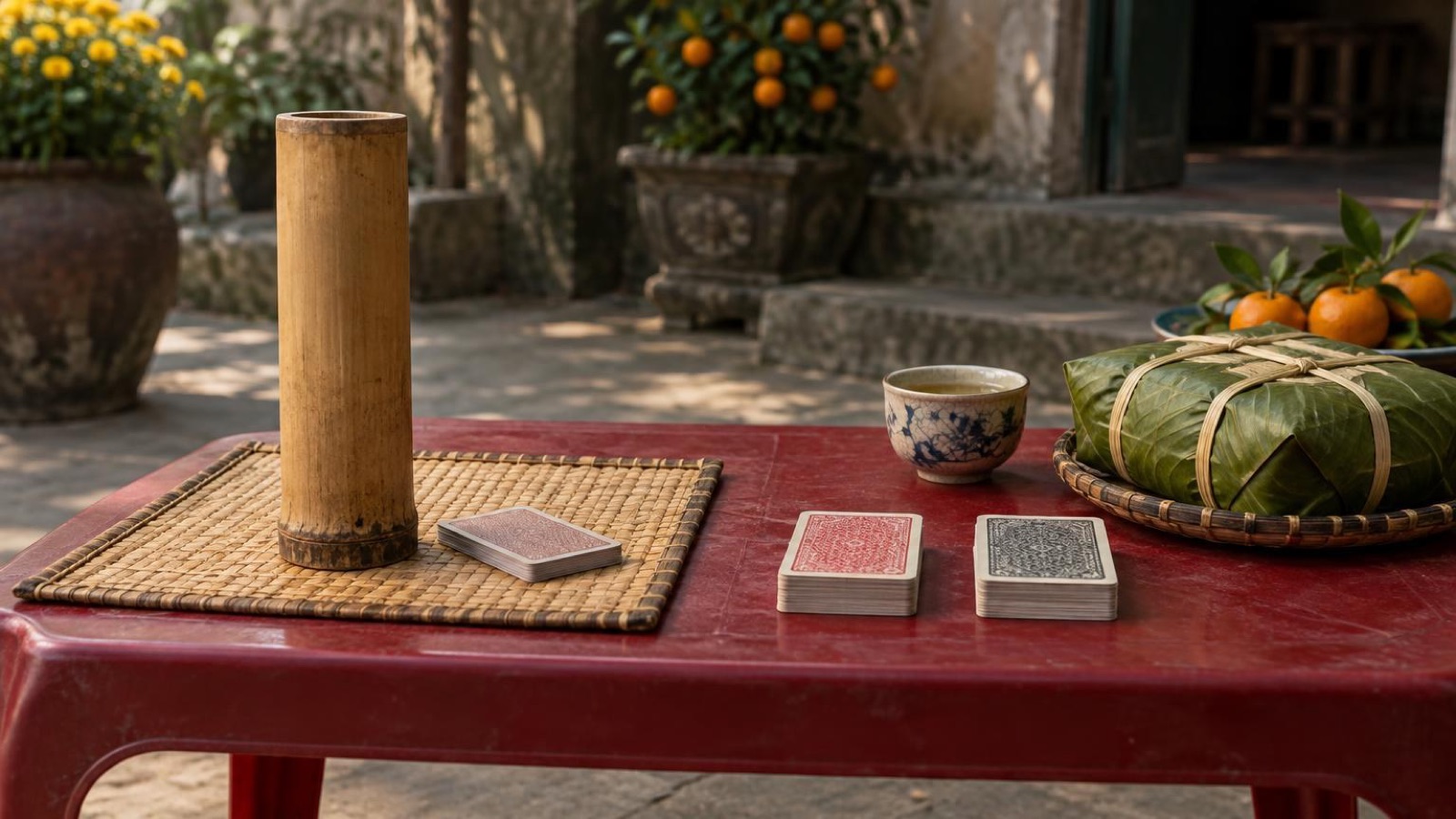
What bai choi and Tam Cúc are
These two games get lumped together because both are Vietnamese and both use cards, but they belong to different worlds. Bai choi is a performance game from central Vietnam, sung aloud, tied to festivals and to the UNESCO heritage list. Tam Cúc is a quiet home game from the north, played across a table during Tết while the bánh chưng cooks.
Tam Cúc is the older-feeling of the two in everyday life. It is a folk card game popular in northern Vietnam, played with a 32-card deck that mirrors the pieces of Chinese chess2. The deck splits into 16 red cards and 16 black cards, and the names are the same ones you would see on a xiangqi board:
- Tướng (the general)
- Sĩ (advisor)
- Tượng (elephant)
- Xe (chariot)
- Pháo (cannon)
- Mã (horse)
- Tốt (soldier)2
Bai choi is a different animal entirely. It is not a card game you sit down to in silence. It is a sung game, performed with a deck and a bamboo tube, where the caller sings the name of the card and the players respond. It belongs to the festival culture of central Vietnam, and it has been recognized internationally as a piece of living heritage.
Both games have deep roots. The Vietnamese card tradition that produced Tam Cúc and Tổ tôm traces back to Tứ sắc, an older four-color card game that is the predecessor of both4. That lineage matters because it explains why Tam Cúc's deck looks like a chess set rather than a French deck: it grew out of an indigenous card tradition, not out of the 52-card pack that arrived with European contact.
Bai choi: the game and its cultural recognition
Bai choi is played with a deck of 30 cards and a bamboo tube. The caller draws a card from the tube and sings its name, and the players mark their boards. The singing is the point as much as the winning is. The game is performed at festivals, at community events and on stages, and it is one of the few gambling-adjacent folk games in Asia that has been formally recognized as cultural heritage.
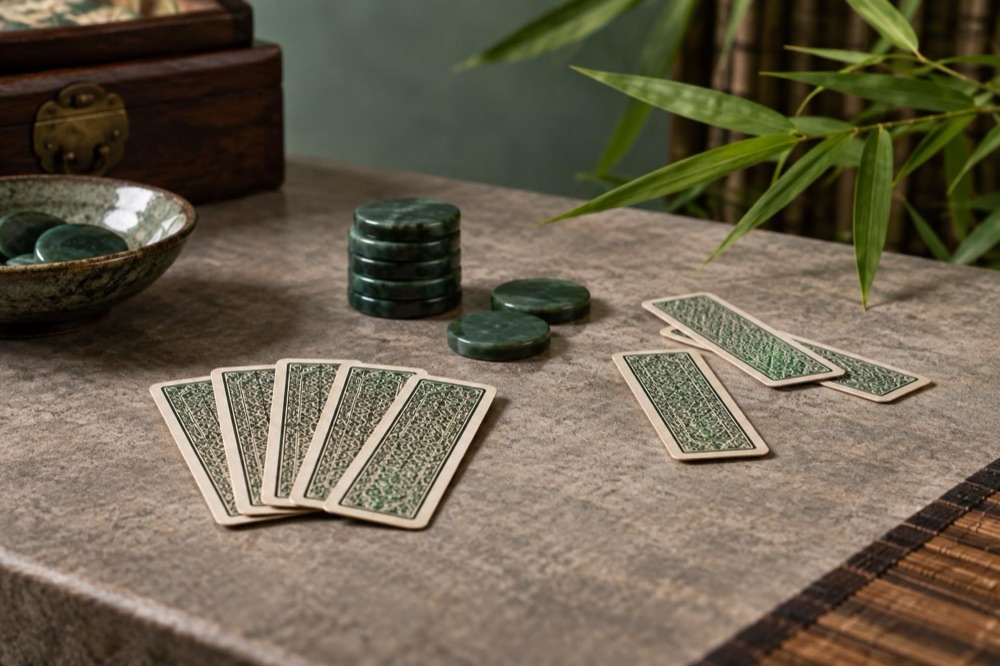
That recognition matters for a practical reason. It means bai choi is not treated as a vice to be suppressed. It is treated as something to be preserved, taught and performed. You will see it at heritage festivals in Hoi An and across central Vietnam, and you will see it performed by troupes rather than by people quietly gambling in a back room.
The game's structure is simple enough that a visitor can follow it after one round. The caller sings, the players listen for the card name, and the first to complete a set wins. The skill is in the listening and the marking, and the atmosphere is closer to a folk concert than to a card table.
If you want the full history of the UNESCO listing, including the date and the criteria, that is covered separately in When Did UNESCO Recognize Bai Choi?. For the broader picture of games that have been formally recognized as heritage across Asia, see Gambling Games Recognized as Cultural Heritage.
Bai choi on the international stage: performances in Germany and Japan
These are cultural diplomacy events, not gambling events. The point of the performances is to introduce the game as a piece of Vietnamese heritage, and the audiences are festival-goers rather than players. If you are in Japan or Germany and want to see bai choi, the way to do it is to watch for Vietnamese cultural festivals and heritage events rather than to look for a card room.
The pattern is worth noting because it tells you what bai choi is in practice today. It is a performance tradition with a card game inside it, and its public life happens on stages and at festivals. That is a very different public life from Tam Cúc, which happens at kitchen tables.
Tam Cúc: how the game is played
Tam Cúc is played by 4, 3 or 2 people, and the rules shift slightly depending on how many are at the table2. The deck is 32 cards, split into 16 red and 16 black. Each color has one Tướng and five Tốt, and two of every other card2. The red version of a card beats the black version of the same card, so a red Xe beats a black Xe2.
The combinations are where the game gets its character. A pair is two cards of the same color and the same name2. A triple is three cards of the same color in sequence, but not every sequence counts: Sĩ-Tượng-Xe, Tượng-Xe-Pháo, Pháo-Mã-Tốt and three Tốt are not valid triples2. Four Tốt of the same color is a special set called tứ tử or tứ quý2.
The opening rule is the part that trips up newcomers. In a 2-player or 4-player game, the saying is "cấm tướng, cấm sĩ lấy tượng cầm đầu": you cannot lead with Tướng or Sĩ, and only the red Tượng may be led on the first call2. In the 3-player variant, the rule changes to "cấm sĩ, cấm tượng lấy xe cầm đầu", and the red Xe becomes the highest card allowed on the first call2. Leading a forbidden card is a foul, and that card cannot win the trick.
The endgame has its own vocabulary. The dealer calls a pair of black Tốt, and winning that is called kết đôi. Calling three black or red Xe-Pháo-Mã at the end is called kết ba, and being beaten by a larger set is called đè2. The scoring bonuses vary by playing group, but a common example is kết đôi adds 2, đè 4, kết ba adds 3, đè 6, and a tứ tử win adds 8 with đè 16, with the bonus sets required to be black2.
For the 3-player variant, you remove cards before the deal: either one red Tốt and one black Tốt, or five specific cards (Tướng ông, tướng bà, one sĩ điều, one tốt đỏ and one tốt đen)2. The red Sĩ card is called Sĩ điều2.
One practice worth knowing about, because you may see it at a table: "đi đêm", where players secretly exchange cards face down to benefit both sides2. It is not cheating in the eyes of the groups that use it; it is a house convention. If you sit down with a group that plays it, expect it.
Tam Cúc is mainly played by women, because the deck is small and the game is quick; men more often play Tổ tôm2. It is played during festivals and Tết, and people in the Red River Delta traditionally play it while waiting for the bánh chưng to cook2.
Key differences between the two games
The two games differ in almost every practical way. Bai choi is sung, public and performed; Tam Cúc is silent, private and played at home. Bai choi has a heritage listing and an international performance schedule; Tam Cúc has a kitchen table and a Tết tradition. Bai choi uses a 30-card deck and a bamboo tube; Tam Cúc uses a 32-card deck modeled on Chinese chess pieces.
| Bai choi | Tam Cúc | |
|---|---|---|
| Where it is from | Central Vietnam | Northern Vietnam |
| How it is played | Sung, with a caller and a bamboo tube | Quietly, with cards dealt to 2, 3 or 4 players |
| Deck | 30 cards | 32 cards, 16 red and 16 black |
| When you see it | Festivals, heritage events, stages | Tết, family gatherings, festivals |
| Who plays it | Performers and festival audiences | Mainly women, in the north |
| Heritage status | Recognized internationally | Folk tradition, no formal listing |
The comparison that matters most for a visitor is this: if you want to see bai choi, go to a festival or a heritage event. If you want to play Tam Cúc, you need a Vietnamese family or a group of friends who already know the rules, because it is not a game you will find taught in a public venue.
Are card games like these legal in Vietnam?
Playing Tam Cúc at home for fun is not the same as gambling for money. Organizing gambling or gambling for money is illegal in Vietnam, and the authorities treat it as a public order offense that brings risks of loan sharking, theft, robbery, fraud and assault3. That is the practical line: a friendly game with no stakes is one thing, and money changing hands is another.
The line is enforced. In Ho Chi Minh City, bridge and poker associations are allowed to exist, but the city's crime police have said that clubs have served as fronts for illegal gambling5. That is the pattern to understand: a legal-looking card club can still be a gambling operation in the eyes of the police, and the police act on it.
If you are a visitor, the safe reading is simple. Do not join a money card game in Vietnam, and do not assume that a private club is legal because it has a sign. If you want to gamble legally in Vietnam, the licensed casinos are the only clear route, and they have their own rules.
Where gambling stands for locals and foreigners in Vietnam
Vietnam has legalized brick-and-mortar casinos, and locals were banned from land-based casinos for over a decade before being allowed back in7. There are currently six legal casinos serving foreigners8. Foreign passport holders can enter them, and the minimum age for casino gambling in Vietnam is 18 for foreign visitors7.
For Vietnamese citizens, the rules are tighter and newer. A government resolution allows eligible Vietnamese citizens to enter casinos at several casino business projects, including Phú Quốc, Hồ Tràm and Vân Đồn9. The Hồ Tràm casino project in HCM City runs a pilot allowing eligible Vietnamese citizens to enter for five years from November 26, 20259. Vietnamese players entering casinos must be 21 or older9.
There are conduct rules inside the casino for Vietnamese players. They may not use the results of casino games to bet directly with each other, and they may not cause insecurity, disorder or social safety problems at the casino10. They may only use Vietnamese dong to exchange for gaming chips, and they may exchange chips back into dong if the chips are unplayed or represent winnings10.
The entry fee for locals has been a moving target. The Finance Ministry has proposed higher casino entry fees for Vietnamese citizens, in part to simplify the process of verifying financial eligibility to gamble7. If you are a Vietnamese citizen planning a casino visit, check the current fee at the specific property before you go, because the pilot terms are still being adjusted.
Betting is a separate category with its own age rule. Players in Vietnam's permitted betting types must be 21 or older with full civil act capacity11. That covers the forms of betting the state permits, not the informal card games at home.
Online gambling and ISP blocking in Vietnam
Online gambling sits in a gray zone. Vietnam does not issue licenses to online poker operators, and the market remains a gray zone12. Locals are not allowed to gamble online in the country7. At the same time, users report no ISP blocking of online poker in Vietnam, and the platforms are accessible in practice, though exposed to possible domain blocks or payment disruptions12.
That combination is worth reading carefully. The absence of blocking does not make it legal, and the absence of licensing does not make it safe. Enforcement focuses on providers, not on Vietnamese poker players6.
The official position is unambiguous. All gambling and football betting, including online, is prohibited and strictly punished6.
For a visitor or expat, the practical takeaway is the same as for locals. If you want to gamble in Vietnam, the licensed casinos are the legal route, and the online market is not. If you are looking at the country's casino landscape more broadly, the Vietnam country guide covers the venues, the entry rules and what to bring.
Common Questions
Is bai choi the same as Tam Cúc?
No. Bai choi is a sung card game from central Vietnam, performed with a deck of 30 cards and a bamboo tube, and recognized by UNESCO. Tam Cúc is a 32-card game from northern Vietnam played quietly at home, especially during Tết. They share nothing but the fact that both use cards.
Where can you see bai choi performed today?
Bai choi is performed at festivals in Hoi An and across central Vietnam, and has traveled abroad to Germany and Japan. In 2023 it appeared at the Hoi An Lantern Festival in Wernigerode, Germany, and in 2024 at events in Sakai and Osaka, Japan.
Is playing cards for money illegal in Vietnam?
Organizing gambling or gambling for money is illegal in Vietnam and carries real legal risk. Friendly card games at home with no stakes are a different matter. If money changes hands, you are in the territory the authorities actively prosecute.
Can Vietnamese citizens enter casinos?
Yes, at certain projects. A government resolution allows eligible Vietnamese citizens to enter casinos at several casino business projects, including Phú Quốc, Hồ Tràm and Vân Đồn. The Hồ Tràm project runs a five-year pilot from November 26, 2025. Vietnamese players must be 21 or older.
Can foreigners gamble in Vietnamese casinos?
Yes. Foreign passport holders can enter Vietnam's licensed casinos, of which there are six serving foreigners. The minimum age for casino gambling in Vietnam is 18 for foreign visitors. Bring your passport, since casinos check it at entry.
What is the minimum age to gamble in Vietnam?
For foreign visitors, the legal casino gambling age is 18. For Vietnamese citizens entering casinos under the pilot scheme, the minimum is 21 with full civil act capacity. Betting players in Vietnam must also be 21 or older.
Are online gambling sites blocked in Vietnam?
Vietnam does not issue licenses to online poker operators, and the market remains a gray zone. Users report no ISP blocking of online poker, though domain blocks and payment disruptions are possible. Locals are not allowed to gamble online.
Sources12 sources
- Bai choi of Hoi An performed in Japan, Hoi An World Heritage
- Tam cúc, Wikipedia
- Lâm Đồng đấu tranh triệt xóa đường dây tổ chức đánh bạc, Bộ Công an
- Tứ sắc, Wikipedia
- 21 arrested in poker ring bust in HCM City, Vietnam News
- Police arrest 27 suspects of major online gambling money laundering ring, Vietnam News
- Best for players from Vietnam, Wizard of Odds
- Danh sách sòng bạc ở Việt Nam, Wikipedia
- Vietnamese citizens are allowed to play in casinos at certain projects, Vietnam News
- Casino Hồ Tràm có cho người Việt Nam vào chơi không, Thư Viện Pháp Luật
- Bet thủ là gì, bet thủ phải đủ bao nhiêu tuổi, Thư Viện Pháp Luật
- Online Poker Vietnam, So Much Poker















