
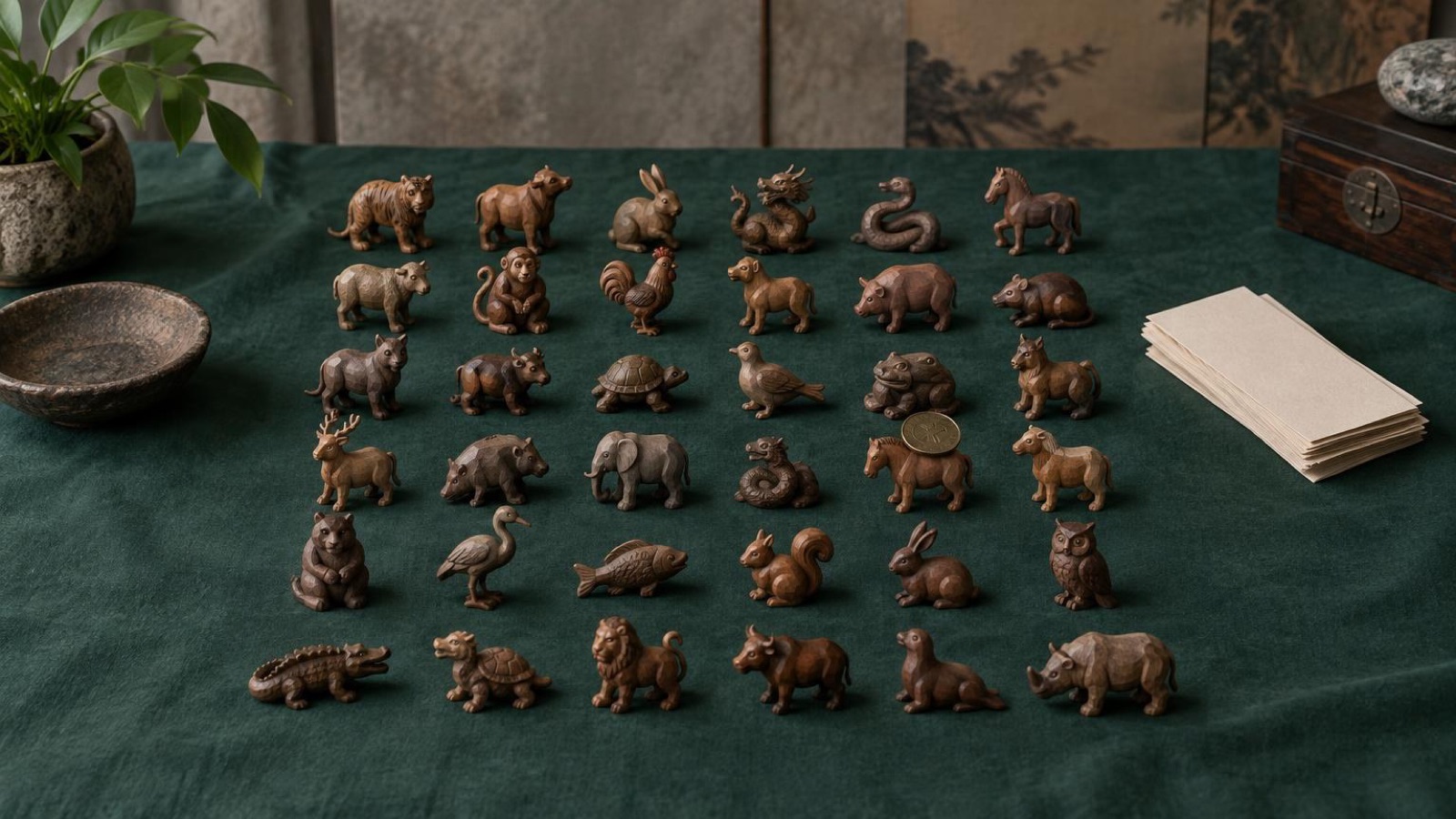
What the 36 animals lottery is
The 36 animals lottery is a family of numbers games that spread across southern China, Macau and colonial Vietnam in the 19th and early 20th centuries. The core idea is simple: a board of 36 figures, each tied to an animal, a character or a number, and you pick one. If your figure comes up, you win. If it does not, the ticket is worthless.
The game went by several names. In Chinese communities it was the flower lottery, or huahui. In colonial Vietnam, where French administrators and Vietnamese players both used it, it was the jeu des 36 bêtes, the game of the 36 beasts. The animals gave players something to hold onto: a tiger, a dragon, a rooster, a rat. You did not need to read or do arithmetic to play. You picked the animal you liked, or the one your dream told you to pick, and you bought a ticket.
That accessibility is why the game spread so widely. It was cheap, it was fast, and it did not require a track, a table or a dealer. A shopkeeper with a board and a box could run it. In port cities and market towns, the flower lottery was often the only gambling a working person could afford.
The 36 figures are the whole game. There is no draw of several numbers, no combination to get right, no partial win. One figure per round. That simplicity is also what made it easy to rig, easy to ban and easy to revive under a new name.
Flower lottery rules: one figure out of 36
The rules of the flower lottery are about as short as gambling rules get. The operator posts a board of 36 figures. Each figure has a name, usually an animal or a classical character. You choose one figure and pay for your ticket. At the draw, one figure is revealed. If it matches yours, you are paid at the posted odds. If not, you lose your stake.
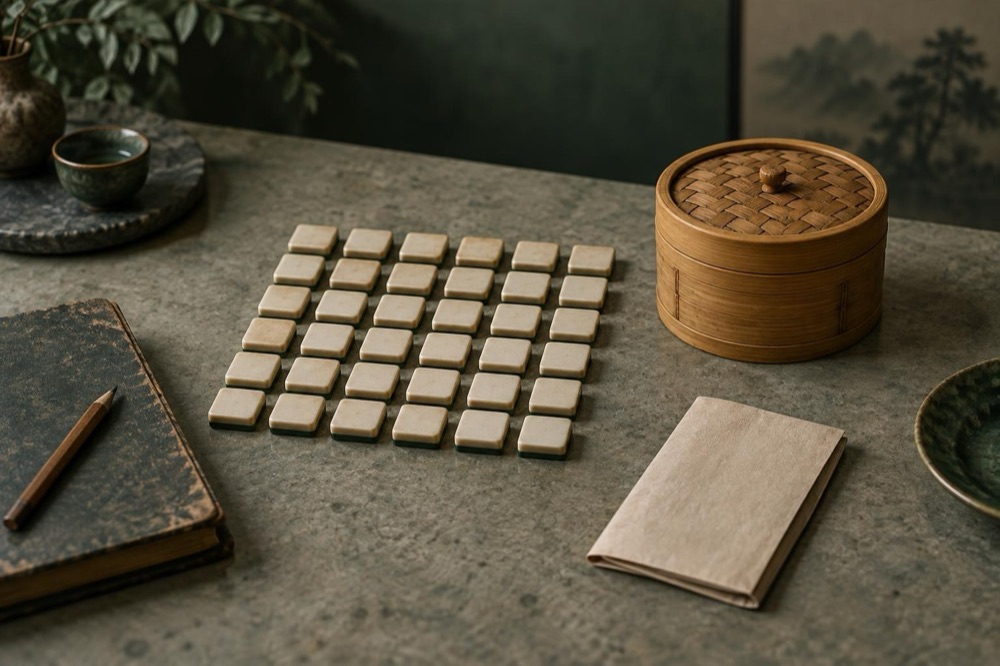
Different operators ran the draw differently.
- Some used a physical drawing from a container.
- Some used a printed result sheet.
- Some, in the White Pigeon style, used characters from the Thousand Character Classic, a classical Chinese text, to label the entries.
The characters 天, 地, 玄 and 黄 are among the ones that appear in the historical record, carried over from pigeon racing, where the birds were numbered with the same characters2.
The ticket itself was usually a slip of paper with the figure printed or written on it. In smaller operations, the shopkeeper kept a ledger and the player got a token. In larger ones, the ticket was a printed slip with the operator's mark. Either way, the player's only decision was which of the 36 to pick.
Because there is only one decision, the flower lottery attracted a lot of ritual. Players consulted dream books, temple fortune slips and almanacs before choosing a figure. That side of the game is covered in more detail in dream numbers and asking spirits for numbers.
House edge: 0 to 25% depending on the game
The house edge in the flower lottery family ranged from about 0 to 25 percent, depending on the game and the operator1. That is a wide range, and it reflects how many variants existed. A game with 36 figures paying 30 to 1 leaves the operator a thin margin. A game paying less, or taking a commission on winnings, leaves a much fatter one.
The White Pigeon lottery sat at the high end. Its house edge was about 24 percent after a 5 percent commission fee on winnings1. That is a steep edge by modern standards. For comparison, American roulette carries a house edge of 5.26 percent4. The White Pigeon ticket was roughly four to five times more expensive to play, in expected-value terms, than a spin of an American wheel.
For players, the practical point is that the flower lottery was never a fair bet. The operator set the odds, and the operator set them to make money. A 30 to 1 payout on a 36-figure board sounds generous until you work out that a fair payout would be 35 to 1. The gap is the operator's margin, and in some variants the gap was much wider.
That margin is also why the game was so profitable for the people who ran it, and why colonial governments and dynasties alike wanted a piece of it. The gambling farm systems that grew up around games like this are covered in gambling farms and monopolies.
Payouts and odds across variants
Payouts varied by operator, era and region. The classic flower lottery paid roughly 30 to 1 on a winning single figure. Some variants paid less, some paid more. The White Pigeon ticket paid on a different structure, closer to a keno game, with a commission taken on winnings.
To see how these odds compare with games you might know, it helps to look at the payout structures of modern legal lotteries and betting games. In Japan, LOTO6 is a pick-six game where you choose six different numbers from 1 to 43, and the prize amounts vary each draw according to sales and the number of winning entries5. The BIG lottery works the same way: prize amounts vary with sales and the number of winning tickets, and the first-prize figures are theoretical values6.
In China, the welfare lottery's Double Color Ball has a fixed structure: each bet is six red ball numbers and one blue ball number, with red balls chosen from 1 to 33 and blue balls from 1 to 167. The prize fund is 50 percent of total sales, of which 49 percent is the current draw prize fund and 1 percent is the adjustment fund7. Kuaile 8, another welfare lottery game, pays 8,000 yuan for pick-nine match-nine, capped at 250,000 yuan, and 52 yuan for pick-six match-three8.
Those modern games are all legal, state-run and transparent about their prize funds. The flower lottery was none of those things. Its payouts were set by the operator, and the operator's margin was whatever the market would bear.
| Game | Payout on a win | House edge | Where it ran |
|---|---|---|---|
| Classic flower lottery | About 30 to 1 on one figure | 0 to 25 percent depending on variant1 | Southern China, Macau, colonial Vietnam |
| White Pigeon lottery | Keno-style, commission on winnings | About 24 percent after 5 percent commission1 | Macau |
| American roulette (for comparison) | Varies by bet | 5.26 percent4 | Casinos worldwide |
Where the game was played: Zhejiang, Shanghai, Heilongjiang
The flower lottery was played across a wide belt of China. Zhejiang, Shanghai and Heilongjiang all had active flower lottery markets at different points. Shanghai, as a treaty port with a large transient population and a dense network of small shops, was a natural home for a cheap, fast numbers game. Zhejiang, just to the south, had similar conditions. Heilongjiang, far to the northeast, shows how far the game traveled from its southern origins.
The game also crossed into Vietnam, where it became the jeu des 36 bêtes. Colonial Vietnam had its own lottery traditions, and the 36 beasts game fit neatly into the existing betting culture. The Vietnamese version is covered in more detail in what was the jeu des 36 bêtes lottery in colonial Vietnam.
In Hong Kong, the legal lottery landscape is different. The Mark Six is a 6-out-of-49 lottery game run by the Hong Kong Jockey Club9. Tickets can be bought at the Club's Sha Tin and Happy Valley racecourses, off-course betting centers and any location where participants may submit lottery entries, including the Club's official website and other approved internet sites10. That is a state-sanctioned, tightly controlled model, the opposite of the informal flower lottery shop.
Macau is where the White Pigeon ticket survived. The territory's gaming industry offers white pigeon tickets with local character, alongside internationally renowned large casinos11. The game is a small, distinctly local product in a market dominated by baccarat and slot machines.
Who could open a lottery shop
In the flower lottery era, almost anyone with a bit of capital and a tolerant local authority could open a shop. The barrier was low: a board, a box, a ledger and a supply of tickets. That low barrier is why the game spread so fast and why authorities found it so hard to stamp out.
In modern legal lottery systems, the barrier is much higher. In Hong Kong, a lottery agent is any person, firm or company approved by the operator at whose premises participants may submit entries and collect prizes or refunds10. You cannot simply open a shop and start selling tickets. You need the operator's approval.
In Vietnam, the state lottery system has been consolidating. A 2025 law provided the legal basis for transferring owner representation of eight provincial lottery companies from provincial People's Committees to the Ministry of Finance, represented by Vietlott12. Vietlott began business operations in 201612. That is a state-controlled model, with the Ministry of Finance at the center.
In India, lottery agent lists are published by state governments. The Maharashtra lottery agent list for 2025 includes agents in Mumbai, Ahmednagar and other cities13. That is a licensing model, where the state publishes who is allowed to sell.
The contrast with the flower lottery era is stark. Then, the game was informal and locally run. Now, legal lotteries are licensed, audited and centralized. The flower lottery's low barrier to entry is exactly what made it a target for bans.
The White Pigeon lottery: a related keno-style game
The White Pigeon lottery is the closest surviving relative of the flower lottery. It is a keno-style game, meaning players pick from a pool of numbers or characters, and the draw selects a set of winners. The name comes from pigeon racing gambling, in which characters of the Thousand Character Classic such as 天, 地, 玄 and 黄 were used to number pigeons2.
That origin matters because it explains the game's character. Pigeon racing was a spectator sport with a betting culture around it. When the betting moved from the birds to a printed ticket, the characters stayed. Players were not picking numbers in the modern sense. They were picking classical characters, which gave the game a literary flavor that the flower lottery's animals did not have.
The White Pigeon ticket has been offered in Macau since the early 20th century2. It is one of the territory's older gaming products, predating the modern casino boom.
Macau's casinos are open 24 hours2. That is the environment the White Pigeon ticket operates in: a round-the-clock gaming market where a small, local-character game coexists with international casino brands.
White Pigeon Ticket in Macau: a small-stakes game with frequent draws
The White Pigeon ticket in Macau is a small-stakes game. Tickets have historically been sold at low denominations, and draws run multiple times a day. The exact price and draw schedule have varied over the years, but the model is consistent: cheap tickets, frequent draws, a local character pool.
Macau's gaming regulator publishes forms and rules for various gaming activities, including raffles and charity draws. A charity lucky draw application form lists a ticket price of MOP 10,000 and a total prize value of MOP 100,000,00014. That is a different product from the White Pigeon ticket, but it shows the range of gaming products the regulator oversees.
For comparison, Macau's craps rules show how the territory regulates table games in detail. A Field bet pays 1:1 on totals of 3, 4, 9, 10 and 11, and 1:2 on a total of 215. A Field total of 12 pays double or triple the bet, at the choice of the concessionaire15. That level of specificity is typical of Macau's gaming regulation.
The White Pigeon ticket is a much simpler product. You buy a ticket, you pick your characters, you wait for the draw. The appeal is the low price and the local flavor. It is not a game for high rollers. It is a game for people who want a small, cheap flutter with a bit of history attached.
Legal status: bans in Qing dynasty Guangdong
The flower lottery was banned in Qing dynasty Guangdong, and that ban set the pattern for later prohibitions. The game was seen as a social problem: it drained money from working people, it was associated with organized crime, and it was hard to tax. Bans were issued, and the game went underground or moved to jurisdictions where it was tolerated.
That pattern repeated across Asia. The history of gambling bans in the region is covered in more detail in historic gambling bans in Asia and what Chinese games were banned under the Qing dynasty.
In mainland China today, the legal position is clear. Only the state welfare lottery and sports lottery are legal. Unauthorized online sales of welfare lottery or sports lottery tickets are illegal3. The legal lottery types include lotto, numbers, sports betting, traditional, instant, video and keno types3. The flower lottery is not among them.
Provincial lottery games exist, but they are tightly controlled. Guangdong Kuai Le Cai was approved by the Ministry of Finance, with sales limited to within Guangdong Province16. That is the modern model: state-approved, province-limited, audited.
For anyone in mainland China today, the practical position is simple. The 36 animals lottery is not a legal game. Playing it, or playing on unauthorized online lottery sites, carries real legal risk. If you want to play a legal lottery in China, the welfare lottery and sports lottery are the only options.
White Pigeon vs flower lottery: how they differ
The White Pigeon lottery and the flower lottery are cousins, but they are not the same game. The differences matter if you are trying to understand what survived and what did not.
The flower lottery is a single-figure game. You pick one figure out of 36, and you win or lose on that one pick. The payout is roughly 30 to 1, and the house edge ranges from about 0 to 25 percent depending on the variant1.
The White Pigeon lottery is a keno-style game. You pick from a pool of characters, and the draw selects a set of winners. The house edge is about 24 percent after a 5 percent commission on winnings1. The character pool comes from the Thousand Character Classic, and the game's name comes from pigeon racing2.
The flower lottery was played across southern China, Macau and colonial Vietnam. The White Pigeon ticket survived mainly in Macau, where it has been offered since the early 20th century2.
The flower lottery was banned in Qing dynasty Guangdong and is illegal in mainland China today. The White Pigeon ticket is a legal, regulated product in Macau11.
If you want to see the White Pigeon ticket today, Macau is the place. If you want to understand the flower lottery, you are looking at history. The game that once filled market towns across southern China is now a subject for museum exhibits and family stories, not a ticket you can buy.
Common Questions
How many figures are in the Huahui lottery?
The flower lottery is built around 36 figures, each tied to an animal, a character or a number. Players pick one figure per ticket. The 36 figures are the whole game: there is no draw of several numbers, just one winning figure per round.
What is the payout if you pick the winning figure?
Payouts varied by operator and era, but the classic flower lottery paid roughly 30 to 1 on a winning single figure. The house kept the rest. Some variants paid less, some paid more, depending on how the operator set the odds and how many tickets were sold.
What is the house edge in the flower lottery?
The house edge ranged from about 0 to 25 percent depending on the game and the operator. The White Pigeon lottery carried a house edge of about 24 percent after a 5 percent commission on winnings. Flower lottery variants with fewer figures or different payouts sat elsewhere on that range.
What characters are used in the White Pigeon lottery?
The White Pigeon lottery used characters from the Thousand Character Classic, a classical Chinese text. Characters such as 天, 地, 玄 and 黄 were used to number the pigeons in the racing game the lottery grew out of. The same characters carried over into the ticket game.
Where can you still play the White Pigeon Ticket?
The White Pigeon ticket survives mainly in Macau, where it is offered as a local-character game. It has been part of Macau's gaming scene since the early 20th century and remains a small, distinctly local product.
Is the 36 animals lottery legal in China?
No. The 36 animals lottery is not a legal game in mainland China. Only the state welfare lottery and sports lottery are legal, and unauthorized online sales of those are themselves illegal. The flower lottery and its variants have been banned since the Qing dynasty.
Sources16 sources
- Despacho do Secretário para a Economia e Finanças, Boletim Oficial de Macau, 2025
- Gaming, Macao Government Tourism Office, 2021
- Illegal Lottery Notice, Ministry of Finance, 2018
- European Roulette, PlaySmart, 2026
- LOTO6, Takarakuji Official, 2026
- BIG Lottery, Toto Dream, 2026
- Double Color Ball Game Rules, China Welfare Lottery, 2012
- Kuaile 8, China Welfare Lottery, 2026
- Responsible Gambling, Hong Kong Jockey Club, 2026
- Lotteries Rule, Hong Kong Jockey Club, 2020
- Gaming, Macao Government Tourism Office, 2021
- Provincial Lottery Company Transfer, Báo Chính phủ, 2025
- Maharashtra Lottery Agent List, Maharashtra Lottery, 2025
- Charity Lucky Draw Application Form, DICJ, 2026
- Craps Rules, DICJ, 2010
- Guangdong Kuai Le Cai Approval, Ministry of Finance, 2014















