
The Qing dynasty gambling ban: in force from 1794
The Qing court did not wake up one morning in 1794 and decide gambling was a problem. It had been issuing narrower orders for generations, against particular games, particular cities, particular crowds. What the 1794 prohibition did was pull those threads together into a general ban on gambling for profit, and that is the date usually attached to the Qing dynasty gambling bans as a whole1.
The logic behind it was practical rather than moral. Gambling moved money sideways. It took silver out of households and put it in the hands of people the state could not tax or control, and it gathered men in rooms where talk could turn to other things. A court that already worried about secret societies, salt smugglers and local strongmen had good reason to dislike an activity that produced its own informal networks and its own credit system.
What makes the Qing case worth knowing about today is how familiar the target list looks. The games banned then are close cousins of the games restricted now, and the arguments used then are close cousins of the arguments used now. If you want the wider regional picture, historic gambling bans in Asia covers the edicts, shogunate laws and colonial prohibitions that ran alongside the Qing's.
What the ban covered, including lottery imitators
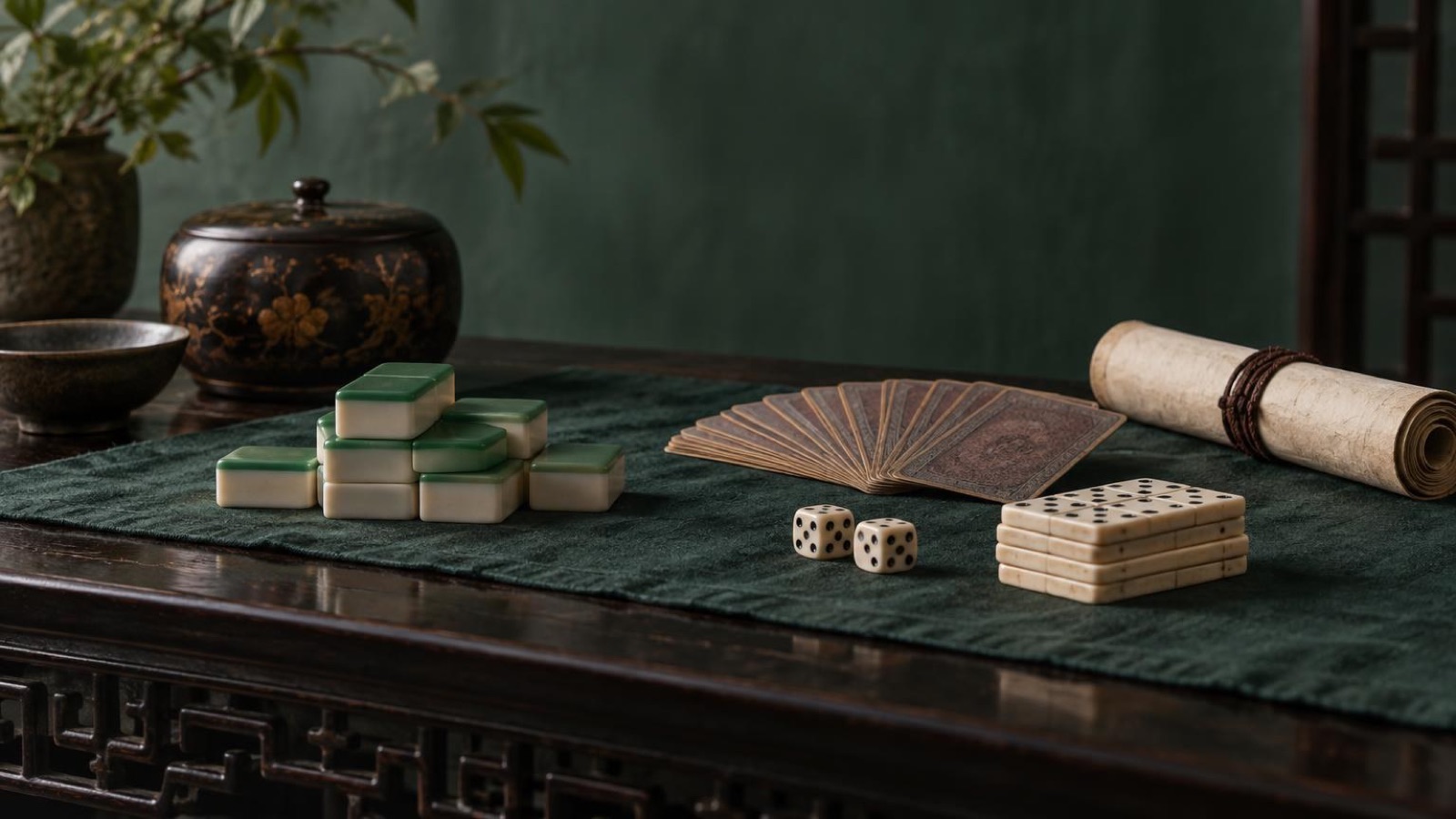
The Qing prohibition was aimed at gambling organized for profit, and in practice that meant the games ordinary people played for money. Cards. Dice. Dominoes. Mahjong as it took shape. Board and tile games played for stakes rather than for fun. And, importantly, the lottery-style games where players bet on drawn numbers, characters or symbols.

Those lottery imitators mattered most to the authorities, because they were cheap to run and reached the largest number of people. A single organizer with a list of numbers could take bets from an entire street. There was no table, no premises, no equipment to seize. That is exactly the shape of the problem mainland China still legislates against: the state lottery is fine, but anything that imitates it outside state control is not.
You can see the same instinct in the modern enforcement notices. A public security notice from Dingcheng District in Changde lists what is prohibited when gambling for profit6:
- Electronic game machines
- Chess and card games
- Mahjong
- Dominoes
- Dice
- Mark Six lottery
- The internet
- WeChat red packets
- Texas Hold'em
Read that list next to the Qing target list and the overlap is obvious. The technology changes. The categories barely move.
Modern Chinese regulation also reaches into the machines themselves. A 2019 regulation forbids gaming machines and devices from having gambling functions at all7. That is the same idea as banning the game rather than the venue: if the device cannot pay out, the room it sits in stops being a gambling den.
Penalties for players today
This is where the history stops being history. If you are in mainland China, the rules apply to you whether you are a citizen, a foreign resident or a visitor passing through.
Under the Public Security Administration Punishments Law, providing conditions for gambling for profit, or participating in gambling with relatively large stakes, brings detention of up to 5 days or a fine of up to CNY 1,000. If the circumstances are serious, that becomes detention of 10 to 15 days plus a fine of CNY 1,000 to 5,0004. The same penalties are restated in embassy legal guidance for Chinese citizens abroad, which is a useful signal that the rules travel with the person, not just the place8.
Beijing adds a layer on top. Organizing gambling for profit, or making a living from gambling, is pursued under the Criminal Law rather than treated as an administrative matter, and cases below that threshold fall back to the Public Security Administration Punishments Law9. The Beijing regulation itself dates from September 8, 1990, and has been amended several times since10.
For foreigners specifically, the practical consequences can go beyond the fine. Foreigners residing in China can face blacklisting and a ban on entry for 10 years11. That is the part most visitors do not think about: the penalty that follows you home is the one that changes your plans.
Cross-border gambling is treated as a criminal matter in its own right. Chinese law strictly prohibits it, and public security organs say they will crack down on participating in cross-border gambling and on committing it inside or outside the border12. A separate official notice describes cross-border gambling as illegal and confirms that both participation and organization are treated as criminal or illegal acts13.
One practical point that catches people out: a gambling debt is not a debt a Chinese court will help collect. If you lose money at a table or on an app, the person holding your marker has no legal route to enforce it, and neither do you if you are owed. Treat any credit extended in a gambling context as gone.
The two legal lotteries and the Hainan proposal
Mainland China has exactly two legal gambling products, both state lotteries. The China Welfare Lottery and the China Sports Lottery are sold at authorized outlets, and that is the whole of the legal market for an ordinary player2.

The lottery types on offer are broad within that frame14:
| Lottery type |
|---|
| Lotto |
| Numbers |
| Sports guessing |
| Traditional |
| Instant |
| Video |
| Keno |
The rules governing them are set out in the lottery administration regulations, which list the same categories15. So there is real variety, but it all sits inside a state monopoly.
What is not allowed is selling or buying lottery tickets over the internet. That is banned outright, and the principle applied is that whoever approves is responsible and whoever sells tickets is investigated and punished3. Telephone sales across provincial lines are prohibited too16. If you see a website or an app offering Chinese lottery tickets, it is not an authorized channel.
Forging or altering lottery tickets, or trying to redeem altered tickets, is punished under the lottery administration regulations, with criminal liability pursued where the law requires it17.
Hong Kong is a separate system and worth knowing if you are nearby. Gambling there is confined to a small number of regulated channels: horse racing, football betting and the Mark Six lottery, all run by the Hong Kong Jockey Club, plus activities approved by the Commissioner such as mahjong parlors18. The government licenses the Jockey Club to run those three products under the Betting Duty Ordinance19. Everything else is illegal unless it falls under an exemption, mainly for social gambling20. The minimum age for legal gambling in Hong Kong is 185.
The Gambling Ordinance itself was enacted in 1977 and amended several times between 1980 and 200621. If you are caught participating in illegal gambling in Hong Kong, the maximum on conviction is a fine of HKD 50,000 and nine months in prison22.
Macau is the other exception, running its own casino market under its own law. And then there is Hainan. A proposal to allow gambling on Hainan Island has been floated, and it has appeared in corporate filings by international operators watching the market23. It has not opened. If you are planning a trip around the idea of a Hainan casino, there is nothing to visit yet.
How mainland players reach offshore sites
Offshore casino websites are illegal in mainland China, and players have been prosecuted. That is the short version, and it is worth taking at face value rather than treating as a technicality.
The reason the offshore market exists at all is that the demand is there and the enforcement is uneven. Operators serving China describe the situation bluntly: as far as they are concerned, no laws against foreign entertainment suppliers outside the country exist11. That is the operator's framing, not a legal opinion you can rely on, and it is exactly the framing that gets players into trouble.
There is also a hard financial limit that shapes how much anyone can move. China formally has a US$50,000 limit on annual foreign currency purchases per person24. That is a capital control, not a gambling rule, but it is the number that decides how much money a resident can legitimately send abroad in a year. Anyone offering to move more than that for you is doing something the rules do not allow.
The mechanics people use are familiar from other restricted markets. In Singapore, where online gambling is also tightly controlled, players are described as finding ways around the laws using VPNs and other options to reach global online casinos25. The same pattern shows up around mainland China. It is worth being clear about what that means in practice: you are relying on the operator to pay you, in a market where you have no regulator to complain to.
That last point is the one that matters most. China has no gambling regulator of the kind that exists in Britain, Malta, Gibraltar, Alderney or Curacao11. There is no licensing body to investigate a dispute, no complaints process, no authority that can order a site to pay out. If an offshore operator decides not to pay you, your options are close to zero.
Support services are thin for the same reason. Because the market is not regulated, there are no official channels of support in mainland China for people experiencing gambling-related harm11. Hong Kong is different: the Ping Wo Fund contributes to counseling, treatment and support for problem gamblers, and the Jockey Club runs responsible gambling resources alongside its betting products26. If you are in Hong Kong and things are getting away from you, that help exists. On the mainland, it largely does not.
Common Questions
When did the Qing dynasty ban gambling?
The Qing court moved against gambling repeatedly, and the prohibition is dated to 1794, in the reign of the Qianlong emperor. Earlier edicts had targeted specific games and specific groups of people. The 1794 ban was the broad one, and it set the tone for how Chinese governments have treated gambling ever since.
What games were banned under the Qing dynasty?
The ban covered the games people actually played for money: cards, dice, dominoes, mahjong as it developed, and the many lottery-style games that let players bet on drawn numbers or characters. Anything organized for profit fell under it, whether it was a back-room card table or a street-corner numbers game.
Were lotteries allowed under the Qing ban?
No. Lottery-style betting was one of the main targets, because it was cheap to run and reached the widest audience. That instinct survives: mainland China today permits only two state lotteries and bans selling or buying lottery tickets over the internet.
Is gambling legal anywhere in China today?
Only through the two state lotteries, the China Welfare Lottery and the China Sports Lottery, sold at authorized outlets. Casinos are not legal on the mainland. Hong Kong and Macau run their own systems under separate laws, and a proposal to allow gambling on Hainan Island has been floated but not opened.
What happens to foreigners caught gambling in China?
The same rules apply to visitors as to residents. Gambling for profit or with large stakes can bring detention of up to 5 days or a fine of up to CNY 1,000, rising to 10 to 15 days and CNY 1,000 to 5,000 in serious cases. Foreigners can also face blacklisting and a 10-year entry ban.
Are gambling debts enforceable in China?
No. A debt from illegal gambling is not a debt a court will collect. That is the practical reason to treat any credit extended at a table or on a betting app as money you have already lost, whatever the person holding the marker tells you.
Sources26 sources
- Gambling policy responsibilities, Home and Youth Affairs Bureau, Hong Kong
- Beijing Municipal Regulation on Prohibiting Gambling, Beijing Municipal People's Congress
- Government statement on gambling legislation, Government of Hong Kong
- Report on gambling in Hong Kong, Home and Youth Affairs Bureau, Hong Kong
- International Federation of Horseracing Authorities resources, IFHA
- China Sports Lottery game rules, China Sports Lottery
- Notice on lottery ticket administration, Ministry of Finance
- Lottery administration service guidance, Ministry of Finance
- Implementation Rules for Lottery Administration, State Council
- Ministry of Finance gazette on lottery sales, Ministry of Finance
- Public Security Administration Punishments Law guidance, Chinese Embassy
- Beijing municipal regulations on gambling, Beijing Municipal Government
- Legal guidance for Chinese citizens abroad, Chinese Embassy
- Gambling Ordinance penalties, Government of Hong Kong
- Hong Kong gambling policy consultation paper, Home and Youth Affairs Bureau
- Government statement on Betting Duty Ordinance, Government of Hong Kong
- MGM Resorts annual filing, US Securities and Exchange Commission
- Regulation on gaming machines and devices, State Council
- Dingcheng District gambling crackdown notice, Dingcheng District Public Security Bureau
- Notice on internet lottery sales, General Administration of Sport
- Online casinos for players from China, Wizard of Odds
- Cross-border gambling enforcement notice, Chifeng Public Security Bureau
- Ministry of Public Security guidance on cross-border gambling, Ministry of Public Security
- China gambling overseas casino warning, Channel NewsAsia
- Responsible gambling, Hong Kong Jockey Club
- Hong Kong gambling policy, Home Affairs Bureau, Hong Kong















