Lotteries look simple from the outside: you buy a ticket, numbers are drawn, and someone wins. Underneath, though, there is a fair amount of machinery, and it differs quite a bit from country to country across Asia. A Thai government lottery ticket works in a completely different way from a Singapore 4D bet or a Japanese football pool, and knowing which format you are holding tells you how numbers are drawn, how the prize is calculated, how long you have to claim, and what gets deducted before the money reaches you.
This page walks through the whole process in plain English: how draws actually happen, the main ticket types you will meet in Asia, when the big games draw, how prize pools are built and split, what odds you are facing, and how claiming and taxes work. For a broader view of which countries run which games, see lotteries in Asia.
How a lottery draw works
Every lottery draw has one job: produce a result that nobody can predict or influence. There are two main ways operators do this.
The first is a physical draw machine. Numbered balls of equal size and weight are blown around in a chamber, and balls are removed and called out one at a time. Because each ball is physically identical, every number has the same chance of coming out7. This is the classic image most people have of a lottery draw, and it is still how many state lotteries conduct their flagship draws, often televised and overseen by officials or notaries.
The second is a Random Number Generator, or RNG: software that produces the winning numbers electronically. Major draw-based games such as Canada's LOTTO MAX and LOTTO 6/49 use an RNG for the reveal of winning numbers8, and the same approach powers fast games drawn every few minutes. If you want more detail on both methods, see how lottery draws are conducted.
China's Super Lotto shows how formal the process can be. After the sales data are sealed, and under the supervision of a notary, five front numbers are drawn at random from 01 to 35 and two back numbers from 01 to 123. The draw takes place at a fixed time, 21:25, and the results are published immediately2.
A few things are worth noticing about any draw:
- The winning numbers are drawn first, and only then are tickets checked against them. In games like Lightning Lotto the order is flipped: winning numbers are drawn at the beginning of the day, and each ticket sold then tries to match them8.
- Some games use the result of another lottery rather than drawing their own. Thai charity lottery tickets, for example, are checked against the government lottery results of the same draw period9.
- The draw result is the single source of truth. Your ticket wins only if it matches what was drawn, in the way the game rules specify.
Ticket types: from pre-printed numbers to self-pick bets
Across Asia, lottery tickets fall into a few distinct families, and the type of ticket determines everything else about the game.
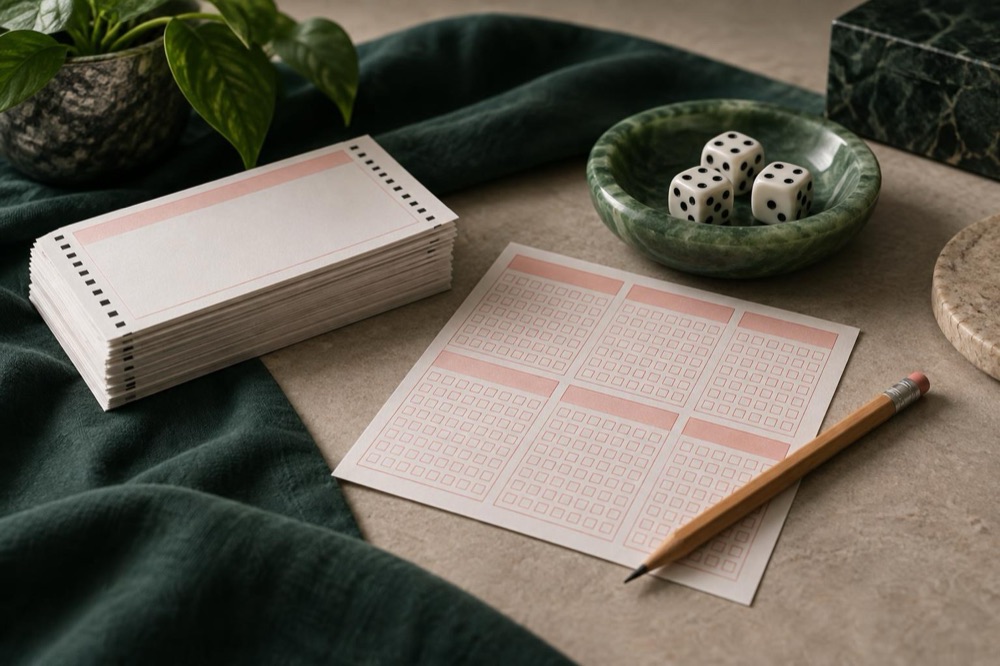
Pre-printed numbered tickets. Japan's Jumbo Takarakuji is the classic example: each ticket comes with a block and number already printed on it, and you win if the drawn winning numbers match your ticket's block and number10. You are not choosing anything; you are buying a specific number, and the appeal is partly that the ticket itself is a collectible object. The Thai government lottery works the same way, with six-digit numbers printed on each THB 80 ticket11. Our page on printed-number ticket lotteries covers this family in depth.
Self-pick number games. Here you choose your own numbers, or let a machine choose them. China's Double Color Ball lets you select numbers yourself or have them machine-selected, with single bets and multiple (compound) bets available12. Super Lotto asks you to pick 5 numbers from the front area (01 to 35) and 2 from the back area (01 to 12)3. Multiple bets let you cover more combinations: Super Lotto offers front-area multiples (6 or more front numbers), back-area multiples (3 or more back numbers), and double-area multiples3. These are explained fully in lottery system bets.
Digit games. Instead of picking from a large pool, you bet on a short number, usually two to four digits. Singapore 4D is the best known: you pick a four-digit number and choose a bet type, including Ordinary, 4D Roll, System Entry and iBet5. The how 4D works page breaks down each bet type, and 2D and 3D digit lotteries covers the shorter versions.
Sports lotteries. Rather than numbers, you are predicting match outcomes. Korea's Sports Toto sells several voting-ticket styles: win/loss type, score type, mixed type and special type13. Its record-style tickets ask you to predict specific elements such as the match score, the score difference, the first scorer, total runs, or the tournament winner14. Japan's sports promotion lottery splits into four families: the computer-predicted basketball lottery DUNK, the no-prediction BIG series, football result prediction toto, and the single-match WINNER15. WINNER itself comes in two flavors, a single-match prediction and a whole-competition prediction16. See sports lotteries explained for how these pools work.
Instant tickets. Scratch cards and similar games decide the outcome at purchase, not at a later draw. They are covered on the instant lotteries and scratch cards page.
One practical difference matters more than any other: with a pre-printed ticket, the physical paper is the bet. Lose it and you have lost everything, since prize money goes to whoever holds the winning ticket and presents it9. With online self-pick bets, your entry is recorded in the operator's system and the ticket is just a receipt.
Draw schedules: Thai lottery, 4D and Takarakuji
Draw frequency varies enormously, from twice a month to several times a week.
The Thai government lottery draws twice a month, on the 1st and 16th, with a few fixed exceptions: the New Year draw is held on 30 December, the Teachers' Day draw on 17 January, and the Labour Day draw on 2 May, and draws are also moved if they would fall on an important religious day17. The office itself describes the rhythm as a draw every 15 days18. Results are announced publicly, and subscribers can receive them by SMS to their mobile phones18.
Singapore 4D draws on Wednesday, Saturday or Sunday, and you can bet on the current draw or on six consecutive draws at an outlet5. Sales for each draw close at 6pm on draw day, whether you bet online or at an outlet5.
Japan's Takarakuji runs on a completely different calendar because most of its games are seasonal. Ordinary lottery tickets such as the Jumbo draws are sold from a reservation start date until 23:50 on the sale end date, and tickets bought during the reservation period are settled on the sale start date19. Number-selection lotteries and the Kisekae Koo-chan game, by contrast, are available 24 hours a day between their sale start and end times19. Physical booth opening hours differ from booth to booth, so you need to check each booth's handling hours on the booth map20.
China's Super Lotto draws at 21:252, and Singapore Toto draws twice a week, with its prize structure described below.
| Game | Country | Draw frequency | Notes |
|---|---|---|---|
| Government lottery | Thailand | 1st and 16th of each month | Moved for certain holidays17 |
| 4D | Singapore | Wednesday, Saturday or Sunday | Sales close 6pm on draw day5 |
| Super Lotto | China | Fixed draw time 21:25 | Five front numbers, two back numbers2 |
| Jumbo Takarakuji | Japan | Seasonal sale windows | Sold until 23:50 on the end date19 |
| Toto | Singapore | Twice a week | Group 1 cascades for at most four draws21 |
Prize pools and payout rates
This is where the economics of a lottery live. In most games, a defined share of sales becomes the prize pool, and that pool is then divided among the winners according to fixed rules.
The simplest version is a fixed percentage. Japan's BIG football lottery sets prize money at 50% of sales, then splits it by grade: for the 14-match version, 1st prize gets 80%, 2nd gets 7%, 3rd 2%, 4th 3%, 5th 3% and 6th 5%22. Other BIG variants split differently: the 9-match version pays 1st 50%, 2nd 20% and 3rd 30%22, the 11-match version pays 1st 60%, 2nd 15%, 3rd 15% and 4th 10%23, and the 12-match total-goals version pays 1st 76%, 2nd 10%, 3rd 4%, 4th 4% and 5th 6%23. Daily games work the same way: in PICK-3, 50% of draw sales go to the prize pool, and the jackpot varies depending on the number of winners24.
Because the pool is shared, prize amounts move with sales and with how many people win. Japan's BIG states plainly that its prize amounts are theoretical values and vary with sales and the number of winning tickets23. If two people win first prize, they split the first-prize share.
China's Super Lotto shows how elaborate a payout formula can get. It has nine prize tiers: first and second prizes are floating (pari-mutuel), while third through ninth are fixed amounts3. The first prize depends on the size of the prize pool. When the pool is below CNY 100 million, the first-prize total is 78% of the current prize amount after fixed prizes are deducted, plus the accumulated pool, with a cap of CNY 5 million per bet. When the pool is at least CNY 100 million but below CNY 800 million, the prize is 58% plus pool (capped at CNY 5 million) plus a second part of 20% (also capped at CNY 5 million). When the pool reaches CNY 800 million or more, the split becomes 28% plus pool and a second part of 50%, each capped at CNY 5 million3. A basic bet of CNY 2 can win at most CNY 10,000,000 on the first prize4. An additional bet pays 80% of the corresponding basic-bet prize in the pari-mutuel tiers3.
Unwon prize money does not vanish; it rolls forward. Double Color Ball's prize pool is funded by unclaimed high-tier prize money and by prize amounts exceeding the single-bet cap, and those pool funds count toward the next draw's first prize12. Singapore Toto does the same by prize group: if there is no winner, the pool cascades to the same group in the next draw, with Group 1 cascading for at most four draws while Groups 2, 3 and 4 cascade until someone wins21. Toto's Group 2 prize, for matching 5 numbers plus the additional number, is 8% of the total prize pool21. These mechanics are covered in more detail in jackpot rollovers, snowballs and cascades and how much of a lottery ticket comes back in prizes.
The Thai government lottery is the exception to all of this: its prizes are fixed amounts per set, not a percentage of sales. Each set carries 14,168 prizes totaling THB 48,000,000, with first prize of THB 6,000,000, second prize THB 200,000, third THB 80,000, fourth THB 40,000 (50 prizes), fifth prize with 100 prizes per set, two-digit last-number prizes of THB 10,000 drawn once, and three-digit front and last prizes of THB 4,0006. But there is a catch, and it is unique to pre-printed lotteries: if the tickets are not fully sold, each prize amount must be reduced proportionally6. The published figures are what you get only when the whole set sells out.
Odds of winning the top prize
Odds come directly from the structure of the game, and the range across Asia is enormous.
For digit games the math is simple. In PICK-4, the odds of winning the top prize are 1 in 10,000, and prizes and odds vary depending on the number combination you choose24. In other words, a four-digit straight match asks you to beat ten thousand possible outcomes, which is why even a small stake can return a prize worth many times what you paid.
Self-pick lotto games are much harder. Super Lotto's first prize requires matching 5+2: all five front numbers and both back numbers, in any order25. Its second prize is 5+1, and its third prize is 5+0 or 4+225. The more numbers in the pool, the longer the odds, which is why pick-6 games can grow jackpots for weeks without a winner. The full comparison across games is on our lottery odds page.
Sports lotteries work differently again. In Japan's WINNER, there is a first prize only, for correctly predicting the match or competition result, and the prize is the payout odds multiplied by your purchase amount, with those odds fluctuating until sales close16. So the "odds of winning" depend entirely on the match you pick, and the payout depends on how many other people picked the same outcome.
Pre-printed lotteries sit somewhere in between. Your odds are fixed by how many tickets are printed, and the prize is fixed too, so the operator's risk is managed by controlling the print run. That is also why the Thai lottery reduces prizes when a set does not sell out: the prize money is tied to the tickets actually sold6.
Claiming a prize: deadlines, ID and payment methods
Winning is only half the process; you still have to claim, and every jurisdiction sets its own deadline.
Thailand. Government lottery winners have 2 years from the draw date to claim, after which the money goes to state revenue6. The claim process is bureaucratic but straightforward: the claimant signs the back of every winning ticket and receives a queue card, staff record details from the national ID card or an official government-issued card, and the claimant checks the payout details on screen, including name, prize amount and tax or levy, and confirms with an electronic signature before payment26. Payment is made by check or bank transfer, and for a transfer you need to provide the bank name and account number26. Thai charity lottery tickets, which use the same draw results, have a longer claim window of 10 years9. Our how to claim a lottery prize page has the step-by-step detail.
China. Super Lotto winners must claim within 60 natural days of the draw date, at a designated location, presenting the winning ticket. Miss the deadline and the prize counts as forfeited, with the forfeited money going to the lottery public welfare fund25. Unclaimed prizes and where the money ends up are covered in unclaimed lottery prizes.
Vietnam. Vietlott's rules show how digital claims work: for phone-channel tickets worth over VND 10 million up to VND 10 billion, the agent sends a payment confirmation notice to the winner's registered receiving account no later than 1 day after the draw result is determined, and pays no later than 5 working days from the date the winner confirms the receiving account27. If a dispute or complaint arises, the payment time is extended until the competent state authority reaches an official conclusion27.
Japan. On the official Takarakuji site, prizes of JPY 10,000 or more are in principle transferred automatically to your registered bank account within about a week from the next business day after the draw, while prizes under JPY 10,000 are held on your My Page the next business day; if your held winnings add up to more than JPY 10,000 during the period, the total is transferred automatically28. For the sports lottery, prizes of JPY 100,000 or less per ticket can be redeemed at booths, credit unions or Seven-Eleven, prizes over JPY 100,000 at credit unions, and prizes over JPY 500,000 require a credit union procedure with cash paid after 12 business days or a bank transfer; Seven-Eleven pays out only up to JPY 15,000, and some booths have their own limits of JPY 10,000 or JPY 50,000 per ticket29.
The common thread: the ticket is the proof. For every paper-based game, the prize goes to the holder of the winning ticket who presents it9, so a lost ticket usually means a lost prize, a problem explored in lost, torn or damaged lottery tickets.
Taxes and deductions on winnings
Whether your prize is taxed, and by how much, depends on where you win.
China. Lottery winnings are classified as incidental income under the Individual Income Tax Law and taxed at a flat 20% on the full amount of each winning30. Single winnings not exceeding CNY 10,000 on welfare and sports lottery tickets are temporarily exempt31. The lottery agency handles everything: it withholds the tax and files the personal income tax return on your behalf, so a CNY 100,000 instant lottery win has CNY 20,000 withheld, leaving CNY 80,00031. For computer lottery single winnings over CNY 3,000 up to CNY 10,000, the agency files a tax-exempt declaration on your behalf; above CNY 10,000 it files a tax declaration30.
South Korea. Lottery winnings over KRW 2,000,000 and up to KRW 300,000,000 are subject to 22% withholding, made up of 20% income tax plus 2% resident tax32.
Thailand. There is no income tax as such on the government lottery, but there is stamp duty: claimants pay THB 1 for every THB 200 of prize money or fraction of THB 2009. On a THB 6,000,000 first prize that is a meaningful deduction, and it is shown on screen as part of the payout details before you confirm with your electronic signature26.
Japan and Singapore. Prizes on Takarakuji and Singapore Pools games are quoted as gross amounts, with no deduction shown at payout.
The practical rule everywhere in Asia: the operator withholds before paying. You rarely need to calculate or file anything yourself for a standard lottery win; the deduction appears on your payout statement.
Buying tickets online and the rules on foreign lotteries
Online sales are the newest and most unevenly developed part of the lottery landscape in Asia.
Japan has the most developed official channel. The Takarakuji Official Site sells ordinary lottery tickets such as the Jumbo draws, plus number-selection games and Quick One, in principle 24 hours a day, all year round33. To buy, you register as a member with a payment method for purchases and a bank account for receiving winnings, both in your own name35. You can also set up continuous purchase at a specified frequency, and reserve Jumbo tickets before sales start33. But there are two hard limits: purchase is restricted to individual residents of Japan aged 20 or over36, and buying from outside Japan is not possible, even if you are an eligible buyer temporarily abroad on travel36. Our page on buying Takarakuji online while traveling abroad covers this in detail.
Singapore allows online 4D betting through Singapore Pools, with the same bet types as outlets and the same 6pm draw-day sales close5.
Thailand is the cautionary tale. Government lottery tickets are sold through a distributor agent system of 31 million tickets and an advance purchase-booking system of up to 69 million tickets per draw, with buyers collecting tickets via Thailand Post at post offices nationwide37. But official news has warned about tickets sold through unofficial online platforms and vending machines: buyers who do not hold the physical ticket may be unable to claim prize money if they win, and tickets may be sold at a price higher than the official THB 8038. Since the prize is paid to the holder of the winning ticket9, buying a "ticket" you never physically receive means someone else holds your claim. The buying official lottery tickets online page lists which operators genuinely sell online.
China treats online lottery buying with suspicion: tickets bought over the internet are likely linked to illegal lottery, private lottery, illegal gambling or fraud, and may make the buyer a participant in criminal activity38. If you do buy through official internet channels, you must register a betting account through the lottery issuer's online sales management system, and the account is for your own use only, holding your name, valid ID number, phone number and transaction records.
As for foreign lotteries, the general pattern across the region is that official online channels are geo-restricted to residents, as Japan's rules show36. Anything offering to sell you another country's official lottery ticket online from abroad deserves close scrutiny; the lottery scams page explains the common schemes, including fake lotteries that borrow the names of real draws.
Common Questions
What happens if a Thai lottery batch is not fully sold?
Each prize amount is reduced proportionally. The published figures, such as THB 6,000,000 for first prize, apply per set only when every ticket in that set is sold, so a partly unsold batch pays less.
How much of a Takarakuji prize can be paid on the same day?
On the official Takarakuji site, prizes of JPY 10,000 or more are transferred automatically to your registered bank account within about a week from the next business day after the draw. Amounts under JPY 10,000 are held on your My Page first.
Can you buy a Takarakuji ticket online from overseas?
No. Online purchase is limited to individual residents of Japan aged 20 or over, and buying from outside Japan is not possible, even if you are an eligible buyer who is temporarily abroad on travel.
What is the minimum age to buy a Thai government lottery ticket?
Thailand does not publish a minimum age for the government lottery. In South Korea, by comparison, you can buy lottery tickets only from January 1 of the year you turn 19.
Where can you claim a Thai three-digit lottery prize?
Prize money is paid to the holder of the winning ticket who presents it to claim. You sign the back of every winning ticket, staff record your national ID card or government-issued card details, and payment is made by check or bank transfer.
What identity documents do you need for a large Takarakuji prize?
For online play you register a payment method and a bank account for receiving winnings, both in your own name. Winnings are then transferred automatically to that registered account, so the account itself acts as your proof of identity.
How much can you win on a Japanese number-selection lottery?
It depends on the game. The football lottery toto offers a first prize of up to JPY 100,000,000, rising to a maximum of JPY 500,000,000 when a carryover occurs. Other games publish their own prize tables.
Sources38 sources
- About the Government Lottery Office, Government Lottery Office of Thailand, 2026
- Draw information, ZHCW, 2026
- Super Lotto game rules, China Lottery, archived November 30, 2022
- Super Lotto, ZHCW, 2026
- Lottery betting FAQ, Singapore Pools, 2026
- Reward check, Government Lottery Office of Thailand, 2026
- How to play bingo, PlaySmart, 2026
- How to play lottery, PlaySmart, 2026
- Reward payment, Government Lottery Office of Thailand, 2026
- Jumbo lottery, Takarakuji Official Site, 2026
- Thai lottery attitude and history, Government Lottery Office of Thailand, 2026
- Double Color Ball game rules, ZHCW, archived June 8, 2012
- Sports promotion voting ticket terms, Sports Toto Korea, June 10, 2026
- Record-style and result-style voting tickets, Sports Toto Korea, March 13, 2026
- Sports promotion lottery types, Japan Sports Promotion Council, 2026
- WINNER how-to, Toto Dream, 2026
- Award FAQ, Government Lottery Office of Thailand, 2026
- Lottery FAQ: sales, Government Lottery Office of Thailand, 2026
- Takarakuji sale hours FAQ, Takarakuji Official Site, September 26, 2026
- Booth hours FAQ, Takarakuji Official Site, September 26, 2026
- Toto how to play, Singapore Pools, 2026
- BIG about, Toto Dream, 2026
- BIG prize details, Toto Dream, 2026
- Daily games how to play, PlaySmart, 2026
- Super Lotto draw details, ZHCW, 2026
- Pay steps, Government Lottery Office of Thailand, 2026
- Prize claiming rules, Vietlott, 2026
- Kisekae Koo-chan prize payment, Takarakuji Official Site, 2026
- Sports lottery guidance 2026, Japan Sports Promotion Council, March 2026
- Lottery winnings tax rule, China Tax, August 15, 2024
- Lottery tax filing example, Guangdong Tax, October 18, 2024
- Lottery winnings withholding, Bokgwon (Korea Lottery), 2026
- Takarakuji member registration, Takarakuji Official Site, September 26, 2026
- Quick One, Takarakuji Official Site, 2026
- Takarakuji purchase FAQ, Takarakuji Official Site, September 26, 2026
- Overseas purchase FAQ, Takarakuji Official Site, September 26, 2026
- Warning on unofficial online lottery sales, PRD Region 4, March 20, 2024
- Ban on online number-ticket selling, Thuvienphapluat, July 30, 2025