Legal status: no state-run lottery in Goa
Lotteries in India are a state subject. Each state decides whether to run one, and the states that do run their own directorate, their own draws and their own prize rules. Goa is not one of the states that runs a public lottery, so there is no Goa State Lottery in the sense of a Goa-run draw with Goa results.
What exists instead is a market. Paper lottery tickets from states such as Maharashtra, Kerala, Nagaland and Sikkim circulate around the country, and some of them are sold in Goa by licensed retailers. The ticket itself tells you which state it belongs to. A Maharashtra Ganesh Laxmi ticket carries the state's name and the sale restriction printed on it1. A Kerala ticket is a Kerala ticket, whatever counter it came from.
The practical point for a player is simple. You are not buying into a Goa scheme. You are buying a ticket issued by another state, and that state's rules govern everything: where it may be sold, how the draw works, how long you have to claim, and who pays you.
Where tickets are sold and who can buy them
Tickets are sold over the counter at small retail shops, kiosks and newsstands. There is no online sales channel for the paper state lotteries. Kerala states plainly that only physical tickets are permitted to be sold3. Maharashtra's claim guidance is built around a retail agent handing over a physical ticket3.

Who can buy one? At the counter, nobody normally asks. There is no ID check, no membership and no registration for a paper ticket. A visitor, a foreign resident and an Indian citizen all buy the same way: hand over cash, take the ticket. That is the easy part.
The harder part is the sale restriction. Maharashtra's monthly and weekly schemes state that tickets are to be sold only within Maharashtra, and the restriction is printed on the ticket itself1. Kerala's guidance is even more direct: no agent shall sell Kerala State Lottery tickets outside the state, directly or indirectly3. So a ticket bought in Goa is, in the strict reading, a ticket sold outside its permitted territory. That does not usually cause a problem at the counter. It can cause a problem later, when you try to claim.
If you are in Goa and want a lottery ticket, the sensible move is to look at what is printed on it before you pay. If it says Maharashtra, you are holding a Maharashtra ticket with a Maharashtra claim process. If it says Kerala, the same applies to Kerala.
Games and draws on offer
The schemes that turn up in Goa are the standard Indian paper lotteries: a printed ticket with a number, a periodic draw, and a set of prize tiers. Maharashtra's Ganesh Laxmi family is the clearest example, and it comes in several shapes.
- Monthly draws. The Ganesh Laxmi monthly scheme runs a draw each month with a full ladder of prizes, from a top prize down to small consolation amounts1.
- Weekly draws. The Ganesh Laxmi Vaibhav weekly scheme runs seven draws a week, each with its own prize structure4.
- Other monthly schemes. Maharashtra also runs schemes such as Gajraj on a monthly cycle, with the same sale restriction printed on the ticket5.
Prize ladders vary by scheme and by draw. In the Maharashtra monthly structure, the seventh prize is Rs. 250 each, with 4,000 of them across all series, awarded by random method, for a total of Rs. 10,00,000 in that tier2. Higher tiers pay more and have fewer winners. The exact ladder for the draw you are buying into is printed in the scheme notice, and the retailer usually has the current one.
Sikkim's bumper schemes show the other end of the scale. The Dear Ganesh Chaturthi Bumper 2026 lottery lists a fourth prize of 9,000 INR with up to 600 winners, and a fifth prize of 5,000 INR with up to 600 winners6. Bumper draws are seasonal, sold in the weeks before the draw, and the prize pool is larger than a routine weekly.
How to play: buying a ticket and checking results
Buying is a counter transaction. You pick the scheme, pay the printed price, and take the ticket. There is no slip to fill in and no number to choose, because the number is already printed on the ticket. That is different from number-selection lotteries elsewhere in Asia, where you mark a play slip and the retailer prints your chosen numbers7.
Once you have the ticket, keep it flat and dry. Do not laminate it, do not fold it along the number, and do not sign it until you know whether it has won. State lottery terms commonly refuse payment for tickets that are lost in transit, defaced, laminated or mutilated8.
Checking results works in three ways.
- The retailer's counter. Most shops post the latest draw list. This is the fastest check for a small prize.
- The official state website. Maharashtra publishes the official result of its draws at lottery.maharashtra.gov.in, and the same results appear in selected newspapers3.
- The scheme notice. Each draw has a published scheme document listing the prize tiers and the winning numbers for that draw1.
If you are checking a Maharashtra ticket, the state website is the authoritative source. If you are checking a Kerala ticket, use Kerala's own results. Do not rely on a third-party results site, because the numbers are copied by hand and errors are common.
Prizes: what you can win and how to claim
The claim process splits by size, and this is where a Goa buyer needs to pay attention.

Small prizes. Maharashtra allows prizes up to Rs. 10,000 to be claimed from the retail agent from whom the ticket was purchased3. You hand over the ticket, the agent verifies it, and you are paid. This is the tier where buying in Goa is least likely to cause trouble, because the transaction stays local.
Larger prizes. Above that threshold, the claim goes to the government. Maharashtra requires the winner to submit the original ticket to the government, and only one prize may be claimed per ticket1. Nagaland's terms set the same kind of threshold: every winner must submit a claim in the prescribed form for all prizes exceeding Rs. 10,000 on a single ticket8.
The original ticket is the whole claim. There is no digital record you can fall back on, because the paper ticket is the only proof of purchase. If it is gone, the prize is gone.
Claim deadlines differ by state and scheme, so check the scheme you bought. Nagaland requires claims within 30 days from the date of the draw as published in its official gazette8. Other states run longer windows. The safe habit is to claim as soon as you know you have won, rather than waiting for a convenient week.
One more rule worth knowing: a single ticket can only be claimed once. If your ticket carries more than one winning line, the scheme rules generally allow only one prize per ticket1.
Taxes on winnings
The tax picture for Indian lottery tickets has two layers, and only one of them touches your prize directly.
The first layer is GST on the ticket itself. Lottery ticket sales in India carry GST at 40 percent, raised from the earlier 28 percent4. This is built into the price you pay at the counter, so you never see it as a deduction. It does mean the ticket costs more than the headline price suggests.
The second layer is tax on the prize. Whether anything is withheld, and at what rate, depends on the scheme and the size of the win. Some state lotteries deduct tax before disbursing, and pay out the net amount after verifying the ticket8. Others leave the winner to handle it. Because the rules vary by state and by scheme, the reliable move is to ask the retailer or the state directorate what will be deducted before you hand over the ticket.
For comparison, other Asian jurisdictions handle this very differently.
| Jurisdiction | Withholding or exemption |
|---|---|
| Philippines | Withholds 20 percent on lotto prizes above PHP 10,0009 |
| South Korea | Withholds 22 percent on winnings over KRW 2,000,000 and up to KRW 300,000,000, and 33 percent above that10 |
| China | Exempts single lottery winnings up to CNY 10,000 and taxes the rest as incidental income11 |
India's structure is closer to a consumption tax on the ticket plus a scheme-specific deduction on the prize.
What happens if you lose the ticket
A lost ticket is usually a lost prize. State lottery terms are blunt about this: the government and its officers are not responsible or liable to pay for tickets lost in transit, defaced, laminated or mutilated8. There is no central register that can reconstruct your purchase, because the ticket is sold anonymously over a counter with no name attached.
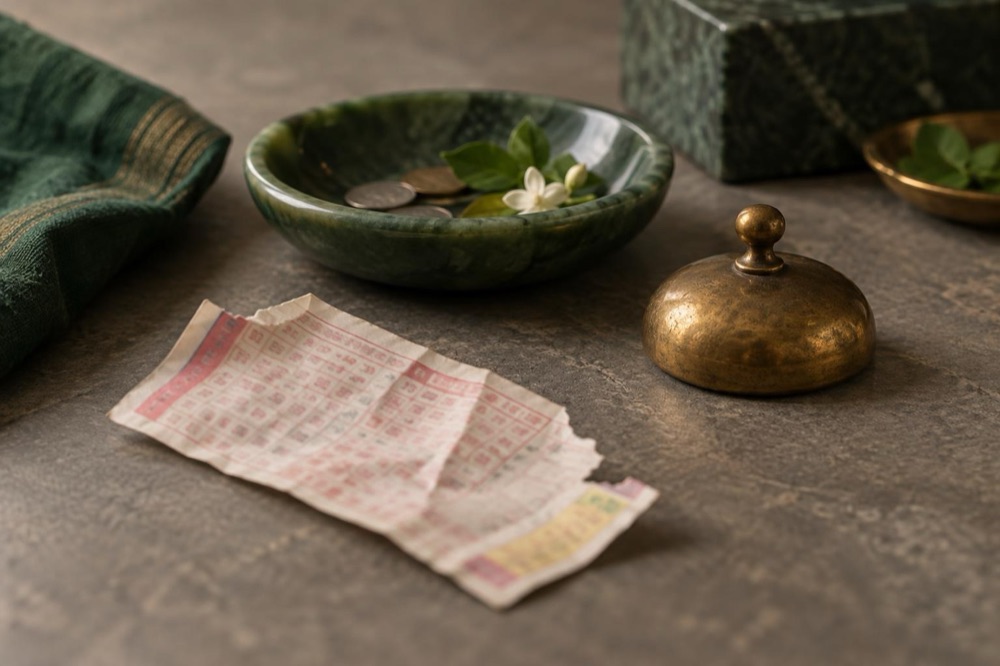
The practical precautions are simple. Keep the ticket flat in a wallet or a book, away from heat and moisture. Do not laminate it, because lamination is specifically listed as a reason to refuse payment8. Do not write on the number. Photograph the ticket front and back as soon as you buy it, so you at least have a record of the number if the paper goes missing, though a photograph will not substitute for the original at the claim counter.
If you lose a ticket and the draw has not yet happened, some states have a hold procedure, but it is slow and bureaucratic. In Thailand, for example, a lost-ticket hold request in the provinces must be reported through the provincial governor, who sends a signed letter by fax to the office13. India's state lotteries do not generally offer an equivalent, so treat the paper as the only copy that matters.
Goa lotteries compared with lotteries in other states
The cleanest way to understand the Goa situation is to compare it with states that do run their own lotteries.
Maharashtra. Runs its own directorate, publishes official results at lottery.maharashtra.gov.in, prints "For sale only in Maharashtra State" on its tickets, and lets you claim prizes up to Rs. 10,000 from the retailer1. This is the scheme most often seen on Goa counters.
Kerala. Runs its own lottery, permits only physical tickets to be sold, and does not allow agents to sell Kerala tickets outside Kerala, directly or indirectly3. Kerala also does not permit 2-digit, 3-digit or 4-digit lotteries based on Kerala draw results14.
Nagaland. Runs its own lottery with a formal claim process, a 30-day deadline from the gazette publication, and a Rs. 10,000 threshold for the prescribed claim form8.
Sikkim. Runs bumper schemes with large seasonal prize pools, paid out by the Directorate of Sikkim State Lotteries in Gangtok6.
Goa. Runs none of the above. There is no Goa directorate, no Goa draw and no Goa results page. A player in Goa who wants a paper lottery ticket is buying into one of the other states' schemes, with that state's rules attached.
If you want to understand how a state lottery works properly, the Maharashtra State Lottery is the closest well-documented example, and the wider picture of what is and is not permitted in the country is covered in The Lottery in India: Who Can Play and How. For the claim mechanics that apply once you have a winning ticket in hand, see How to Claim a Lottery Prize in India.
Common Questions
Where can I buy Goa State Lottery tickets?
There is no Goa State Lottery. Tickets sold in Goa under a state lottery name come from other states, such as Maharashtra, and those lotteries are meant to be sold only inside their own state. Buy from a licensed retailer and check which state's name is printed on the ticket.
How do I check the winning numbers?
Check the official website of the state lottery printed on your ticket. Maharashtra State Lottery publishes its official results at lottery.maharashtra.gov.in, and results also appear in selected newspapers. Retailers usually post the latest draw list at the counter.
How long do I have to claim a prize?
It depends on the lottery. Maharashtra State Lottery prizes up to Rs. 10,000 can be claimed from the retailer who sold you the ticket. Larger prizes go to the government, and you must hand in the original ticket. Claim promptly, because deadlines vary by scheme.
Can people outside Goa play the Goa State Lotteries?
There is no Goa lottery to play. Other states' lotteries are restricted to their own territory. Kerala, for example, does not permit its agents to sell Kerala State Lottery tickets outside the state, directly or indirectly, and Maharashtra prints its tickets for sale only in Maharashtra.
How much of a prize is taken in tax?
Lottery ticket sales in India carry GST at 40 percent, up from 28 percent. That tax sits in the ticket price rather than being deducted from your prize. Any further deduction depends on the scheme and the size of the win, so ask the retailer or the lottery directorate.
What happens if I lose my ticket?
A lost ticket usually means a lost prize. State lottery terms commonly state that the government is not liable to pay for tickets lost in transit, defaced, laminated or mutilated. Keep the ticket flat, dry and unsigned until you know the result.
Can tourists buy Goa lottery tickets?
Foreign visitors can buy a paper lottery ticket from a licensed retailer in Goa if one is on sale, since no ID is normally required at the counter. The catch is that the ticket belongs to another state's lottery, and claiming a large prize means dealing with that state's directorate.
Sources15 sources
- Ganeshlaxmi monthly July 2026, Maharashtra State Lottery, 2026
- Ganeshlaxmi monthly 28-10-25, Maharashtra State Lottery, 2025
- Maharashtra State Lottery claim guidance, Maharashtra State Lottery, 2025
- Ganeshlaxmi Vaibhav weekly from July 2026, Maharashtra State Lottery, 2026
- Maharashtra Gajraj Monthly Draw 04-12-2022, Maharashtra State Lottery, 2022
- Dear Ganesh Chaturthi Bumper 2026 scheme gazette, Directorate of Sikkim State Lotteries, 2026
- Vietlott Keno how to play, Vietlott, 2026
- Nagaland State Lotteries claim form and terms, Nagaland State Lotteries, 2026
- Can I buy a PCSO Lotto ticket online?, PCSO, 2026
- Donghaeng Lottery prize and tax guidance, 2026
- Individual income tax rules on lottery winnings, 2024
- Guangdong tax guidance on lottery winnings, 2024
- Government Lottery Office prize payment FAQ, Government Lottery Office Thailand, 2026
- Kerala State Lotteries FAQ, Kerala State Lotteries, 2026
- Kerala State Lotteries FAQ (English), Kerala State Lotteries, 2026