What a rollover is and when it happens
A rollover is what happens when a draw produces no winner for the top prize. Instead of the money staying with the operator or being returned to players, it moves into the next draw and is added to that draw's top prize pool. The jackpot gets bigger, and the next set of players is playing for more.
Most big lottery jackpots work this way. They are progressive, which means jackpots that are not won roll over between successive draws and get larger5. The same idea runs through Japan's sports lottery games, where the carryover is the standard term. If there is no first prize winner, or if there is a winner but the dividend money is left over, that first prize money is carried over to the next round. That is what a carryover is1.
The trigger is simple: no first prize winner, or a first prize that pays out less than the full pool. Either way, the leftover moves forward. In Japan's LOTO 6, the rule is broader. The total prize pool and per-entry prize of any grade with no winners, plus any amount above the preset maximum, is carried over to the next draw's first prize6. So a rollover can build from more than one source.
Some games do not roll over at all. Japan's WINNER football lottery states plainly that no carryover occurs7. And when a progressive jackpot is finally won, it resets. In Ontario's LIGHTNING LOTTO, for example, when a jackpot is won it resets to $125,000 and starts growing again5. That reset figure is the game's starting point, not a cap.
Carryover mechanics in Japan's toto: the formula behind the pool
Japan's toto is a football pool. You predict the result of each designated match over 90 minutes8. For the 13-match game, you call the home team's win, loss or other result (a draw or extra time) for each of 13 designated matches9. A home win is "1", a loss is "2", and other is "0"8.
The carryover formula is published. The first prize dividend pool equals the previous round's carryover plus 35% of the current round's total toto sales1. That is the whole mechanic in one line. Everything else follows from it.
Here is how it plays out with the game's own figures. If the first prize pool reaches JPY 1,500,000,000, up to three people could win JPY 500,000,000 each1. That is because the first prize is shared among the winners, and the per-person cap is JPY 500,000,000 when a carryover is in place.
The caps matter. In toto, the first prize is JPY 100,000,000 normally, and JPY 500,000,000 when a carryover occurs9. The same figures appear in the operator's own rules10. So a carryover does not just add money, it lifts the ceiling on what a single winner can take.
The same structure applies across the toto family. mini toto has a first prize of JPY 100,000,000 normally and JPY 200,000,000 with a carryover9. totoGOAL2 and totoGOAL3 both sit at JPY 100,000,000 normally and JPY 200,000,000 with a carryover9. Each game has its own pool and its own cap, but the carryover idea is identical.
A worked example helps. Say the previous round left a carryover, and this round's toto sales total JPY 1,000,000,000. The first prize pool is the carryover plus 35% of those sales3. If one person has all 13 results right, they take the pool up to the cap. If three share it, each gets a share, again subject to the cap. The cap is JPY 100,000,000 normally and JPY 500,000,000 when a carryover occurs9.
How big the jackpot can get: toto, BIG and MEGA BIG compared
Japan's sports lottery games differ mainly in how many matches you predict, what you pay, and how high the top prize can climb. The carryover is what pushes each one past its normal ceiling.
| Game | What you predict | Price per bet | Top prize normally | Top prize with carryover |
|---|---|---|---|---|
| toto | 13 football matches | JPY 100 | JPY 100,000,000 | JPY 500,000,000 |
| mini toto | Fewer matches | JPY 100 | JPY 100,000,000 | JPY 200,000,000 |
| BIG | 14 matches, computer picks | JPY 300 | JPY 300,000,000 | JPY 600,000,000 |
| 100-yen BIG | 12 matches | JPY 100 | JPY 100,000,000 | JPY 200,000,000 |
| MEGA BIG | 12 matches | JPY 300 | JPY 700,000,000 | JPY 1,200,000,000 |
toto costs JPY 100 a bet8. BIG costs JPY 300 a bet2. The 100-yen BIG and MEGA BIG sit at JPY 100 and JPY 300 respectively per entry7. Prices are per entry, so a system entry covering several combinations costs more.
The top prizes are set out clearly. toto reaches a maximum of JPY 500,000,000 when a carryover occurs, against JPY 100,000,000 normally11. BIG reaches JPY 600,000,000 with a carryover, against JPY 300,000,000 normally12. MEGA BIG reaches JPY 1,200,000,000 with a carryover, against JPY 700,000,000 normally2. The 100-yen BIG reaches JPY 200,000,000 with a carryover, against JPY 100,000,000 normally12.
One important detail: these are theoretical maximums, and the actual prize varies. In BIG, prize amounts vary with sales and the number of winning tickets, and the first prize figures are theoretical values13. The same is true of MEGA BIG, where the prize amount varies with the sales amount and the number of winning entries14. So a headline figure is a ceiling, not a promise.
MEGA BIG: JPY 1.2 billion with a carryover
MEGA BIG is the headline game. Its first prize can reach JPY 1,200,000,000 when a carryover occurs, and JPY 700,000,000 when there is no carryover2. That top figure is described as the highest amount in Japanese lottery history, excluding public sports racing14.
The game works like the other BIG products. The computer randomly selects the result for each designated match, and you do not pick the numbers yourself. MEGA BIG covers 12 matches, and the prize tiers run from first down to fourth7. The first prize pool takes 35% of total sales2.
The carryover is what turns a good prize into a record one. Without a carryover, the ceiling is JPY 700,000,000. With one, it is JPY 1,200,000,000. The gap between those two numbers is the whole point of a rollover: the unwon money from earlier rounds is sitting in the pool, waiting for a winner.
The odds are long, and the game publishes them. For the 12-match format, there are 16,777,216 possible combinations per set7. That is the scale you are playing against. The prize is large because the chance is small.
Singapore TOTO cascade draws: when sales close at 9pm
Singapore TOTO handles an unwon jackpot differently. Instead of rolling over forever, the jackpot cascades. If there is no Group 1 prize winner after four consecutive draws, the final jackpot amount cascades, meaning it is paid to the next prize group that has a winner and shared equally4.

That final jackpot amount is built from two parts: 38% of the fourth draw's prize pool plus the snowballed amount from the three preceding draws4. So the money from three earlier draws is sitting in the pool, and on the fourth draw it drops down a tier if nobody has won the top prize.
The practical effect for you is a deadline change. Sales for each TOTO draw, including TOTO MATCH bets, close at 6pm on draw day. If the current draw is a cascade draw, sales close at 9pm on draw day4. So a cascade draw gives you three extra hours to buy.
TOTO draws happen on Monday or Thursday15. You can place Self Pick bets for Ordinary, System Entry and System Roll for the current draw, or Quick Pick bets by bet type or amount15. The number pool runs from 1 to 4916.
The prize fund is a set share of sales. The total prize amount for each draw is 54% of total sales17. That is the money that gets split across the prize groups, and the jackpot is the top slice of it.
Prize tiers and how the pool is split
Every game splits its prize fund across tiers, and the top tier takes the largest share. Knowing the split tells you where a rollover lands and how a cascade behaves.
In toto, the prize money is 50% of the sales amount, and that is split with 70% to the first prize, 15% to the second and 15% to the third8. The tiers are defined by how many matches you get right: first prize is all matches correct, second is one match wrong, and third is two matches wrong10.
In BIG, the split is wider. The first prize takes 80%, the second 7%, the third 2%, the fourth 3%, the fifth 3% and the sixth 5%12. BIG has six tiers: first is all numbers matching, then one wrong, two wrong, three wrong, four wrong and five wrong out of 14 numbers13. The 100-yen BIG and MEGA BIG run to four tiers, and mini BIG to three7.
Singapore TOTO's cascade rule is the key difference. If no one wins Group 1, the prize pools cascade to the same group in the next draw. Group 1 can cascade for at most four draws, while Groups 2, 3 and 4 cascade until there is a winner17. So the top group has a hard stop, and the lower groups do not.
That is the difference between a rollover and a cascade. A rollover keeps the money at the top and lets it grow. A cascade moves it down to a lower tier once the top tier has gone unwon for long enough. Both put more money in players' hands, but they do it in different places.
Odds of hitting the first prize
The odds are published, and they are worth reading before you buy. They explain why jackpots get so large.
In toto's 13-match game, the first prize is about 1 in 1,600,000, the second about 1 in 60,000 and the third about 1 in 5,000, as theoretical values9. The operator's own rules give the same picture with more precision: first prize 1 in 1,594,323, second about 1 in 61,320 and third about 1 in 5,1108.
For totoGOAL3, the first prize is 1 in 4,096 and the second about 1 in 228, again theoretical values10. That is a much shorter game, which is why its top prize is smaller.
For BIG, the combination counts tell the story. BIG and 100-yen BIG have 4,782,969 possible combinations, MEGA BIG has 16,777,216, BIG1000 has 177,147 and mini BIG has 19,683 per set7. The more combinations, the longer the odds and the larger the potential prize.
The practical takeaway is that a carryover does not change your odds. It changes the size of the prize if you win. The chance of matching all the results is the same whether the pool is JPY 100,000,000 or JPY 1,200,000,000.
Where to buy and check results
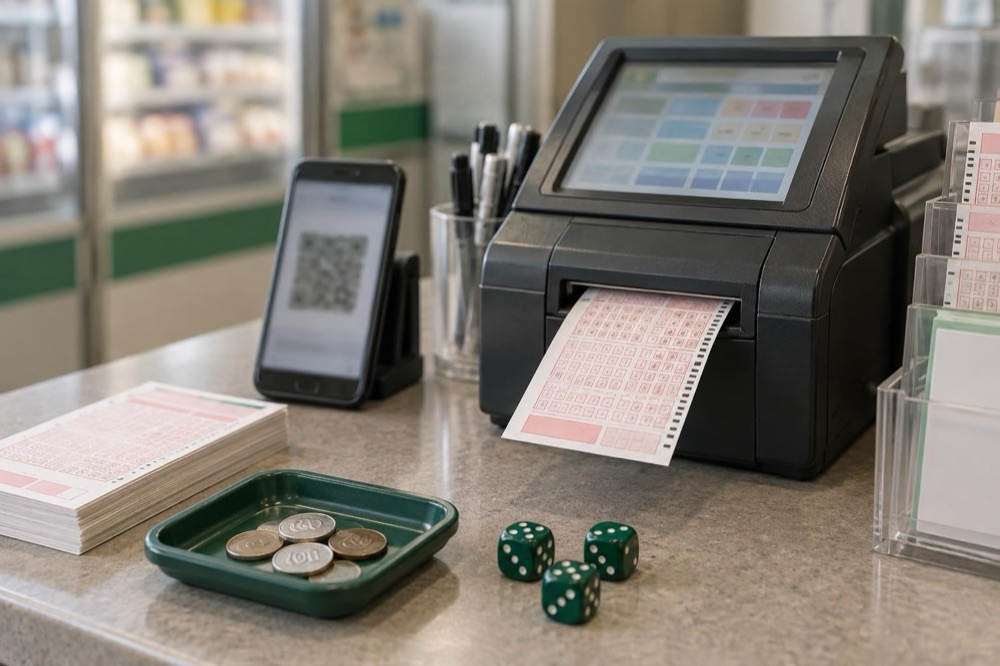
Japan's sports lottery tickets are sold in several places. You can buy:
- on the internet
- at lottery counters
- at convenience stores that handle sports toto2
The official sports lottery website and partner sites also sell tickets1.
Sales hours vary by channel. Lottery booths run from 8:00 to 23:00, though hours vary by store. Convenience store multimedia terminals and copiers handle toto and BIG only, and the official website sells online7. Online sales run 24 hours a day during the sales period7.
The sales deadline differs by channel. At booths, sales close at 12:00 noon on the final sales day, and at convenience store terminals at 11:307. For WINNER, online sales close 10 minutes before each match kicks off7. The operator repeats the noon deadline for toto and notes it can change, so check each round's information18.
If you buy online, winnings are paid automatically into your account, including purchases made through official site convenience store payment2. If you buy at a store, you collect at a shinkin bank that handles sports toto, at a lottery counter that allows payouts, or at 7-Eleven2.
Checking results is straightforward. Winning results can be checked at lottery counters and 7-Eleven stores20. Online, go to the top page, click the results check, select the lottery type and draw number, enter the reference number from your ticket and display the result20. If you bought on the official site, log in to Club toto, click purchase history and results check, then open the details to see your result, with filtering by product, purchase period and result20.
For number-selection lotteries more broadly, tickets are sold at number-selection lottery counters, at ATMs of some banks, and at convenience stores21. So the counter and convenience store route is common across Japan's lottery products.
When a draw is canceled: the Mark Six refund process
Sometimes a draw does not go ahead, and the money goes back to players rather than rolling over. Where a lottery operator terminates a draw, all valid entries in that pool are refunded in full19. Refunds are not held open forever: prizes or refunds not claimed within 60 days of the draw are forfeited, and claims must be made on any working day within those 60 days at a lottery sale outlet19.
The pattern is consistent: a rollover moves money forward to the next draw, while a cancellation moves money back to the player. Which one applies depends on whether the draw still happens. If it does, the unwon pool carries over. If it does not, you get a refund.
Common Questions
What happens to the jackpot if nobody wins the first prize?
In most games the top prize pool carries over to the next draw and grows. In Japan's toto, BIG and MEGA BIG, the unwon first prize is added to the next round's pool. In Singapore TOTO, if no one wins after four draws, the jackpot cascades to the next prize group that has a winner.
How much of each round's sales goes into the next round's first prize pool?
It varies by game. In Japan's toto, the first prize pool is the previous carryover plus 35% of that round's toto sales. For BIG it is the previous carryover plus 40% of BIG sales. MEGA BIG puts 35% of total sales into its first prize pool.
What is the difference between toto, BIG and MEGA BIG?
toto asks you to predict the result of 13 football matches and costs JPY 100 a bet. BIG is a 14-match game where the computer picks your numbers, costing JPY 300 a bet. MEGA BIG is a 12-match version with a bigger top prize, also JPY 300 a bet.
How do I check my BIG results if I bought my ticket at a shop?
You can check at lottery counters and 7-Eleven stores. Online, go to the sports lottery site, click the results check, choose the lottery type and draw number, enter the reference number from your ticket and display the result.
Can I buy toto or BIG online?
Yes. Both are sold on the official sports lottery website and partner sites, at lottery counters and at convenience stores that handle sports toto. Online sales run 24 hours a day during the sales period, and winnings are paid automatically into your account.
What is the minimum age to buy MEGA BIG?
You must be at least 19. Buying or receiving a MEGA BIG ticket is prohibited by law for anyone under 19, and they cannot collect payouts either. The same age rule applies across Japan's sports lottery games.
Sources21 sources
- How to Play toto, toto-dream
- How to Play BIG, toto-dream
- MEGA BIG Press Release, Japan Sports Promotion Center, April 24, 2026
- Lottery Betting FAQ, Singapore Pools
- How to Play Lottery, PlaySmart
- LOTO 6 Features, Takarakuji Official Site
- Sports Lottery Guide, Japan Sports Promotion Center, March 2026
- About toto, toto-dream
- Sports Promotion Lottery, Japan Sports Promotion Center
- toto Rules, Japan Sports Promotion Center
- Sports Lottery, Japan Sports Promotion Center
- toto Prize Structure, Japan Sports Promotion Center
- About BIG, toto-dream
- MEGA BIG Results Check, toto-dream
- Betting Online, Singapore Pools
- TOTO Results, Singapore Pools
- TOTO Prize Structure, Singapore Pools
- Where to Buy toto, toto-dream
- Mark Six, Hong Kong Jockey Club
- BIG Results Check, toto-dream
- How to Buy Number-Selection Lottery, Takarakuji Official Site