
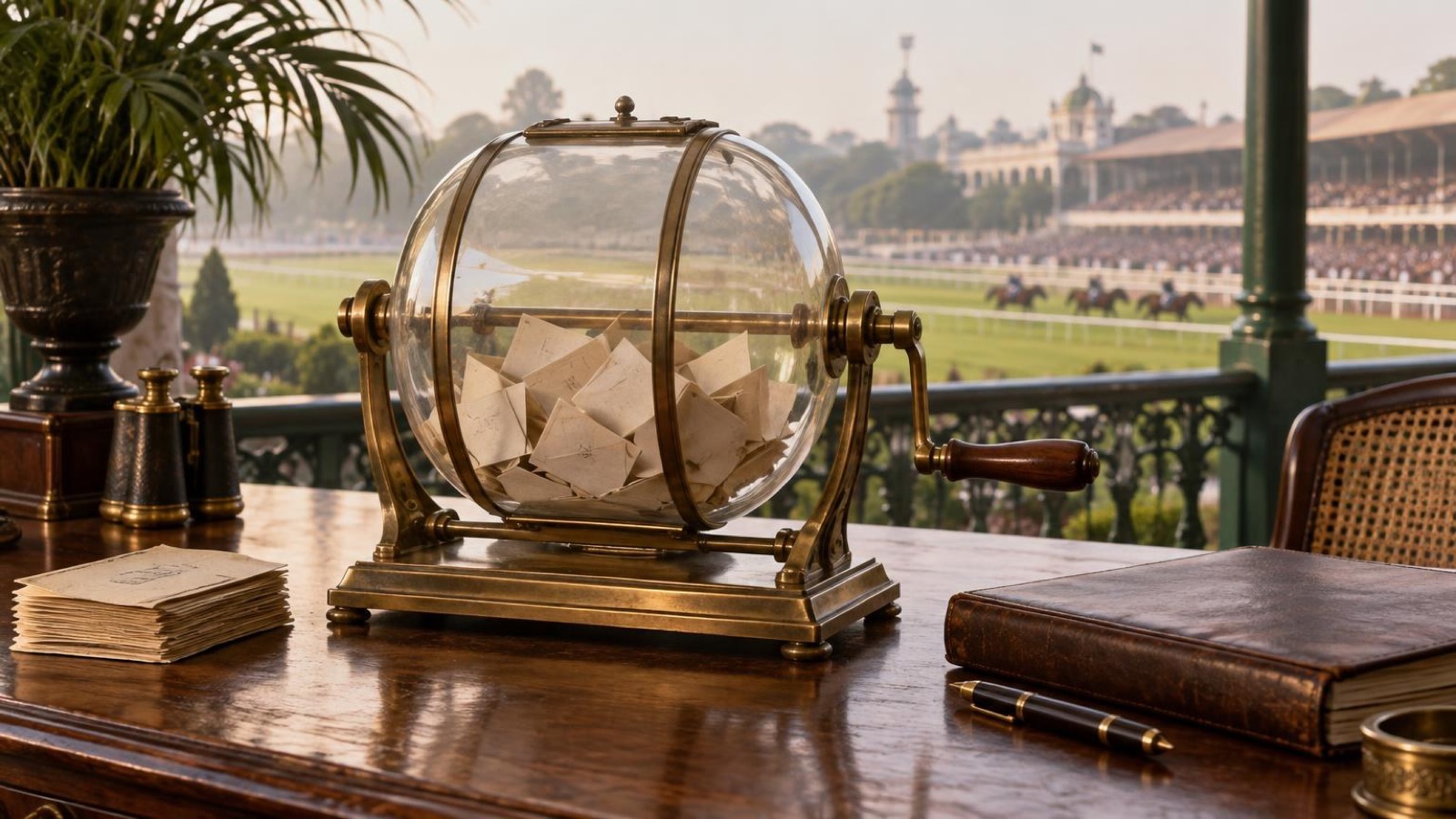
What a racing sweepstake is
A sweepstake is a lottery built around a race. Instead of studying form and picking a horse, you buy a numbered chance, and after the race the winning numbers are drawn or allotted from a drum. Your horse is effectively assigned to you by luck, and the prize pool is shared out among the holders of the drawn numbers. It is a game of pure chance dressed in the colors of horse racing.
This made sweepstakes enormously popular in colonial Asia, where racecourses were the social centers of cities like Calcutta, Shanghai, Hong Kong and Manila. A big race meeting gave the lottery a fixed date, a crowd, and a sense of occasion that an ordinary draw could not match. Racing clubs liked them because a sweepstake tied to the Derby could raise far more money than a day of ordinary betting, and the club kept a slice of the pool for itself.
The sweepstake is a cousin of pari-mutuel betting, but the two work differently. In pari-mutuel betting you choose your horse and the payout depends on how many other people chose it, with the operator returning a fixed share of the pool to winners. Japanese horse racing, for example, returns at least 70 percent of turnover to winning ticket holders, and in practice about 75 percent of sales are paid back, with roughly 10 percent going to the national treasury3. A sweepstake instead sells numbered chances, and the race result decides which numbers win. Both ideas, the shared pool and the fixed payout share, shaped the great racing lotteries described below.
If the wider world of racing culture interests you, our page on gambling culture and history in Asia covers the traditions, venues and attitudes around it.
The Calcutta Derby Sweep: how it worked
The Calcutta Derby Sweep was the most famous of all Asian racing lotteries, run by the Royal Calcutta Turf Club around the running of the Derby at Calcutta. The club itself was formally founded in 1847, though its story began much earlier, with the first recorded races at Akra near Calcutta in 17694. Racing in the city got a further push with the institution of The Viceroy's Cup at the Hastings Race Course in Calcutta in 18565, and the club earned the title "Royal" after the visit of King George V and Queen Mary in 19124.
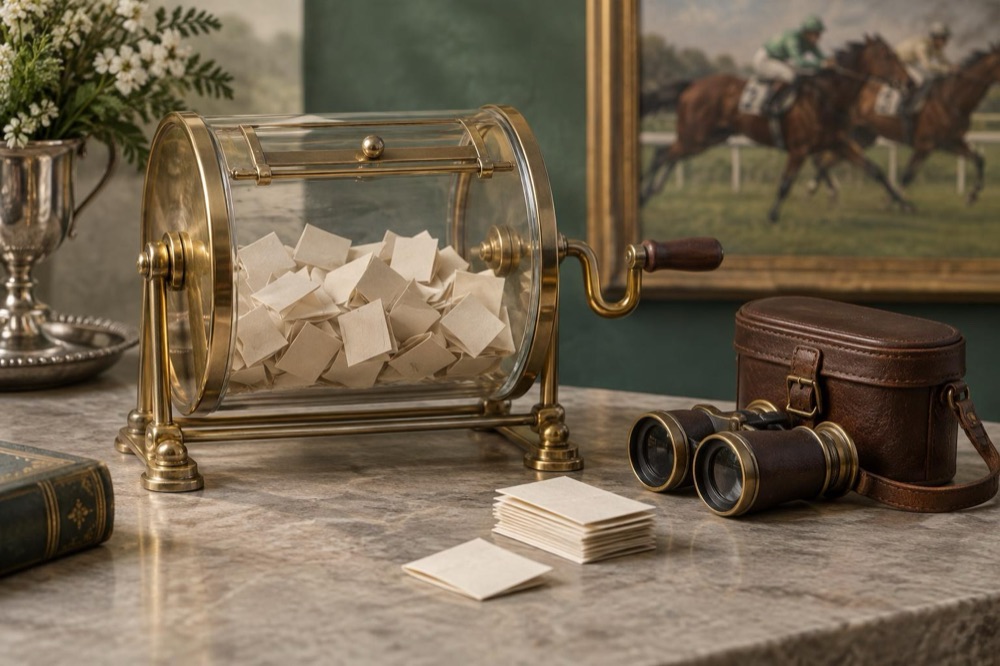
The sweep was first drawn in 1867, and that first draw had a pool of 34,700 Rupees1. The idea was simple. The club sold chances on the Derby field. Each horse in the race corresponded to a set of numbers, and after the race the numbers attached to the first, second and third horses, and to the unplaced horses, went into a draw. The holders of the numbers drawn against each group of horses shared the portions of the pool set aside for that group.
In its heyday the lottery used a glass drum with brass fittings, big enough to hold about 1.25 million tickets1. Picture that for a moment: a drum the size of a small room, turned by hand in front of a crowd, with a million paper chances tumbling inside. The draw was a public spectacle, held with the Derby as its backdrop, and the result could make an ordinary member wealthy overnight.
The Royal Calcutta Turf Club's racing season ran from May 1 to April 305, and the Derby and its sweep were the high point of the Calcutta racing year. You can read the full story on our page about the Calcutta Derby Sweep.
Ticket price, payouts and the 90 percent rule
A chance in the Calcutta Derby Sweep cost 10 Rupees each1. That was a serious sum for the time, which is why the sweep was a game for the well-off rather than the crowd in the cheap stands.
The payout structure was fixed and published in advance.
- The first prize was 40 percent of the total pool1
- 20 percent went to the second1
- 10 percent to the third1
- 20 percent was shared among the unplaced horses1
- 10 percent was kept for the Club and expenses1
So of every 10 Rupees a member paid, 90 percent went into the draw and only 10 percent was creamed off by the club. In other words, 90 percent of his ten rupees went into the draw1.
That 90 percent return was remarkably generous for a lottery of its era, and it explains much of the sweep's appeal. Compare it with modern pari-mutuel racing, where the return to winners is typically 70 to 80 percent of the betting pool3. Japanese central horse racing, for instance, pays out about 75 percent of sales and sends roughly 10 percent to the national general account6. Boat race betting in Japan similarly returns 75 percent of sales, excluding refunds, to holders of winning tickets7. The Calcutta sweep's 90 percent, achieved with 1920s technology and paper tickets, stands up well against all of these.
The fixed percentage structure also meant everyone knew the stakes in advance. If the pool was 1 Crore, the first prize would be 40 lakh, the second 20 lakh, the third 10 lakh, and so on down the list. No form study, no odds calculation, just a number and a drum.
Who could enter: the Club and Stand Members rule
Here is the part that surprises many readers today: you could not simply walk up and buy a chance. Chances, at 10 Rupees each, could only be allotted to Club or Stand Members, whether in India or elsewhere in the world1.
Membership of the Royal Calcutta Turf Club was the preserve of British expatriates and the upper crust of Indian society, and Stand Members held a slightly lower tier of privilege. The sweep was therefore a closed game, a lottery among a few thousand people rather than a public one. Members in London could hold chances in a Calcutta draw just as easily as members in Bengal, which is why the sweep's reach extended across the British Empire.
This exclusivity had a practical effect on the sweep's scale. Because the pool came only from members, the record figures it reached are all the more striking. It also meant the prizes stayed within a small social circle, and stories of Derby Sweep winners were a fixture of expatriate society gossip for decades.
Peak years and the record revenue of 1.25 Crores
The sweep grew steadily from its 1867 beginning, but its biggest years came between 1927 and 1930, during a period when numbers rather than tickets were issued1. Issuing numbers instead of physical tickets allowed the club to sell far more chances than a drum of paper could hold, and the figures exploded.
In the record years of 1929 and 1930, the sweep reached the staggering figure of 1.25 Crores, nearly a million Pounds Sterling1. To put that in perspective, the Indian Derby run at Mumbai today, one of the country's premier Grade 1 races, offers prize money of 8,395,670 Rupees5, about two thirds of the 1.25 Crores (12,500,000 Rupees) the Calcutta sweep was turning over each year in the late 1920s. The sweep was not just a lottery; it was one of the largest financial events in colonial India, moving money on a scale that rivaled banks.
For scale elsewhere in Asia, the Breeders Gold Cup in Japan, a major local racing event, offered a first prize of JPY 25,000,000 in fiscal 20178, and JPY 31,000,000 in fiscal 20209. These are today's big race prizes, and they show how far ahead of its time the Calcutta pool was.
Why the sweep closed in 1953
The Calcutta Derby Sweep was discontinued in 19531. By then the world that had created it had vanished. Independence in 1947 ended the British expatriate society that had supplied the Club and Stand Members, and with them the customer base for a members-only lottery. The 10 Rupee chance and the glass drum belonged to an imperial Calcutta that no longer existed.
The sweep's decline was not unique. Racing lotteries across Asia faded or transformed in the mid-20th century as governments took over lottery operations, taxed betting directly, or replaced club lotteries with state-run draws. What replaced the sweep in most countries was either ordinary pari-mutuel betting at the track or a national lottery run for public revenue. The Philippine case below shows the second path, where the sweepstakes idea survived by becoming a government institution.
Shanghai and old Hong Kong: racing club lotteries
Calcutta was not alone. Racing clubs across colonial Asia ran their own sweeps and lotteries around big race days, and two of the most important were in Shanghai and Hong Kong.
In old Shanghai, the race clubs of the International Settlement and the Chinese Race Club ran racing sweeps alongside their betting operations, and the city's racing culture became one of the largest in Asia before 1949. You can read the full story on our page about horse racing and betting in old Shanghai, and about the Jiangwan Racecourse, the former Chinese Race Club track.
In Hong Kong, the racing club that became the Hong Kong Jockey Club built its fortune on betting rather than lotteries, but the sweepstakes idea lived on in the city's own numbers games. The Hong Kong Derby was first held in 187310, making it one of the oldest Derbies in Asia, and the club's betting rules still define a full range of pool bets today, from the Double, where you must select the first horse in each of two nominated races, to the Double Trio, where you select the first three horses regardless of order in each of two races11. Payouts can be collected in cash, by check, by cash voucher or as a deposit into the betting account used to place the bet12. The club's pool bets, such as the Tierce, where you pick the first three in correct order, and the Quartet, the first four in correct order13, descend from the same family of shared-pool gambling that powered the old sweeps. Hong Kong's own numbers lottery, the Mark Six, is a separate descendant of the tradition, covered on our Mark Six history page.
The old racecourses themselves have their own afterlives, which our page on gambling museums and heritage sites in Asia explores, including the story of Happy Valley Racecourse, Hong Kong's first racetrack.
The Philippine Sweepstakes and Doble Panalo
The Philippines took the sweepstakes idea and made it a national institution. Horse racing itself arrived early: betting was introduced in 1903, extending the sport's mass appeal14. Racing betting in the Philippines was later put on a formal legal footing, with Republic Act No. 309, dated June 18, 1948, serving as the basis for betting in horse racing14. Today the country has one racecourse, and its principal bet types include the Daily Double, Forecast, Winner-Take-All, Pick-6, Quartet, Trifecta, Superfecta, Pentafecta, Win, Place and Triple-Trifecta14.
Alongside the racing, the Philippine Charity Sweepstakes Office built a national sweepstakes tradition. Its most successful innovation came in March 1998, when the new Bonus Sweepstakes "Doble Panalo" was launched2. The name means "double win," and the game delivers exactly that: it is a combination of Sweepstakes and Instant Win, where players can have the chance to win twice with a purchase of just one share15.
Unlike the Calcutta sweep, Doble Panalo was a game for everyone. A share cost Php10.00, a price any Filipino could afford, and the draw was a public event broadcast to the nation rather than a private ceremony for club members. The sweepstakes tradition in the Philippines thus traveled the opposite road from Calcutta's: instead of a club lottery that faded when its elite audience disappeared, it became a mass game run for charitable purposes, with the prize structure and ticket price set for ordinary players. If you are in the Philippines today and want to know what you can play, see our guide to gambling in the Philippines.
Prizes and ticket structure of Doble Panalo
Doble Panalo's structure is straightforward. One share costs Php10.0016, and that single share gives two chances to win.
The first chance is the Sweepstakes portion, a traditional draw with prizes of over Php3 million2. The second chance is the Match & Win portion, an instant-win style game with prizes of over Php550,0002. So a player holding one share could win in the draw, win in the instant portion, or, in the best case, win in both, which is where the "Doble Panalo" name comes from.
Compare that with the Calcutta sweep's structure and the difference in philosophy is clear. Calcutta sold one expensive chance to a member and paid out 90 percent of the pool in a single grand draw tied to one race. Doble Panalo sells a cheap share to anyone and splits the winning opportunities across two games, trading the single spectacular payout for two smaller, more frequent ones. Both are sweepstakes in the same tradition, but one was built for an imperial elite and the other for a national public.
Calcutta and Doble Panalo side by side
Putting the two games next to each other shows how the racing sweepstakes evolved across a century:
| Calcutta Derby Sweep | Doble Panalo | |
|---|---|---|
| First draw | 18671 | March 19982 |
| Ticket price | 10 Rupees per chance1 | Php10.00 per share16 |
| Who could buy | Club or Stand Members only1 | The general public |
| Top prize | 40 percent of the pool1 | Over Php3 million in the Sweepstakes portion2 |
| Ways to win | One draw tied to the Derby | Two: Sweepstakes draw and Match & Win15 |
| Return to pool | 90 percent of each 10 Rupees1 | Set prize structure rather than a shared pool |
| Status | Discontinued in 19531 | Part of the Philippine Charity Sweepstakes Office |
The through-line is the fixed published prize structure. What changed is who the game was for. The Calcutta sweep was a private lottery for a colonial club; Doble Panalo is a public one for a nation. The racing connection also loosened over time: Calcutta's sweep was inseparable from the Derby, while the Philippine Sweepstakes is a general lottery that no longer depends on any race result.
Where to read more
If this page caught your interest, several related stories fill out the picture. The full tale of the Calcutta Derby Sweep is on its own page, and the racing world it belonged to is covered in our history of horse racing and betting in old Shanghai. For the numbers-game tradition that grew alongside the sweeps, see when lotteries first appeared in China and the 36 Animals lottery, the flower lotteries of old Asia. The Mark Six lottery shows how the sweepstakes idea took root in Hong Kong, and why many Asian countries restrict gambling explains the attitudes that eventually pushed private club lotteries out in favor of state-run draws.
Common Questions
When was the first Calcutta Derby Sweep drawn?
The Calcutta Derby Sweep was first drawn in 1867. That first draw had a pool of 34,700 Rupees, and the sweep continued in various forms until it was discontinued in 1953.
How much did a Calcutta Derby Sweep ticket cost?
A chance in the Calcutta Derby Sweep cost 10 Rupees each. Chances could only be allotted to Club or Stand Members of the Royal Calcutta Turf Club, whether they lived in India or elsewhere in the world.
What was the first prize share of the Calcutta Derby Sweep pool?
The first prize was 40 percent of the total pool. The second took 20 percent, the third 10 percent, 20 percent was divided among unplaced horses, and 10 percent went to the Club and expenses.
When did the Calcutta Derby Sweep stop?
The Calcutta Derby Sweep was discontinued in 1953. Its record years had come much earlier, between 1927 and 1930, when it reached a gross figure of 1.25 Crores.
When did the Doble Panalo sweepstakes launch?
The Bonus Sweepstakes known as Doble Panalo was launched in March 1998 by the Philippine Charity Sweepstakes Office. It combined a Sweepstakes draw with an Instant Win game.
How much does a Doble Panalo ticket cost?
One share in Doble Panalo costs Php10.00. A single share gives the player two ways to win, through the Sweepstakes draw and the Match and Win instant portion.
What prizes could Doble Panalo players win?
Doble Panalo prizes included over Php3 million in the Sweepstakes portion and over Php550,000 in the Match and Win portion. Because the game combines a draw with an instant game, one share can win twice.
Sources16 sources
- Royal Calcutta Turf Club history, RCTC Online, archived
- PCSO history, Philippine Charity Sweepstakes Office, archived
- Central horse racing payout research, National Tax Agency, Japan
- Royal Calcutta Turf Club annual report, Royal Calcutta Turf Club, 2026
- India racing profile, Asian Racing Federation, archived
- Payout and treasury payment in central racing, National Diet Library, Japan, July 2014
- Boat race payout rules, Boat Race official site
- Hokkaido Keiba fiscal 2017 business report, Hokkaido Horse Racing Association, 2017
- Hokkaido Keiba fiscal 2020 business report, Hokkaido Horse Racing Association, 2020
- Hong Kong Derby press release, Hong Kong Jockey Club, archived
- Horse race betting rules, Chapter 1, Hong Kong Jockey Club, May 2025
- Horse race betting rules, Chapter 2, Hong Kong Jockey Club, January 2023
- Betting guide: pool types, Hong Kong Jockey Club
- GAB mandate and functions, Games and Amusements Board, Philippines
- PCSO history page, Philippine Charity Sweepstakes Office, archived
- PCSO about and history, Philippine Charity Sweepstakes Office, archived















