
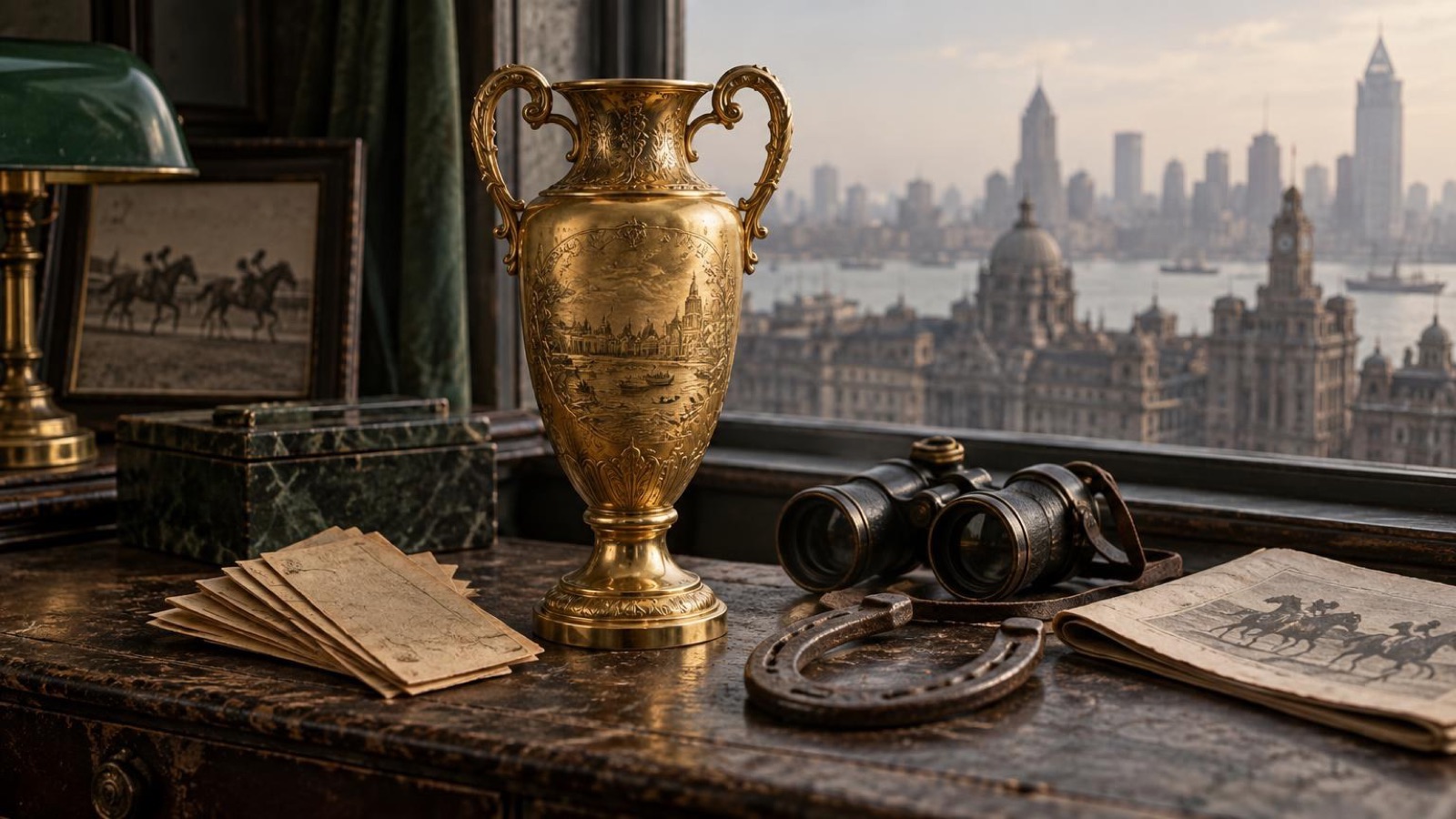
The first racecourse opened by Chinese people
Horse racing arrived in Shanghai with the foreign settlement community, and the first race there was held in the spring of 18481. For decades the sport was organized by and for the foreign residents of the concessions, and Chinese spectators and owners were largely shut out of the main club.
That changed in 1910, when a group of Chinese racing figures established the International Recreation Club and built their own racecourse at Jiangwan, a village in Baoshan County outside the city1. This was the first racecourse in Shanghai created by Chinese people, and it gave Chinese owners, trainers and bettors a track of their own rather than a place in the stands at someone else's meeting.
The club was not the only Chinese racing body to appear in this period. In 1926 the Chinese Jockey Club was established in Yinxiang, a suburb of Shanghai, with purely Chinese members1. The two organizations reflected the same impulse: a Chinese racing scene that ran its own meetings, set its own prizes and kept its own books.
Location and scale of the site: 1,200 mu at Wuchuan and Wudong Roads
The racecourse stood at Jiangwan, on land bounded by Wuchuan Road and Wudong Road, and covered roughly 1,200 mu1. That is a very large tract by any standard, and it tells you something about the ambition behind the project. A track of that size needed a grandstand, stabling, a paddock, training gallops and the roads and tram links to bring crowds out from the city.

Jiangwan in 1910 was still a village in Baoshan County, not part of the built-up city. Putting a racecourse there meant building the venue and effectively creating the access to it. The choice of a large, cheap, open site outside the crowded center was the same logic that produced racecourses on the edges of most Asian cities of the period.
For comparison, the scale of racing grounds elsewhere in Asia varies widely. Macau's old racecourse was an oval track of one mile in circumference, with a turf straight of about 370 meters and a sand straight of about 320 meters2. Japanese local racecourses run shorter, with courses from 1,000 to 1,600 meters3. Jiangwan's 1,200 mu was about the land, not the length of the straight, but it shows the room the club had to work with.
Racing, betting and facilities
Race days at Jiangwan followed the pattern of the sport across Asia at the time. There was:
- a card of races
- a paddock parade
- a grandstand for members and paying spectators
- betting on the outcome of each race
The club ran its own meetings and offered its own prizes.
The feature race was the China Gold Vase, created at the end of 1926 by the Chinese Jockey Club, with a beautiful trophy and unprecedented prize money1. A race like that was designed to draw the best Chinese-owned horses and to make the point that the Chinese racing scene could stage a meeting to rival anything in the concessions.
The social side mattered as much as the sport. Race meetings were occasions for the Chinese business and professional classes to be seen, to entertain and to bet. The spring meeting of the Shanghai Race Club in May 1939 saw Mrs. Jack Liddell win the Champions with Rain, a reminder that the racing calendar in old Shanghai was a busy one with several clubs and meetings running through the year1.
Betting at the track worked on the same principle as at racecourses across the region today: you buy a ticket on a horse or a combination, and the payout depends on the pool and the result. Modern Asian tracks show how the mechanics have been formalized. In Hong Kong, betting is offered at the Club's Sha Tin and Happy Valley racecourses, off-course betting centers and approved locations including the official website4. In Japan, betting tickets can be bought at the 10 JRA racecourses and the off-track betting facilities around the country5. At Jiangwan in the 1920s and 1930s, the same idea applied with paper tickets and clerks at the windows.
Destruction in the Battle of Shanghai and sale in 1939
Racing at Jiangwan did not survive the 1930s. When the Battle of Shanghai broke out in 1937, the racecourse was destroyed, and its management and horses moved into the Shanghai Race Club1. The fighting and bombardment wrecked the facilities and ended horse racing at the site.
What followed was a slow unwinding. The Shanghai Race Club received the assets of the racing association and took control of the grounds, and in 1939 the racecourse closed and the land was sold to the Japanese-owned Shanghai Hengchan Company, which converted it into farmland1. The sale was forced by unpaid bank loans, and the 1,215 mu site and its buildings went for 760,000 fabi in three installments1.
The war scattered the racing world of old Shanghai. Owners, trainers and jockeys who had raced at Jiangwan either moved to the Shanghai Race Club's course or left the sport. The horses that survived the fighting were absorbed into other stables. By the time the war ended, there was no Jiangwan racing scene left to revive.
What stands on the site today
Nothing of the racecourse survives. After the war the land passed through different uses, and the area around Jiangwan became factories and housing as Shanghai expanded north and east. The last remaining racecourse buildings were demolished in early 2000 to make way for a residential development1.
That pattern, a grand old track disappearing under the city, is common across Asia. The Guangzhou Racecourse site, opened in 1992, stopped racing and business operations in 1999 and was converted into a car city from 2008, later adding dining, fitness, entertainment and home furnishing businesses6. Some venues keep a piece of their history: the grandstand at Mumbai's Mahalaxmi Race Course is now designated a heritage structure7. Jiangwan kept nothing.
If you want to see how a racing ground of that era was laid out, the closest surviving examples are elsewhere in the region. Modern tracks in Japan, Korea and Hong Kong still run the same basic operation: a course, a grandstand, betting windows and a paddock.
| Venue | Year | Details |
|---|---|---|
| Seoul Racecourse | Opened in 19898 | |
| Jeju Racecourse | Opened in 19908 | |
| Busan-Gyeongnam Racecourse | Opened in 20059 | |
| Vietnam racecourse project, Bình Dương Province | Planned | A 30 hectare parking lot and a grandstand able to hold 50,000 to 60,000 people10 |
For the wider story of the sport in the city, see History of Horse Racing and Betting in Old Shanghai. If you are interested in how old tracks are remembered, Gambling Museums and Heritage Sites in Asia covers racing museums and memorials, and Happy Valley Racecourse: History of Hong Kong's First Racetrack looks at a track that is still running.
Common Questions
When did Jiangwan Racecourse open?
The International Recreation Club opened its racecourse at Jiangwan in 1910. It was the first racecourse in Shanghai established by Chinese people rather than by the foreign settlement community, and it sat on about 1,200 mu of land in Baoshan County.
Who founded Jiangwan Racecourse?
It was founded by Chinese racing figures who set up the International Recreation Club in 1910. A separate body, the Chinese Jockey Club, was established in 1926 in the Yinxiang suburb of Shanghai with purely Chinese members, and it created the China Gold Vase race that same year.
Where exactly was the racecourse located?
The track stood at Jiangwan, then a village in Baoshan County outside the main city, on land bounded by Wuchuan Road and Wudong Road. The site covered roughly 1,200 mu, a scale that made it one of the largest sporting grounds in the Shanghai area.
What were 'champagne tickets'?
Champagne tickets were the premium admission and betting tickets sold at the big race meetings, named for the champagne prizes and celebrations attached to feature races. They gave holders access to the members' areas and the better viewing spots on race day.
Why was it renamed International Stadium?
After racing ended, the site was taken over and reused, and the grounds were later referred to as the International Stadium as the old racing identity faded. The name change reflected the shift from a working racecourse to a multi-purpose venue and then to other uses.
What happened to the site after racing ended?
The racecourse was destroyed during the 1937 Battle of Shanghai, and the land was sold in 1939 to the Japanese-owned Shanghai Hengchan Company, which turned it into farmland. Later the area became factories and housing, and the remaining racecourse buildings were demolished in early 2000.
Sources10 sources
- Women in the Chase: Chinese Studies in History, Academia Sinica, 2021
- Macau Jockey Club racecourse, Macau Jockey Club, archived
- JRA Racing Guide, Japan Racing Association, 2026
- Betting Facilities Rule, Hong Kong Jockey Club, 2026
- JRA Racing FAQ, Japan Racing Association, 2026
- Guangzhou Racecourse site, Yangcheng Evening News, 2026
- Mahalaxmi Race Course, Royal Western India Turf Club, 2026
- Korean horse racing, Asian Racing Federation, archived
- Busan-Gyeongnam Racecourse, Korea Racing Authority, 2026
- Vietnam racecourse project, Vietnam News, 2017















