
Who could hold a chance: Club and Stand Members only
The Calcutta Derby Sweep was not a public lottery in the way a modern national draw is. You could not simply walk up and buy a ticket. Chances, at 10 Rupees each, could only be allotted to Club or Stand Members, whether in India or elsewhere in the world1. That single rule shaped everything about the sweep: who played it, how it was sold, and why it stayed a relatively contained affair even as the money grew enormous.
The Royal Calcutta Turf Club itself had been formally founded in 1847, though its story began much earlier, with the first recorded races at Akra near Calcutta in 17692. By the time the sweep was running at full strength, the Club was the center of organized racing in eastern India, and its membership was the gate through which every sweep participant had to pass.
For a member, the practical steps were simple:
- You held your membership.
- You put your name down for one or more chances at 10 Rupees each.
- You waited for the draw.
Because membership extended to people living outside India, a member who had moved abroad or who maintained a stand membership from a distance could still take part. The rule was about your standing with the Club, not about where you happened to be when the draw was made.
This is the part that surprises people who read about the sweep today. The record years produced a gross figure of 1.25 Crores, nearly a million Pounds Sterling, in 1929 and 19301. That is a staggering sum for a lottery whose tickets were restricted to a private membership. The money came from a relatively small pool of buyers, each holding one or more 10 Rupee chances, and the pool compounded because so much of each ticket went back into the prize fund.
If you were not a Club or Stand Member, there was no route in. There was no general sale, no agent selling to the public, no equivalent of a corner shop ticket. The sweep was a members' lottery attached to a racing club, and that is the single most important thing to understand about it.
Tickets, prize pool and payout percentages
The arithmetic of the Calcutta Derby Sweep is unusually clean, and it explains why the lottery was so popular among those who could enter. A chance cost 10 Rupees. Of that, 90 percent went into the draw, meaning 9 Rupees of every 10 paid in went straight to the prize pool1. The remaining 10 percent went to the Club and to expenses.
That 90 percent return is high by the standards of most lotteries, and it is the reason the pool could reach the figures it did. When you are returning nine-tenths of everything taken in, the prize fund grows quickly even from a modest number of players.
The prize money was divided in a fixed pattern1:
| Place | Share of the total pool |
|---|---|
| First prize | 40 percent |
| Second prize | 20 percent |
| Third prize | 10 percent |
| Unplaced horses | 20 percent, shared among them |
| Club and expenses | 10 percent |
The 20 percent shared among the unplaced horses is the detail that most distinguishes the Calcutta Derby Sweep from a modern draw. It was not a winner-takes-most affair. Even if your horse finished nowhere, you still had a claim on a fifth of the pool, divided among everyone in the same position. That consolation structure kept the sweep attractive to members who might otherwise have seen a single 40 percent top prize as too long a shot.
The first draw, in 1867, had a pool of 34,700 Rupees1. Set against the 1.25 Crores of the record years, that first figure shows how far the sweep traveled in roughly sixty years. The growth was not steady year on year, but the direction was unmistakable, and by the late 1920s the sweep had become one of the largest racing lotteries anywhere.
The drawing drum and how the draw worked
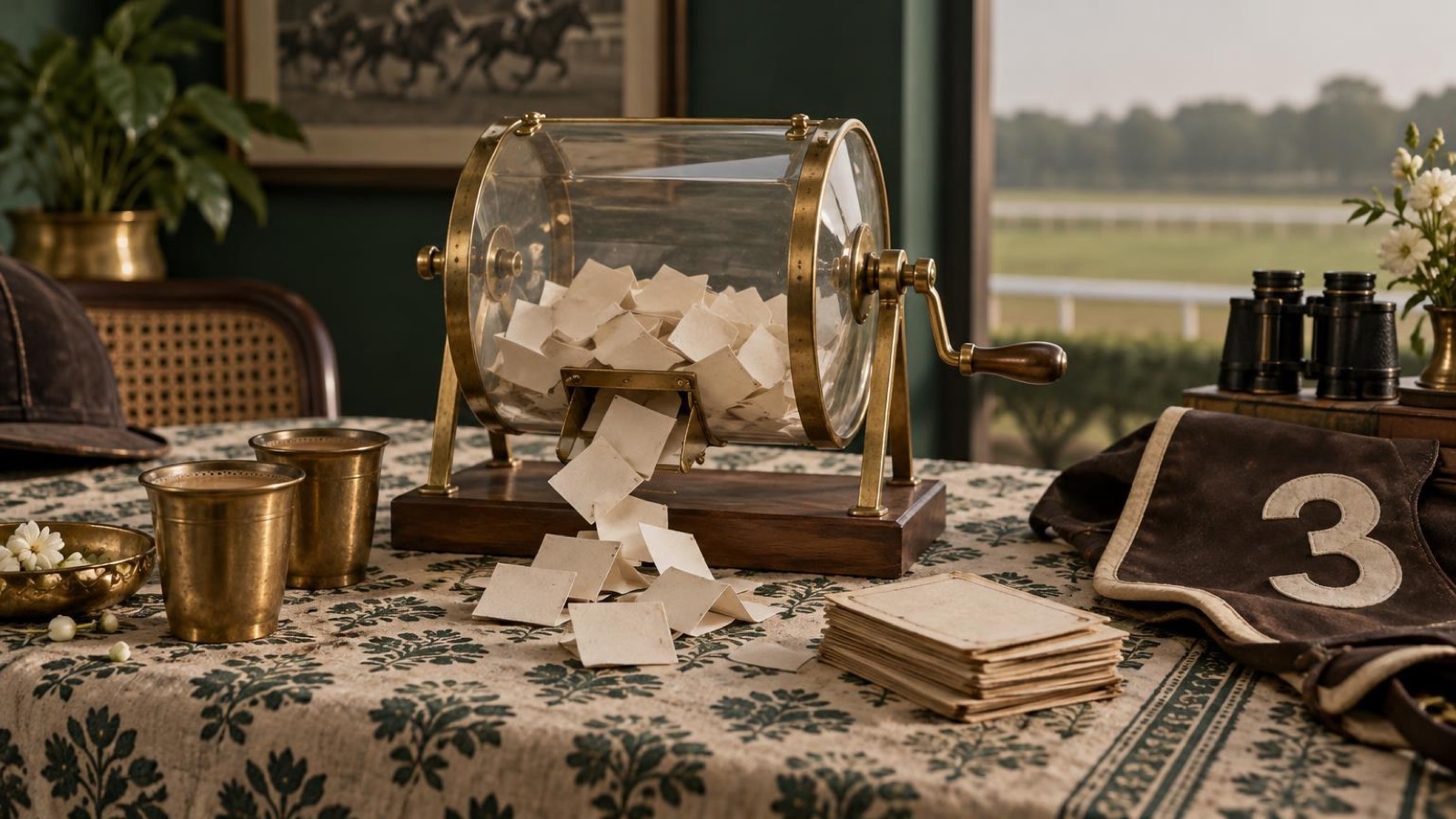
The physical centerpiece of the Calcutta Derby Sweep in its prime was a glass drum with brass fittings, big enough to hold about 1.25 million tickets1. A drum of that capacity tells you something about scale. By the peak years, the sweep was handling numbers of entries that ran into the millions, and the draw had to be conducted in a way that everyone could see and trust.
The biggest years of the sweep, between 1927 and 1930, fell during a period when numbers rather than tickets were issued1. That change matters for how the draw worked. Instead of printing and handling a physical ticket for every chance, the sweep moved to a system where each entry was represented by a number. Numbers are far easier to hold, count and draw from a drum than paper, and the shift is part of why the sweep could scale to the size it reached in those years.
The draw itself followed the logic of a racing sweep. Entries were drawn and matched to the horses in the race, so that each holder of a chance ended up with a horse. When the race was run, the finishing positions of the horses determined which chances won which share of the pool. The drum was the mechanism that made the matching fair and visible: entries went in, they were drawn out in public, and the pairing of chance to horse was settled before the race.
For a member taking part, the experience was a two-stage wait. First came the draw, when you learned which horse your chance had drawn. Then came the race itself, when that horse's performance decided your payout. A good draw was only half the story; the horse still had to run.
The drum's capacity of about 1.25 million tickets is the clearest single measure of how large the sweep became. It is also a reminder that this was a mechanical, physical operation. Every entry had to be represented in that drum, and the draw had to be conducted in a way that satisfied a membership that had a great deal of money riding on the outcome.
Why the sweep closed in 1953
The Calcutta Derby Sweep was discontinued in 19531. By then it had run for more than eighty years, from the first draw in 1867 through the record years of 1929 and 1930 and on into the post-war period. The sweep did not fade out because interest collapsed. It closed at a point when it had long been established as one of the great racing lotteries of the world.
The timing places the sweep's end in the early years of independent India, a period when the legal and administrative treatment of lotteries and gambling was being reworked. The sweep had always been a members' lottery tied to a private club, and that structure, which had served it well for decades, left it exposed once the surrounding rules changed.
What the sweep left behind is a template. The idea of drawing entries against the runners in a big race, with a large share of the pool returned to players and a consolation spread across the unplaced horses, is the ancestor of the racing sweeps that followed in other parts of Asia. If you want to see how that model traveled, the story of racing sweepstakes in Asia picks up where the Calcutta sweep leaves off, covering the Shanghai horse lotteries and the Philippine sweeps that drew on the same basic idea.
The Royal Calcutta Turf Club itself continued. Its racing season runs from 1st May to 30th April, and the Club remains based at its registered address at 2A Bakery Road, Hastings, Kolkata2. Its annual general meeting is still held at the Reserve Stand at the Race Course in Kolkata4. The sweep, though, is a closed chapter, remembered as the lottery that turned a members' racing club into the operator of one of the largest prize pools in the world.
For anyone tracing the history of gambling in the region, the Calcutta Derby Sweep sits at an interesting point. It was a private, membership-restricted lottery that nonetheless reached a scale comparable to national draws, and it did so with a payout structure generous enough to keep members coming back for more than eight decades. When it closed in 1953, it took with it a particular way of running a sweep, one built around a glass drum, a fixed set of percentages, and a membership list that decided who could play.
Common Questions
When was the first Calcutta Derby Sweep drawn?
The first Calcutta Derby Sweep was drawn in 1867. It was run by the Royal Calcutta Turf Club, which had been formally founded in 1847, and the first draw carried a pool of 34,700 Rupees.
How much did a ticket cost?
A chance in the Calcutta Derby Sweep cost 10 Rupees each. Chances could only be allotted to Club or Stand Members, whether they lived in India or elsewhere in the world.
What was the first prize pool in 1867?
The first draw in 1867 had a pool of 34,700 Rupees. In the record years of 1929 and 1930 the sweep grew to a gross figure of 1.25 Crores, nearly a million Pounds Sterling.
How much of the ticket price went into the draw?
Ninety percent of the ten Rupees went into the draw. The remaining 10 percent went to the Club and to expenses, so the sweep returned 90 percent of the money taken in.
How was the prize money divided?
First prize took 40 percent of the total pool, second took 20 percent, third took 10 percent, 20 percent was shared among the unplaced horses, and 10 percent went to the Club and expenses.
When did the sweep stop?
The Calcutta Derby Sweep was discontinued in 1953. It had run for more than eighty years, with its biggest years falling between 1927 and 1930.
Sources4 sources
- Book 11, Royal Calcutta Turf Club
- RCTC Annual Report 2025-26, Royal Calcutta Turf Club
- India, Asian Racing Federation
- AGM Notice, Royal Calcutta Turf Club















