
The forms at a glance
| Form | What it is | Where you find it |
|---|---|---|
| Flat racing | Thoroughbreds on the level, turf or dirt | Japan, Hong Kong, Singapore, South Korea, Malaysia, India, Philippines |
| Jump racing | Hurdles and steeplechase | Japan, alongside the flat cards |
| Ban'ei | Draft horses pulling a weighted sled | Obihiro, Hokkaido only |
Minimum age: 20 in Japan
Flat racing: the dominant format
Almost everything you will see at a racecourse in Asia is flat racing: thoroughbreds running on the level over turf, dirt or all-weather, with no jumps in the way. It is the format that fills the daily cards in Japan, Hong Kong, Singapore, South Korea, Malaysia, India and the Philippines, and it is the one most visitors picture when they think of a day at the races.

Japan splits its flat racing into two parallel worlds. Central racing, run by the Japan Racing Association, is the top tier, with bigger purses and the country's best horses. Local racing, run by prefectures and municipalities, is the smaller circuit, spread across regional tracks. Both are flat racing most of the time, and both take bets on the same basic menu of outcomes1.
The shape of a flat race is simple to follow. Horses break from starting stalls, run the trip, and the first past the post wins. What changes from race to race is the distance, the surface and the class of horse. A sprint and a staying race look like different sports, but the betting works the same way.
If you are new to reading a card, the practical things to check are the distance, the going (how soft or firm the ground is) and the number of runners, because the number of runners decides how many places pay in a place bet. In Japan, a place bet pays out to third when eight or more horses run, but only to second when the field is smaller6.
Ban'ei: Japan's draft-horse racing at Obihiro
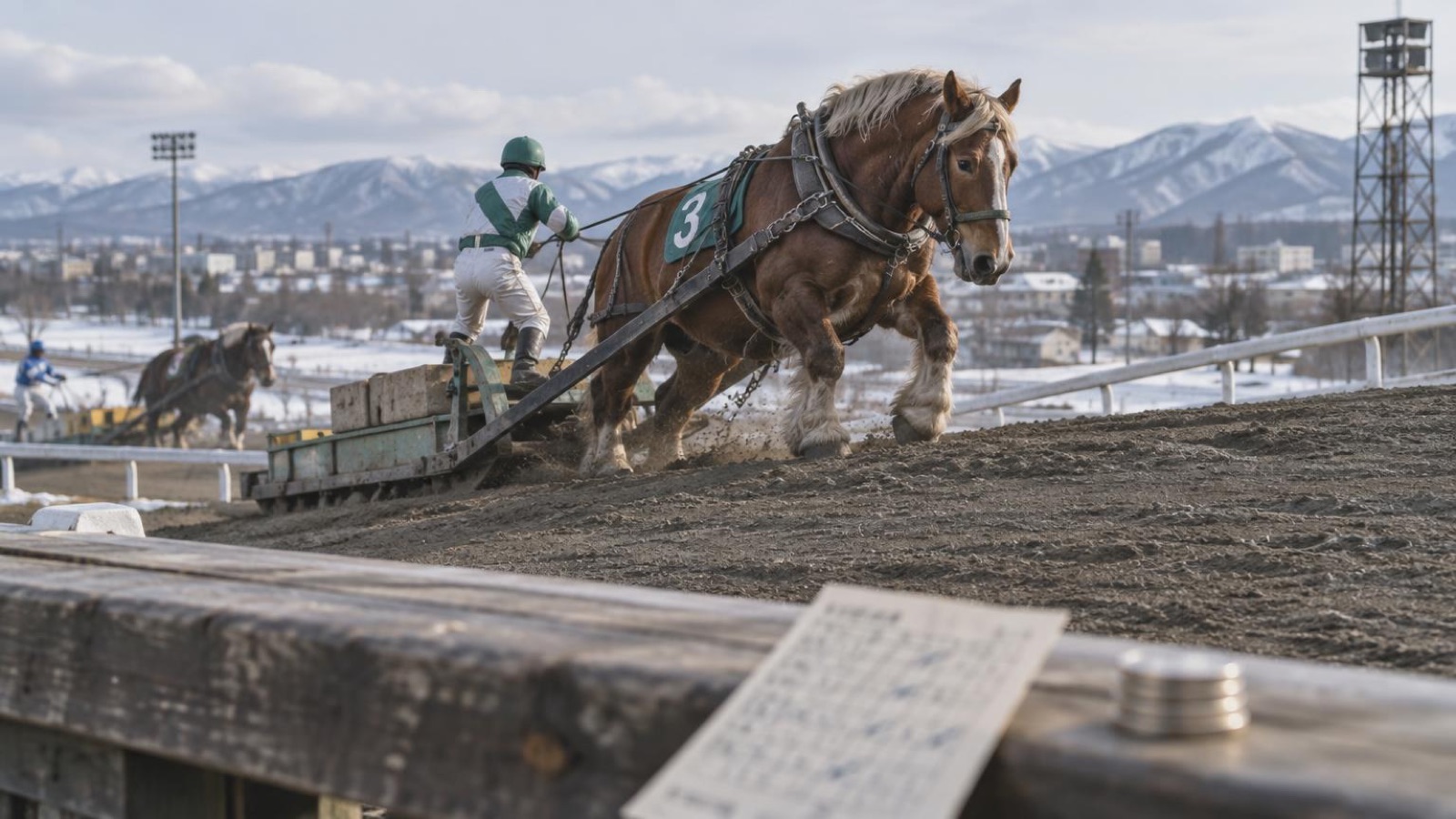
Ban'ei is the form of racing you will not find anywhere else. It uses draft horses weighing from 800 to 1,200 kg, and instead of galloping on the flat they pull a sled carrying a jockey and a prescribed heavy load over a 200-meter dirt track with two humps2. The weight and the humps turn each race into a grind of strength and balance rather than a pure speed test, and the horses are working animals rather than sleek thoroughbreds.
It is held only in Hokkaido, at Obihiro Racecourse. The flagship race, the Banei Derby, is graded BG1 and has been run at Obihiro every year since the 2005 edition7. Meetings run through the year, and you do not have to be in Obihiro to follow them: off-course betting locations carry the action. J-PLACE Sapporo, for instance, takes bets on all Ban'ei race meetings and all main races8.
For a visitor, Ban'ei is the most distinctive day out in Japanese racing. The pace is different, the horses are enormous, and the crowd is local. If you are planning a trip around it, check the meeting schedule first, because Ban'ei does not run every day.
Central racing in Japan: schedule and structure
Central racing is the JRA's circuit, and it runs at ten racecourses: Sapporo, Hakodate, Fukushima, Niigata, Nakayama, Tokyo, Chukyo, Kyoto, Hanshin and Kokura3. Each racecourse hosts about five meetings a year, and each meeting runs for about twelve days3. A race day normally has twelve races3.
The calendar is tightly defined. Central racing can be held on Saturdays, Sundays, national holidays, January 5 to 7, or dates from December 28, and the total across the year cannot exceed 288 days3. That is why Japanese racing clusters into weekends and holiday periods, and why there are stretches with no central meetings at all.
For anyone visiting, the calendar is worth checking before you travel. If you turn up at a JRA track on a day with no live racing, it may still be open: Tokyo Racecourse, for example, offers free admission on days when it has no live races and is used as an off-course betting facility11. So a quiet day is not necessarily a closed day.
Racing by local governments in Japan
Local racing, often called NAR racing, is run by prefectures and municipalities rather than by the JRA. It is the same sport at a smaller scale, spread across regional tracks, and it is where you will find the smaller crowds and the more relaxed atmosphere1.
The two systems are separate but connected for bettors. You can bet local racing through local channels, and central racing through JRA channels, and some off-course shops carry both. J-PLACE Kamaishi, for example, takes all central race meeting days, and on Iwate racing days it takes races 6 to 12 at all racecourses plus all obstacle stakes races and advance-day sales races; on non-Iwate days it takes all races at all racecourses12.
The prize money gap between the two tiers is wide. In local racing the largest first-place purse is ¥100 million, for the JBC Classic, Kawasaki Kinen, Tokyo Derby and Tokyo Daishoten2. In central racing the largest first-place purse is ¥500 million each for the Japan Cup and Arima Kinen, while the smallest is ¥5.8 million for events for winless three-year-olds and two-year-olds2. That gap tells you where the best horses usually run.
Local racing also has its own support programs. Hokkaido Horse Racing, for instance, raised the first prize of top-class special races for two-year-olds and three-year-olds and up to ¥1,000,000, and raised the first prize of two graded races for three-year-olds and up to ¥5,000,000, in fiscal 201713. It also ran a two-year-old added prize program paying ¥500,000 for first, ¥100,000 for second and ¥75,000 for third, ¥675,000 per race, in the 2019 fiscal year14.
Bet types across Japanese racing
Japanese racing offers nine standard bet types, and the menu is broadly the same whether you are at a central or a local track. The nine are4:
- Win
- Place
- Bracket quinella
- Quinella
- Wide
- Exacta
- Trio
- Trifecta
- WIN5
The underlying law groups them into basic methods (win, place, exacta and quinella) plus multi-race bets15.
The simplest is the win bet: you pick the horse that finishes first1. A place bet is the each-way equivalent, and how many places pay depends on the field size. In Japan, a place bet pays to third when eight horses run, and only to second when the field is seven or fewer6.
The combination bets are where the variety sits. A quinella picks the first two in any order, an exacta picks them in order, a trio picks the first three in any order, and a trifecta picks them in order4. A wide bet is a quinella place, paying if your two horses both finish in the places. WIN5 is different again: it is a single bet across five designated races, and you need the winner of all five4.
The menu is not identical everywhere. Kanazawa Racecourse lists nine types in total6. Some off-course shops that carry JRA racing list eight types: win, place, bracket quinella, quinella, wide, exacta, trio and trifecta17. And the types on sale can shrink with the field: a race with only two starters sells win bets only, while races with five to seven starters sell win, place, quinella, trifecta and trio, and wide16.
If you want the detail on any single bet, the bet types guide walks through each one, and there are dedicated pages for win and place bets, quinella and quinella place, exacta versus quinella, trifecta and trio and multi-race bets.
Where and how to bet: on-course, off-course and internet
You have three practical routes to a bet in Japan: at the track, at an off-course betting shop, or online through an official account.
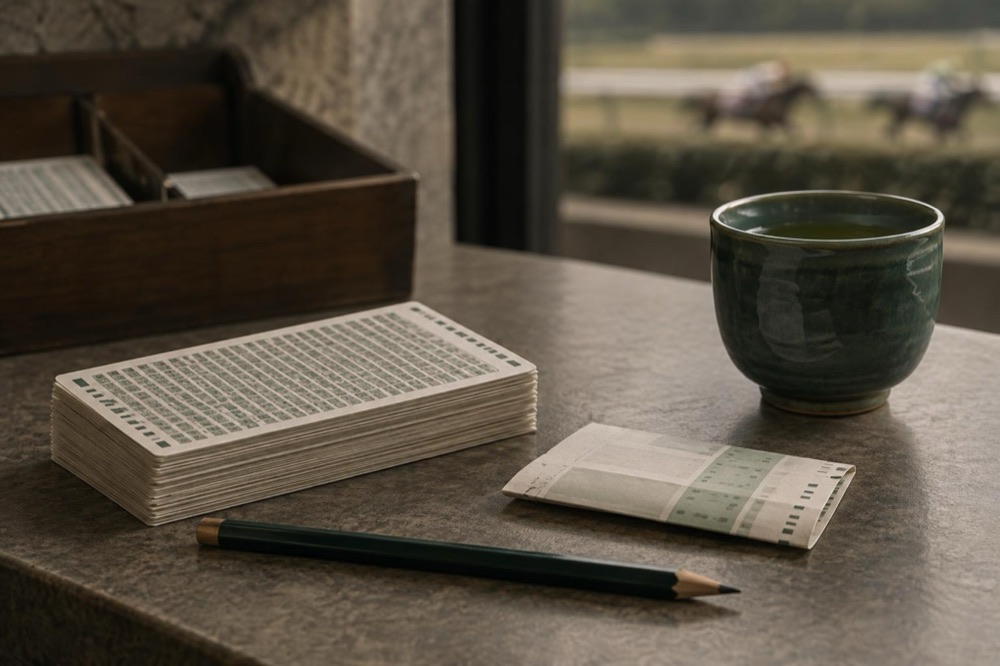
At the track, you buy tickets with cash or with a UMACA card, and you can use a mark card to fill in your selections19. The same options apply at the off-course shops. JRA runs 37 WINS off-course betting facilities nationwide, and the ten JRA racecourses also function as off-course betting facilities on days when they are not hosting live racing2.
Online, the JRA offers telephone and internet betting with four forms of membership: A-PAT, Soku-PAT, JRA Direct and ARS2. A-PAT covers all races at all racecourses where central racing is held, plus designated overseas races, and supports win, place, bracket quinella, quinella, wide, exacta, trio, trifecta and WIN59. For local racing, SPAT4 covers betting on all local venues including the four Nankanto tracks, and it offers trifecta and trio by horse number10.
One thing to keep straight: the JRA's online accounts are for JRA races. Ban'ei is local racing, so you bet it through local channels or at a shop that carries Hokkaido meetings, not through A-PAT9.
If you are setting up an account, the online betting accounts guide covers who can open one, and there are separate pages on Soku-PAT signup and topping up a UMACA card.
Payout rates: what returns to bettors
Japanese racing is pari-mutuel: all the money bet on a pool is shared among the winners after the operator takes its cut. The law sets the range. Payouts must be at least 70 percent of ticket sales, at a rate the JRA sets within a range set by the Minister of Agriculture, Forestry and Fisheries5. In practice, pari-mutuel racing in Japan returns 70 to 80 percent of sales to winning tickets15.

That range is not uniform across every bet. Nagoya Racecourse, for example, paid about 75 percent across all bet types before a change, and from April 1, 2014 it paid 75.0 percent on place and quinella bets20. The amendment that allowed this set payout rates at not less than 70 percent and not more than the rate set by the minister, which is 80 percent, with the race organizer choosing within that band20.
For comparison, Hong Kong's consultation on racing duty described dividends to winners of at least 82.5 percent for standard bets and at least 76 percent for exotic bets, with the club's commission capped at 5.5 percent and 5 percent respectively21. The point for a bettor is simple: the higher the return rate, the smaller the house's share, and the more of your long-run stake comes back.
There is also a bonus scheme. JRA Premium pays back the normal payout plus an added 5 percent on target races and bet types4. It is worth checking whether the race you are betting carries it.
What else you will see
Beyond flat racing and Ban'ei, the region has other forms worth knowing about. Jump racing, over hurdles and fences, runs alongside the flat cards in Japan, and J-PLACE Kamaishi takes bets on all obstacle stakes races on Iwate racing days12. In South Korea, pari-mutuel racing offers win, place, quinella and exacta, and there are no bookmakers and no off-course betting in the model described22.
Singapore's rules list a much longer menu than Japan's, including win, place, evens and odds, forecast, place forecast, tierce, trio, quartet, quadro, double, double forecast, double trio, triple trio, six up, all up and roll betting21. That is a useful reminder that "types of horse racing" and "types of bet" are different questions: the racing itself is mostly flat, while the betting menu varies widely by jurisdiction.
If you want to see how the forms fit together country by country, the horse racing overview covers the region, and the JRA vs NAR page explains the two Japanese systems side by side.
Common Questions
Where is Ban'ei horse racing held?
Only in Hokkaido, Japan, at Obihiro Racecourse. Ban'ei uses draft horses weighing 800 to 1,200 kg that pull a sled with a jockey and a set load over a 200-meter dirt track with two humps. The Banei Derby has been run at Obihiro every year since the 2005 edition.
How do Ban'ei races work?
Draft horses pull a heavy sled over a 200-meter dirt track with two raised humps. The weight and the humps make the race a test of stamina and balance rather than pure speed. The top race, the Banei Derby, is graded BG1.
Can I bet on Ban'ei races through the JRA's IPAT system?
No. A-PAT and the other JRA accounts cover races at the ten JRA racecourses plus designated overseas races. Ban'ei is local racing run by Hokkaido, so you bet it through local racing channels such as SPAT4 or at an off-course betting shop that carries Hokkaido meetings.
When are Ban'ei race meetings held?
Ban'ei meetings run through the year at Obihiro, mostly on weekends, and are shown at off-course betting locations. J-PLACE Sapporo, for example, takes bets on all Ban'ei race meetings and all main races.
How many bet types are there in Japanese horse racing?
Central JRA racing offers nine types: win, place, bracket quinella, quinella, wide, exacta, trio, trifecta and WIN5. Local racing also offers nine standard types. The exact menu can vary by racecourse and by field size.
When is there no horse racing in Japan?
Central racing is limited to Saturdays, Sundays, national holidays, January 5 to 7 and dates from December 28, capped at 288 days a year. On days when a racecourse has no live races it often opens free as an off-course betting facility.
Sources22 sources
- Beginners Book 2026, Japan Racing Association, 2026
- Japan Racing Guidebook 2026, Japan Racing Association, 2026
- Regulation on Central Horse Racing, e-Gov, 2026
- Bet Types List, Japan Racing Association, 2026
- Horse Racing Act, Japan Racing Association, 2024
- Beginner's Guide, Kanazawa Racecourse, 2026
- Banei Derby, Wikipedia, 2026
- J-PLACE Sapporo, Japan Racing Association, 2015
- A-PAT Instructions, Japan Racing Association, 2026
- SPAT4 First Purchase and Refund, Hokkaido Racing, 2026
- Tokyo Racecourse, Japan Racing Association, 2026
- J-PLACE Kamaishi, Iwate Horse Racing, 2026
- Legislative Council Brief on Racing Duty, Hong Kong Legislative Council, 2001
- Hokkaido Horse Racing Business Report 2017, Hokkaido Racing, 2017
- Research Paper on Public Racing, National Tax College, 2025
- Betting Tickets, Kanazawa Racecourse, 2026
- J-PLACE Fukuyama-Ekimae, Sonoda Himeji Racecourse, 2026
- J-PLACE Yokawa, Sonoda Himeji Racecourse, 2026
- Beginners Book, Japan Racing Association, 2024
- Hokkaido Horse Racing Business Report 2019, Hokkaido Racing, 2019
- Horse Race Betting Game Rules, Singapore Pools, 2026
- Korean Horse Racing, Asian Racing Federation, 2011















