
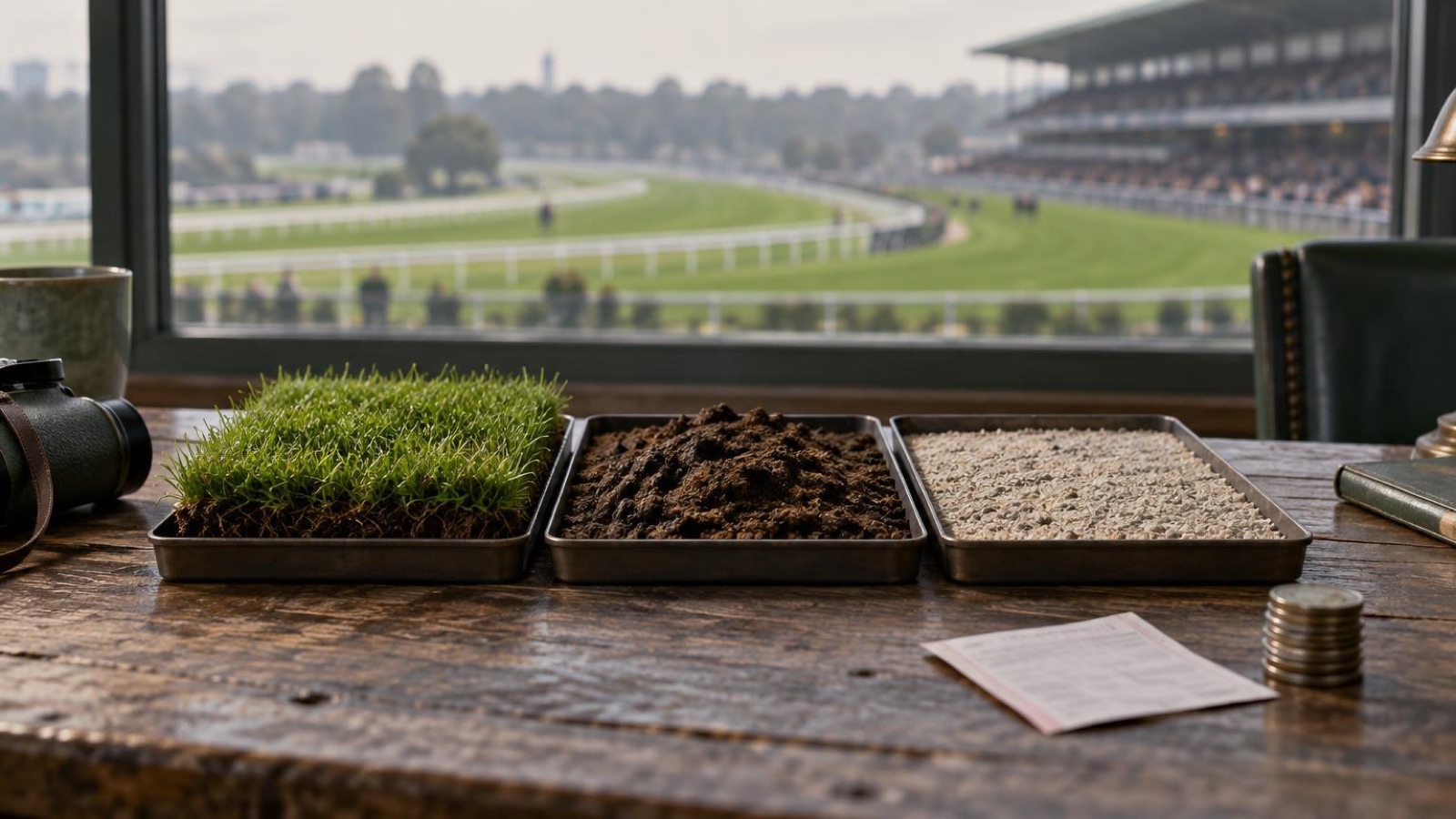
Track surfaces: turf, dirt and all-weather
There are three surfaces you will meet at an Asian racecourse, and the racecard tells you which one a race is on before you bet.
Turf is grass. It is the surface used for the biggest races in the region, including the Longines Hong Kong Vase, the Cathay Pacific Hong Kong Sprint and the LONGINES Hong Kong Mile, all run at Sha Tin on turf1. Japan's ten central racecourses, Sapporo, Hakodate, Fukushima, Niigata, Nakayama, Tokyo, Chukyo, Kyoto, Hanshin and Kokura, are the home of the country's top-level turf racing8.
Dirt is a sand and soil surface. It is the everyday surface on Japan's local racing circuit. All NAR racecourses have only dirt tracks, with the exception of Morioka Racecourse, which also has a turf track3. Individual tracks follow the same pattern: Urawa Racecourse is listed as a dirt course, and so is Sonoda Racecourse9.
All-weather is an engineered synthetic surface. It is designed to drain and to ride consistently in normal weather, which is why it is described differently from turf and dirt4.
The racecard makes the surface obvious at a glance. In the past performances for a horse's last three races, a circled mark means turf, a squared mark means dirt, and a bold mark means steeplechase11. Once you know that, you can read a horse's form by surface in a few seconds.
What 'going' means and the common descriptions
The going is the official description of the state of the surface on race day. It is not a forecast and it is not a tip. It is a measurement and an assessment, published by the operator, that tells you whether the ground is riding fast, slow, hard or soft.
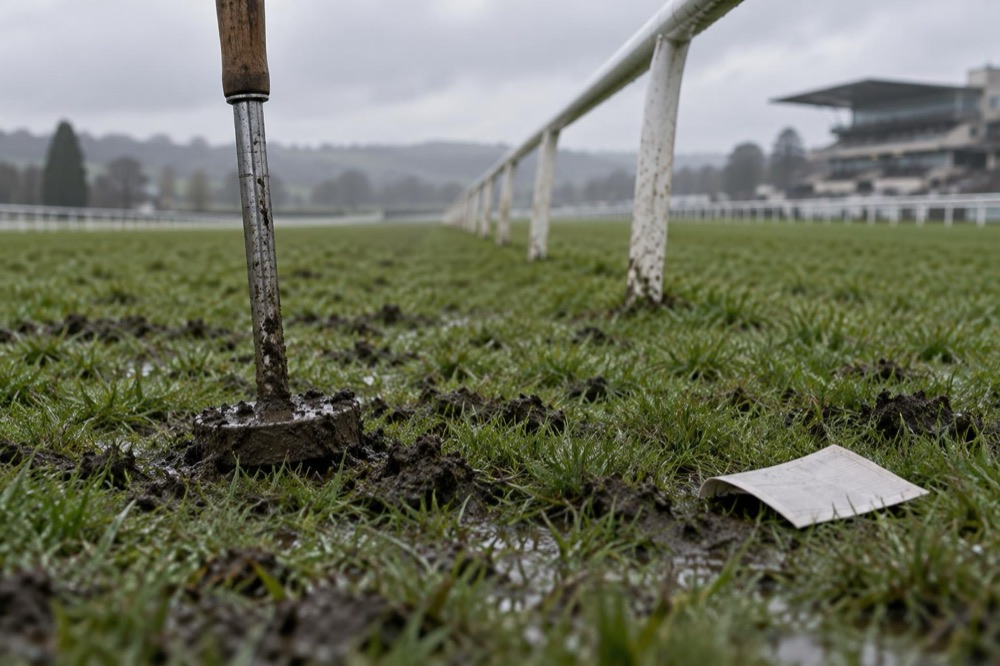
On turf, the going runs along a scale. At the soft end you get descriptions such as 黏至軟地 (yielding to soft, Y/S), 軟地 (soft, S) and 大爛地 (heavy, H)4. At the other end the ground is firm and fast. The exact wording differs by jurisdiction, but the idea is the same everywhere: the further toward heavy you go, the more the surface will take out of a horse, and the further toward firm you go, the faster the race will be run.
The going is not decided by one number alone. In Hong Kong, the going index is reference data for deciding track conditions, and jockey opinions, the condition of the turf and the weather are also taken into account4. That matters practically: if the index says one thing and the riders say another after the first race, the official description can be updated during the meeting.
For a bettor, the going tells you two things. First, whether the race is likely to be run at a fast or slow overall time. Second, whether a particular horse's known form was recorded on similar ground. A horse that has only ever run on firm turf is an unknown quantity if the going turns soft.
How going is rated on turf tracks
Turf going is rated on a scale, and Hong Kong publishes the numbers alongside the words. The scale runs from the soft end through to the firm end, with a numeric index attached to each description. Yielding, written 黏地 and abbreviated Y, sits at -3.50 on that index4.
The practical reading is simple. Lower, more negative numbers mean softer, more testing ground. As the number rises toward the firm end, the surface is drier and faster.
Two things are worth knowing about how the rating is used on the day.
- It is a reference, not a verdict. The index is one input, and jockey opinions, turf condition and weather are weighed alongside it4.
- It can change. Weather during the meeting, and the effect of race after race being run over the same strip, both feed into the official description.
If you are comparing a horse's form, look at the going description recorded for its previous races rather than the number alone. A horse that won on yielding ground has shown it handles that surface; a horse that has only run on firm ground has not.
How dirt and all-weather tracks are described
Dirt and all-weather are not described with the turf going scale. Each has its own vocabulary.
Dirt is described by how wet the surface is. Korean race programs use a five-term set: 건 for dry, 양 for good, 다 for wet, 포 for muddy and 불 for sloppy12. That is a practical scale for a surface that changes quickly in rain. Dry and good are the fast conditions; wet, muddy and sloppy are progressively slower and more testing, and they favor different types of horse.
All-weather is described by hardness rather than wetness. Hong Kong rates it on an index where higher values mean the surface is harder and lower values mean it is softer4. Because the surface is engineered to drain, the description is about how the track is riding rather than how much rain has fallen.
The practical difference for you as a bettor is this. On dirt, rain changes the race materially, and the going description is the fastest way to see it. On all-weather, the surface is designed to stay consistent in normal weather, so the description moves less and the form lines hold up better.
Major racecourses in Asia and their surfaces
The table below sets out the surfaces at the tracks you are most likely to meet, and what each one runs.
| Racecourse | Country or region | Surface | Notes |
|---|---|---|---|
| Sha Tin | Hong Kong | Turf, plus all-weather | Hosts the Hong Kong Vase, Sprint and Mile on turf1 |
| Happy Valley | Hong Kong | Turf | Wednesday night meetings13 |
| Sapporo, Hakodate, Fukushima, Niigata, Nakayama, Tokyo, Chukyo, Kyoto, Hanshin, Kokura | Japan | Turf and dirt | The ten central racecourses8 |
| Urawa | Japan | Dirt | Listed as a dirt course9 |
| Sonoda | Japan | Dirt | Listed as a dirt course10 |
| Morioka | Japan | Turf and dirt | The only NAR track with a turf course3 |
| Other NAR racecourses | Japan | Dirt | All NAR racecourses have only dirt tracks apart from Morioka3 |
A few practical points sit behind that table.
Japan's central racing is run at the ten racecourses named in the legislation, and on a race day meetings are held at two to three racecourses8. That means the surface you are betting on can differ between the meetings on the same afternoon, so check the racecard for each one.
At JRA racecourses you can pick up a free English race program, a How To Bet guide, and a booklet that translates the mark card into English at the information counters6. If you are new to reading a Japanese racecard, that is the fastest way to work out which surface each race is on.
Hong Kong's Happy Valley races on Wednesday nights, and the atmosphere there is part of the appeal for visitors13. Sha Tin is the track that hosts the international turf features1.
Races moved between tracks: why and what changes
Races do get moved, and when they do, the surface can change with them. The usual reasons are renovation work and scheduling.

A race can be declared void if it is run on a course other than the designated one, or if there is interference such as a disaster, stone throwing or a vehicle entering the track14. That is the rule that sits behind any switch of venue: the race has to be run on the course it was set for.
The practical point for a bettor is that the sales schedule is not fixed in stone. Scheduled sales dates, the number of races, the time slots and the methods of sale can all change14. So check the day's program rather than assuming last week's pattern still holds.
For a bettor, a moved race means three things to check before you stake anything.
- The surface. A race moved from a turf track to a dirt track is a different race for the horses in it.
- The distance. Moves often come with a change in trip, and a horse's form over the old distance may not transfer.
- The draw and the track shape. A different racecourse means a different run to the first turn and a different finish.
The racecard and the official program will show the new venue, surface and distance. Read them rather than assuming the race is as it was last year.
Where to find going reports before you bet
The going is published by the operator, and it is easy to find once you know where to look.
At the racecourse. Odds can be checked on monitors inside the racecourse, and the same screens carry the day's track information5. In Hong Kong the going index and the track condition sit alongside the racecard4.
In the official app and digital guide. Hong Kong's digital guide includes a Speed Map, which forecasts the running positions and speed of each horse for each race15. That is a different tool from the going, but the two are read together: the going tells you how fast the surface is, and the speed map tells you how the race is likely to be run over it.
In the printed and online race program. Japan's race programs carry the surface marks in the past performances, so you can see at a glance whether a horse has been running on turf or dirt11. Free English race programs are available at JRA racecourse information counters6.
In the operator's betting guide. JRA publishes a How to Bet guide running to 18 pages, and a separate guide to QR betting through the SMAPPY app running to 5 pages16. Both are free and both explain how the day's information is presented.
A practical routine before you bet on any race:
- Check the surface for the race in the racecard.
- Check the going description for that surface.
- Look at whether the horses you are considering have run on similar ground before.
- Check the odds on the monitors or in the app, and remember that odds show the likely payouts on winning bets, with lower odds meaning the horse is favored by many people and your return is lower5.
One last point on how the going feeds into your bet. It does not change the rules of the bet type you are placing. In Japan, a Place bet pays the top three finishers when eight or more horses run, and the top two when the field is seven or fewer17. There is no equivalent of the North American Show wager at these racecourses, so the Place payout is what you are working with. What the going changes is the chance of that happening, and that is what the odds are pricing.
If you want to go deeper on the bet types themselves, the horse racing hub covers the pools and how they are settled, and how to read a racecard walks through the draw, weight, rating and form figures that sit next to the surface marks.
Common Questions
What does 'good to firm' going mean for a horse?
It describes a turf surface that is dry and on the hard side, so it rides fast. Horses with a quick action often handle it well, while some stayers prefer softer ground. The label is one of a scale that runs from heavy and soft through good to firm and firm.
Which Asian racecourses run on all-weather surfaces?
Hong Kong's Sha Tin has an all-weather track alongside its turf course, and Japan's local NAR circuit is almost entirely dirt, with Morioka the one track that also has turf. Most Asian racing is turf or dirt rather than synthetic.
Does the going affect betting odds?
It can. Odds reflect how the betting pool is being spread, and a surface that suits or spoils a horse's chance will shift money. Odds are shown on monitors inside the racecourse and in the official app, and they move as the pool builds.
What is the difference between dirt and all-weather tracks?
Dirt is a natural sand and soil surface that changes a lot with rain, going from dry to muddy to sloppy. All-weather is an engineered synthetic surface designed to drain and stay consistent, so it is rated on a hardness index rather than the turf going scale.
Where can I check the going for a race today?
The official operator publishes it. In Hong Kong the going index and track condition appear in the racecard and on-course monitors, and in Japan the race program and information counters carry the day's going along with free English race programs and a How To Bet guide.
Why are some races moved to a different racecourse?
Usually because of renovation work or a scheduling clash. When Sapporo was being renovated, a race was run at Hakodate instead, and other races have shifted between Hanshin, Nakayama and Kyoto over the years. The surface and distance can change with the move.
What going do all-weather tracks have?
All-weather tracks are not described with the turf going scale. They are rated on a hardness index, where a higher number means a harder surface and a lower number means a softer one, and the surface is designed to stay consistent in normal weather.
Sources17 sources
- Longines Hong Kong Vase, Hong Kong Jockey Club, 2015
- LONGINES Hong Kong Mile, Hong Kong Jockey Club, 2014
- JPN Racing Guidebook 2026, Japan Racing Association, 2026
- Racing Course, Hong Kong Jockey Club, 2018
- Go Racing Guide, Japan Racing Association, 2014
- JRA Information Guide, Japan Racing Association, 2016
- Cathay Pacific Hong Kong Sprint, Hong Kong Jockey Club, 2011
- 競馬法施行規則, e-Gov, July 28, 2026
- Urawa Racecourse, Japan Racing Association
- Sonoda Racecourse, Japan Racing Association
- How to Bet, Japan Racing Association
- Horse Racing Information, Korea Racing Authority, September 26, 2026
- Happy Valley Racecourse, Discover Hong Kong, 2026
- Hanshin Summer Stadium, Japan Racing Association, June 30, 2008
- HKJC Digital Guide, Hong Kong Jockey Club, July 25, 2023
- Betting Guide, Japan Racing Association, September 25, 2026
- Tokyo City Keiba Race Program, Tokyo City Keiba, December 29, 2024















