
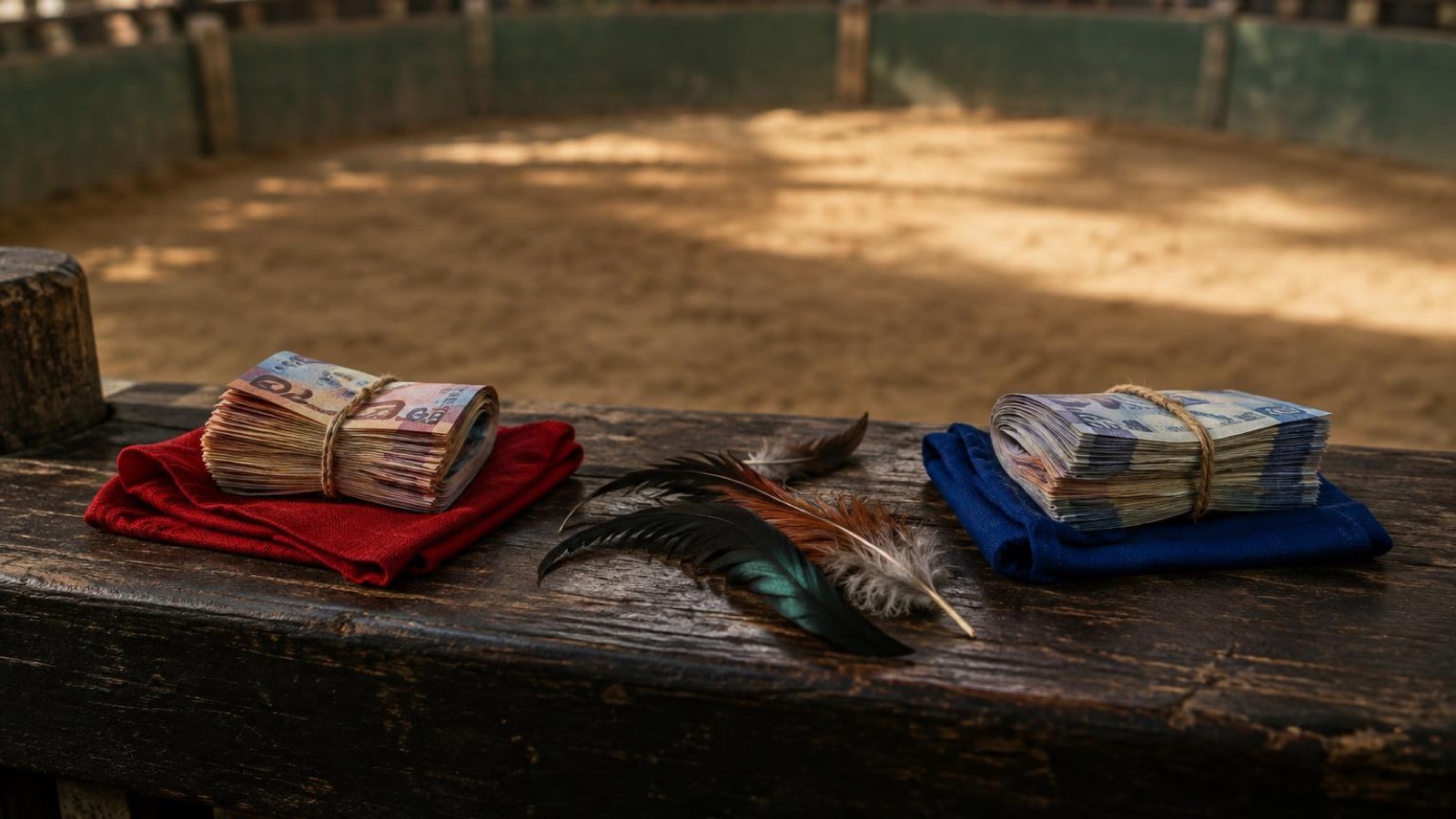
What sabong betting is
Sabong is cockfighting, and the betting around it is not a bookmaker product in the way a sports bet is. There is no printed slip and no account balance at the arena. Instead, the crowd itself is the market. Money moves between people standing around the pit, and the arena takes its cut from the winners.
The basic unit is a single fight between two roosters. Each rooster is assigned a side, meron or wala, and the crowd splits into two groups of backers. You choose a side, hand your cash to a kristo, and if your rooster wins you get your stake back plus your winnings, minus the house commission2.
What makes sabong different from a pari-mutuel pool at a racetrack is that the odds are not calculated from a pool after the fact. They are called out by the kristos and by the crowd, and they move as money arrives on each side. If too much money lands on meron, the odds on meron shorten and the odds on wala lengthen, which is the market's way of balancing the book4.
For a first-timer, the practical point is this: you are not betting against the arena. You are betting against the people on the other side, with the arena taking a slice of the winner's profit. That is why the odds you hear matter so much, and why the same fight can be offered at different prices by different kristos at the same time.
Meron and Wala: the two sides of a fight
Every fight has two sides, and they are named rather than numbered.

- Meron is the side you back if you think the rooster in the red corner wins.
- Wala is the side you back if you think the rooster in the blue corner wins.
The names come from the Filipino words for "red" and "blue," and the corners are color-coded so you can tell at a glance which rooster you are backing. Before the fight, the handlers bring the birds out and the crowd gets a look at them. That look is the whole basis of your decision, because there is no form guide, no past results sheet and no official rating.
You pick one side. You cannot back both meron and wala in the same fight, because the two bets would cancel each other out and you would still owe commission on whichever side won1. If you want to hedge, you do it across different fights on the card, not within one.
The money you hand over is your stake. If your side wins, you get the stake back plus winnings calculated at the odds you were given. If your side loses, the stake is gone. There is no partial refund and no cash-out.
One practical detail that surprises visitors: the minimum bet at most arenas is small, often the equivalent of a few dollars, and there is no maximum in the way a casino table has one. The limit is what the kristo on the other side is willing to take. A large amount may need to be split across several kristos, and the odds tend to move against you as you do.
The house commission: 5% of winnings
The arena does not charge you to enter, and it does not take a cut of your stake. It takes 5% of what you win2.
That distinction matters more than it sounds. If you bet PHP 1,000 at even money and win, your winnings are PHP 1,000. The house takes 5% of that PHP 1,000, which is PHP 50, and you collect PHP 950 plus your original PHP 1,000 back. Your total return is PHP 1,950 on a PHP 1,000 stake.
If you bet PHP 1,000 and lose, the house takes nothing, because there are no winnings to tax. Your loss is the full PHP 1,000.
The commission is deducted before you are paid, so you never handle the gross amount. The kristo settles with you net. This is worth knowing because it means the effective price you are getting is slightly worse than the odds called out. A fight offered at even money is really paying you 0.95 to 1 after commission.
Across a full card, that 5% is the arena's revenue, and it is why the arena does not need to take a position on any individual fight. It profits from volume, not from outcomes.
How odds are set and payouts calculated
Sabong odds are not posted on a board. They are shouted, and they are negotiated in the moment.
The way it works in practice is that a kristo calls out a price for one side, and the crowd either takes it or does not. If money piles onto meron, the kristo shortens the meron price and lengthens wala, until the two sides are roughly balanced. The odds you agree to are the odds you get, and they are locked in when the kristo takes your cash4.
Payouts follow the same simple arithmetic used in fixed odds betting everywhere: your stake multiplied by the odds you were given6. The fixed odds recorded in the operator's official records for each bet are the odds used to calculate the payout, and neither the operator nor the bettor may change them for a valid bet regardless of later changes.
A few things to know about how the numbers behave:
- Short odds mean a likely winner. The lower the payout, the more likely the outcome, which is the same relationship you see in any betting market7.
- Odds move until the fight starts. The price you hear early is not the price you will get later if the money shifts. If you like a number, take it when you hear it.
- The recorded price is the price. Once the kristo has taken your money at a stated price, that is the price used to settle, regardless of what happens to the market afterward8.
- Rounding is at the arena's discretion. Small change is usually rounded, and the arena decides how.
If you are used to a sportsbook where the price is displayed and fixed, this feels loose. It is. The compensation is that you can sometimes get a better price than a bookmaker would offer, because you are dealing with another bettor rather than a company.
Kristos: betting on a draw
A kristo is a draw. Neither rooster wins, usually because both stop fighting, both refuse, or the fight is stopped without a result.

There are two separate things you can do about a kristo, and they are easy to confuse.
The first is what happens to your meron or wala bet if the fight is declared a kristo. Your stake is refunded. You do not win, you do not lose, and you get your money back3. This is the standard treatment for a void outcome in betting markets generally: when the event does not produce a result, the bet is returned rather than settled9.
The second is a kristo bet placed before the fight. This is a separate wager that the fight will end in a draw, and it pays at its own odds, which are usually long because draws are uncommon. If you place a kristo bet and the fight ends in a draw, you win. If it does not, you lose your stake.
The practical consequence is that a kristo bet is a bet on an unusual outcome, and it is priced accordingly. It is not a hedge against your meron or wala bet in any meaningful sense, because if the fight is a draw your meron or wala stake comes back anyway. It is a standalone wager.
One thing to watch: not every stoppage is a kristo. If a rooster is declared the winner on points or the fight is awarded, that is a result, and meron or wala bets settle normally. The declaration is made by the referee, and it is final.
How a derby works
A derby is a tournament, not a single fight. Several roosters are entered, they are matched against each other across a series of fights, and the card runs until a winner emerges.
The practical differences from a regular fight are these:
| Difference | What it means |
|---|---|
| More fights, more betting | A derby card can run for hours, and each fight is its own betting market with its own meron and wala sides. |
| The same rooster may fight more than once | A winning bird can be matched again in a later round, which means you may see a rooster you backed earlier come back out. |
| Entry fees and prize money | Derbies are run under a permit, and owners pay to enter. The prize pool is what the owners are fighting for, and the betting around the pit is separate from it. |
| The card is published in advance | You can see the order of fights and the pairings before betting starts, which is not always true of ad hoc fights at a small arena. |
For a bettor, a derby is mostly a longer version of the same thing. You still pick meron or wala per fight, you still deal with kristos, and the 5% commission still applies to your winnings2. The difference is volume: you have more fights to bet on, and more chances to get your money down.
If you are new, a derby is actually a better introduction than a single fight, because you can watch a few rounds without betting and get a feel for how the odds move and how the kristos work before you put money down.
Placing bets at the arena vs online
Arena betting and online sabong are different products with different rules, and the difference matters.
At the arena, everything is cash and in person. You find a kristo, tell them your side and your amount, hear the odds, and hand over the money. If you win, the kristo pays you on the spot. There is no account, no app and no record beyond what the kristo remembers. This is the traditional form, and it is the one that operates under an arena permit.
Online sabong runs through an app or a website. You deposit, you tap a side, and the bet settles against a digital balance. The mechanics look like any other online betting product, and the odds are displayed rather than shouted.
The legal position is where the two diverge. In most places where arena sabong is legal and regulated, online cockfight betting is not covered by the same permit, and running or using an online cockfight operation can be a separate offense. In Japan, for example, gambling online is a crime regardless of what the game is called or what it contains5. Where arena sabong is permitted, that permission does not automatically extend to the online version.
For visitors and expats, the practical rule is simple: bet at the arena if arena sabong is legal where you are, and treat online sabong as a separate question with its own answer. If you want the country-by-country picture, see where Asian games are legal and the Philippines guide.
Reading the fight card before you bet
There is no form guide in sabong, so reading the card means reading the birds and the crowd.
Before each fight, the handlers bring the roosters out and walk them around the pit. This is your look. You are assessing size, condition, stance and how the bird carries itself. Experienced bettors also watch the handlers, because a handler who seems confident is a signal, and a handler who seems nervous is a signal too.
The crowd is the other half of the card. Where the money is going tells you what the people who bet every day think. If meron is heavily backed, the odds on meron will be short, and that is the market's opinion of the fight. You can either follow it or take the other side at a better price.
A few practical things to check before you bet:
- Which corner is which. Meron is red, wala is blue. Confirm before you hand over money, because the colors are the only label.
- The gaff or blade rules. Fights are run under a set of rules about the weapons fitted to the birds, and the rules affect how the fight is likely to end. Ask if you are not sure which rules are in force for that card.
- The odds on both sides. Listen to what is being called for meron and for wala before you commit. The gap tells you how the crowd sees the fight.
- The minimum bet. It is small at most arenas, but ask, because it varies.
- What happens on a kristo. Confirm with your kristo that meron and wala stakes are refunded on a draw, so there is no surprise3.
If you are visiting and want to watch before you bet, the Manila cockfight guide covers where to go, and the visitor and expat guide covers how to behave at a local venue. For the online version and its legal status, see e-sabong.
Common Questions
What does meron mean in sabong?
Meron is the side of the fight you back when you think the rooster in the red corner will win. Wala is the opposite side, the blue corner. You pick one side, hand your money to a kristo, and collect if your side wins.
What happens to bets if a fight is declared a kristo?
A kristo is a draw. Bets on meron and wala are refunded rather than settled as wins or losses, and separate kristo bets placed before the fight pay out. You get your stake back, not a profit.
How much does the house take from a winning sabong bet?
The arena takes a 5% commission on the amount you win, not on your stake. If you win PHP 1,000, the house keeps PHP 50 and you collect PHP 950. The commission is deducted before you are paid.
Can you bet on both meron and wala in the same fight?
No. You pick one side per fight. Betting both sides would cancel out your stake and leave you paying commission on whichever side won, so the arena does not accept it.
What is the difference between a regular fight and a derby?
A regular fight is a single bout between two roosters. A derby is a tournament of several fights run under one permit, often with entry fees and prize money, and the same roosters may fight more than once across the card.
Is online sabong betting the same as arena betting?
No. Arena betting is cash, in person, through a kristo. Online sabong runs through an app or website, and in most places where arena sabong is legal, online cockfight betting is not, so the legal risk is different.
Sources9 sources
- Bet Placement Horse Racing Guide, Singapore Pools
- Horse Race Betting Game Rules, Singapore Pools, July 6, 2026
- Poker3Cartas Rules, DICJ Macau, 2026
- Mahjong Bacarrat Rules, DICJ Macau, 2026
- Online Casino Gambling Guidance, National Police Agency Japan, September 25, 2026
- Football Rule 3, HKJC, January 17, 2026
- Sic Bo How to Play, PlaySmart, September 25, 2026
- Football Rule 3 (Chinese), HKJC, 2023
- Football Rule 4, HKJC, March 30, 2026















