Mahjong's origins in China
Mahjong is a tile-based game of skill, strategy and luck that originated in 19th century China1. The strongest traditions point to the Ningpo area of China as its birthplace2, while other accounts place its creation around Shanghai in the mid- to late 1800s4. Either way, the game emerged in the final decades of the Qing dynasty, in the prosperous commercial cities of eastern China where merchants, officials and sailors had both the money and the leisure to play.
The game that spread from there was not quite the game we know by name. The word "Mahjong" itself is a Western invention: the term was coined by Joseph P. Babcock, an American businessman, around 1920 when he began exporting the game to the United States7. Before that, the game existed under various Chinese names, and the tile sets varied from region to region. Babcock simplified the rules for American players, gave the game a trademarked English name, and in doing so fixed in the Western mind a single "mahjong" where China had known many local variants7.
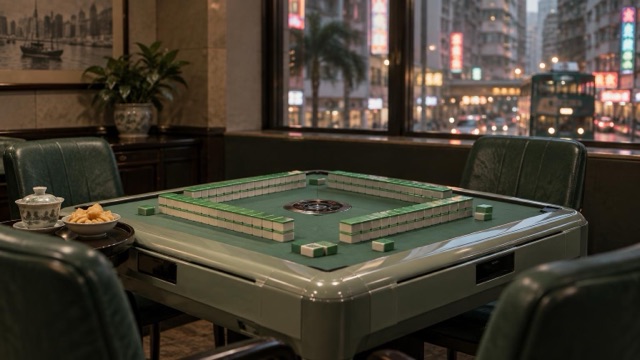
The game reached Hong Kong during the Qing dynasty, carried by traders and migrants along the coastal routes that connected Shanghai, Ningpo, Guangdong and the British colony8. Hong Kong took to it immediately. The city's Cantonese-speaking population already had a deep culture of card and tile games, and mahjong fitted neatly into family life, teahouse culture and festival gatherings. A typical game can last more than two hours, which made it a natural centerpiece for long evenings with relatives or friends8.
One later wave added a local twist. Vietnamese mahjong, a distinct style, was introduced to Hong Kong by overseas Chinese returning from Vietnam, adding one more variant to the city's already crowded mahjong landscape9.
How the colony handled gambling
Gambling was part of everyday life in 19th century Hong Kong, and for a time the colonial government simply regulated it rather than suppressed it. On July 1, 1867, the Governor passed an ordinance giving the police power to license gambling houses, with gaming licenses granted through open tender3. In other words, the colony ran gambling as a licensed business, taxing and controlling it through the police rather than banning it outright.

That permissive era did not last. Over the following decades the colonial government shifted from licensing to prohibition, pushing gambling into the background of public life. But the appetite did not go away. It moved into private homes, mahjong parlors, and informal networks, which is where much of it stayed for the first half of the 20th century.
The turning point toward today's system came with horse racing. The Hong Kong Jockey Club, founded in the 19th century, grew into the colony's single legal betting outlet, and the government built its modern gambling policy around it. The key milestones look like this:
| Year | What happened |
|---|---|
| 1867 | Governor passes an ordinance licensing gambling houses through open tender3 |
| 1973 | Jockey Club authorized to operate off-course betting branches10 |
| 1975 | Mark Six lottery authorized under the same framework10 |
| 1977 | Gambling Ordinance enacted, later amended several times between 1980 and 200611 |
| 2002 | Amendment targets offshore bookmakers taking bets from Hong Kong12 |
Football betting came later, completing the trio of Jockey Club products that still defines legal gambling in the city.
For more detail on the current rules, see gambling laws in Hong Kong.
Setbacks during the Cultural Revolution
While Hong Kong's gambling culture was settling into its modern shape, the game at its root was being destroyed in its homeland. After the Communist revolution of 1949, gambling was banished in China by Mao Tse-tung, and officially sanctioned gambling became a politically sensitive issue that stayed off the table for decades13.
Mahjong suffered its worst blow during the Cultural Revolution, from 1966 to 1976. The game was banned outright, seen as a symbol of capitalist corruption4. Its association with gambling and with the old merchant class made it exactly the kind of pastime the revolution was designed to erase. During the Cultural Revolution the game suffered many setbacks in its country of origin, particularly in connection with gambling5. Tiles were destroyed, play went underground, and a tradition that had been building for a century was nearly severed.
Hong Kong, outside Beijing's control, kept the game alive. The colony's mahjong tables never stopped, and the game remained woven into family life, weddings, Chinese New Year and ordinary weekends. In that sense Hong Kong served as a refuge for mahjong during the decades when the mainland could not openly play it.
The story has a happier ending. Mahjong has since been considered an official sport in mainland China since 199814, and it has been officially recognized as an international sport since that same year14. The game that was once a symbol of capitalist corruption is now a competitive mind sport, with tournaments and federations, and it is making a comeback in the country of its birth5.
Mahjong in Hong Kong today
In today's Hong Kong, mahjong is everywhere and nowhere at once. It is a home game, a family game and a festival game, played by generations who learned it at their grandmother's table. The Hong Kong version, known as Hong Kong Old Style, is only slightly different from the classical Chinese version and is one of the world's most common variants8. Other well-known versions include Chinese Classical and Zung Jung15.
| Variant | What it is |
|---|---|
| Hong Kong Old Style | The local version, only slightly different from classical Chinese, and one of the world's most common variants8 |
| Chinese Classical | The older rule set from which most regional versions descend15 |
| Zung Jung | A modern, competition-oriented variant also well known in the region15 |
| Vietnamese style | A distinct style brought to Hong Kong by overseas Chinese returning from Vietnam9 |
Money is often part of the picture, but usually in a small-stakes, social way. A common stake level is called "一二蚊" (one-two dollars). At that level:
- A three-fan self-drawn win costs each of the three opponents HKD 816
- If you win off a discard, the discarder pays HKD 16 and the other two players pay HKD 4 each16
The amounts are modest by design: the money keeps score and keeps the game sharp, rather than emptying anyone's wallet.
The legal line depends on where you play. It is the type of premises in which mahjong games take place that largely determines the legality of the game17. Social gambling among friends, such as a home game, falls under an exemption in the Gambling Ordinance6. Licensed mahjong parlors are also permitted, as gaming activities approved by a public officer appointed under the Gambling Ordinance6. But playing for money in unlicensed clubs or associations, or on premises where rental or commission is charged for tables, tiles and chips, is unlawful, and the players themselves may be committing an offense17.
If you want to see the game up close, licensed parlors still exist. The Hong Kong Mahjong Company in Wan Chai has hosted open house events where newcomers are walked into the game18. Beyond the parlors, you will find mahjong in homes, at family gatherings, and in the general hum of the city's older neighborhoods. For a fuller practical guide, see mahjong in Hong Kong.
The rest of the city's legal gambling sits with the Jockey Club. The government's long-standing policy restricts gambling to a small number of regulated avenues19:
- Horse racing, run by the Hong Kong Jockey Club
- The Mark Six lottery
- Football betting, also run by the Jockey Club
- Betting activities approved by the licensing authority, such as mahjong parlors
Everything else, from casinos to online betting, sits outside the permitted channels. There are no traditional casinos in Hong Kong, and casino gambling in land-based casinos is not legal, with no license available for it6. For the racing side of the story, see horse racing in Hong Kong and the Hong Kong lottery.
What the history explains about gambling attitudes
This history shapes how Hong Kong feels about gambling today, and it explains a few things that might otherwise puzzle a visitor.
First, the city draws a sharp line between gambling as a social pastime and gambling as a business. Mahjong at home with relatives is normal, unremarkable, almost wholesome. The same game played for money in an unlicensed club is a criminal matter. That distinction runs straight back to the colonial era, when the government learned that banning the appetite only pushed it into shadows, and that licensing it kept it visible and controllable.
Second, Hong Kong's system is built on monopoly rather than prohibition. Instead of many competing operators, the city channels nearly all legal betting through the Hong Kong Jockey Club, which offers horse race betting, football betting and a lottery10. The government's stated policy is to restrict gambling to a small number of regulated channels while cracking down hard on illegal gambling and its social problems, such as fraud, underage gambling, loan sharking, triads and crime20. The 2002 amendment against offshore bookmakers fits the same pattern: when gambling moved offshore, the law followed it12.
Third, the mainland's harsh experience with gambling left its mark on the region's attitudes. Gambling has been prohibited in China since 194913, and that prohibition, combined with the Cultural Revolution's assault on mahjong, created a sharp contrast between a mainland that treated gambling as a social evil and a Hong Kong that treated it as something to be regulated and taxed. Visitors from the mainland often find Hong Kong's betting shops and racecourses striking precisely because such things do not exist at home.
Fourth, the government does acknowledge the costs. Alongside enforcement, it funds counseling and treatment services for problem and pathological gamblers, with two service centers set up and their effectiveness evaluated over time12. Gambling is treated as a managed part of life, not celebrated and not denied.
For a first-time visitor, the practical takeaway is simple. Hong Kong's gambling culture is real, old and mostly domestic: mahjong tiles clicking at a family table, a Mark Six ticket bought at a Jockey Club outlet, a night at Happy Valley Racecourse. The history explains why the city offers this narrow, orderly version of gambling rather than the casino floors of Macau or Manila, and why a game that was once banned as capitalist corruption is now, on both sides of the border, simply part of the furniture of life.
Common Questions
Is mahjong originally from Hong Kong?
No. Mahjong developed in Qing dynasty China, most likely in the Ningpo area or around Shanghai in the mid- to late 1800s. Hong Kong later adopted it and made its own version, Hong Kong Old Style, one of the most widely played variants in the world.
Why was mahjong targeted during the Cultural Revolution?
Between 1966 and 1976 the game was banned in mainland China because it was seen as a symbol of capitalist corruption, largely because of its association with gambling. Hong Kong, outside the mainland's control, kept playing throughout.
Is mahjong played for money in Hong Kong?
Yes, often with small stakes among friends, which falls under the social gambling exemption. Playing for money in unlicensed clubs or on premises where table rental or commission is charged is unlawful, and players themselves can face charges.
How is Hong Kong mahjong different from other versions?
Hong Kong mahjong, or Hong Kong Old Style, is only slightly different from the classical Chinese version and is one of the world's most common variants. Other well-known versions include Chinese Classical and Zung Jung.
Did mahjong ever disappear completely in China?
It came close. Gambling was banished after the 1949 Communist revolution and mahjong suffered further setbacks during the Cultural Revolution, but the game survived and has been considered an official sport in mainland China since 1998.
Is mahjong considered gambling or a game of skill?
Both, depending on context. It is a tile-based game of skill, strategy and luck, and since 1998 it has been officially recognized as a sport. In Hong Kong it only touches gambling law when played for money outside the social exemption.
Where can visitors see mahjong played in Hong Kong?
Licensed mahjong parlors exist, including the Hong Kong Mahjong Company in Wan Chai, which has hosted open house sessions for newcomers. You will also see the game played at home, at family gatherings and in community spots across the city.
Sources20 sources
- Mahjong: The tile game that originated in 19th Century China, BBC News, 2025-05-04
- Mahjong Game Rules, Mahjong Time, accessed 2026-10-09
- Gambling in Hong Kong: Final Report 2009, Home Affairs Bureau, 2008-12
- The Asian Game of Mahjong, Which Creates Order Out of Chaos, Is Trending in the West, Smithsonian Magazine, 2025-02-07
- How to Play Mahjong: Rules and Guidelines, NA Japan, 2007
- Gambling policy, Home and Youth Affairs Bureau, 2026
- Mahjong(g) before Mahjong(g), Part 1, The Mahjong Tile Set, archived 2021-02-10
- Hong Kong hostel mahjong, The i, 2022-11-26
- Vietnamese mahjong in Hong Kong, Next Plus, archived 2019-11-16
- Gambling in China: Socio-Historical Evolution and Current Challenges, academic paper, 2014
- Gambling Ordinance amendments, Hong Kong Government Information Services, 2017-06-28
- Counselling and treatment centres for problem gamblers, Hong Kong Government Information Services, 2006-04-26
- Gambling in China, AP News, archived 2020-04-22
- Mahjong history, InfoSpace, archived 2021-05-18
- Mahjong, BoardGameGeek, accessed 2026-10-09
- How to play mahjong, Cosmopolitan Hong Kong, 2025-01-17
- Press release on mahjong gambling, Hong Kong Government Information Services, 1999-04-26
- All about mahjong: Hong Kong parlour inducts newbies to beloved game, South China Morning Post, 2025-03-08
- Gambling policy (archived), Home Affairs Bureau, archived 2010-06-14
- Responsible gambling, Hong Kong Jockey Club, accessed 2026-10-09