
What it is
Zha jinhua and Guandan are both Chinese card games, but they sit at opposite ends of the same table. Zha jinhua is a bluffing game. Each player gets three cards, bets into a pot, and either folds or pays to see the showdown. The skill is in reading the other players, not in the cards themselves. It is quick, it is individual, and in most private games it is played directly for money.
Guandan is a partnership game. Four players sit in two teams, partners opposite each other, and work through a climbing sequence of card combinations. It uses two full decks, so there are 108 cards in play. A single hand takes longer than a zha jinhua round, and the game rewards memory, coordination and long-term planning rather than nerve.
The two games also have very different public profiles. Zha jinhua is a private, cash-oriented game that most often happens in homes, back rooms and informal gatherings. Guandan has moved into the open. In 2016 it was a demonstration event at the International Mind Sports Association Mind Sports Elite Games held in Huai'an, Jiangsu2. By 2023, China's sports administration had organized the first national Guandan competition, a clear signal that the game had official comfort behind it2.
That difference in status is the heart of the shift. Players who wanted a game they could play in public, in clubs and in tournaments moved toward Guandan. Players who wanted a fast cash game stayed with zha jinhua.
| Zha jinhua | Guandan | |
|---|---|---|
| Players | Individual, usually 3 or more | Four, in two partnerships |
| Cards | Three per player | Two full decks, 108 cards |
| Format | Short betting rounds into a pot | Longer climbing rounds |
| Skill | Bluffing and reading opponents | Memory, coordination, planning |
| Money | Cash stakes set by the table | Usually points; small stakes in casual play |
| Public play | Private homes and back rooms | Teahouses, clubs, competitions |
Licenses and regulator
There is no gambling regulator in China of the kind you find elsewhere. The Gambling Commission of Great Britain, the Malta Gaming Authority, the Gibraltar Regulatory Authority, the Alderney Gambling Control Commission and the Curaçao Gaming Control Board all have counterparts in other markets, but China has no equivalent body4. That means neither zha jinhua nor Guandan has a licensing framework, a permitted operator list or a formal dispute process.
For Guandan, the relevant body is not a gambling regulator at all. It is the sports administration, which treats the game as a mind sport and runs competitions. The 2016 demonstration event and the 2023 national competition both came through that channel2. If you want to play Guandan in an organized setting, you are dealing with a sports body, not a casino regulator.
For zha jinhua, there is no equivalent. It is a private game. There is no license to hold, no operator to check and no authority to complain to if a game goes wrong. That is worth knowing before you sit down at a table with strangers.
Macau is the closest thing to a regulated market in the region, and it licenses junket operators rather than card games. The Macau regulator publishes a register of licensed corporate gaming promoters, including names such as 勵陞博彩中介有限公司 (license E515) and 信威有限公司 (license E520)5. Older registers list promoters such as 志達博彩中介一人有限公司, 君豪環球娛樂有限公司 and 晉盈博彩中介人一人有限公司6. None of this covers zha jinhua or Guandan, which are not casino games.
Where it accepts players
Neither game has an operator that "accepts players" in the online sense. Both are played in person, and the venues differ sharply.
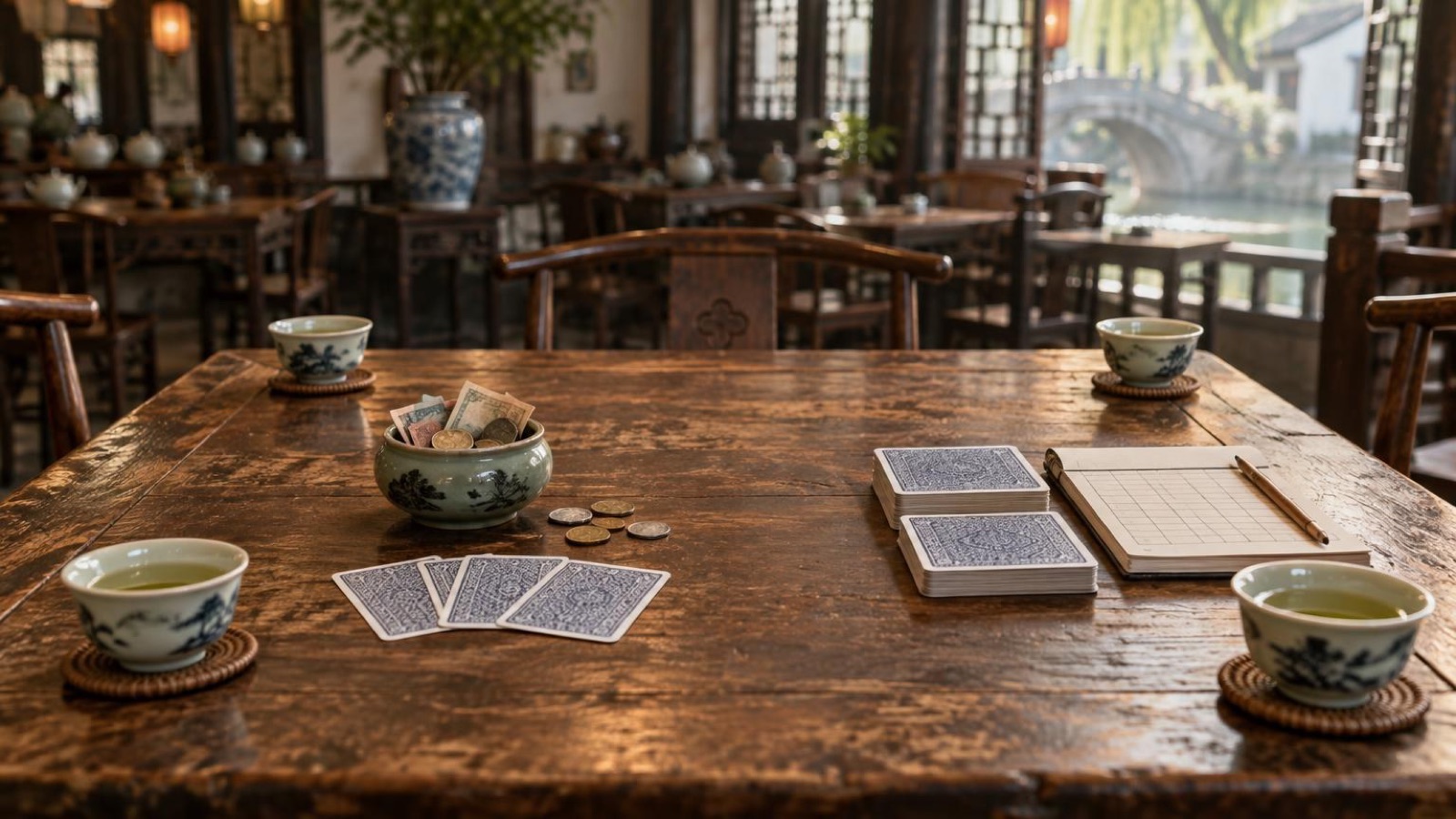
Zha jinhua turns up in private homes, teahouses, back rooms of restaurants and informal clubs. There is no membership, no entry fee and no published schedule. You get in through people you know. If you are a visitor or a new resident, you will not find a zha jinhua table by walking down the street.
Guandan is far more accessible. It is played in teahouses, community centers, company break rooms and dedicated clubs across China, and in Jiangsu and Anhui provinces alone more than 20 million people regularly take part in Guandan activities2. If you want to learn, a local club or a workplace group is the usual route.
For foreign residents, Guandan is the easier entry point. Casual games are social, and nobody asks for identification to join a table in a teahouse. Official competitions may require entry through a registered club or a qualifying event, so check with the organizer before you plan to compete.
Visitors have a narrower window. If you are in China for a short trip, you are unlikely to find either game without a local introduction. Guandan is the more realistic option because it is played openly and often in public venues.
The legal position by country
The practical rule in China is simple. Gambling is illegal under Chinese law, and online football betting in particular is treated as a criminal offense3. That applies to zha jinhua played for cash, and it applies to any online version of either game.
For foreign residents, the risk is not only a fine. Foreigners residing in China may face additional restrictions, including blacklisted status and a ban on entry for 10 years4. That is a serious consequence for something that starts as a friendly card game.
For visitors, the same law applies while you are in the country. There is no tourist exemption for cash card games.
Guandan sits in a different category because it is played as a sport. The national competition run by China's sports administration in 2023 shows that organized Guandan is not treated as gambling2. Casual games for small stakes are common, but the moment a game is run for profit or organized as a betting operation, it falls under the same rules as any other form of gambling.
Macau is the exception in the region. Gambling is legal there under a licensing system, and the junket register is public5. But Macau's licensed activity is casino gaming, not zha jinhua or Guandan. If you want a legal, regulated gambling experience in the region, Macau is where you go, and the games on offer are the ones you find in a casino.
One more thing worth knowing: because China has no regulated gambling market, there are no official channels of support for people experiencing gambling-related harm4. If a private game gets out of hand, there is no helpline or regulator to turn to.
Games and payments
The two games handle money in completely different ways.
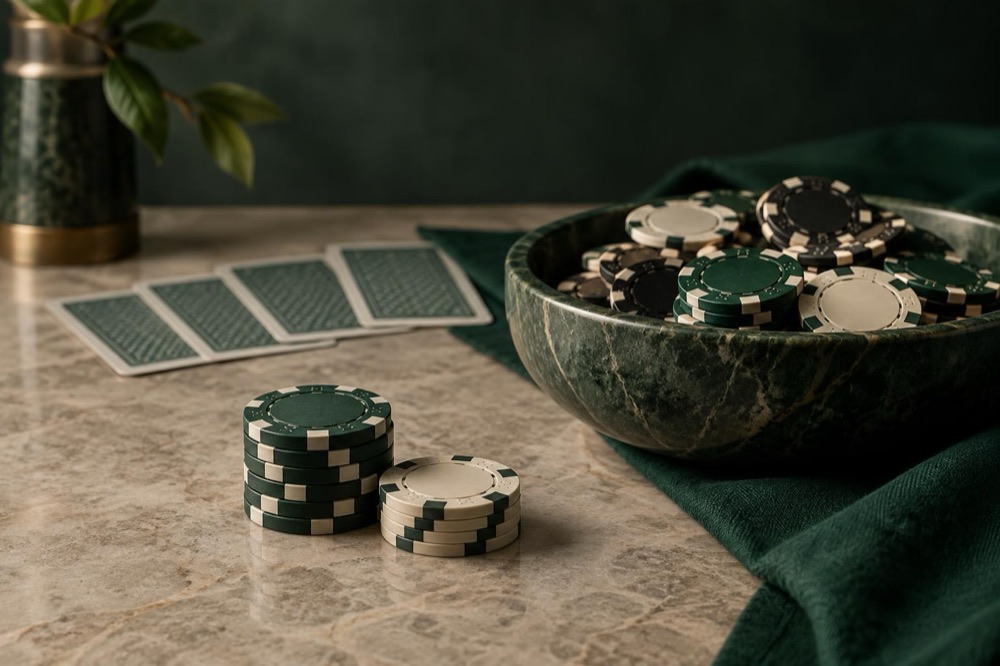
Zha jinhua is built around a pot. Players ante, then bet in rounds, and the last player standing or the best three-card hand takes the pot. In private games the stakes are set by the group, and there is no house, no rake and no published limit. That is exactly why it stays private: there is no operator to license and no record to keep.
Guandan is usually played for points, not cash. In club and competition play, the score is what matters. Casual groups sometimes attach a small stake to the result, but the game itself is a climbing and partnership contest, not a betting game. The prize structure in official events is a competition prize, not a payout on a wager.
If you want a sense of how Chinese card and tile games handle scoring and payment, the mahjong world gives useful comparisons. In Japanese mahjong, a mangan win pays 8,000 to a child and 12,000 to the dealer, with a basic point of 2,0007. In the Zung Jung scoring system, winning off a discard with a hand worth more than 25 points multiplies the hand value by three, with the two non-discarding players paying 25 points each and the discarder paying the remainder8. These are structured, published systems. Zha jinhua has nothing like them, which is part of its appeal and part of its risk.
Other regional games show the same split between structured and informal play:
- In three-player Japanese mahjong variants such as Shin Janryumon, scoring uses a split payment system9
- In the Japanese game Shonben, an unconditional loss pays the stake, the same amount10
- In jumai-kabu, if a player wins the dealer pays four times the stake, and if the player loses the stake is confiscated by the dealer11
- In Shuanglu, the winner takes the stake and the loser pays11
Each of these has a defined settlement rule. Zha jinhua's settlement is whatever the table agrees.
For online play, the picture is different again. Offshore operators do serve Chinese players, and some publish terms for that market4. But online football betting in China is illegal and a criminal offense, and the same logic applies to online card games played for money3. The licensed markets sit outside China, and each operator's own terms set out who it accepts and on what basis12.
Ownership and history
Neither game has an owner. Both are folk games that grew out of older Chinese card and tile traditions, and both have been shaped by the people who play them rather than by a company.
The deeper history is in the card and tile games that came before. Chinese card games were already well established by the Qing dynasty. The term 赶麻雀 (gan ma que) appears in an 1887 source as a leaf or card game, not the tile game, played in the Jinling (Nanjing) countryside in Jiangsu province15. A related game, gan mo ziang, was grouped with leaf and card games including guo he and bi gun in the same region16. In Xiamen, Fujian, 捉麻雀 (zhuo ma que), meaning "snatch sparrows," was also a leaf or card game, recorded in 188815. These are the ancestors of the card games played across China today.
The tile game has its own documented history. The General King (zong wang) in hua ma que can act as any of the Cash, Strings, Myriads, or East, South, West, North1. Jin Xueshi's Mu zhu xianhua (Idle Chats on the Swineherds' Game) was published in 1783 by Zhang Chao15. In the novel Haishang hua liezhuan, published between 1892 and 1894, the gameplay was called peng hu, meaning "playing for points"16. By 1941, hua ma que was associated with North China, referring to Beijing and Tianjin17.
Guandan's own history is much shorter and much better documented. The game originated in Huai'an, Jiangsu, where "guan" in the local dialect means to smash or throw down, and it dates to the 1960s and 1970s2. Four people are credited as its inventors, and only Sun Zhaocheng is still alive; the other three, Fan Yuerong, Geng Zhichang and Tao Wanzhi, have died2.
The shift from zha jinhua to Guandan is not a story of one game replacing another. It is a story of two games finding different homes. Zha jinhua stayed private, cash-based and informal. Guandan went public, got organized and picked up official backing. For a player in China today, that means the game you can play openly, join a club for and compete in is Guandan. The game you play quietly, with people you trust, is zha jinhua.
Common Questions
Is zha jinhua the same as poker?
No. Zha jinhua uses a standard 52-card deck and three cards per player, but the hand rankings and betting rounds are its own. It is closer to a bluffing duel than to Texas hold'em, and it is usually played for cash stakes.
How many people play Guandan?
Guandan is a four-player game in two partnerships, sitting opposite each other. It uses two full decks, so 108 cards are in play. You can also play with more people in some house variants, but the standard game is four.
Is Guandan gambling?
Guandan is a skill game and is played in official competitions, including a national competition organized by China's sports administration. Many casual groups play for small stakes, but the game itself is not a casino game and is not licensed as one.
Can foreigners play Guandan in China?
Yes. Guandan is played in clubs, teahouses and tournaments across China, and foreign residents join casual games regularly. You do not need any registration to play socially, though official competitions may require entry through a registered club.
Why did players switch from zha jinhua to Guandan?
Guandan is a partnership game with a longer, more social format, and it gained official recognition through competitions. Zha jinhua is faster and more directly tied to cash stakes, which makes it less suitable for public venues and formal events.
Sources17 sources
- Flowers and Kings: An Hypothesis of Their Function in Early Ma Que, The Mahjong Tile Set
- Guandan competition news, Jiangsu Sports
- Online football betting notice, Xuzhou Municipal Cyberspace Administration
- Best Online Casinos for Players from China, Wizard of Odds
- Junket license register, Macau DICJ
- Junket license register 2015, Macau DICJ
- Mahjong scoring, Wikipedia
- McGill Mahjong, McGill Mahjong
- Three-player mahjong, Wikipedia
- Chinchiro, Wikipedia
- Kabu, Wikipedia
- GCWIN99 FAQ, GCWIN99
- PokerStars Terms and Conditions, PokerStars
- Bovada, Bovada
- Mahjong Terms 1780-1920, The Mahjong Tile Set
- Mahjong Terms 1780-1920 (archived), The Mahjong Tile Set
- MGM 10-K 2017, U.S. Securities and Exchange Commission















