
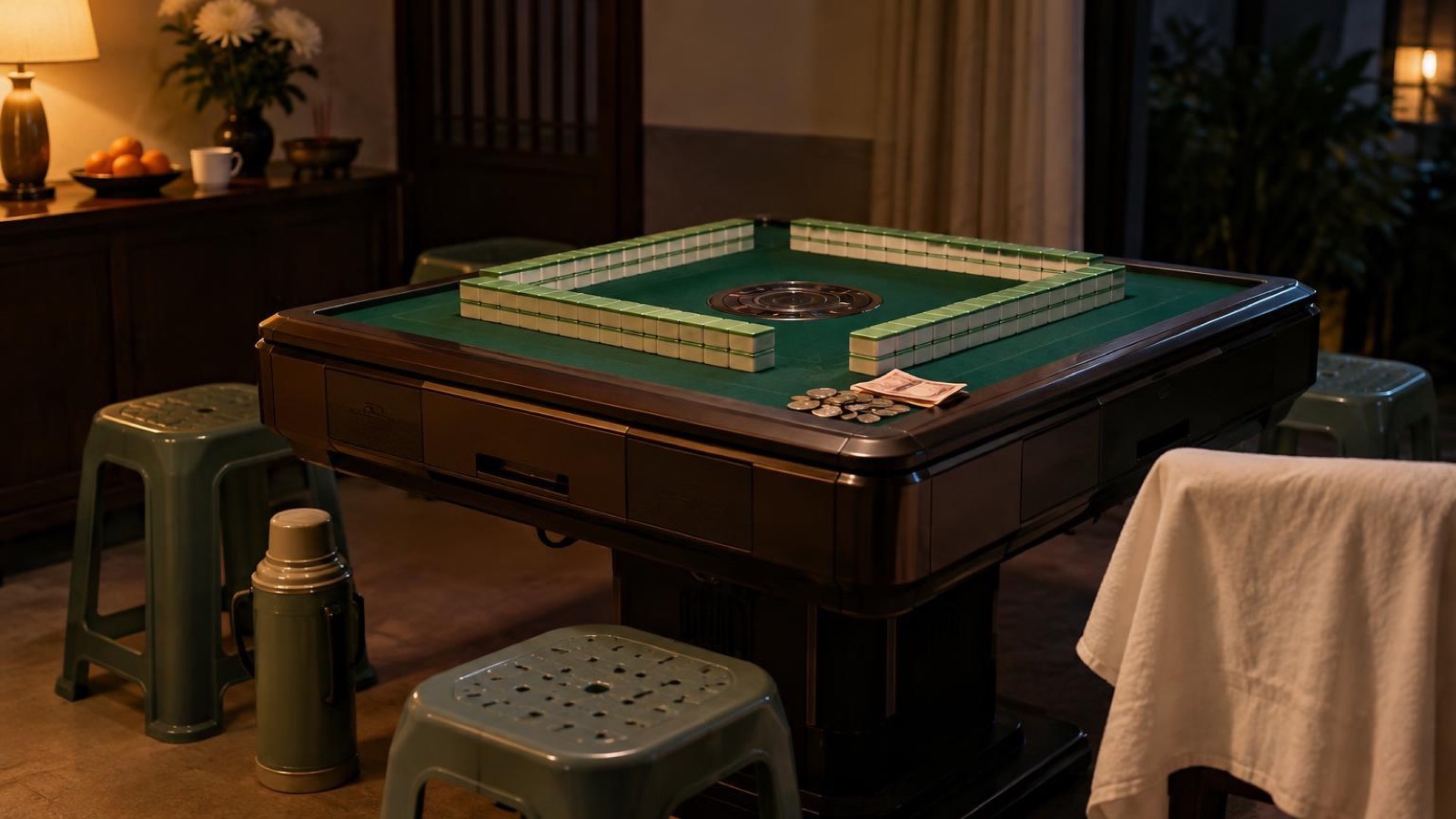
Why mahjong is the game most often played at wakes
Mahjong is the game you are most likely to hear before you see. The clatter of tiles being shuffled and stacked carries down a corridor, and at a wake it usually means a table has been set up somewhere near the door, or in a back room, or on a covered porch, and will stay busy until dawn.
The game fits the occasion unusually well. A hand takes a few minutes, so players can get up to greet arriving visitors, offer incense, or sit with the family, then come back and pick up where they left off. Four people can play, three can play, and a fifth can watch and take over when someone needs a break. Nobody has to commit to a long session, and nobody has to stop.
The tile game has deep roots in the same coastal Chinese cities where overseas communities later carried it across Asia. Literature points to a version called mo ziang that had reached prominence in Ningbo and spread to Shanghai by the late 1880s, and from there it traveled with traders, laborers and families4. Where those communities settled, the wake table went with them.
That is why the same scene turns up in so many places. In Chinese communities in Malaysia, Singapore, Hong Kong and beyond, mahjong at a wake is unremarkable. In Japan, where mahjong has its own parallel culture of parlors and professional play, the game appears at family gatherings of all kinds. In the Philippines, the wake has its own games, and mahjong sits alongside them.
There is also a practical reason the game is played rather than, say, cards alone. Mahjong needs a table, four chairs and a set of tiles, and it makes enough noise to keep a room awake. A quiet card game lets people drift off. A mahjong table does not.
How a mahjong game works: tiles, players and the winning hand
If you have never played, the table looks more complicated than it is. The standard four-player game uses a set of tiles that are shuffled face down, then built into four walls. Players take turns drawing and discarding, and the first to complete a valid hand wins it.
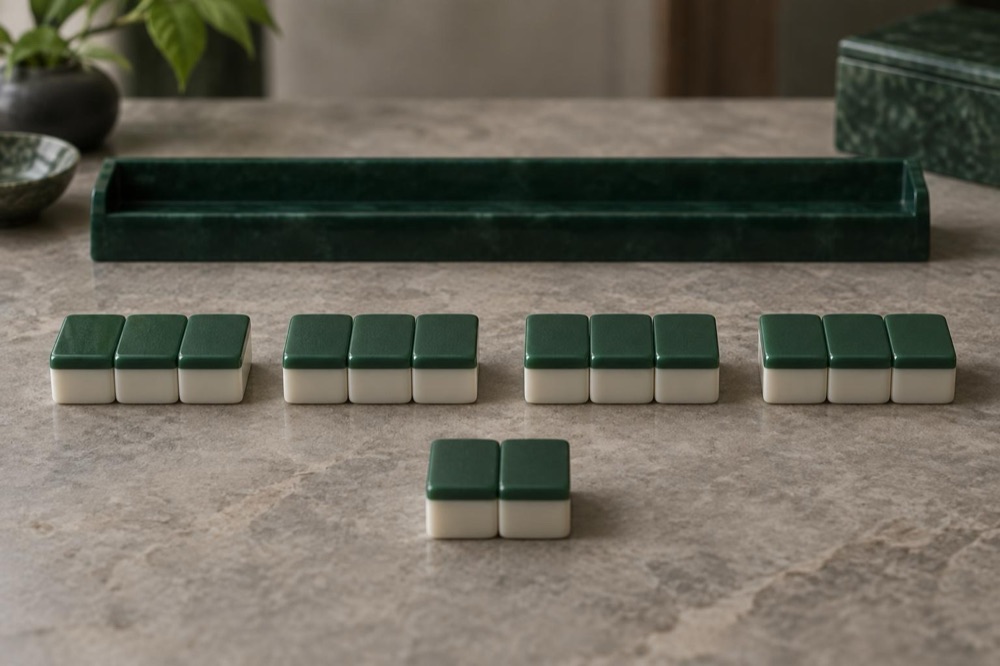
A winning hand is four sets and one pair, 14 tiles in total1. A set is three tiles of the same kind, or three consecutive tiles in the same suit. The pair is two identical tiles. That is the whole shape of the game, and everything else is detail about which sets count and what they are worth.
The tiles come in suits and honors. The suits run in sequences, and the honor tiles are the winds and the dragons, which cannot be sequenced and only form sets of three or four. A set of three identical tiles can be extended to four, which is called a kong, and a player holding three of a kind may claim the fourth when someone discards it. After any kong, the player draws a replacement tile from the end of the wall and discards one, to keep the hand at the right size1.
Play moves counterclockwise. On your turn you draw a tile, look at it, and discard one. Between turns you can claim certain discards: a tile that completes a set of three identical tiles, a tile that completes a run from the player to your left, or a tile that completes your winning hand. Claiming a discard interrupts the normal order, which is why the table has rules about who gets priority.
Scoring is where regional versions diverge most. Some hands are worth a fixed amount, some are scored by pattern, and some tables simply play for a flat rate per win. At a wake, the flat rate is the common arrangement, because nobody wants to stop and count patterns at three in the morning.
| Element | What it is | Notes for a first game |
|---|---|---|
| Winning hand | Four sets plus one pair, 14 tiles1 | The only shape you need to remember |
| Set | Three identical tiles, or three in sequence | Honors cannot be sequenced |
| Kong | Four identical tiles | Draw a replacement tile, then discard1 |
| Turn order | Anticlockwise | Claims interrupt the order |
| Claim types | Win, set of three, run from the left | Priority order decides ties |
| Scoring | Fixed rate, or by pattern | Wake tables usually play flat |
The rule variations you may meet at the table
No two mahjong tables play quite the same game, and this is worth knowing before you sit down. The differences are not cheating; they are local custom, and the table will usually tell you what it plays before the first hand.
The biggest split is between four-player and three-player games. Three-player mahjong is a well-established variant, especially in western Japan, where dedicated three-player parlors exist and many online sites offer three-player tables2. Current automatic mahjong tables can usually be set for three players, so a wake table that starts with four can carry on after one person leaves.
Three-player rules change the game in specific ways. The standard version removes the chi call, the claim that lets you take a discard from the player to your left to complete a run, because it lets hands finish too early2. Some rulesets instead remove the 2 through 8 of characters, leaving 27 tile types and 108 tiles, and a few regions, particularly on the Seto Inland side of western Japan, remove the 2 through 8 of bamboo instead2.
Scoring adjusts too. Because there are only three players, some rulesets raise the starting points to 30,000 or 35,000 so that nobody busts out during the east round2. On a win by the dealer, the two other players split the third player's share, a rule called oya sanbai kaburi2. In a common Kyoto and Tokyo arrangement called baidori, a self-drawn win pays the winner ron-equivalent points from both opponents, which doubles the income from that hand2.
A three-player game is also shorter. In an east-south game, each round runs three hands, six hands in total excluding draws2. That suits a wake, where people come and go and nobody wants to be locked into a long session.
Beyond the player count, expect small differences in what counts as a winning hand, whether certain bonus tiles are used, and how much each hand pays. Ask before you play. Every table has someone happy to explain.
Stakes and payouts: what people actually play for
At a wake, the money is usually small and often symbolic. Coins, a few low-denomination notes, or a running tally on a piece of paper are all common. The point is to give the game a little edge, not to win anyone's rent.
In Chinese practice, the line between a friendly game and gambling is drawn mainly by stake size and intent. Guidance on applying the law in gambling cases states that playing mahjong or poker with money stakes among relatives, without a profit motive, is not punishable, and that games with small stakes among people who are not relatives are also not punishable3. The same guidance notes there is no unified national standard for what counts as a small amount, that local practice varies, and that amounts mostly within 200 to 300 yuan are treated as a small amount of property3.
That is the practical marker to keep in mind. A wake game played for coins, or for a few yuan a hand, sits comfortably inside ordinary social play. A game where the stakes climb into serious money, or where someone is taking a cut, is a different thing entirely.
If you are a visitor and want to join, the simplest approach is to ask what the table plays for and match it. Nobody at a wake expects a guest to know the local rate. They will tell you, and if the answer is more than you want to spend, watching is perfectly normal and often more welcome than you would think, because a table with spectators feels livelier.
Payouts at a wake table are settled hand by hand or at the end of the night. There is rarely a formal accounting. If you are playing for the first time, keep your stakes small enough that you do not need to track them carefully.
Where the law stands: China, Japan and the taboo around the game
This is the part most visitors want to know, and it is shorter than the rest of the page.
In China, gambling is illegal under Chinese law, and there are no gambling regulators of the kind found in some other jurisdictions5. But the same body of guidance makes clear that small-stakes mahjong among relatives and friends, played for leisure rather than profit, is legal entertainment6. Courts have applied that distinction: in one case, a court held that playing mahjong with small stakes among relatives and friends did not constitute gambling and revoked the penalty3.
So the practical position for a wake game in a Chinese community is straightforward. Family and friends, small stakes, no organizer taking a profit: that is ordinary social play. The risk sits with the size of the stakes and with anyone running the game for gain.
In Japan, mahjong parlors operate openly and the game is played for small stakes as a pastime. The legal question there generally turns on whether play is treated as casual recreation or as organized gambling for profit, and that is where the risk sits rather than in the game itself.
Elsewhere in Asia the picture varies by country, and the wake custom travels with the community rather than the statute book. If you are joining a table in a country you do not know well, the safe assumption is that small private games among friends are treated differently from anything organized, advertised or played for serious money.
Table etiquette: calls, claim priority and pace of play
Mahjong has more etiquette than most games, and at a wake the etiquette matters more than usual because the room is not a parlor.
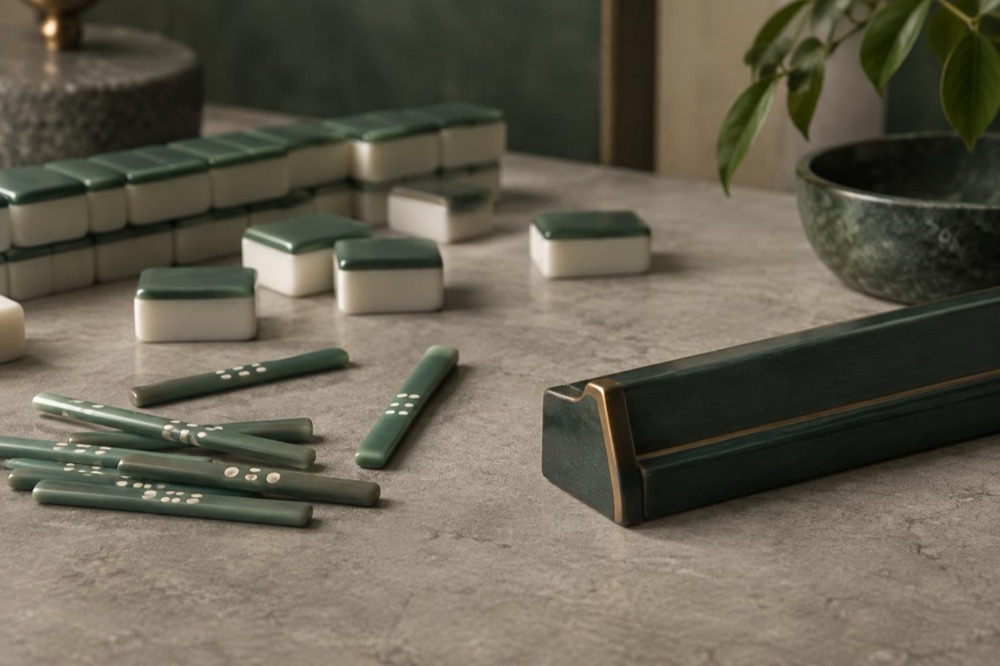
The first rule is pace. Keep the game moving, and do not hold up the table while you decide. Casino guidance on table games makes the same point in a different setting: respect other players' time by acting in a timely fashion when betting7. At a wake, where people are taking turns to greet visitors, a slow player holds up the whole room.
The second is claim priority. When a tile is discarded, more than one player may want it, and the table needs a settled order. The usual principle is that a claim to win the hand outranks a claim to complete a set, and a claim to complete a set outranks a claim to complete a run. If two players want the same tile for the same kind of claim, the player nearest in turn order from the discarder takes it. Ask the table to confirm before the first hand, because local versions differ.
The third is that a discard is a discard. Once a tile is out of your hand and on the table, it stays there. The same principle appears in formal rules for the game, which state that discarded tiles may not be taken back1. Reaching for a tile you have already thrown is the fastest way to annoy a table.
The fourth is about hands and eyes. Do not look at other players' tiles, and if you catch a glimpse by accident, say so. Formal rules treat an accidental look as barring that player from certain claims for the round1, and the same courtesy applies at a friendly table.
A few smaller habits help. Keep your money and personal items tucked away rather than spread across the table, the way casino guidance suggests for card tables8. Keep drinks off the playing surface. And if you are not sure whether a move is allowed, ask before you make it rather than after.
Beyond the wake: clubs, tournaments and the game's revival
The wake table is one end of a much larger mahjong culture, and if the game catches your interest there is plenty more to find.
If you want to learn properly rather than pick it up at a wake, a club is the easiest route. Clubs are used to complete beginners, they usually have spare sets, and they will teach you the local rules before you sit down. Parlors in Hong Kong and Japan are another option, though the pace there is faster and the stakes are usually higher than a family table.
For the wider context, the site has pages on several related topics:
- gambling culture and history in Asia
- the games played at Filipino wakes
- why many Asian countries restrict gambling
- gambling games recognized as cultural heritage, which covers the traditions that have been formally protected
Common Questions
What does the word mahjong mean?
The name comes from the Chinese for sparrow, pronounced ma que. The tile game adds wind tiles to an older card game, and regional pronunciations vary: mo ziang in Shanghainese, ma jiang in Mandarin. The sparrow name is usually linked to the clatter of tiles being shuffled.
How many tiles are in a mahjong set?
A standard four-player set has 144 tiles across several suits and honor tiles. Three-player versions use fewer: one common Japanese variant removes the 2 through 8 of characters, leaving 27 tile types and 108 tiles. Automatic tables can usually be set for three players.
Is playing mahjong for money illegal in Japan?
Mahjong parlors operate openly across Japan and the game is played for small stakes as a pastime. The legal position on money games generally turns on whether the play is treated as casual recreation or as organized gambling for profit, which is where the risk sits.
Is mahjong legal in China today?
Gambling is illegal under Chinese law, but small-stakes mahjong among relatives and friends is treated as legal entertainment. Courts have revoked penalties where play was casual and winnings were tiny. Stakes of roughly 200 to 300 yuan are commonly treated as a small amount.
Can mahjong be played with three players?
Yes. Three-player mahjong is well established, especially in western Japan, with dedicated parlors and online tables. Standard rules drop the chi call to prevent early wins, and some rulesets raise starting points so players are less likely to bust out early.
How much do people typically stake in a Chinese mahjong game?
It varies enormously, from a few coins among family to serious money in private games. The practical marker in Chinese guidance is whether stakes stay small, with amounts within roughly 200 to 300 yuan commonly treated as a small amount of property rather than gambling stakes.
Sources8 sources
- Legal Mahjong Gaming Rules, DICJ Macau, August 5, 1991
- Three-player Mahjong, Wikipedia (Japanese)
- Notice on Applying the Law in Gambling Violation Cases, Shuangcheng District, February 16, 2024
- Mahjong terms 1780-1920, The Mahjong Tile Set
- Best online casinos for players from China, Wizard of Odds, May 5, 2026
- Mahjong among relatives and friends, Shaanxi Qixian Procuratorate, May 26, 2026
- Sic Bo Etiquette, PlaySmart, September 25, 2026
- Pai Gow Poker Etiquette, PlaySmart, September 25, 2026















