
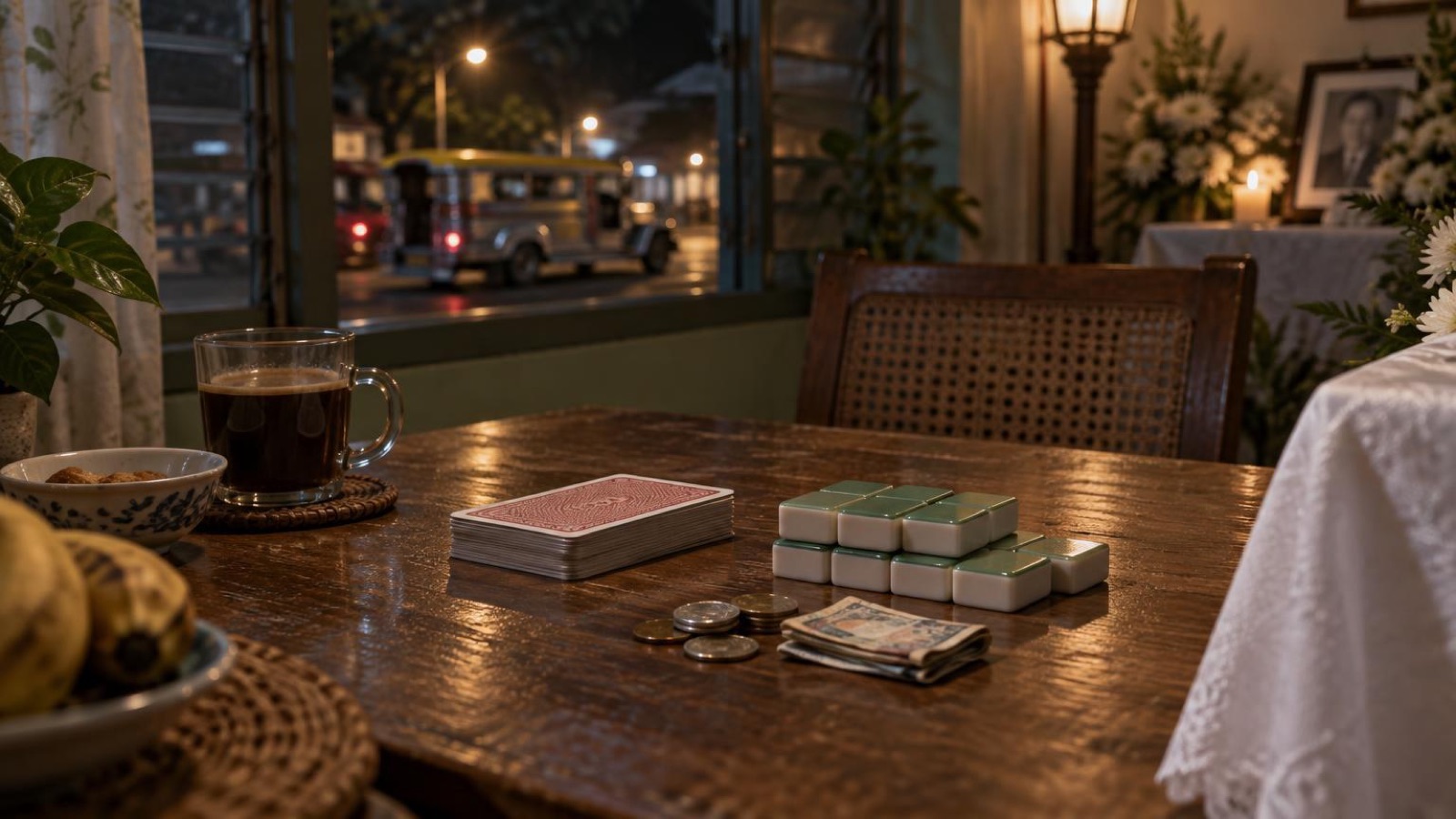
What games are played at a Filipino wake
The short version: cards, mahjong and small-stakes betting games, played by whoever is sitting vigil at that hour. A wake in the Philippines is a multi-day affair, and the practical problem for a family is filling the dead hours between visitors. Games solve that. They keep people awake, keep them in the house, and give the room something to do besides sit in silence.
The games themselves are the ordinary household kind. Card games, mahjong, and simple betting games with coins or small notes on the table. The stakes are deliberately low. Nobody at a wake is trying to win a month's rent; the point is the rhythm of the game, the noise, and the company. If you are a visitor who has been invited to sit down, the etiquette is straightforward: play small, play for the company, and do not treat it as a casino.
What you will not find at a wake is anything that looks like a commercial operation. No dealer, no rake, no table fee. If money changes hands it is between the players themselves, and it tends to circulate back into the household as help with funeral costs.
Poker deserves a separate note because it is the game visitors most often ask about. Poker is legal in the Philippines, but only at licensed venues. There are licensed gaming sites around the country offering poker games other than land-based casinos, and licensed poker rooms operate under PAGCOR's register3. A poker game at a house wake is not one of those venues. If you want to play poker legally in the Philippines, you go to a licensed room, not to a neighbor's living room.
How long the games run
A Filipino wake typically runs for several days, with visitors arriving in shifts. That length is the reason the games exist at all. A single evening of mourning is one thing; several nights of it, with relatives sleeping in shifts and neighbors dropping by after work, needs something to occupy the room.
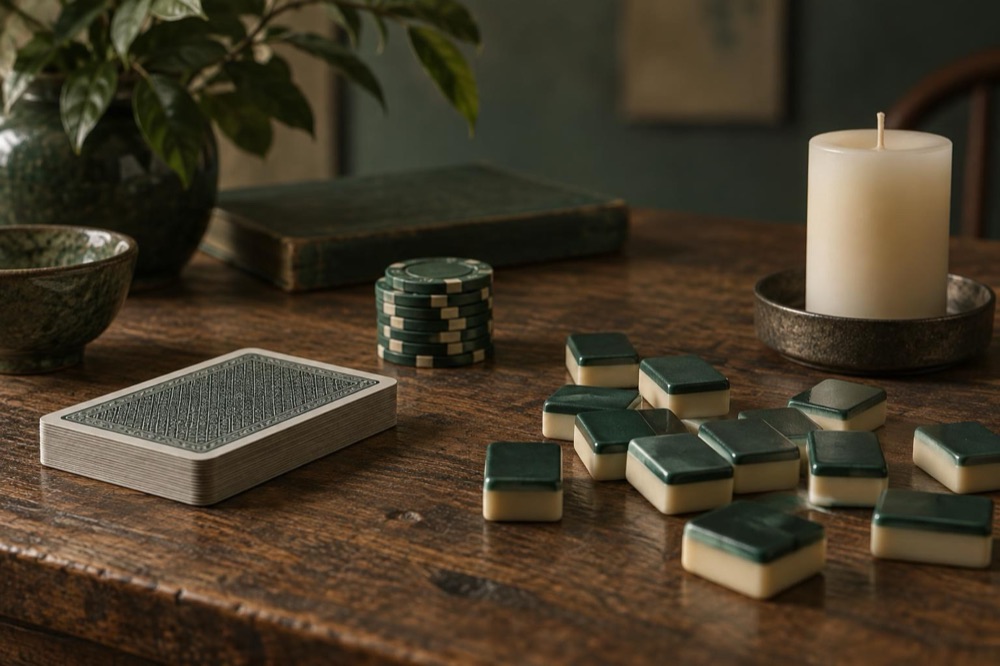
So the games are not one long session. They are a rolling series of short ones. People sit down, play for a while, eat, sleep, take over from someone else, and the table keeps going with a changing cast. If you are visiting, you can join for an hour and leave without disrupting anything.
For a sense of scale, other betting games in the region run in short bursts rather than marathons. A round of Bầu Cua Tôm Cá, the Vietnamese dice game, typically lasts 30 to 60 seconds, with a full game running 10 to 20 minutes5. A bingo session runs one and a half to three hours including an intermission6. A single-table sit-and-go poker tournament lasts about 45 to 90 minutes and pays the top two or three players, while a heads-up sit-and-go finishes in about 15 to 30 minutes per game7. Wake games sit in that same range: short, repeatable, easy to step away from.
That is the practical shape of a wake. Not a multi-day gambling session, but several days of short games with people coming and going.
Sabong and other traditional betting games
Sabong is the one Philippine betting tradition that outsiders hear about most, and it is worth being clear about what it is and what it is not.
Sabong means placing bets on live cockfighting. It is described as an established tradition in the Philippines dating back as early as 3,000 years, and as a national pastime8. Online sabong, or eSabong, is a regulated betting product, and its regulation sits with the Philippine Amusement and Gaming Corporation1. So this is not a folk custom operating in a gray area; the online version is a licensed product with a regulator behind it.
It is also not a wake game. Cockfighting happens at dedicated venues and, in its online form, on regulated platforms. If you are at a wake and someone suggests sabong, they are talking about something else entirely, and you would be leaving the house to do it.
Other traditional betting games in the Philippines sit under the same regulatory umbrella. PAGCOR's licensed operators cover sports betting, numeric games, electronic bingo, electronic casino games and traditional bingo9. Licensed poker rooms operate separately4. One operator, OZMT Philippines, holds a traditional bingo license but had yet to commence commercial operations as of the register date10.
For a visitor, the practical takeaway is that the Philippines has a wide, licensed betting market: casinos, poker rooms, bingo, sports betting and numeric games. Wake games are not part of it. They are a household custom that happens to involve cards.
If you want the wider picture of how these customs fit together across the region, gambling at funerals and wakes covers the mahjong and card traditions that show up at vigils from Vietnam to the Philippines, and cockfighting and other animal contests goes deeper on sabong itself.
Is wake gambling legal? The wider Philippine gambling rules
Here is the plain version. Playing cards or mahjong for small stakes among family and neighbors at a wake is a social custom, but under Philippine law it is not an authorized game. Any game scheme with wagers at stake that is not authorized or licensed by the government falls within the definition of illegal gambling, so a house card game sits on the wrong side of that line even if nobody treats it that way at a wake. The regulated market is casinos, licensed poker rooms, bingo, sports betting, eSabong and online platforms approved by PAGCOR.
The line that matters is authorization. Illegal gambling is committed by anyone who takes part in a game scheme with wagers at stake when that scheme is not authorized or licensed by the government agency empowered by law, or is conducted in a way that violates the terms that agency set12. In practice, that means the question is not "is there money on the table" but "is this an authorized game." A licensed casino table is authorized. A house card game among relatives is not a licensed product at all.
PAGCOR is the regulator. It is the government agency responsible for regulating and supervising gaming operations in the Philippines, and it issues the licenses2. Only games regulated under PAGCOR are considered legal; all other games or gambling activities outside its jurisdiction are considered illegal14. Online slots, for example, are legal on platforms authorized and regulated by PAGCOR15.
The minimum age is 21. The legal gambling age in the Philippines is 21 or older, and online gambling users in the Philippine market must be at least 212. Casino Filipino states plainly that gaming is strictly for players aged 21 and above17. Some international sites set their own limit at 18, usually European-based ones, but Filipinos are still expected to respect the country's own age of 212. Under 21, you are also barred from buying betting tickets18.
Certain people are prohibited from playing in any casino in the Philippines. That list covers:
- Government officials directly involved in the operations of government or its agencies
- Members of the Armed Forces of the Philippines including the Army, Navy, Air Force and Philippine National Police
- Anyone under 21
- Students of any school, college or university in the Philippines
- Gaming Employment License holders19
Banning orders apply nationwide and can be self-exclusion, family exclusion or imposed by a licensee20.
For visitors, the practical position is relaxed. Ordinary passport holders from many countries get a 21-day visa-free stay, which is more than enough for a casino trip21.
| Type of gambling | Legal? | Where | Minimum age |
|---|---|---|---|
| Wake card and mahjong games | Social custom, not a licensed product | Private homes | Not regulated |
| Casinos | Yes, licensed | Casino Filipino venues and licensed casinos | 2117 |
| Poker | Yes, licensed | Licensed poker rooms and gaming sites3 | 21 |
| Bingo | Yes, licensed | Licensed bingo operators10 | 21 |
| Sports betting and numeric games | Yes, licensed | PAGCOR-licensed operators9 | 21 |
| eSabong | Yes, regulated | PAGCOR-regulated online platforms1 | 21 |
| Online slots | Yes, on PAGCOR-authorized platforms15 | PAGCOR-regulated sites | 212 |
| Offshore online casinos | Outside PAGCOR's jurisdiction14 | Foreign sites | 21 |
Can Filipinos play at offshore online casinos?
This is the question that comes up most often from residents, and the answer is more permissive than people expect, with one important caveat.
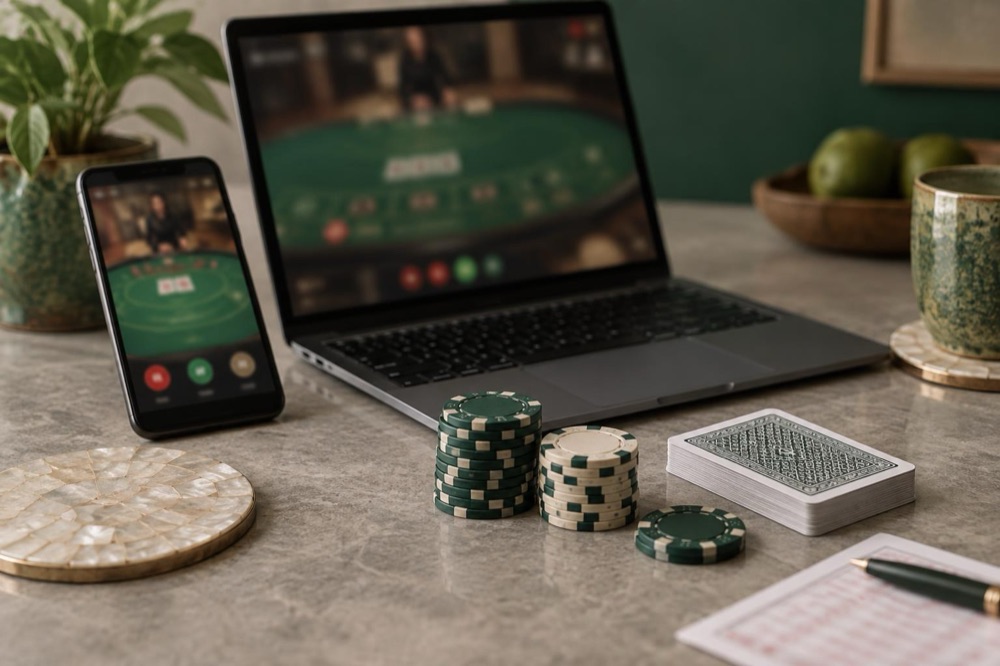
Players in the Philippines cannot join local online casino sites outside the licensed system, but they are allowed to frequent offshore-based casinos2. Players are not fined for joining offshore operators2. In practice, you are free to place bets across international online casinos that accept players from the Philippines2.
The caveat is the licensing line. Only games regulated under PAGCOR are considered legal, and everything outside its jurisdiction is considered illegal14. Offshore sites are, by definition, outside PAGCOR's jurisdiction. So the position is that the player is not penalized, but the site is not a Philippine-licensed product. That distinction matters if you ever need to complain about a payout, because you have no Philippine regulator to appeal to.
If you want to know which operators are actually licensed, PAGCOR publishes registers of accredited gaming system administrators, affiliates, service providers and licensed poker operators9. Those lists are the authoritative source, and they are updated. Checking them takes a few minutes and settles the question for any brand you are considering.
Offshore sites serving players in the region are typically licensed in jurisdictions like the Philippines, Malta or Curacao23. That means a site can be licensed somewhere and still not be licensed in the Philippines. The two things are separate.
For the full country picture, including land-based casinos, entry rules and what visitors need to bring, see can I gamble in the Philippines. If you are curious how the country's attitudes and restrictions compare with its neighbors, why many Asian countries restrict gambling sets out the regional pattern.
What to expect if you are invited to a wake
A few practical notes for a visitor who has been asked to sit down at the table.
Bring small notes. The stakes are low by design, and turning up with large bills changes the mood of the room. Coins and small denominations are what the game runs on.
Expect to rotate. You will not play for hours straight. You will play for a while, then someone else takes the seat, and you eat something. The wake runs on shifts, and the game runs with them.
Do not treat it as a casino. There is no dealer, no house, no rake. If you win, the money came from the person across the table, who is probably a relative of the deceased. The custom is that winnings tend to go back into the household as help with costs.
Know where the legal line sits if you want to keep playing afterward. If you want a licensed game, the Philippines has plenty: casinos, licensed poker rooms, bingo halls, sports betting and PAGCOR-authorized online platforms3. The wake table is a different thing entirely, and it is not the place to test the boundaries of the regulated market.
And if you are under 21, sit this one out. The legal gambling age in the Philippines is 21, and it applies across the licensed market17. At a family wake nobody is checking IDs, but the rule is the rule, and it is worth knowing before you are handed a hand of cards.
Common Questions
What games are played at a Filipino wake?
The usual mix is cards, mahjong and small-stakes betting games played by relatives and neighbors keeping vigil. Sabong, or cockfighting, is a separate Philippine betting tradition and is not a wake game. Poker is legal in the Philippines only at licensed venues, not at a house wake.
How long does a typical Filipino wake last?
Wakes commonly run for several days, with visitors coming and going in shifts. The games fill the long overnight hours rather than running as a single session. Expect people to rotate in and out rather than one group playing straight through.
Does the money from wake gambling go to the family?
In practice, yes. Small-stakes games at a wake are usually played among relatives and neighbors, and any winnings tend to circulate back to the bereaved family as help with funeral costs. There is no formal rule; it is a social custom, not a regulated arrangement.
What is sabong?
Sabong is betting on live cockfighting, an established Philippine tradition that dates back as far as 3,000 years and is described as a national pastime. Online sabong, or eSabong, is a regulated betting product overseen by PAGCOR. It is a separate activity from wake games.
What is the legal gambling age in the Philippines?
The legal gambling age in the Philippines is 21 or older. That applies at Casino Filipino venues and to online gambling users in the Philippine market. Some international sites set their own limit at 18, but Filipinos are still expected to respect the local age of 21.
Who is prohibited from gambling in the Philippines?
Government officials directly involved in government operations, members of the Armed Forces of the Philippines including the Army, Navy, Air Force and Philippine National Police, anyone under 21, students of any school, college or university in the Philippines, and Gaming Employment License holders are barred from playing in any casino.
Sources23 sources
- e-Sabong, PAGCOR, 2026
- Bitcoin Gambling in the Philippines, Wizard of Odds, 2026
- Poker, PAGCOR, 2026
- List of Poker Operators With Issued Gaming License, PAGCOR, 2026
- Bầu Cua Tôm Cá Rules, Xoviet, 2026
- How to Play Bingo, PlaySmart, 2026
- Sit and Go, CoinPoker, 2026
- eSabong Regulatory Framework, PAGCOR, 2022
- List of PAGCOR Accredited Gaming System Administrators and Registered Brands and Domain Names, PAGCOR, 2026
- List of PAGCOR Accredited Gaming Affiliates, PAGCOR, 2026
- List of PAGCOR Accredited Gaming System Administrators and Registered Brands and Sub-brands, PAGCOR, 2025
- G.R. No. 207118, Leonen, Supreme Court of the Philippines, April 2025
- 777 Slots, Casino Plus, 2026
- Online Gambling, Iskomunidad, University of the Philippines Diliman, 2026
- Slots, Bingo Plus, 2026
- APT Manila Classic 2025 Info, Asian Poker Tour, 2026
- Branches and Satellites, Casino Filipino, 2026
- 競馬, Wikipedia, 2026
- Responsible Gaming Program, Newport World Resorts, 2026
- Regulatory Framework for Gaming Venue Operations, PAGCOR, 2025
- Which Countries Allow Casino Play, Corona Resort & Casino, 2026
- List of Service Providers and Registered Domains, PAGCOR, 2025
- Malaysia Online Gambling Laws, MB5 Casino, August 2025















