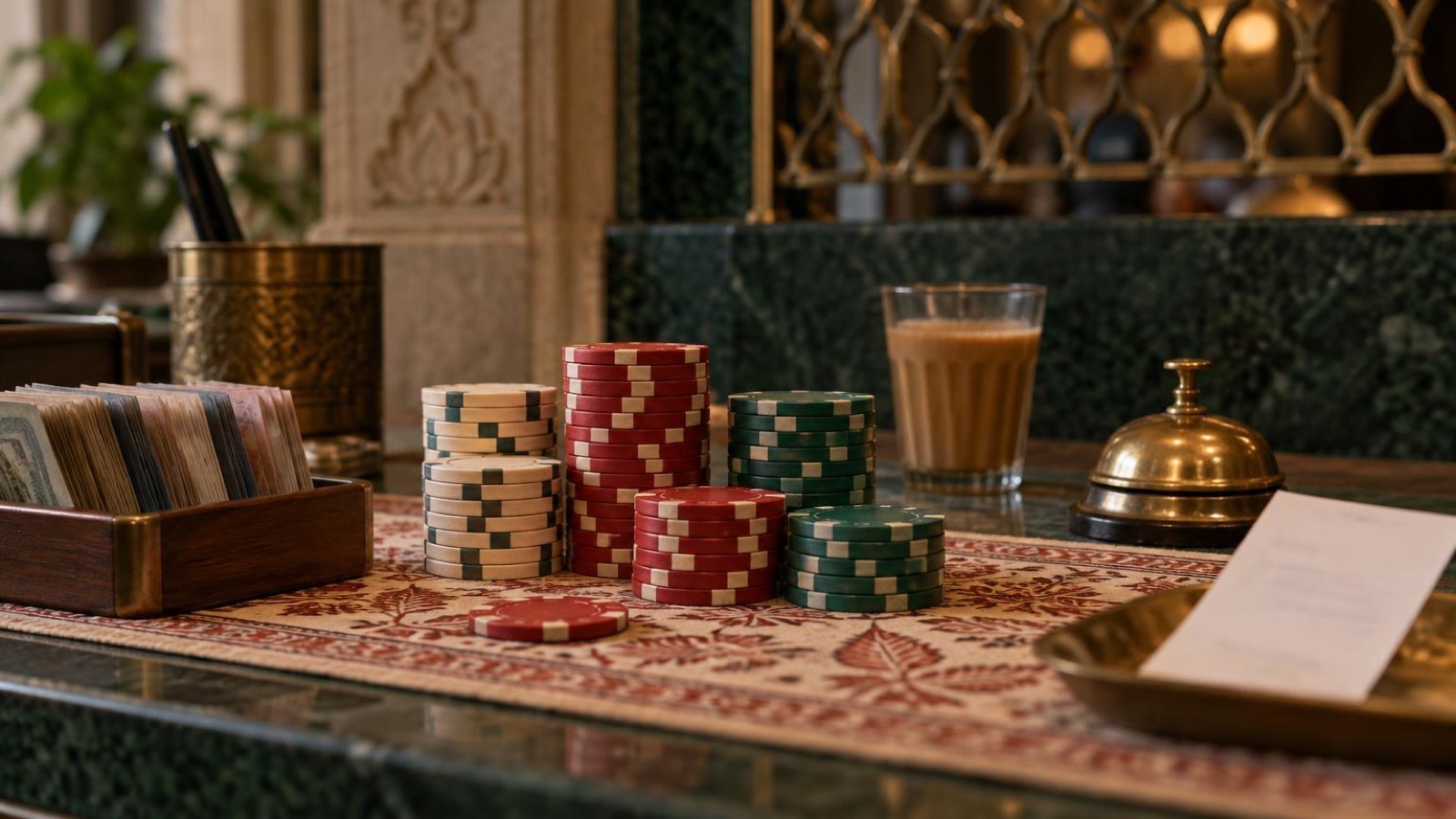
How casino chips work: buy-in, play and cash-out
The basic loop is the same almost everywhere. You hand over money, you get chips, you bet the chips, and when you are done you turn whatever is left back into money. The details of where each step happens are what trip people up.
| Step | Where it happens | What you hand over | What you get |
|---|---|---|---|
| Buy-in at a table | At the table, after the current hand or roll | Cash on the felt | Chips from the dealer |
| Buy-in at the cage | Cashier or chip exchange | Cash, card or foreign currency | Chips |
| Play | The table or machine | Chips or tickets | Chips or tickets |
| Cash-out | The cage, or the table for roulette chips | Chips or tickets | Cash, check or transfer |
At a live table, you generally do not hand cash to the dealer and get chips back in your hand. On Pai Gow Poker tables, for example, money and chips are never exchanged directly between a dealer and a player. You place your cash on the table and the dealer exchanges it for chips6. Craps works the same way: put your cash on the table and let one of the crew know you want chips. The polite moment to do it is after the current shooter has rolled, while the dice are sitting in front of the boxperson, so you are not interrupting the game7.
If you would rather not deal with a table at all, the cage, also called the cashier or chip exchange, does the same job. At Paradise City in Incheon, chips can be bought at open tables or at the chip exchange in the casino center, and credit cards and foreign currency are handled at the cashier4. That is the practical difference: the table is faster if you are already sitting down, the cage is where you go for larger amounts, foreign currency or a card.
At Paradise City, the cash-out path is slightly different depending on what you are holding. Remaining chips can be exchanged for high denomination chips, slot and electronic table game tickets come out via the CASH OUT button, and those tickets can be redeemed for Korean won at redemption machines or at the cashier4. If you are on the machines rather than the tables, look for the redemption machine first, since it saves a queue.
Currencies and payment at the cage
The currency you use is almost always the currency of the country you are standing in. Singapore Pools, for instance, pays winnings on all its products in Singapore dollars only9. Casinos work the same way: the cage quotes in local money, and if you arrive with foreign cash it gets converted, usually at the cashier rather than at the table.
| Country | Currency at the cage | Foreign currency accepted? | Card accepted? |
|---|---|---|---|
| Singapore | Singapore dollars | Converted at the cage | Yes, subject to rules for citizens and residents1 |
| Korea (Paradise City) | Korean won | Yes, at the cashier4 | Yes, at the cashier4 |
| Vietnam | Vietnamese dong for Vietnamese nationals5 | Not for Vietnamese nationals buying chips5 | Not stated |
| Mauritius | Local currency | Not stated | No, credit cards prohibited at casinos10 |
Korea is the clearest example of a casino set up for foreign currency. At Paradise City, credit cards and foreign currency are handled at the cashier, while slots and electronic table games accept cash in Korean won or dedicated tickets, and there are unmanned exchange machines as well as the cashier for exchanging money4. So you have two routes: change money at the cashier and carry won to the machines, or use the unmanned exchange machines if the cashier queue is long.
Vietnam has a rule that catches people out because it applies to locals rather than visitors. Vietnamese nationals who are allowed to play at casino business points may only use Vietnamese dong to exchange for the chips they play with, and unspent chips or a winning prize can be exchanged back into dong5. In practice that means a Vietnamese player cannot buy in with dollars or baht and skip the conversion.
Singapore settles in Singapore dollars, and the payment methods at the cage are set out in the casino regulations rather than left to the operator. You can pay for chips in cash, with casino chips issued by another casino operator (subject to limits), in exchange for chip purchase vouchers, by credit card, by direct debit from a deposit account or check cashing account, on a credit account, or by another mode approved by the Authority1. Chip purchase vouchers themselves can be paid for by direct debit from your deposit account or by exchanging the vouchers issued by the casino operator1.
One thing that is not universal: credit cards. Mauritius prohibits credit card transactions at casinos outright, including at hotel casinos, and directs transactions to a main cash desk instead10. If you are used to putting a buy-in on a card, check before you travel, because in some jurisdictions the answer is simply no.
India: 28% GST on chip purchases at Deltin casinos
India is the one place in this guide where buying chips carries a visible tax on top of the amount you are putting into play. At Deltin Casinos, GST applies at a rate of 28% on the amount paid for the purchase of chips and playing coupons2. That rate has been in force since October 1, 20232.
The legal basis is Notification No. 51/2023, issued by the Ministry of Finance through the Department of Revenue, Central Board of Indirect Taxes and Customs11. You do not need to quote it at the cage, but it is the reason the tax line appears on your receipt, and it is the answer if you are trying to work out why the number you paid is larger than the number you asked for.
The practical effect is simple arithmetic on your buy-in. If you hand over a sum for chips, 28% of that amount goes to GST, and the chips you receive reflect the purchase. This is not a tax on winnings and it is not deducted when you leave. It is charged at the moment of purchase, on the amount you pay2.
Because the tax is charged on the purchase rather than on the outcome, it applies whether you go on to win, lose or walk away even. There is no threshold mentioned, no exemption for small buy-ins, and no distinction drawn between chips and playing coupons: both are covered at the same 28% rate2.
GST is not refunded when chips are returned or cashed
This is the part people ask about most, and the answer is blunt. The GST paid at the time of every purchase of chips or playing coupons is not refunded in the event of a return or encashment2. Returning unused chips to the cage does not trigger a tax refund. Cashing in chips after a session does not trigger one either.
So the sequence is:
- You buy chips. 28% GST is applied to the amount you paid.
- You play, or you do not.
- You return or cash in whatever chips are left.
- The GST portion is still not returned to you2.
It helps to think of it as a tax on the transaction, not a deposit. Nothing about returning the chips reverses the transaction in the tax sense. The chips coming back to the cage is a separate step, and the tax authority is not part of it.
The same logic shows up in other jurisdictions in a different form. In Singapore, the entry levy paid by citizens and permanent residents is not refundable in whole or in part, even if the person who paid it does not enter or remain on the casino premises during the validity period12. The regulator states plainly that no refund will be given even if the levy is not used in full or in part3, and the casino operator is barred from refunding, remitting or reimbursing an entry levy directly or indirectly13. Different tax, same principle: once paid, it stays paid.
Singapore: chips and match play coupons as the only table wagers
Singapore is unusually explicit about what can sit on a table as a bet. A wager on approved casino gambling conducted at a table must be made by casino chips and, if applicable, one or more match play coupons1. Cash is not a table wager. You use cash to obtain chips, and the chips do the betting.
That matters if you are used to a more casual setup where you can drop a note on the felt. In Singapore, the table takes chips. If you want to know how the non-cash side of this works in practice, including the coupons that can be played alongside chips, see casino promotional chips.
Winnings follow the same logic in reverse. Winnings on approved casino gambling must be paid to a patron only in casino chips, unless the approved rules provide otherwise1. So a table win arrives as more chips, not as cash, and you take those chips to the cage when you are ready to convert them.
Cashing out is also defined rather than left to the operator. Chips and chip purchase vouchers can be redeemed:
- in cash;
- by a check issued by the casino operator payable to the patron or anyone the patron names;
- by telegraphic or electronic funds transfer;
- by credit into the patron's own or another patron's deposit, check cashing or credit account with the casino operator1.
That last option is worth knowing if you plan to come back the next day and would rather not carry cash.
Singapore: proxy wagering is prohibited
You cannot have someone else place your bet at a Singapore casino table while you watch from somewhere else. Proxy wagers are prohibited: a wager placed on behalf of a patron who is not present in person at the table by another person, or placed by a patron who is not present in person using a communication device or equipment, is not allowed1.
The rule is about physical presence at the table. If you are standing there, you can bet. If you are on the phone, on a video call, or asking a friend to put chips down for you while you are elsewhere, that is proxy wagering and it is prohibited1.
This is separate from the general position on proxy gambling outside casinos, which is an offense under section 170D of the Gambling Control Act14. The two rules cover different settings, but the direction is the same: the person betting is expected to be the person present.
For visitors, the practical takeaway is that a "bet this for me" arrangement with a friend at the table is not a workaround. If you want to play, be at the table.
What casinos do not accept: cash, coupons and other limits
Beyond the chip-only rule for table wagers, there are a few payment limits that catch people out.
Credit cards are the big one. Mauritius prohibits credit card transactions at casinos, including hotel casinos, and routes transactions through a main cash desk10. Singapore's casino regulations list credit card as an accepted way to pay for chips, but that sits alongside a broader local caution about gambling on credit, and Singapore citizens face restrictions on using credit cards, promissory notes and borrowing from casinos1. If you are a Singapore citizen or resident, do not assume the card in your wallet works at the cage the way it would at a hotel desk.
Chip type matters too. Roulette chips are the clearest example of a chip that is not general currency inside the casino: they can only be played at the table where they were bought, cannot be converted to regular casino chips, and cannot be used elsewhere in the casino8. If you are moving between tables, cash in first.
There is also a cap on how much you can move between operators in Singapore. Paying for casino chips with casino chips issued by another casino operator is prohibited where the value is equal to or exceeding an aggregate of SGD 10,000 in a single business day1. Below that, it is allowed subject to the regulations; at or above it, it is not.
For the wider picture of what each jurisdiction permits on its floors, see which casino games are allowed.
Cashing out: encashment rules and unpaid debts
Cashing out is usually the easiest part of the day, but a few rules shape how you do it.
In Singapore, the redemption options are set out in the regulations: cash, a check from the casino operator payable to you or someone you name, telegraphic or electronic funds transfer, or credit into a deposit, check cashing or credit account with the operator1. If you are cashing out a large amount and would rather not walk out with it, the transfer and account options are the practical ones.
In Korea, the route depends on what you are holding. Remaining chips at Paradise City can be exchanged for high denomination chips, and slot or electronic table game tickets are redeemed for Korean won at redemption machines or at the cashier4. If you have both chips and tickets, the cashier handles both, but the redemption machine is usually quicker for tickets.
In India, remember that cashing in does not bring the GST back. The 28% charged on the amount you paid for chips and playing coupons is not refunded on return or encashment2. Budget for it at the point of purchase rather than expecting it to wash out at the end.
One more thing worth knowing if you are playing in Singapore as a citizen or permanent resident: the entry levy is SGD 150 for every consecutive period of 24 hours13. It is not refundable, in whole or in part, even if you do not enter or remain on the premises during the validity period12, and the operator cannot refund, remit or reimburse it directly or indirectly13. So the levy is a fixed cost of the visit, separate from whatever you buy in for.
If you want to understand how the entry rules differ between locals and visitors before you get to the cage, the country guides cover that ground, starting with casinos and integrated resorts in Asia.
Common Questions
Can I get a refund on the GST I paid when buying chips at a Deltin casino?
No. The 28% GST charged on the amount you pay for chips or playing coupons at Deltin Casinos is not refunded when you return chips or cash them in. You pay it once at purchase and it stays with the tax authority, whatever happens to the chips afterward.
Can I play casino table games with cash instead of chips in Singapore?
No. A wager at a Singapore casino table must be made with casino chips and, where applicable, match play coupons. Cash is used to buy the chips, but it cannot sit on the table as a bet.
Can someone place bets at a Singapore casino table on my behalf while I watch remotely?
No. Proxy wagering at a table is prohibited, including bets placed by someone else for a patron who is not physically present, or placed by a patron using a communication device. You have to be at the table yourself.
What is Notification No. 51/2023?
It is the Ministry of Finance notification that made 28% GST apply to amounts paid for chips and playing coupons at Deltin Casinos in India, effective October 1, 2023. It is the reason the tax appears on your chip purchase receipt.
Do I pay GST again when I cash in my chips?
No. The 28% GST is charged once, when you buy the chips or playing coupons. Cashing chips back in is not a second taxable purchase, and the GST already paid is simply not returned to you.
Which currency do I use to buy chips at Asian casino cages?
It depends on the country. Korean casinos such as Paradise City take Korean won and foreign currency at the cashier, Singapore tables settle in Singapore dollars, and Vietnamese nationals at Vietnamese casinos must use Vietnamese dong to buy their chips.
Sources15 sources
- Casino Control (Casino Gaming) Regulations 2009, Singapore Statutes Online
- Deltin Suites Casino Gallery, Deltin Casinos
- Entry Levy, Gambling Regulatory Authority of Singapore
- Casino Operation, Paradise City
- Casino business points open to eligible Vietnamese nationals from 26 November 2025, Thu Vien Phap Luat
- Pai Gow Poker: How to Play, PlaySmart
- Craps: How to Play, PlaySmart
- Roulette: How to Play, PlaySmart
- Singapore Pools House Rules, Singapore Pools
- Gambling Regulatory Authority Act 2007, Gambling Regulatory Authority of Mauritius
- Deltin JAQK Casino Venues, Deltin Casinos
- Casino Control (Entry Levy) Regulations 2010, Singapore Statutes Online
- Casino Control Act 2006, section 116, Singapore Statutes Online
- Gambling Control Act 2022, Singapore Statutes Online
- Gambling Report 2011, Home Affairs Bureau, Hong Kong