
What morning service is in pachinko and pachislo parlors
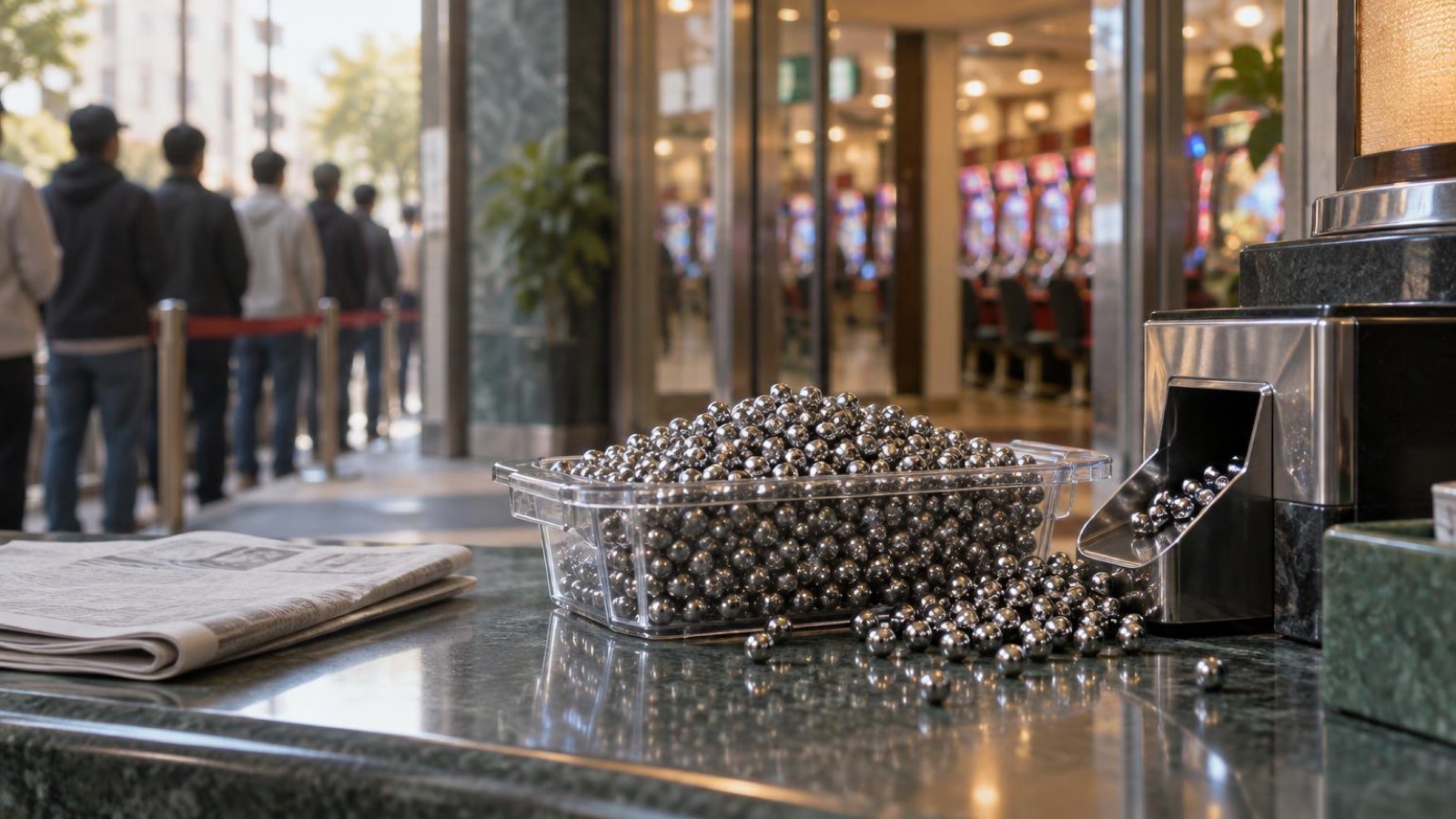
Morning service is the parlor's opening ritual. The doors unlock, often a few minutes before the posted hour, and the players who have been waiting outside walk or jog to the machines they have picked out. In halls that run a formal version, staff make an announcement, sometimes a short ceremony, and the first balls or tokens go into play.
The reason it matters is that pachinko and pachislo machines are not identical. Two machines of the same model can be set to different payout rates, and regulars believe the machine they sat down at on day one is the one they should sit down at again. Morning service is how you get the seat you want before someone else takes it. If you have no preference, morning service is simply the quietest, calmest time to walk in and learn the machine without a crowd behind you.
Pachinko itself comes in several forms. There are hane-mono machines, where balls fall through pins and a small flipper decides the outcome, and there are pachislo machines, which are essentially slot machines using tokens exchanged for prizes7. A pachinko machine has even been built with a parlor clerk as its protagonist, which tells you how much of the culture is about the hall itself3.
What time morning service usually starts
Parlors set their own opening hours, and the rush is over within the first ten or fifteen minutes. A parlor in Kanuma, Tochigi, lists opening hours of 9:00 to 22:50, with a phone number of 0289-76-0717 and a website at saotomesp.co.jp if you want to check before you go2. In Okinawa, parlors close at midnight rather than running later3.
If you want a specific machine on a weekend or a day when a new model has just been installed, arrive 30 to 60 minutes before opening. You will be standing outside with everyone else, and the queue is usually orderly. If you just want to try pachinko for the first time, come mid-morning on a weekday instead. The hall will be half empty, staff will have time to explain the machine, and you will not be pushed along by a line of regulars.
One practical note: some parlors run a formal morning service event with announcements and a set start, and some simply open the doors. There is no national rule requiring it, so check the individual hall's site or call ahead.
Minimum age: 18 for pachinko, 20 for public sports
The age rules in Japan split into two tiers, and this is the single most useful thing to know before you go.
| Type of gambling | Legal? | Where | Minimum age |
|---|---|---|---|
| Pachinko and pachislo | Yes | Licensed parlors nationwide | 181 |
| Horse racing, keirin, boat racing, auto racing | Yes | Racecourses and licensed off-track betting | 201 |
| Lottery tickets and sports lottery (toto, BIG) | Yes | Convenience stores, official sites | 18 or over in practice |
| Casino table games | Not yet open | Integrated resort, not yet operating | Not applicable yet |
| Online casino from inside Japan | No | Anywhere you connect from in Japan | Illegal at any age4 |
Pachinko and pachislo are 18 and over1. Parlors are prohibited from letting anyone under 18 enter as a customer, and the rule has to be posted at the entrance8. For slot-machine type businesses, entry is also prohibited after 10 p.m. for under-18s9. In practice, staff will ask for ID if you look young, so bring your passport if you are a visitor.
Public sports betting is 20 and over1. That covers horse racing, keirin, boat racing and auto racing. If you are 18 or 19 and in Japan, pachinko is open to you and the racecourses are not.
How pachinko fits among Japan's legal forms of gambling
Japan's gambling landscape is narrower than most visitors expect. The legal options are pachinko and pachislo, the four public sports, and the national lotteries and sports lottery. That is roughly it for a casual player.
Pachinko sits in its own category. Parlors are allowed to operate through a set of workarounds on how prizes are exchanged, plus a cultural carve-out that has kept the game legal for decades10. You do not win cash at the machine. You win balls or tokens, which you exchange for prizes at a counter inside the hall, and then, at many parlors, you take those prizes to a separate exchange window nearby. That separation is the mechanism that keeps the whole thing on the right side of the law.
Online casinos are illegal for players in Japan
Playing on an offshore casino website from inside Japan is illegal, and players have been prosecuted4. This applies to everyone physically in Japan, whether you are a citizen, a foreign resident or a visitor on holiday. It applies even when the casino holds a license in another country, and it applies to free play and free bonuses as well as real-money play4.
The police position is that connecting from Japan is what makes it a domestic offense, regardless of where the operator is licensed12. Enforcement has been stepped up, and the government's own plan names online casinos as a target13. There have been cases of customers, not just operators, being arrested for gambling5. Online pachinko carries the same risk14.
If you want to play casino table games legally, you need to leave Japan. Macau, Singapore and the Philippines all run licensed casinos with table games, and each has its own minimum age and entry rules. If you are staying in Japan, stick to pachinko, the public sports and the lottery.
Are there casinos in Japan?
Not yet. Japan has passed legislation allowing integrated resorts that include casinos, and the law sets an entry rule for Japanese customers of up to three days within any seven-day period, though because the resorts would operate 24 hours a day a customer could in theory stay 72 hours continuously6. No such resort has opened, so there is nowhere in Japan today where you can sit down at a legal casino table.
That is why pachinko matters so much to the local gambling scene. It is the closest thing Japan has to a mass-market machine gambling industry, and it is everywhere. There are thousands of pachinko parlors across the country10. For a visitor, a pachinko hall is the one form of Japanese gambling you can walk into on any given afternoon without planning.
What to expect on your first visit
Your first visit follows a few simple steps.
- Walk in, and you will see rows of machines, most of them vertical, with a seat in front of each.
- Find an empty seat, or ask a staff member where to start.
- Put cash into the machine or into the ball dispenser next to it.
- In pachinko you turn a handle to launch balls into the play field; in pachislo you press buttons to spin reels.
Staff will help if you ask, though English is not guaranteed.
When you are done, take your remaining balls or tokens to the counter. You exchange them for prizes, and at many halls you then take those prizes to a separate window nearby to convert them. Bring cash in yen, because most machines take notes and coins rather than cards. There is no entry fee and no membership required.
If you want to understand the machine before you sit down, the specs on the front panel tell you the jackpot odds, the kakuhen (probability change) state and the payout rate, and there is a guide to reading them here: How to Read Pachinko and Pachislot Machine Specs. If you are new to the country entirely, the wider picture of what is and is not legal is in Can I Gamble in Japan?, and the regional comparison across Asia is in Where Mahjong, Pachinko, Sabong, Teen Patti and Other Asian Games Are Legal.
Common Questions
What time does morning service usually start?
Parlors set their own hours, and the rush happens in the first minutes after the doors open. A parlor in Kanuma, Tochigi, lists hours of 9:00 to 22:50. Arrive 30 to 60 minutes early if you want a specific machine.
Do all pachinko parlors offer morning service?
No. Morning service is a parlor by parlor decision, not a national rule. Some halls run a formal opening event with staff announcements, while others simply unlock the doors at their normal opening time. Check the individual parlor's website or call ahead.
Is pachinko legal for tourists in Japan?
Yes. Pachinko and pachislo are legal for anyone aged 18 or over, including visitors. You do not need a Japanese address or membership. Bring cash in yen, since most parlors do not accept foreign cards, and expect to exchange any prizes for cash at a separate window outside the hall.
Can you play pachinko at 18 in Japan?
Yes. The minimum age for pachinko and pachislo is 18. Parlors are prohibited from letting anyone under 18 enter as a customer, and the rule is posted at the entrance. Public sports betting such as horse racing and boat racing has a higher minimum age of 20.
Are there casinos in Japan?
Not yet. Japan has passed legislation allowing integrated resorts with casinos, but no casino has opened. If you want casino table games today, you would have to travel to a jurisdiction such as Macau, Singapore or the Philippines, or play at an illegal online site, which carries real risk.
Can Japanese players be arrested for using online casinos?
Yes. Gambling on an online casino from inside Japan is a crime even when the operator is licensed abroad, and there have been cases of customers being arrested for gambling. Free play and free bonuses are treated the same way. Police have said enforcement is being strengthened.
Sources14 sources
- パチンコ店, Wikipedia, 2026
- 1円の達人 鹿沼店, P-World, 2026
- パチンコ大賞, Wikipedia, 2026
- オンラインカジノ対策特設サイト, National Police Agency, 2026
- オンラインカジノに関する消費者トラブルにご注意ください, Consumer Affairs Agency, 2026
- カジノ実施法に関する請願, House of Councillors, 2026
- Gambling in Japan, Oxford Brookes University, 2007
- 風営法, e-Gov, 2025
- ギャンブル依存症パンフレット, SCGA, 2026
- Best Online Casinos for Players from Japan, Wizard of Odds, May 6, 2026
- オンラインカジノの違法性に関する講演資料, National Police Agency, 2026
- オンラインカジノの違法性に関する講演資料, National Police Agency, 2026
- ギャンブル等依存症対策基本計画, Cabinet Secretariat, March 21, 2025
- オンラインパチンコの違法性, RSN Sakura, 2026















