
What this glossary covers
Racing terminology travels badly. The same bet has four or five names depending on where you are standing, and the local-language version on the screen in front of you often does not match the English word in a guidebook. This page collects the terms you will meet at Asian racecourses and on Asian betting screens, in the order you are likely to meet them: the bet types first, then the numbers that decide whether a bet is even available, then what happens when a horse comes out, then the form and earnings language, then the track and racecourse words, and finally the calendar.
The Hong Kong Jockey Club organizes its own beginner material into six categories: racecourse, system, horse, jockey, trainer and wager1. That is a reasonable map of the vocabulary too, and it is roughly the order below. Where an operator uses a local-language name, that name is given alongside the English one, because that is what you will see on the ticket.
One thing worth saying at the start: the words are not decorative. "Field size" decides whether your quinella bet is accepted at all. "Scratched" decides whether you get money back. "Track number" is not the same as the number on the saddle cloth. Getting these four right removes most of the confusion a first-timer runs into.
Betting terms
Start with the two bets almost everyone places first. A win bet is a selection of the 1st placed horse in a race of four or more declared starters2. A place bet is a horse in a race with seven or more declared starters finishing 1st, 2nd or 3rd, or a horse in a race with four to six declared starters finishing 1st or 2nd2. In Japan the same two bets are 単勝 (win) and 複勝 (place), and the operator explains them the same way: pick the horse you think will finish 1st, or pick a horse you think will finish in the top three6.
From there the family branches quickly. The full list of bet types offered under one major Asian operator's rules runs: win, place, evens and odds, forecast, place forecast, tierce, trio, quartet, quadro, double, double forecast, double trio, triple trio, six up, all up and roll2. You do not need all of them on day one, but you will see the names on the screen, so here is what the core ones mean.
- Win: select the 1st horse in a nominated race7.
- Place: select at least one of the placed horses in a nominated race7.
- Forecast (exacta): select the 1st and 2nd horses in the correct finishing order7.
- Tierce: select the 1st, 2nd and 3rd horses in the correct finishing order7.
- Double: select the 1st horse in each of two nominated races7.
The order-free versions are the ones that trip people up. A quinella (Q) asks you to pick two horses to finish 1st and 2nd in either order8. A quinella place (QP) asks for two horses to finish 1st, 2nd or 3rd in any order8. A trio (T) asks for three horses to finish 1st, 2nd and 3rd in any order8. The difference between a forecast and a quinella is one word, "order," and it is the difference between a much harder bet and a much easier one.
At the window, the sequence matters. When you place a bet at the teller you give, in this order: the race number, the type of bet you are placing, the amount of your bet, and the horse's number9. Some operators also sell a coupled bet, which is a bet placed on a stable to win a race, and it wins if any of the stable's representatives wins10. That is a stable-level bet rather than a horse-level one, and it behaves differently when a horse comes out, which is covered below.
Field size: why a 1400m race may hold 14 horses
Field size is the number of declared runners in a race, and it is the single most useful number on the card because it decides what you are allowed to bet. At one major operator, quinella, quinella place and trifecta bets are available only when there are nine or more horses in a race, while place bets are available from five or more3. So a seven-horse race is a place-bet race, not a quinella race, no matter how strongly you feel about two horses.
Field size also sets the arithmetic of your chances. With a 12-horse field, a win bet has a one-in-twelve chance and a place bet has a three-in-twelve chance, as the operator's own beginner page puts it11. That is not a prediction, just the shape of the pool: more runners, more combinations, and in the exotic bets, bigger dividends when they land.
There is a floor as well as a ceiling. If a place pool has fewer than five horses starting, the pool is terminated; if a quartet pool has fewer than six horses starting, that pool is terminated too12. In plain terms, the operator will not run a bet it cannot settle fairly, and your stake comes back rather than being settled on a thin field.
Scratches and withdrawals: what happens when a horse is out
A scratched horse is one withdrawn from the race before it starts. The refund rule is the part that matters. Where a selected horse is scratched in a single race pool, bets on the scratched horse are refunded; in multiple bets, only the portion relating to the scratched horse is refunded4. So a straight win bet on a scratched runner comes back in full, while a double where one leg is scratched comes back in part, with the other leg still running.
Timing matters too. Once a scratching is announced, no bets involving the scratched horse, including up to the next leg of multiple-leg combinations, will be accepted4. If you were planning to add that horse to a multi-leg bet, the window closes when the scratching is posted.
The multi-race bets have their own rule, and it is not a refund. In the 孖T and 三T bets, stakes are not refunded when a horse is scratched; each scratched horse is replaced by the favorite, with the second or third favorite substituted in specified combination cases13. That is a substitution, not a refund, so if you are playing those pools, read the replacement rule before you build the ticket.
There is also a fallback for the case where nobody has the winning combination at all. In a 連贏 single pool, if there are no winning bets, the first and third placed horses qualify, then the second and third placed horses; if there are still no bets, all bets are refunded13. It is a rare outcome, but it explains why a dividend sometimes looks strange.
A fall is treated as a withdrawal. A fall is deemed when the horse falls during the race, part of the jockey's body touches the ground, or the jockey is separated from the horse and its gear at the finish line, and the horse is treated as withdrawn14. If you see 落馬 on a result sheet, that is what it means.
Bracketed numbers have their own rule for withdrawals. If one or more but not all horses in a bracket are withdrawn, all bets remain valid and bettors are treated as having selected the remaining bracketed runners15. So a bracket bet does not collapse when one horse in the bracket comes out; it simply narrows to the horses still in.
Form, stakes and earnings terms
Form is the horse's recent record, and it is the first thing a regular looks at. One operator's race analysis module breaks the reading of a race into form, condition, class and weight, jockey and trainer, draw, and pace16. Those six words are the working vocabulary of form study, and you will see them as headings on racecards and analysis pages across the region.
Stakes earnings are the total prize money a horse has accumulated, and they are published by the authority or club rather than shown on the tote. The Royal Calcutta Turf Club publishes a stakes earnings sheet that records the total for every horse in its jurisdiction, updated through the season. That is where you look if you want to know how much a horse has actually won, as opposed to how it ran last time.
The bet types themselves have local names worth knowing. In Korean racing the principal bet types are win, place, quinella and exacta17, and the operator's own support pages use the short forms W (pick one horse to finish 1st), Q (pick two horses to finish 1st and 2nd in either order), QP (pick two horses to finish 1st, 2nd or 3rd in any order) and T (pick three horses to finish 1st, 2nd and 3rd in any order)8. In Japan, the central racing bet types set out in the rules include bracket-number exacta, horse-number exacta, horse-number trifecta, bracket-number quinella, ordinary horse-number quinella, extended horse-number quinella, and combined horse-number trifecta, plus the weighted-pool multi-race bets: double, triple, quadruple, quintuple, sextuple and septuple win bets18.
Race programs carry their own shorthand. In a Korean race program, a horse's country of origin is given as 한국 for Korea and 미국 for USA, and its gender as 암 for mare, 수 for stallion and 거 for gelding8. Once you know those three characters, the program stops looking like code.
Track and racecourse terms
A track number is an official registration number issued to a horse for a season. It is not the number the horse wears in a race. The Royal Calcutta Turf Club issues black and green track numbers to horses for the 2026-2027 season, and the list is published as a trackbook. If you are following a horse across a season, the track number is the identifier that stays with it.
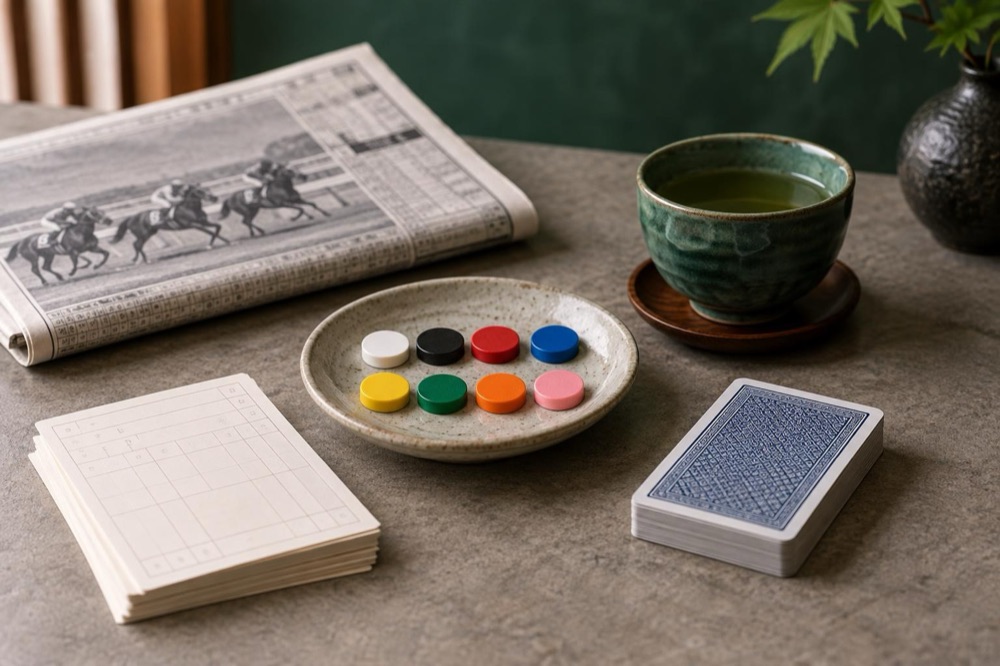
Race numbers and bracket numbers are the ones you see on the day, and they are not the same thing either. At Kanazawa Racecourse, with 8 or fewer horses the bracket number and the horse number are the same; with 9 or more, horses are grouped two per bracket starting from bracket 819. Bracket-number bets are sold in races with 9 or more runners under the 8-bracket system, and the bracket colors run 1 white, 2 black, 3 red, 4 blue, 5 yellow, 6 green, 7 orange, 8 pink14. That color sequence is why you will hear people at the rail talking about "the pink."
At Kasamatsu Keiba, the horse-number exacta asks you to pick the horse numbers of the 1st and 2nd finishers in exact finishing order, using horse numbers 1 to 10, and the horse-number trifecta does the same for the first three20. The cap at 10 is a local rule, not a universal one, which is why you check the ticket type rather than assuming.
Racecourses themselves have names worth knowing. The central racecourses in Japan are Sapporo, Hakodate, Fukushima, Niigata, Nakayama, Tokyo, Chukyo, Kyoto, Hanshin and Kokura18. On a race day, races are held at 2 to 3 racecourses, and the race program (the shuttoba) is distributed free at the racecourse21. If you are going for the first time, pick up the free program at the gate; it carries the field, the draw and the form in one place.
One restriction that surprises visitors: persons engaged in horse racing affairs may not buy betting tickets19. That covers staff working the meeting, not the public, but it is worth knowing if you are at a track in an official capacity.
Race days and special events on the calendar
Race days are not every day. In Japanese central racing, permitted race days are Sundays, Saturdays, national holidays, January 5 to 7, or from December 2818. The annual total is capped at 288 days, with 12 days per meeting, 12 races per day, and 5 meetings per racecourse per year18. That structure is why the calendar looks the way it does: a handful of meetings per track, each running over about a fortnight.
The pattern repeats across the region, with local variations. In Korea, betting is pari-mutuel, with totalizator betting available both on course and off course, and no bookmakers17. That single fact explains most of the vocabulary differences you will notice between an Asian tote ticket and a British or Irish betting slip.
Special events sit on top of the regular calendar, and they are where the local vocabulary gets colorful. The Soma Nomaoi Armored Horse Race (Kacchu Keiba) is one of the events of Soma Nomaoi, and Oi Racecourse will host it on Sunday, October 4, 2026. It is a traditional armored horse event staged at a modern racecourse, which is a good example of how racing vocabulary in Asia carries both the tote terms and the older ceremonial ones.
Big races have their own names and their own entry deadlines5.
| Race | Overseas horses entry deadline | Hong Kong horses entry deadline |
|---|---|---|
| Citi Hong Kong Gold Cup | 01/02/2027 | 15/02/2027 |
| Queen's Silver Jubilee Cup | 25/01/2027 | 09/02/2027 |
| Stewards' Cup | 04/01/2027 | 18/01/2027 |
| Centenary Sprint Cup | 28/12/2026 | 11/01/2027 |
If you are following a horse into one of these, those are the dates that matter.
At the club level, the Selangor Gold Cup is a 1600m G1 worth RM300,000, run as Race 8 at the Selangor Turf Club, with an upcoming event listed for Sunday, September 27, 2026. And at the results level, God Barock, a Hokkaido-trained horse, won the Aki no Kura race at Nagoya Racecourse on September 17, 2026, finishing first of 12 runners. That is the kind of line you will see in a results summary: horse, race, track, date, field size.
If you want the bet types in more depth, the horse racing bet types page walks through each one, and how to read a racecard covers the draw, weight, rating and form figures that sit alongside the terms above. For the wider picture of where each of these bets is offered, start with horse racing and betting in Asia.
Common Questions
What does it mean when a horse is scratched?
A scratched horse is withdrawn from the race before it starts. In single-race pools your bet on that horse is refunded. In multi-race bets, only the portion tied to the scratched horse comes back, and the rest of your bet stays live.
What is a field size in horse racing?
Field size is simply the number of declared runners in a race. It matters because some bet types need a minimum number of horses. Place bets need five or more runners, while quinella, quinella place and trifecta bets need nine or more.
Where can I see a horse's stakes earnings?
Stakes earnings appear in the official statistics published by the racing authority or club that runs the meeting. For example, the Royal Calcutta Turf Club publishes a stakes earnings sheet listing every horse's total, updated through the season.
What is a track number?
A track number is an official registration number issued to a horse for a season, separate from its race number on the day. The Royal Calcutta Turf Club issues black and green track numbers to horses for the 2026-2027 season.
What was God Barock's Aki no Kura win?
God Barock, a Hokkaido-trained horse, won the Aki no Kura race at Nagoya Racecourse on September 17, 2026, finishing first of 12 runners. It was a notable result for the Hokkaido Keiba stable at a NAR meeting.
When is the Selangor Gold Cup run?
The 1600m G1 Hygain Horse City Selangor Gold Cup, worth RM300,000, is run as Race 8 at the Selangor Turf Club, with an upcoming event listed for Sunday, September 27, 2026.
Sources21 sources
- Racing Beginners Guide, Hong Kong Jockey Club
- Horse Race Betting Game Rules, Singapore Pools, 2026-07-06
- How to Bet on Local Racing, Japan Racing Association, 2026-09-25
- Horse Race Rule 6, Hong Kong Jockey Club, 2025-05
- HKJC Events, Hong Kong Jockey Club, 2026-09-27
- Betting at Sonoda Himeji, Sonoda Himeji Racecourse, 2026-09-25
- Horse Race Rule 1, Hong Kong Jockey Club, 2025-05
- Horse Racing Information, Korea Racing Authority, 2026-09-26
- Getting Started with Betting, Philracom, 2026-09-25
- Rules for Conduct of Betting Operations, Gambling Regulatory Authority of Mauritius, 2021
- Betting at Sonoda Himeji (Chinese), Sonoda Himeji Racecourse, 2026-09-25
- Horse Race Illustration, Hong Kong Jockey Club, 2022
- Horse Race Rule 3, Hong Kong Jockey Club, 2023-01
- Keiba Q&A, Japan Racing Association, 2026
- Horse Race Rule 4, Hong Kong Jockey Club, 2023-01
- Racing Academy, Hong Kong Jockey Club, 2026-09-25
- Asian Racing Statistics: Korea, Asian Racing Federation
- Enforcement Regulation of the Horse Racing Act, e-Gov Japan, 2026-07-28
- Betting Tickets at Kanazawa Racecourse, Kanazawa Racecourse, 2026
- Betting Tickets at Kasamatsu Keiba, Kasamatsu Keiba, 2026-09-25
- JRA Information, Japan Racing Association, 2016















