
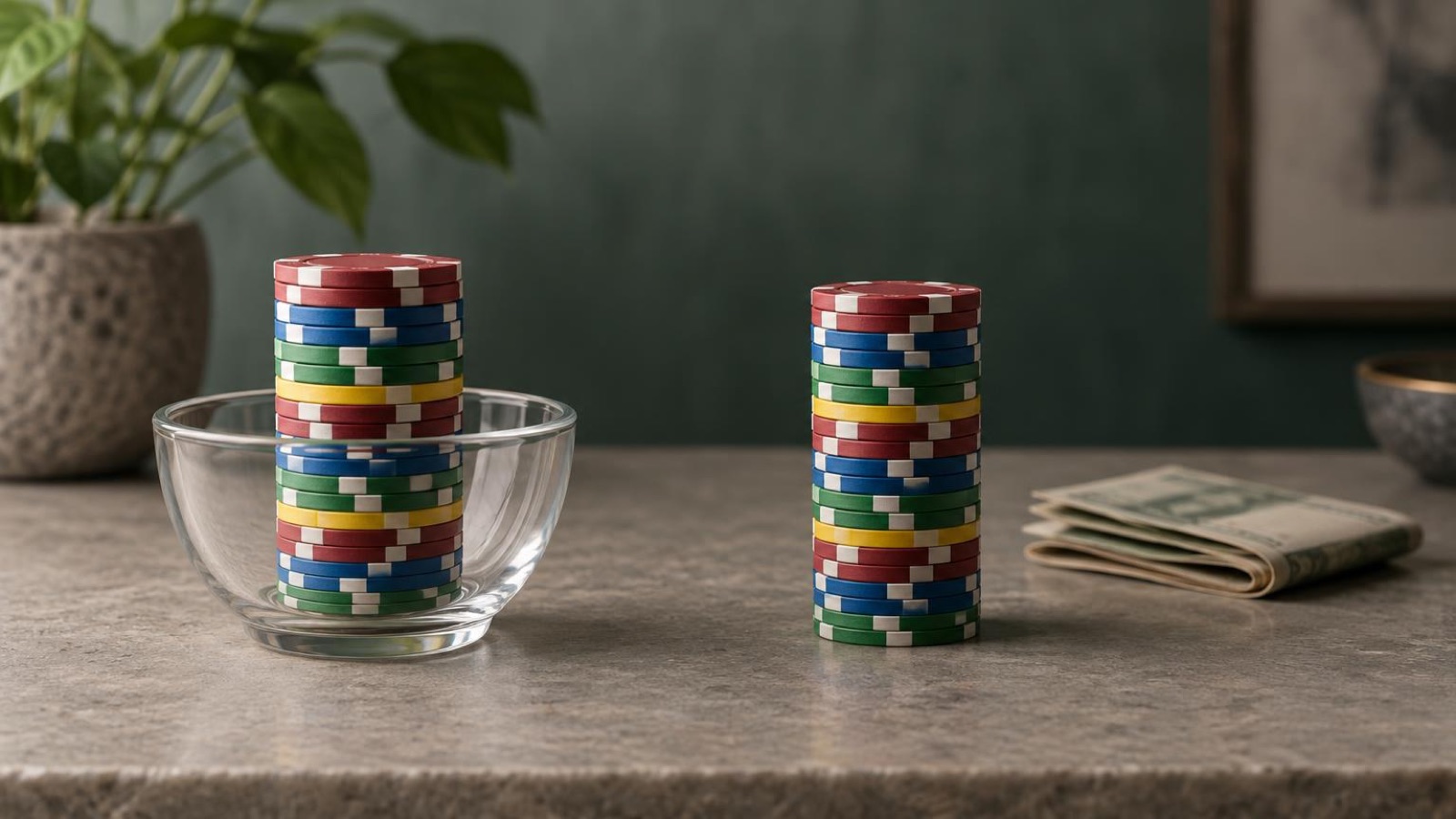
Play money: what it is and what it is worth
Play money is the free-chip side of online poker. You sit at tables where the blinds carry a "P" in front of the number, and the chips you use there are free chips that only work on those tables6. They are not a deposit, not a balance you own, and not something you can move around.
The single most important thing to understand is that play money has no cash value. It cannot be used together with cash, CP, TP or any other currency or ticket2. That rule is repeated across the play money tables, and it is the line that separates free poker from real-money poker. You cannot buy in with play chips at a cash table, and you cannot turn a big play money stack into a withdrawal.
What play money does give you is the full structure of the game without the money. You still post blinds, you still face a rake, and you still play real hands of Texas Hold'em, Omaha or short deck. The difference is that the chips are a scorekeeping device rather than a bankroll.
It helps to think of play money as a practice environment with a scoreboard. You can learn the flow of a hand, get used to the software, and see how a table plays, all without risking anything. What you cannot do is treat a play money win as income.
Starting balance and free chips: P20,000 for new players
When you sign up, you do not need to deposit anything to start playing. Newly signed-up players receive P20,000 in play money chips to begin with3. That starting balance is the same across the play money tables, whether you head to Texas Hold'em, Omaha or the faster formats7.
The P20,000 is a one-time welcome balance, not a recurring allowance. It is there so a new account can sit down at the lower play money tables straight away. If you burn through it, the top-up system takes over.
A few practical points about the starting balance:
- It is play money, so it has no cash value and cannot be withdrawn2.
- It applies to new players only, not to accounts that have already been active3.
- It is enough to buy in at the play money tables, where the buy-in is P5,000 on the Pot Limit Omaha tables5.
- It does not unlock real-money tables, which use their own currencies and tickets.
If you are trying poker for the first time, the P20,000 start is a low-pressure way to learn the interface and the betting flow before you ever think about real money.
Top-ups for existing players: P10,000 every four hours, twice a day
Once the starting balance is gone, existing players can claim or reload up to P10,000 every four hours, up to a maximum of two times per day4. That is the standard top-up rhythm on the play money tables, and it applies to accounts that have already used their welcome balance8.
The practical effect is a soft cap on how much play money you can hold at once. You cannot top up on demand, and you cannot stack reloads. If you play through your balance quickly, you wait for the next four-hour window.
A simple way to plan around it:
- Two reloads a day at P10,000 each gives you P20,000 in top-ups daily, on top of whatever you have left4.
- The four-hour gap means a session that drains your chips ends when the chips end, unless you still have some in reserve8.
- The limit applies to existing players, so a brand new account starts from the P20,000 welcome balance instead3.
This is one of the clearest differences between free and real-money poker. With real money, you decide how much to deposit and when. With play money, the site decides how much free chips you get and how often.
Table stakes, buy-ins and tournament fees on play money tables
Play money tables come in a few stake levels, and the numbers are all in play chips. The main play money stakes are P200/P500 and P100/P2009. The maximum rake on those tables is P10,000 at P200/P500 and P2,000 at P100/P200, all in play money10.
Tournaments on the play money side charge a fee too, but again in chips rather than cash. The play money tournament fee is 5%, with a maximum fee of P5,000 play money9. So even the free side of the site mirrors the structure of a real card room, just with chips that cannot leave the table.
Here is how the play money tables break down:
| Table type | Blinds | Buy-in | Rake or fee |
|---|---|---|---|
| Play money cash | P200/P500 | P5,000 (PLO) | P1,500 (PLO)5 |
| Play money cash | P100/P200 | varies by table | up to P2,00010 |
| Play money tournaments | varies | varies | 5%, max P5,0009 |
The point of these numbers is not that they matter financially. They do not. The point is that the play money tables are built to behave like the real ones, so the habits you build there transfer when you move to real money.
Play money in Pot Limit Omaha: blinds, buy-in and rake
Pot Limit Omaha is a good example of how the play money tables are set up, because the numbers are specific. On the play money Pot Limit Omaha tables, the blinds are P200/P500, the buy-in is P5,000, and the rake is P1,5005. Those are play money figures, so nothing is deposited and nothing is withdrawn.
If you want to compare that with the real-money side, the gap is obvious. Real-money Pot Limit Omaha runs from $0.01/$0.02 up to $5,000/$10,000, on two- or six-handed tables, around the clock11. Real-money Omaha tournaments start from $0.50 and go up to the big buy-ins in the larger series11.
The structure is similar, but the units are different. On the play money tables you are posting P200 and P500 in free chips. On the real-money tables you are posting actual currency, and the rake is taken in that currency.
A few things worth knowing before you sit down at play money PLO:
- The buy-in is P5,000, so your P20,000 starting balance covers four buy-ins5.
- The rake is P1,500, which is charged in play chips5.
- The blinds are P200/P500, so the stakes are fixed and the table does not change limits mid-session5.
- None of it can be converted to cash, CP, TP or tickets2.
If you are learning Omaha, the play money tables are a reasonable place to get comfortable with four hole cards and the pot-limit betting structure before you look at real-money PLO.
Real-money poker: how the currencies and tickets differ
Real-money poker is the other side of the same software. Instead of P chips, you play with the site's currency, and the amounts you win can be withdrawn. On one operator, for example, all games display and process in VND12. Other sites use their own currencies and ticket systems.
The practical differences come down to four things:
- Value. Real-money chips represent money you deposited or won, and they can be cashed out. Play money chips cannot2.
- Entry. Real-money tables and tournaments require a deposit or a ticket. Play money tables require only the free chips3.
- Fees. Real-money cash games charge rake in currency, and tournaments charge a fee in currency. Live poker instead uses a rake or a session fee, and in some games an ante contributed by each player before the hand starts9.
- Stakes. Real-money PLO runs from micro-stakes to high-roller levels, with tables available around the clock11.
If you are moving from play money to real money, the mechanics are familiar but the consequences are not. The same hand that costs you P500 in play chips costs you real currency at a real table.
Where free and real-money poker sit in Asia's legal picture
The legal picture in Asia turns on whether real money is involved, and on where you are. Free play money poker, where no cash or prize changes hands, sits in a different category from real-money play.
Thailand is a useful example. Texas Hold'em and poker games both with and without community cards are not specifically illegal as games, but the restrictions around them are tight enough to make play illegal in practice, and underground poker rooms still operate there13. For a visitor or expat, that means real-money poker in Thailand carries real risk, while free play money games do not involve the same exposure.
Across the region, the pattern is that licensed real-money poker exists in some places and not others. In the Philippines, poker operators hold gaming licenses issued by the regulator14. In Vietnam, players buy tickets to enter poker tournaments at clubs, with costs from a few hundred thousand dong to a few tens of millions of dong15. Those are real-money, regulated settings.
For free poker, the question is simpler. If there is no cash value and no prize, you are playing a game rather than gambling. The moment a free game offers a real-money prize or a withdrawable ticket, it moves closer to the real-money side and the local rules start to matter.
If you want the country-by-country detail, the guides for Thailand, Vietnam, the Philippines and Japan set out what residents and visitors can and cannot do.
Freerolls and other ways to play without depositing
Freerolls are the bridge between free and real-money poker. A freeroll is a free-to-enter tournament where you can win real-money prizes or tournament tickets without paying a buy-in1. You are not depositing, but the prize is real.
That is different from play money. Play money chips never leave the play money tables. A freeroll prize can be cash or a ticket into a paid event, which is why freerolls sit in their own category.
There are a few other no-deposit routes worth knowing:
- No-deposit bonuses. These come in two main types: no deposit bonus funds (free chips) and no-cost spins (free spins), plus freeroll tournaments and free playtime16. Availability is limited, and they are usually designed for new players creating their first account1.
- Wagering requirements. Where a no-deposit bonus is offered, the wagering requirement often reaches up to 50x the bonus amount, so read the terms before you count on cashing anything out1.
- Demo modes. Some operators offer a free demo mode with virtual money for most of their games, with no registration or deposit needed, though live casino games do not have a demo mode12.
- Practice chips. Some sites direct players to practice chips and freerolls rather than a traditional no-deposit bonus1.
The practical takeaway is that you can play poker for real prizes without depositing, but the route is usually a freeroll or a limited new-player offer rather than an open-ended free balance.
Choosing between free and real-money poker
The choice comes down to what you want out of the game. If you want to learn the rules, get comfortable with the software, or play socially without risk, play money does that. If you want the chance to win something you can keep, you need real-money tables or freerolls.
A few practical points to weigh:
- Cost. Play money costs nothing and tops up automatically. Real money requires a deposit, and live poker charges a rake or a session fee9.
- Withdrawal. Play money cannot be cashed out. Real-money winnings can2.
- Skill transfer. The mechanics are the same, but real-money players tend to make bigger mistakes and the live game is softer and less competitive than the online pool17.
- Pace. Online play lets you see many more hands per hour, while live poker is one table at a time and allows for a higher hourly win rate per table played17.
- Budgeting. If you do play for real money, consider using cash only and leaving credit cards at home, and set a budget and a win limit in advance9.
If you are new to the game, a sensible path is to start on the play money tables, learn the flow, then try a freeroll where the prize is real but the entry is free. Only move to real-money tables when you are comfortable with the pace and the cost.
For more on the mechanics, see poker rake, time fees and tournament fees and cash games vs tournaments. If you are playing from a specific country, the poker in Asia hub links to the local rules.
Common Questions
Can I convert play money chips into cash or tickets?
No. Play money has no cash value and cannot be combined with cash, CP, TP or any other currency or ticket. It only works on the play money tables where the blinds carry a P. You cannot cash it out, transfer it or use it to buy into a real-money game.
How often can I refill my play money balance?
Existing players can claim or reload up to P10,000 every four hours, up to a maximum of two times per day. New players start with a one-time P20,000 balance. If you run through both, you wait for the next four-hour window rather than topping up on demand.
What do the 'P' symbols next to the blinds mean?
The P marks play money. Blinds shown as P200/P500 or P100/P200 are play money tables, and the chips used there are free chips that cannot be mixed with cash, CP, TP or tickets. Real-money tables show currency amounts instead.
What is the buy-in on play money Pot Limit Omaha tables?
On the play money Pot Limit Omaha tables, the buy-in is P5,000, with blinds of P200/P500 and a rake of P1,500. These are play money figures, so nothing is deposited or withdrawn. Real-money PLO tables use actual currency stakes instead.
How much is the tournament fee on play money tables?
The play money tournament fee is 5%, with a maximum fee of P5,000 play money. It is deducted in play chips, not cash. Real-money tournaments charge a fee in the site's currency, and live poker instead uses a rake or a session fee.
Do any poker apps offer a no-deposit bonus?
Some do, but availability is limited. No-deposit bonuses usually target new players creating a first account and often carry wagering requirements up to 50x the bonus amount. Freerolls and free playtime are the more common no-cost route.
Sources17 sources
- No Deposit Bonus, CoinPoker, August 23, 2026
- Omaha, Natural8
- Spin and Gold, Natural8
- All-in Poker, Natural8
- Omaha, Natural8
- Short Deck, GGPoker
- Texas Hold'em, Natural8
- Rush and Cash, Natural8
- How to Play Poker, PlaySmart
- Texas Hold'em, Natural8
- Pot Limit Omaha, CoinPoker, July 17, 2026
- Trò chơi, W88 Poker
- Poker Life in Thailand, GGPoker, May 5, 2025
- List of Poker Operators With Issued Gaming License, PAGCOR, May 7, 2026
- Trường hợp nào chơi poker bất hợp pháp và hợp pháp tại Việt Nam, Xây dựng chính sách, July 7, 2025
- No Deposit Codes South Korea, Wizard of Odds, September 26, 2026
- Live vs Online Poker, CoinPoker, August 7, 2025















