What a crypto casino is and how it works
A crypto casino is an online gambling site where the money moving in and out is cryptocurrency rather than fiat currency through a bank. You play the same kinds of games you would find anywhere online: slots, card games, table games, live dealer tables and sports or event markets, wagering digital assets on the outcome7.
The difference is the plumbing. Instead of entering card details, you send coins from a wallet you control to an address the casino gives you. Instead of a bank transfer back, the casino sends coins to an address you paste in. There is no card processor in the middle, no bank statement line, and usually no identity check at the front door.
Most of these sites are built around a small number of coins. Bitcoin and Ethereum are the baseline, and larger operators add stablecoins and altcoins. One long-running site supports Tether (USDT), Bitcoin, Ethereum, Tron, Litecoin, Ripple, Cardano, Dogecoin, Binance Coin, Polygon, Binance USD, USD Coin, Solana and The Open Network7. Another lists Bitcoin, Ethereum, USDT, Litecoin and Dogecoin among its supported assets8.
If you only hold fiat, you are not necessarily shut out. Some operators partner with services that convert fiat to crypto so you can fund an account without buying coins elsewhere first7. Others accept card payments and e-wallets alongside crypto, with balances displayed in fiat currency5. What they generally will not do is act as an exchange: one site states plainly that it does not perform conversions between cryptocurrencies and fiat currencies5.
The practical upshot is that a crypto casino is less a different kind of gambling than a different kind of cashier. The games, the odds and the house edge are the same as their card-and-bank equivalents. What changes is how money gets in, how it gets out, and how little anyone knows about who you are.
Deposits, wallets and withdrawals step by step
The deposit flow is short and identical in shape across most sites.
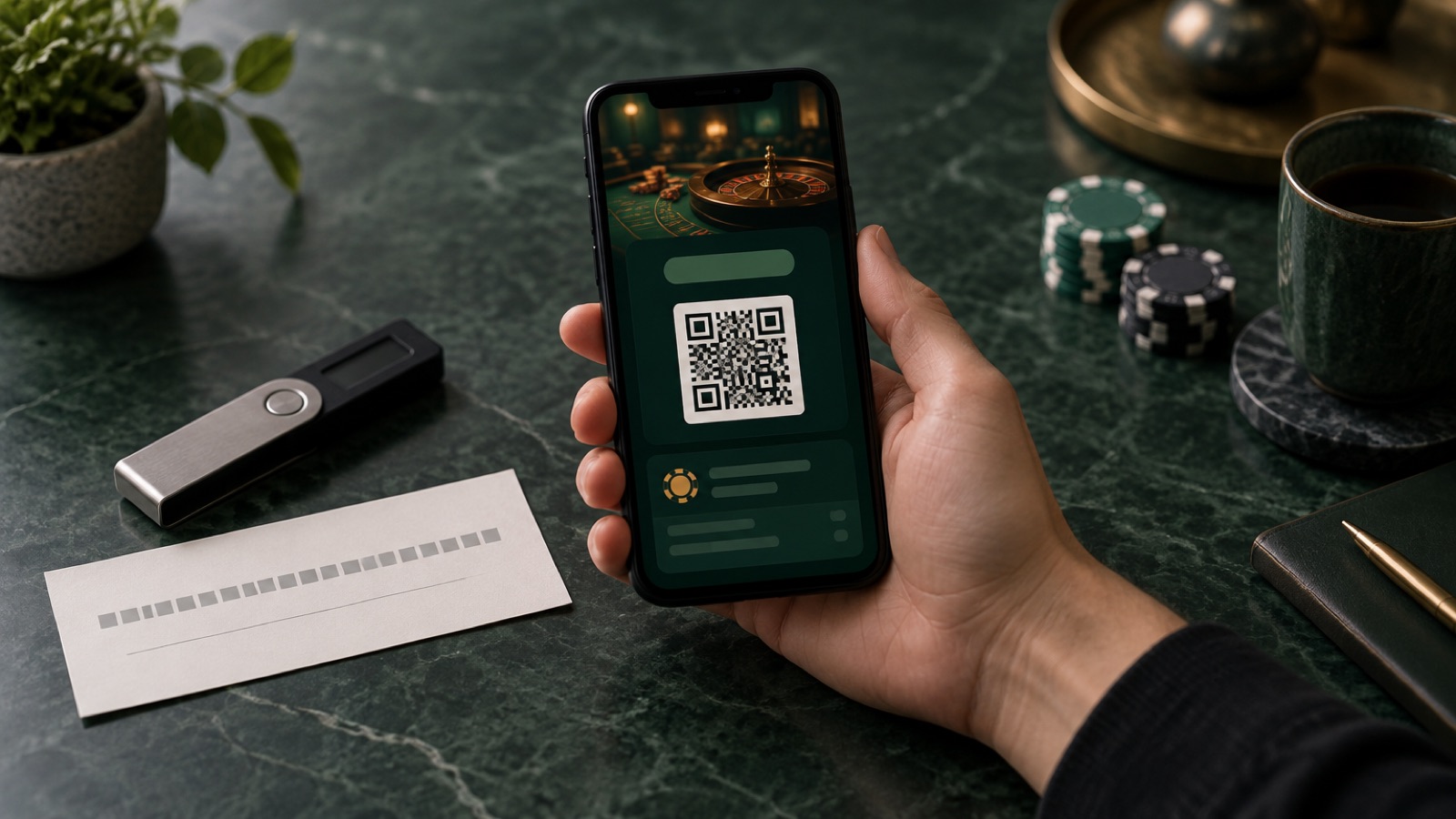
- Open your account and go to the deposit screen. You will see a QR code, a wallet address and your balance9.
- Choose which cryptocurrency you want to use9.
- Open your own wallet or an exchange app, scan the QR code or copy the address, and send the coins1.
- Wait for the transfer to be reflected in your casino balance10.
That is the whole process. There is no card number, no CVV, no bank verification. On the sites that describe their own speeds, crypto deposits and withdrawals are described as near-instant1, though withdrawals still wait on blockchain confirmation before the coins land9.
Withdrawals run in reverse:
- Switch from the deposit tab to the withdrawal tab11.
- Select the cryptocurrency and the method1.
- Enter the amount, or a percentage of your balance9.
- Paste the wallet address you want the coins sent to, then confirm1.
Some sites route this through a cashier section instead, where you pick the token you played with and enter a crypto address12. Either way, the destination is a wallet address, not a bank account.
Two details matter more than they look. First, before you send anything, confirm the coin, the network, the address and any required tag or memo, because assets like XRP use one and a wrong network can lose the transfer13. Second, on-chain transactions are irreversible: once you have sent a deposit, it cannot be reversed13. That cuts both ways. It is why payouts can be fast, and it is why a mistaken deposit is gone.
There is also a custody question worth understanding before you deposit. When you send coins to a casino, you are handing control of those coins to the site. That is the difference between a custodial and a non-custodial wallet, and it means your balance at the casino is a claim on the operator, not coins you hold13. If the site freezes your account, the coins are not in your pocket.
Fees vary. One operator lists no deposit fees for crypto14. Others do not publish a flat schedule, and network fees on the blockchain side apply regardless of what the casino charges.
Licenses: what a Curaçao license does and does not guarantee
Almost every crypto casino you will encounter in Asia runs on a Curaçao license. That is not a coincidence: it is cheap, fast to obtain and requires no physical presence in a regulated market.
The names differ slightly. One site operates under a Curaçao gaming license issued by the CGA, the Curaçao Gaming Authority2. Another cites Curaçao eGaming9. A third says it operates under a Curaçao Gaming Commission license15. A fourth is licensed and regulated by the Curaçao Gaming Authority5. A fifth holds a license from the same authority12.
What that license actually gives you is narrower than the word "licensed" suggests. It confirms the operator registered with a regulator and met that regulator's filing requirements. It does not give you a local gambling authority in your own country to complain to, a dispute resolution body with power to order a payout, or a compensation fund if the operator stops paying. When you have a problem with a Curaçao-licensed site, your practical route is the site's own support and complaints process.
The licensing regime itself has been under scrutiny. In September 2026, the Curaçao Gaming Authority disclosed unauthorized access to its online gaming portal and said the access had been contained while a forensic investigation continued. Around the same period, an investigation reported that the authority granted licenses even after assessors flagged unresolved ownership and wealth-source questions, and the authority issued a statement defending its process and warning against drawing conclusions from internal documents without the complete application files. A separate report described a researcher registering a fictitious company and being given access to the licensing portal within days.
None of that means every Curaçao-licensed casino is unsafe. It means the license is a registration, not a guarantee, and it should not be the only thing you weigh.
Games you will find at crypto casinos
The game libraries at the larger crypto casinos are genuinely big, and they are the main reason players choose them over a local operator.
| Site | Games listed | Coverage |
|---|---|---|
| One site | over 7,000 | playable with both fiat and cryptocurrencies3 |
| Another | more than 10,000 | slots, jackpots, live dealer games, table games and crypto-focused Originals4 |
| A third | more than 1,500 | video slots, blackjack, baccarat, roulette and live casino games5 |
Live dealer is a standard part of the offer now. One operator runs live blackjack, baccarat, roulette and more, hosted by live croupiers with HD streaming7. Another streams live dealer games 24 hours a day14. If you want the feel of a table without a physical casino, this is where you find it.
The in-house games are the other category worth knowing. These are the crash, dice, plinko and similar titles that crypto casinos build themselves, and they are usually the ones covered by provably fair verification. That label means the site publishes cryptographic data letting you check a result was not altered after you bet. It is a real mechanism, but its scope is narrower than the marketing implies: one operator states that provably fair verification applies to eligible Originals and games that specifically provide cryptographic verification, not to all games4. Another describes its library as provably fair and RNG-confirmed3.
On the question of bonuses, this guide does not cover them. What matters practically is that the games themselves, the table limits and the payout percentages are broadly comparable to mainstream online casinos. The slot payout schedules and percentages you would look up for any online casino apply here too9.
Where crypto casinos stand legally across Asia
This is the part where the answer depends entirely on where you are sitting, and it is worth being precise because the difference between jurisdictions is large.
Japan is the clearest case. Gambling at an online casino by connecting from within Japan is a crime, even if the casino is legally operated overseas6. The National Police Agency states the same position: gambling on online casinos from Japan is a crime even when the operator is legally run abroad2. Consumer guidance from February 2024 repeats it: using online casinos from within Japan to gamble is illegal16. A government statement from 2022 said connecting to an online casino website from Japan to gamble is a crime even if the casino is legally operated overseas17.
That is the strictest position in the region and it applies to residents and visitors alike when they connect from Japanese soil. If you are in Japan, the practical risk is not theoretical.
Elsewhere the picture is more varied, and the rules turn on whether you are a citizen, a foreign resident or a visitor, and on whether the operator holds any local authorization. The full position for each of the twelve jurisdictions is set out in online gambling in Asia: the law for players in 12 jurisdictions, and the country pages for Japan, South Korea, Singapore, Malaysia, Thailand, Vietnam, the Philippines, Cambodia, China, Hong Kong, India and Macau cover the local detail.
Two practical points cut across all of it. First, many crypto casinos restrict players from certain locations outright, and a site may simply refuse to serve you based on where you are connecting from1. Second, using a VPN to get around that is its own problem, both for your account and for any payout, which is covered in using a VPN to gamble online.
Risks for players: blocked withdrawals and no recourse
The single biggest risk with a crypto casino is not the games. It is what happens when the site decides not to pay you.
Accounts get frozen and funds confiscated for reasons that are written into the terms. One operator blocks players who run ten or more instances of its site at once, and blocks and confiscates all funds from anyone holding multiple accounts18. Another states that if you use a double-spend method, confirm your deposit on the blockchain and then try to withdraw, all winnings will be confiscated and your account closed permanently9. The same operator blocks withdrawals for 48 hours if you change your password, for security reasons9. And if you are located in or from a restricted jurisdiction, your account may be closed immediately, with winnings and rewards confiscated and only the remaining balance returned, subject to reasonable charges9.
Notice the pattern. The triggers are broad, the penalty is total, and the decision is the operator's. There is no independent body in the loop.
Compare that with a regulated market. In Singapore, for instance, there is a formal casino patron dispute process you can use when you believe a casino has treated you unfairly19. That kind of route does not exist for a Curaçao-licensed crypto casino. Your options are the site's support desk, then the site's complaints process, then nothing.
The irreversibility of crypto makes this worse, not better. A deposit you have already sent cannot be pulled back13. If the site later freezes your account, the coins are already gone from your wallet.
There is one more layer. Even when a withdrawal is approved, it still has to clear blockchain confirmation before the coins reach you9. That is usually minutes, but it is a step outside the casino's control and outside yours.
If you are worried about your own spending rather than a specific site, most banks let you block gambling payments on your debit or credit card, which does not close your account or affect your credit score, and some banks add a cooling-off period before the block can be removed20. Self-exclusion tools are covered in blocking gambling sites on your own devices.
How to judge a crypto casino before signing up
You cannot eliminate the risks above, but you can sort the obvious problems from the less obvious ones before you send any coins.
Check the basics of the site itself. A legitimate-looking operation runs on HTTPS, has some form of verification, and publishes a privacy policy21. If any of those are missing, stop there.
Look at the license, then discount it. A Curaçao license tells you the operator registered somewhere2. It does not tell you they will pay you. Treat it as a minimum, not a reassurance.
Read the terms on withdrawals and account closure. This is where the real rules live. Look specifically for what triggers a freeze, what happens to your balance if your account is closed, and whether withdrawals are locked behind verification12. One operator unlocks withdrawals only after account verification, which is worth knowing before you deposit rather than after you win12.
Check whether your location is served at all. Many sites exclude players from certain countries, and you will find out at the deposit screen or later1. Finding out before you deposit is better.
Understand what provably fair covers. If the in-house games are the draw for you, check that the specific games you want are covered, because the label does not extend to the whole library4.
Start small. Because deposits are irreversible and balances are held by the operator, the amount you are willing to leave sitting in an account is the amount you are willing to risk on the operator's behavior, not just on the games13.
Know your own jurisdiction. If you are in Japan, the answer is simple and it is not a risk calculation6. Elsewhere, check the position for where you actually are before you open an account.
Common Questions
Do you have to give your name to play at a crypto casino?
Usually not. Many crypto casinos let you register with just an email address and a username, and some let you play using only a wallet address without revealing personal or bank details. That said, a site can still ask for documents later, especially before a large withdrawal, so anonymity at signup is not a guarantee.
Is a Curaçao license any protection if a casino refuses to pay out?
It is weaker than most players assume. A Curaçao license shows the operator registered and paid for a permit, but it does not give you a local regulator to complain to or a fund that covers unpaid winnings. If a dispute arises, your practical options are limited to the site's own complaints process.
Can you play at a crypto casino using Bitcoin?
Yes. Bitcoin is the most widely accepted coin, and many sites also take Ethereum, USDT, Litecoin, Dogecoin and others. You deposit by sending coins to a wallet address or scanning a QR code, and you withdraw back to a wallet address you control.
What happens if a casino blocks your withdrawal?
Often very little you can do. Sites commonly freeze accounts and confiscate funds for multiple accounts, suspected cheating or breaching terms, and because on-chain transfers are irreversible, a deposit you already sent cannot be pulled back. Your realistic route is the site's support and complaints process.
Are crypto casino winnings taxable in Asia?
It depends on where you live. In Japan, for example, online casino winnings are treated as miscellaneous income and you must file a return once annual winnings pass JPY 500,000. Other jurisdictions in the region treat gambling winnings differently, so check the rules where you are resident.
What is a provably fair game?
It is a system where the site publishes cryptographic data that lets you check a game's result was not altered after you placed your bet. It usually applies only to a casino's own in-house games, not to third-party slots, so the label covers less than it sounds like it does.
Sources21 sources
- Payment options at Bitcasino for Vietnamese players, Bitcasino
- Online casino information, National Police Agency, Japan
- Minimum deposit, CoinPoker
- Jack, Jack
- Terms, TrustDice
- Integrity, TOTO DREAM
- Bitcasino, Bitcasino
- Pending payout in online casinos, Bitcasino
- Terms and conditions, Bitcasino
- Why are crypto casino withdrawals so fast, Bitcasino
- Bitcoin in South Korea, Wizard of Odds
- Casino Khajana, Casino Khajana
- Custodial vs non-custodial crypto wallets, Shuffle
- 7Bit Casino, 7Bit Casino
- Terms and conditions, TrustDice
- Consumer affairs report, National Consumer Affairs Center of Japan
- Statement on online casinos, Consumer Affairs Agency, Japan
- FAQ, Crypto.Games
- Casino patron dispute, Gambling Regulatory Authority of Singapore
- Gambling blocking and self-exclusion, BeGambleAware
- Beginner safe guide, Lady Club 777