
What a gambling license does and does not guarantee
A gambling license is a regulator's promise that an operator passed its checks. What those checks cover depends on the regulator, but licensed platforms generally must comply with rules covering operational standards, player protection, anti-money laundering measures, and responsible gambling practices4. A license is not a guarantee that you will win, that a game is generous, or that a dispute will always go your way. It is a guarantee that someone is watching the operator and can discipline it.
It is also not a guarantee that the site is legal for you, wherever you are. An offshore casino may be licensed and lawful in its base country while your own jurisdiction restricts online gambling, so the license tells you about the operator, not about your local position5. The UK Gambling Commission puts the core habit simply: before transferring money into a gambling account, check that the gambling business holds a license, and read the terms and conditions for each product so you understand exactly what you are betting on6.
One more limit worth knowing: some gambling statutes carve out conduct inside licensed casinos or by class licensees from their scope, which is a reminder that a license defines a regulated space rather than a blanket approval of everything a company does7. For a fuller picture of what each license type covers, see types of gambling licenses.
In short, a license check answers three questions and no more:
- Who is the operator? The register names the licensed company.
- Is anyone watching it? The regulator can inspect and discipline it.
- Is the badge real? The number matches the regulator's own records.
It does not answer whether the site is open to you where you live, whether the games are generous, or whether a dispute will go your way.
The licensing authorities you will actually see
In practice, players in Asia meet a small set of names again and again in website footers.

| Regulator | Where it is based | What it licenses | What you will see in a footer |
|---|---|---|---|
| PAGCOR | Philippines | Land-based casinos and Philippine online gaming | "Licensed by PAGCOR" |
| Curaçao (CGA, GCB, eGaming) | Curaçao | Offshore online casinos | "Regulated by Curacao eGaming" |
| Malta Gaming Authority | Malta | European-facing online casinos and betting | "Under Malta Gaming Authority (MGA)" |
| Anjouan Gaming Authority | Comoros | Crypto-facing online casinos and poker | "Licensed by the Government of the Autonomous Island of Anjouan" |
| Kahnawà:ke Gaming Commission | Kahnawà:ke, Canada | Poker and casino sites | "Licensed by the Kahnawà:ke Gaming Commission" |
PAGCOR. The Philippine Amusement and Gaming Corporation licenses both land-based casinos and Philippine online gaming. Casino Plus, for example, describes itself as registered and regulated by PAGCOR8, and Okada Online Casino holds an approved online gaming license (PIGO) from PAGCOR9. Online play in the Philippines is legal only when the operator is licensed by PAGCOR, the government regulator for gaming10.
Curaçao. You will see several variants: "Curacao eGaming," the Curaçao Gaming Authority (CGA), the Curacao Gaming Control Board (GCB), and older "Curacao Master Gaming License" claims. Bitcasino.io states it operates under a Curaçao gaming license issued by the CGA11, me88 says it is licensed by the Curaçao Gaming Authority12, Casino Khajana's terms cite the Curacao Gaming Control Board13 while its homepage says "Curaçao Gaming Commission"14, and Glory Casino displays a "Curacao Master Gaming License"15. License numbers in the old format look like CUR-365/JAZ16. The variety of names is itself a reason to check carefully; see what replaced the Curacao master license system.
Malta. The Malta Gaming Authority (MGA) is one of the stricter regulators, and its license is commonly claimed by European-facing sites. In September 2026 the MGA published a notice declaring it has no connection with twelve URLs whose claimed MGA licenses are false, which tells you two things: MGA licenses get faked, and the MGA actively names the fakes. See the Malta Gaming Authority.
Anjouan. The Autonomous Island of Anjouan, part of Comoros, has become a common home for crypto-facing sites, and its name now shows up in the footers of sites serving Asian players5. As with any other stamp, the name alone tells you little: if a site says it holds an Anjouan license, check it with the regulator before you rely on it. See Anjouan gaming licenses.
Kahnawà:ke. The Kahnawà:ke Gaming Commission licenses many poker and casino sites; its new application and renewal fees take effect for complete applications submitted on or after January 1, 2027. See the Kahnawà:ke Gaming Commission.
Step by step: checking an online site
Here is the method, in the order that catches most problems.
Step 1: Find the license claim in the footer. Licensed online casinos must display the registration number or logo of the licensing body in the website footer, for example "Licensed by PAGCOR," "Regulated by Curacao eGaming" or "Under Malta Gaming Authority (MGA)"1. No license claim at all is itself an answer.
Step 2: Write down two things separately: the license number and the company name. Regulators license companies, not brands. A site may trade as one name and hold the license under another, and the register will only show the licensed company. Some operators also run lookalike brands; Casino Plus, for instance, explains how to tell its deposits apart from a similarly named account10. The company behind the brand is what the register must match.
Step 3: Go to the regulator's own register, not the site's seal. Every serious regulator publishes a public list of its licensees, and several run a live validator where you enter the domain or license number. PAGCOR requires licensed platforms to publicly display their registration number and allows players to verify validity directly on its website1. For the Philippines specifically, check the operator's disclosed company name against PAGCOR's list of accredited operators and confirm the approved gaming scope10. Our page on public gambling license registers lists where each regulator publishes its licensees.
Step 4: Match all three: number, company and domain. A license can be real but belong to someone else. The MGA's September 2026 notice about twelve URLs with false MGA claims is exactly this pattern. If the register shows a different company, or the license number does not exist, or the domain is not listed, treat the site as unlicensed regardless of the badge on display.
Step 5: Read the terms and conditions for the product you want. The UK Gambling Commission's guidance is worth adopting everywhere: look at the terms for each gambling product so you understand exactly what you are betting on before you commit money6.
The whole check, summarized:
| Step | What you do | What a pass looks like |
|---|---|---|
| 1 | Scroll to the footer | A named regulator and a license number are shown |
| 2 | Note the number and the company | You have both written down separately |
| 3 | Open the regulator's register | The register loads on the regulator's own domain |
| 4 | Match number, company, domain | All three line up on the regulator's page |
| 5 | Read the product terms | You know what the bet covers before depositing |
Running the method on a real site: coinpoker.com
Take a real site and run the method.
That is what a successful check looks like: the domain, the company and the license number all line up on the regulator's own page, not the operator's. Note also what the check does not tell you. CoinPoker describes itself as an offshore casino, licensed and lawful in its base country, while noting that your jurisdiction may restrict online gambling5. The license confirms the operator is registered somewhere; it does not confirm the site is open to you legally. For the same reason, a site can be fully licensed and still refuse your registration, or exclude your country in its terms.
If the status had read "Not Active," that would mean something different again; see what an Anjouan license marked Not Active means.
PAGCOR licensees: registration numbers and the official list
The Philippines is the one Asian jurisdiction whose online market most readers of this site will encounter directly, and PAGCOR gives you three layers of checking.
First, the display rule: PAGCOR requires licensed platforms to publicly display their registration number and lets players verify validity directly on its website1. A Philippine-licensed site with no visible registration number is already failing its own regulator's requirements.
Second, the official list. PAGCOR urges the public to check its list of licensees on the PAGCOR website before accessing offshore gaming sites, and provides a hotline, 09278098610, for reporting suspected illegal offshore activities and websites17.
Third, the PAGCOR Guarantee site, launched to fight illegal online games. It is an online verification facility that allows the public to check whether an online gaming provider is licensed or not, and it features a regularly updated list of licensed internet gaming platforms under PAGCOR's oversight2. PAGCOR has also announced an app to protect online gaming players, extending the same checking to mobile2.
| Layer | What it is | Where to find it |
|---|---|---|
| Display rule | Licensed platforms must show their registration number | The site's own footer |
| Licensee list | PAGCOR's list of licensed operators | The PAGCOR website |
| PAGCOR Guarantee | A verification facility with a regularly updated list of licensed internet gaming platforms | The PAGCOR Guarantee site |
Licensed Philippine platforms must comply with strict regulations covering operational standards, player protection, anti-money laundering measures, and responsible gambling practices4. Casino Plus, BingoPlus and Okada Online Casino are examples of brands operating under PAGCOR licenses8. For the companies behind the big integrated resorts, see which companies hold PAGCOR Entertainment City licenses.
Red flags from the Curaçao leaks
In September 2026, an investigation by Follow the Money and partner outlets, called "Casino Secrets," published findings based on leaked Curaçao Gaming Authority documents. Three findings matter to anyone checking a license.

First, the leak exposed about 800 owners of nearly 650 Curaçao-licensed gambling companies, mostly European, led by Ukraine, the United Kingdom and Cyprus. Beneficial ownership, long hidden behind the license, is now public knowledge for many operators.
Second, the investigation reported that the CGA approved licenses even after its own assessors flagged unresolved ownership and wealth-source questions. In other words, a Curaçao license number that validates is a weaker signal of vetting than many players assumed.
Third, a hacker gained access to the CGA licensing portal by registering with a fictitious gambling company and a mismatched Gmail address, and was let in within days. The CGA defended its licensing procedures after the documents drew international scrutiny, but the episode shows the portal itself was not tightly controlled.
What does this mean for your checks? A Curaçao license still means the operator registered somewhere and can in principle be disciplined, and sites like Las Atlantis continue to advertise their Curaçao license as a mark of regulatory standards19. But the leaks are a reason to weight the register check more heavily than the badge: confirm the number on the regulator's own records, and treat a Curaçao license as one signal among several rather than a seal of approval. For the mechanics, see how to verify a Curacao gambling license, and for what the regulator can actually do for you, can the CGA help if a casino does not pay.
Land-based casinos and lotteries
Checking a land-based license is simpler, because the venue is fixed and the regulator is usually national.
In the Philippines, PAGCOR itself operates casinos as well as licensing private ones, so a PAGCOR-run venue carries the regulator's own name. Entry has its own rules: under the presidential memoranda governing PAGCOR casinos, only tourists and foreigners who are not residents of the Philippines, and residents with a net income for the previous year of at least ₱50,000, certified by the Bureau of Internal Revenue, may play20. PAGCOR's licensed venues have historically spanned branches in major cities across the three major island groups plus members-only VIP clubs, offering baccarat, blackjack, roulette, craps, big and small, pai gow, stud poker, slot machines and in-house bingo21. If you want to confirm a specific private Philippine casino, the PAGCOR licensee list is the reference point.
In Japan, where integrated resorts are newly regulated, entry to a casino gaming area involves confirming your identity and that you are not in a banned category with your My Number Card or equivalent, at both entry and exit22. The presence of that identity check at the door is itself evidence you are in a licensed establishment.
For lotteries, the same principle applies as for casinos: an official lottery sells through channels the operator publishes, and a ticket seller claiming to represent a lottery should be checkable against the operator's own list of authorized sellers. Our guide to how to tell if a lottery is official or fake covers the details, and checking land-based casinos across Asia covers venue checks country by country.
If a site will not pay
A verified license matters most when something goes wrong. If a licensed site stalls a withdrawal, your first move is a complaint to its regulator; every regulator listed above has a complaints channel, and we cover the routes in how to complain to a gambling regulator and gambling ADR services.
If the site turns out to be unlicensed, your options narrow sharply. In the Philippines, PAGCOR's role with offshore sites is limited to warnings and reports: it publishes warnings against fake online gaming sites and takes reports of suspected illegal offshore activity through its POGO Hotline at 0927809861017. PAGCOR cannot recover money from a site it does not regulate, which is the practical reason to do the license check before you deposit rather than after. For the fuller picture of what goes wrong, see risks of playing on unlicensed sites and what happens when a gambling license is suspended or revoked.
Taxes on winnings in the Philippines
If your check confirms a Philippine-licensed operator and you win, two tax points apply.
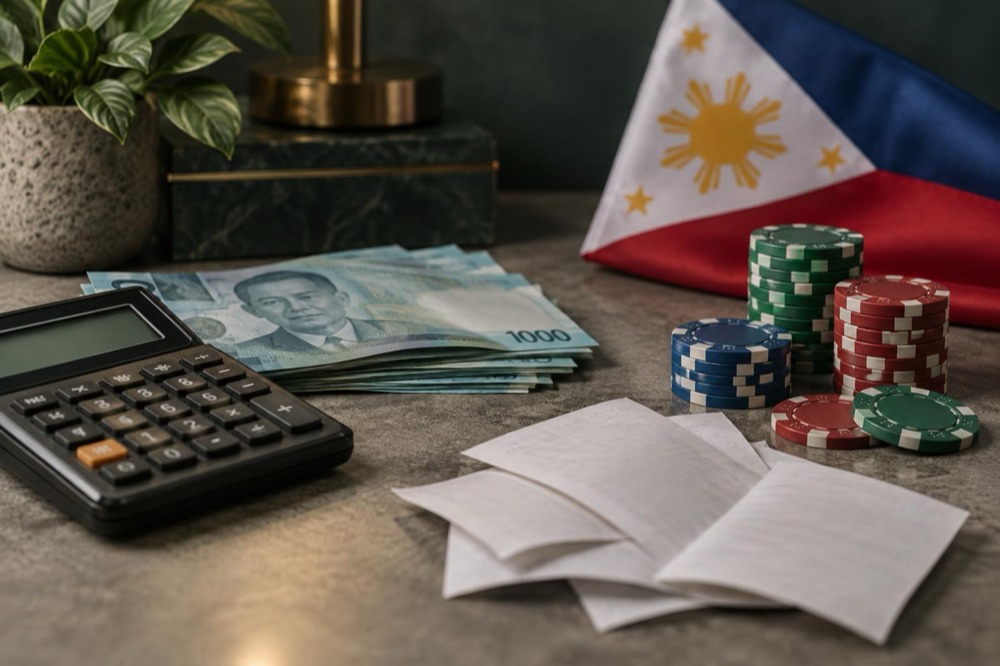
Prizes and other winnings from sources within the Philippines carry a final tax of 20 percent, with two exceptions: prizes of ₱10,000 or less, and Philippine Charity Sweepstakes and Lotto winnings, which are exempt3. Separately, PAGCOR's own reporting notes that 5 percent of winnings goes to the BIR as franchise tax21. The operator typically handles withholding on regulated games, but knowing the rates lets you check that what reached your account is what should have.
| Item | Rate | Exceptions |
|---|---|---|
| Prizes and winnings from Philippine sources | 20 percent final tax | Prizes of ₱10,000 or less; PCSO and Lotto winnings |
| Franchise tax on winnings | 5 percent to the BIR | None stated |
Self-exclusion and help in the Philippines
A license check is also the moment to notice what help exists. PAGCOR's Self Exclusion/Banning program is for patrons who feel that they are developing a problem with gambling23. PAGCOR provides patrons, or relatives who feel someone is developing a problem with gaming, the option of barring them from the gaming venue or site, and the self-exclusion order is enforced in all PAGCOR operated and regulated gaming facilities, regardless of where the application was made24.
The easiest route is the PAGCOR Online Self-Exclusion Application (OSEA) Portal at osea.pagcor.ph, which restricts your access to all casinos and gaming sites nationwide25. Major venues point to the same system: Newport World Resorts tells gaming members they can exclude themselves from playing in any casino in the Philippines by completing the form and submitting the required documents, with relatives also able to file subject to the Code of Practice's conditions26, and LaVie Resort & Casino Manila directs patrons to the PAGCOR Self-Exclusion Portal27.
For information and assistance, call (02) 8248-9568 or email ResponsibleGaming@pagcor.ph23. Outside the Philippines, the same habit applies anywhere: visit the venue you want to self-exclude from and speak to the shop manager or a member of staff, and for online sites, use the regulator's national exclusion scheme where one exists28.
Common Questions
How can I verify a PAGCOR license number?
Use the PAGCOR Guarantee website, an online verification facility where you can check whether an online gaming provider is licensed. It features a regularly updated list of licensed internet gaming platforms under PAGCOR's oversight, and PAGCOR urges the public to check it before playing.
What is the PAGCOR responsible gaming helpline number?
Call (02) 8248-9568, or email ResponsibleGaming@pagcor.ph. To report suspected illegal offshore gaming activities and websites, PAGCOR also runs a POGO Hotline at 09278098610.
Is a Curaçao license still trustworthy after the 2026 leaks?
The September 2026 Casino Secrets investigation found the Curaçao Gaming Authority approved licenses despite unresolved ownership questions, and a hacker entered its licensing portal with a fictitious company. A Curaçao license still means the site passed some checks, but verify it yourself and treat it as a weaker signal than before.
Which regulator licensed coinpoker.com?
CoinPoker is licensed by the Government of the Autonomous Island of Anjouan, through the Anjouan Gaming Authority. A validation page generated on September 26, 2026 shows status VALID for Precise Interactive Inc under License No. ALSI-202412004-FI1.
Can PAGCOR help me get money back from an overseas gambling site?
PAGCOR regulates Philippine-licensed operators and keeps a list of licensees, but an offshore site licensed elsewhere falls under its own regulator. PAGCOR's role is limited to warning the public and taking reports of suspected illegal offshore gaming through its POGO Hotline.
How do I self-exclude from all PAGCOR-regulated venues?
Apply through the PAGCOR Online Self-Exclusion Application (OSEA) Portal at osea.pagcor.ph, which restricts your access to all casinos and gaming sites nationwide. The order is enforced in all PAGCOR operated and regulated gaming facilities, regardless of where you applied.
What tax is taken from gambling winnings in the Philippines?
Prizes and winnings from sources within the Philippines carry a 20 percent final tax, except prizes of ₱10,000 or less and Philippine Charity Sweepstakes and Lotto winnings. Separately, 5 percent of winnings goes to the BIR as franchise tax.
Sources28 sources
- Giấy phép hoạt động, gamebaidoithuong1.com, October 23, 2025
- PAGCOR Guarantee subsite launched to fight illegal online games, PAGCOR, June 18, 2025
- GR No. 177387, November 9, 2016, LawPhil, November 9, 2016
- Casino, BingoPlus, September 26, 2026
- CoinPoker Crypto Casino offshore, CoinPoker, July 6, 2026
- What to look at before you gamble, UK Gambling Commission, August 23, 2021
- Gambling Control Act 2022, Singapore Statutes Online, 2026
- Why Casino Plus, a legit online casino, is approved by PAGCOR, Casino Plus, September 26, 2026
- Okada Online Casino takes gaming anytime, anywhere, Okada Manila, April 10, 2025
- Philippine online casinos, Casino Plus, September 26, 2026
- Terms and conditions, Bitcasino.io, March 10, 2025
- Terms and conditions, me88, September 26, 2026
- Terms and conditions, Casino Khajana, July 15, 2024
- Casino Khajana, Casino Khajana, September 26, 2026
- Glory Casino in Bangladesh: your ultimate gaming destination, NagaWorld, November 29, 2017
- Khelo24 Betin, Khelo24, November 9, 2025
- PAGCOR warns vs fake online gaming sites, PAGCOR, September 12, 2023
- PAGCOR to launch app to protect online gaming players, PAGCOR, August 25, 2026
- Las Atlantis Casino, Las Atlantis, September 26, 2026
- Memorandum Circular No. 20, s. 1986, LawPhil, October 8, 1986
- PAGCOR Annual Report 2024, PAGCOR, 2024
- Casino regulatory policy, Japan Casino Regulatory Commission, 2026
- Responsible gaming, PAGCOR, September 25, 2026
- Exclusion, PAGCOR, September 25, 2026
- Online Self-Exclusion Application (OSEA) Portal, PAGCOR, September 26, 2026
- Responsible gaming program, Newport World Resorts, 2026
- Responsible gaming, LaVie Resort & Casino Manila, September 25, 2026
- Self-exclusion, GamCare, July 10, 2026