
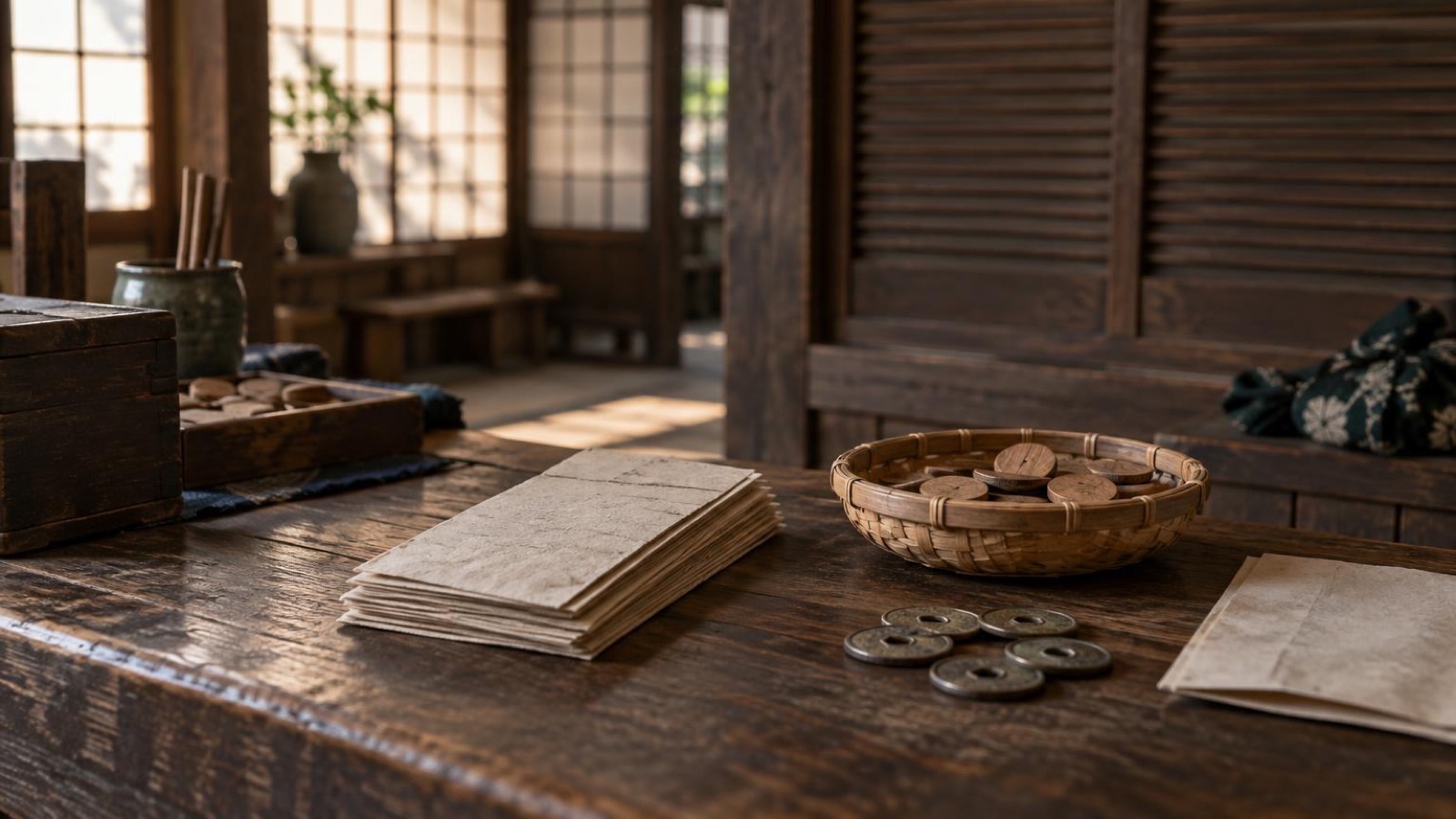
What tomikuji were and why temple lotteries matter
Tomikuji were lottery tickets sold with the backing of temples and shrines. The temple connection was not decoration. It gave the ticket seller an air of respectability and a physical place to sell from, which mattered in a country where straight money wagering was already viewed with suspicion. The lottery was one of the few forms of gambling that ordinary people could take part in without sitting at a table.
That is why the ban matters so much in Japan's gambling history. It was not a ban on a fringe activity. It cut off a mass-market game that had woven itself into religious and commercial life. When the Tokugawa government moved against tomikuji in 1842, it was making a statement about who controlled luck, money and public order.
The same instinct shows up in other Japanese gambling traditions. Tabu, thought to have been born in Kyushu, was a full-fledged form of gambling rather than casual play2. The line between a festival game and a vice has always been drawn by authorities, not by players.
If you want the wider regional picture, historic gambling bans in Asia covers how imperial edicts, shogunate laws and colonial prohibitions reshaped gambling across the continent, and why many Asian countries restrict gambling explains the attitudes behind those laws.
The betting ban of 1908 and the subsidy era that followed
The 1842 ban did not end lottery culture. It pushed it underground and into new forms. By the early twentieth century, betting on horse racing had become popular enough to cause a public and media outcry, with open involvement by bakuchiuchi, the professional gamblers who ran illegal betting operations. The government responded with legislation in 1908 that once again prohibited the sale of betting tickets2.
That law is the hinge on which modern Japanese gambling policy turns. Wagering for money became strictly and unambiguously illegal under the 1908 legislation, and horse racing carried the status of being officially illegal since that year2. Even today, one of the main obstacles to introducing casinos in Japan is how to work around that 1908 law2.
What followed was not a clean prohibition but a subsidy era. The state kept the sports and the venues alive while cutting off the betting that funded them, then gradually rebuilt legal channels that fed money back into public purposes. That is the pattern you still see: the activity is tolerated, the wagering is controlled, and the proceeds are directed somewhere the government can defend.
Tacit approval and relegalization: from tubai mokyo to the Racecourse Law
The rebuilding happened in stages. The Keiba Kitei, Cabinet Order No. 1 of Meiji 41, was designed to ban the sale of betting tickets that had previously been tacitly permitted under a cabinet resolution, while at the same time encouraging the holding of horse race meetings8. In other words, the races could go on, but the betting had to be brought under official control.
At first, only officially recognized racing by government-approved race clubs and festival racing were permitted8. That is the tubai mokyo era in practice: betting existed in a gray zone, tolerated but not fully legal, until the framework caught up.
The modern legal basis arrived in the twentieth century. Lotteries in Japan are issued under the Act on Public Lottery Tickets, enacted in 19489. Sports promotion lotteries such as MEGA BIG, BIG and toto are issued under the Act on Sports Promotion Voting, enacted in 19989. Club toto membership terms rest on the Act on Sports Promotion Voting, the Japan Sport Council Act and related government and ministerial ordinances10.
The result is a patchwork rather than a single gambling law. Each product has its own statute, its own operator and its own age limit. That is why the practical answer to "what can I play in Japan" depends entirely on which product you are asking about.
Legal forms of gambling in Japan today
Japanese law starts from the position that gambling is basically illegal, but not all gambling is illegal, and legal forms do exist, partly to respect everyday entertainment and partly to return proceeds to social welfare11. The legal forms are listed under separate laws:
- The Financial Instruments and Exchange Act for derivatives11
- The Sports Promotion Voting Act for sports lotteries11
- The Act against Unjustifiable Premiums and Misleading Representations for prize draws11
- The Act on New Year's Gift Postal Cards11
- The IR Development Act for integrated resorts11
Here is how the main options compare.
| Type of gambling | Legal? | Where | Minimum age |
|---|---|---|---|
| Takarakuji (public lottery) | Yes | Banks, lottery stalls, tobacco and liquor shops, supermarkets, station kiosks, some bank ATMs | 20 for online purchase12 |
| Sports lottery (toto, BIG, WINNER, DUNK) | Yes | Official sales channels and online | 195 |
| Horse racing (JRA and local) | Yes | Racecourses and off-track betting | 204 |
| Boat, bicycle and motorcycle racing | Yes | Venues and off-track betting | 20 |
| Pachinko | Prize game, gray zone | Pachinko parlors nationwide | Varies by parlor |
| Casinos (integrated resorts) | Planned, not open | None open yet | 20, with entry restrictions15 |
| Online casinos | No | None licensed in Japan | Not applicable7 |
Takarakuji, the public lottery
Takarakuji tickets are issued by local governments, and they are sold at banks such as Mizuho Bank, at lottery stalls in shopping and station areas, at tobacco shops, liquor shops, supermarkets and station kiosks, and at post offices in areas without stalls3. Some bank ATMs sell them too3.
Online purchase is available, but it is limited to individual residents of Japan aged 20 or over, and you cannot buy online from outside the country12. If you are a visitor, buy in person at a stall or a bank branch.
The tax treatment is unusually generous. Takarakuji prize money is tax exempt, so there is no income tax, no resident tax and no tax return required3.
Sports lotteries
Sports lotteries such as MEGA BIG, BIG and toto are issued under the 1998 Act on Sports Promotion Voting9. Purchase or receipt by anyone under 19 is prohibited by law, and prizes cannot be paid to them13. The same 19-and-over rule applies to toto tickets generally17.
The money goes somewhere specific. Revenue from these lotteries funds the development of regional sports facilities, the holding of sports classes and competitions, and the discovery and development of future top athletes5. Sales can be suspended while match cards are finalized and preparation periods are secured, so check the official site before you plan a purchase18.
Horse racing and the public racing sports
Horse racing betting tickets require you to be 20 or older, and anyone under 20 may not buy or cash them4. The Horse Racing Act itself states that pari-mutuel betting tickets must not be purchased by or transferred to individuals under the age of 2014. The Japan Racing Association has a formal regulation aimed at preventing the purchase of win betting tickets by persons under 2019. Local racing follows the same rule: betting on horse races is prohibited by law for those under 2020.
Boat racing, bicycle racing and motorcycle racing operate on the same model, with legal betting at the venues and at off-track betting windows. If you are a visitor, bring photo identification. Age checks at the window are routine, and cashing a ticket as an under-20 is treated the same as buying one.
Online casinos are prohibited for players in Japan
Playing on offshore casino websites is illegal in Japan, and players have been prosecuted. Gambling at an online casino by connecting from within Japan is a crime, even if the casino is legally operated overseas6. The reasoning is that using a smartphone inside Japan makes it a domestic act that harms Japanese social and legal interests, and a foreign license does not justify it; being mistaken about the law does not negate intent21.
Advertising and promoting online casinos in Japan is also illegal22. Police have been instructed to enforce thoroughly against operators, including payment agents and affiliates23. There are no licensed and regulated online casinos inside Japan, and none of the offshore ones are specifically legal for the operator to deliver or for players to bet at7.
The practical risk is not theoretical. People who used online casinos as customers have been arrested for the crime of gambling6. Applying for ticket purchases or receiving payouts from illegal internet betting operators from within Japan is itself an illegal act, and users may be investigated by police and severely punished24.
If you are a visitor or a foreign resident, the rule applies to you the same way. Connecting from a hotel room, an apartment or a phone on a Japanese network is the act that matters, not your nationality or your home country's law.
Penalties for players and enforcement in practice
The penalty framework for gambling offenses sits in Japan's criminal code, and the practical consequences for players are real. For lottery-related offenses outside the permitted categories, the Penal Code provides a fine of up to JPY 200,000 or a petty fine25. That figure is a useful reference point for how Japanese law treats unauthorized lottery activity, though the specific charge depends on what you did.
Enforcement against online casinos has been the focus in recent years. The government has produced posters to publicize that connecting to online casinos from within Japan and gambling there is a crime23. The basic plan on gambling addiction measures, published in March 2025, sets out the policy direction, and the relevant government office coordinates it15.
For comparison, other countries in the region treat gambling offenses differently. China's Public Security Administration Punishments Law sets detention of up to five days or a fine of up to CNY 1,000 for providing conditions for gambling for profit or participating in gambling with relatively large stakes, while serious cases carry detention of 10 to 15 days and fines of CNY 1,000 to 5,00026. South Korea's lottery framework runs under its own enforcement decree27. Japan's approach is its own, shaped by the 1842 and 1908 bans and the patchwork of legal products built afterward.
What this means if you are in Japan now
If you are a visitor or a new resident, the practical summary is short. Buy takarakuji tickets in person at a stall, bank or convenience-adjacent outlet, and remember that online purchase is limited to Japan residents aged 20 or over12. If you want to bet on horse racing, you need to be 20 and you need photo ID4. If you want to play the sports lotteries, you need to be 1913.
Do not open an offshore casino site from a Japanese connection. That is the one area where the law is actively enforced against players, and the arrests are of customers, not just operators6.
If you are interested in how Japan's gambling culture developed beyond the lottery, when and where pachinko was invented traces the pinball-adjacent game that became the country's most visible gambling pastime, and what punishments gamblers faced in feudal Japan shows how far back the enforcement instinct goes. For the current country-level picture, can I gamble in Japan covers the venues, ages and rules in one place.
Common Questions
What gambling is legal in Japan?
Public lotteries (takarakuji), sports lotteries like toto and BIG, horse racing, boat racing, bicycle racing and motorcycle racing are all legal and run under specific laws. Pachinko operates in a legal gray zone as a prize game. Casino gambling is limited to the planned integrated resorts, none of which are open yet.
How old do you have to be to buy a betting ticket in Japan?
It depends on the product. Horse racing tickets require you to be 20 or older. Sports lotteries such as toto, BIG, WINNER and DUNK are restricted to 19 and over. Online takarakuji purchases are limited to residents of Japan aged 20 or over.
Can players be arrested for gambling on banned sites?
Yes. Japanese police have arrested customers who used online casinos, treating the act as gambling. Connecting to an offshore casino from inside Japan is a crime regardless of where the operator is licensed, and users can be investigated and punished.
Are there any casinos in Japan?
No licensed casino is open yet. Japan has passed legislation to allow integrated resorts with casinos, but no resort has opened. There are no licensed and regulated online casinos operating inside Japan either.
How many casino resorts is Japan planning to allow?
Japan's framework allows for a small number of integrated resort licenses, with the first expected in Osaka. The exact number and opening dates have not been finalized, so treat any specific timeline you see as provisional.
What taxes and entrance fees apply to IR casinos?
Under the IR framework, Japanese customers pay an entry levy of JPY 6,000 per entry. Entry is banned for anyone under 20, organized crime members, those with unpaid admission fees and those who exceed the entry limit. Winnings from takarakuji, by contrast, are tax exempt.
Is online gambling legal in Japan?
No. Gambling at online casinos from within Japan is a crime, even if the casino is legally operated overseas. Advertising and promoting online casinos in Japan is also illegal, and police have been instructed to enforce against operators, payment agents and affiliates.
Sources27 sources
- Takarakuji Official Site, inbound information, Takarakuji Official Site, 2026
- Gambling in Japan, Oxford Brookes University, 2007
- 宝くじ, Wikipedia, 2026
- JRA betting guide, Japan Racing Association, 2026
- toto integrity, toto official site, 2026
- Consumer caution on online casinos, Consumer Affairs Agency, 2026
- Online casinos for players from Japan, Wizard of Odds, 2026
- 競馬規程, Wikipedia, 2026
- Gambling in Japan and its regulation, NLI Research Institute, 2021
- Club toto membership terms, toto official site, 2023
- 賭博及び富くじに関する罪, Wikipedia, 2026
- Takarakuji FAQ: online purchase, Takarakuji Official Site, 2026
- Sports promotion lottery 2026, Japan Sport Council, 2026
- Horse racing law, Japan Racing Association, 2026
- Casino regulatory framework, Japan Casino Regulatory Commission, 2026
- Takarakuji FAQ: purchase from outside Japan, Takarakuji Official Site, 2026
- toto purchase rules, Japan Sport Council, 2026
- toto sales suspension notice, toto official site, 2026
- JRA gambling disorder countermeasure regulation, Japan Racing Association, 2026
- Tokyo City Keiba buying guide, Tokyo City Keiba, 2026
- National Police Agency lecture materials, National Police Agency, 2026
- Gambling addiction measures, Cabinet Secretariat, 2025
- Basic plan on gambling addiction measures, Cabinet Secretariat, 2025
- Illegal betting warning, Japan Racing Association, 2026
- Penal Code provisions on gambling and lotteries, Ministry of Internal Affairs and Communications, 2010
- Public Security Administration Punishments Law, National People's Congress, 2025
- Korean lottery framework, Korea Lottery Commission, 2026















