
What a backdoor draw is
A backdoor draw is a hand that is not yet a draw but could become one. You need two more cards, not one, to complete it. The name comes from the idea that you get there through the back door, by a route you did not plan when the hand started. One glossary puts it simply as "completing a draw that wasn't intended"1.
The clearest example is a backdoor flush draw. You hold two cards of the same suit, say two hearts, and the flop brings one more heart. You do not have a flush draw yet, because a flush needs five cards of the suit and you only have three. But if the turn and the river are both hearts, you make the flush. That is a backdoor flush draw.
A backdoor straight draw works the same way with ranks instead of suits. You hold cards that could connect if two more cards fall in the right places. A backdoor gutshot is the inside version: you need two cards to fill a gap in the middle of a sequence.
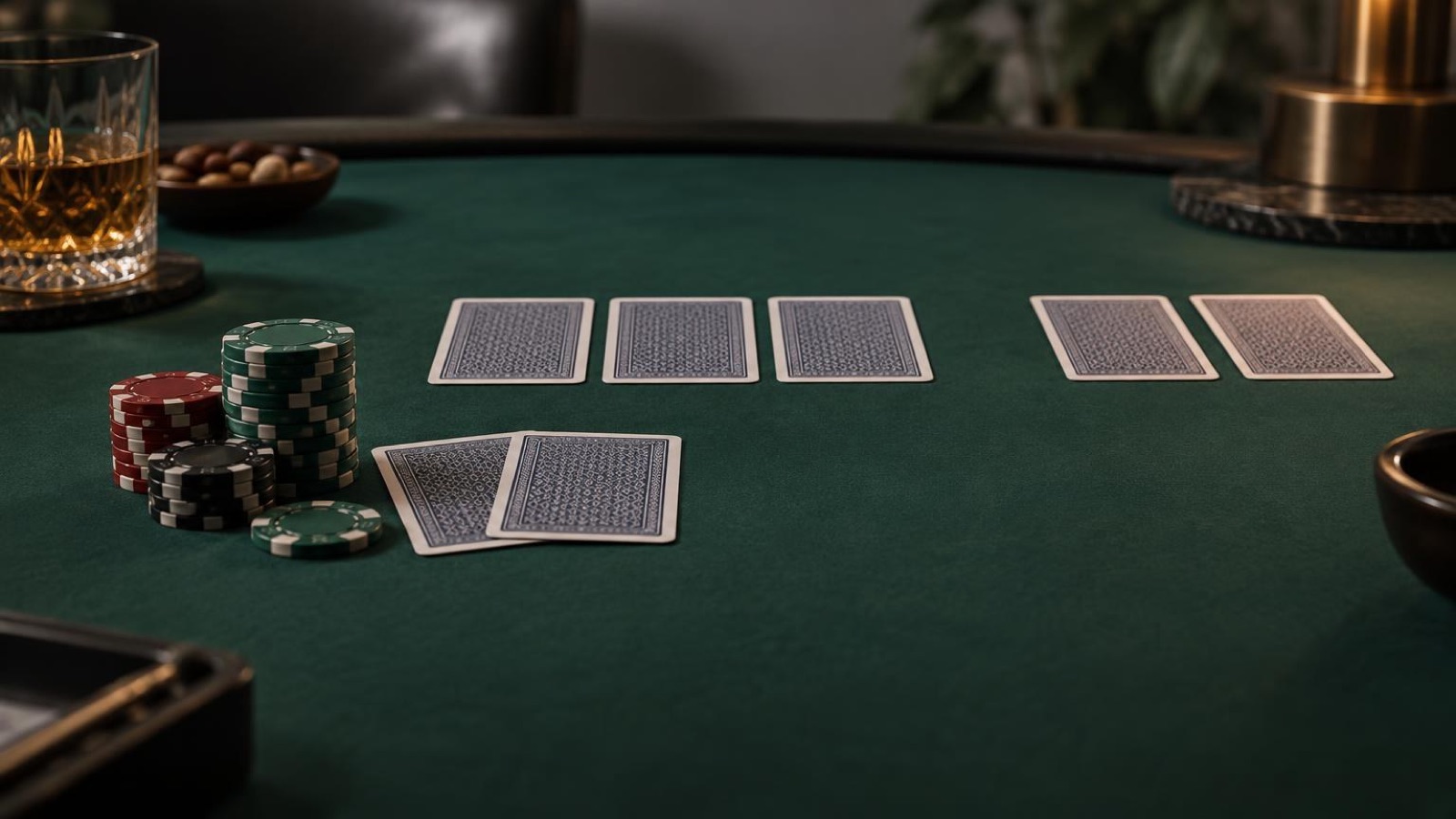
Backdoor draws show up in every community-card game, and they are part of what makes Texas Hold'em and Omaha interesting to play. In Hold'em the dealer puts out three community cards on the flop, then the turn and river5. Those two later cards are exactly what a backdoor draw is waiting for. The same idea applies in Short Deck, which also runs four betting rounds: preflop, flop, turn and river6.
Backdoor draws vs. regular draws: how they differ
The difference is how many cards you still need.
A regular draw needs one card. If you have four cards to a flush after the flop, any one more card of that suit completes it. You have one chance left, on the turn or the river, and you know roughly where you stand.
A backdoor draw needs two cards, and both must come. That is why it is so much less likely to get there. On the flop you are not really drawing yet. You are holding a hand that could turn into a draw on the turn, and only then would you be drawing for real.
This changes how you think about the hand. With a regular draw, you are deciding whether to pay to see one more card. With a backdoor draw, you are deciding whether to pay to see the turn, knowing that most of the time you will fold there. The turn is the checkpoint. If it improves you, you now have a regular draw and a fresh decision. If it does not, you usually let the hand go.
A useful way to picture it: a regular draw is a plan. A backdoor draw is an option. You are buying the right to continue, not committing to it.
Why backdoor draws matter for equity and implied odds
On their own, backdoor draws are worth little. A backdoor flush draw adds roughly four percent equity on the flop, and a backdoor straight draw a little less3. That is not enough to justify calling a big bet by itself.
Where they matter is at the margins. Many flop decisions are close, and a few extra percent of equity can tip a fold into a call. If you already have a pair, an overcard or a backdoor straight draw to go with your backdoor flush draw, the combined equity starts to look reasonable.
The other reason they matter is implied odds. Implied odds are the future bets you expect to win if you make your hand, and you can include them in your calculations2. A backdoor draw that completes on the turn gives you a strong hand while your opponent may still be betting into you. That is the scenario where a backdoor draw pays off: you get there cheaply on the flop, then win a bigger pot later.
Backdoor draws also help you stay in hands without becoming predictable. If you only ever continue with made hands and real draws, opponents can read you. Having some backdoor equity in your continuing range keeps your play harder to exploit.
Playing backdoor draws on the flop and turn
The flop is where you decide whether the backdoor draw is worth continuing for. The turn is where you find out if it turned into something real.
On the flop, treat the backdoor draw as a tiebreaker, not a reason on its own. If you are closing the action for a small bet and you have a pair plus a backdoor flush draw, calling is reasonable. If you are facing a large bet with nothing but a backdoor draw, folding is usually right.
Position matters here. Playing out of position makes every draw harder to play, because you act first on later streets and cannot control the size of the pot. When you have a strong hand on a coordinated board, the standard approach is to bet the flop to charge opponents for chasing their draws, then check the turn for pot control if the turn completes obvious draws4. As the player with the backdoor draw, you are on the other side of that logic: you want to see the turn cheaply.
On the turn, the picture changes completely. If the turn card completes a real flush draw or straight draw, the hand is now a regular draw and plays like one. If the turn card misses, the backdoor equity is gone, and further betting is usually a fold.
A simple way to run it:
- On the flop, count your backdoor outs alongside your made-hand strength.
- Continue only if the price is small or you have other equity to go with it.
- On the turn, check whether you picked up a real draw.
- If you did, play the turn and river as a normal draw.
- If you did not, fold to pressure.
One more factor is how many players are in the hand. Aggression is far more valuable and effective against a single opponent, because betting and raising frequently force folds and let you win pots with medium-strength hands7. In multiway pots, aggression must be more selective, and bluffing loses effectiveness7. Backdoor draws fit the heads-up picture better: fewer opponents means your made hands hold up more often and your semi-bluffs get more respect.
Common examples: backdoor flushes, straights and gutshots
Backdoor flush draw. You hold two hearts. The flop has one heart. You need the turn and river both to be hearts. This is the most common backdoor draw and the easiest to spot, because you only need to track one suit. A third suited card on the board is what makes flushes possible at all, and it is often called an action card for that reason8.
Backdoor straight draw. You hold cards that could connect over two streets. Say you hold 8-9 and the flop is 2-5-J. A 10 on the turn gives you an open-ended draw, and a 7 or a Q on the river completes the straight. You needed two cards, so it is backdoor.
Backdoor gutshot. This is the inside version. A gutshot is a straight draw made from the inside, for example holding 4-5 on a 7-8-Q flop and needing a 62. A backdoor gutshot needs two cards to fill that gap. It is the weakest backdoor straight draw, because only specific ranks complete it.
Both at once. The strongest backdoor hands have a flush draw and a straight draw together. If you hold two hearts that also connect, a flop with one heart can give you two ways to improve on the turn. That combination is worth noticeably more than either draw alone.
It helps to know the hand you are aiming for. The highest hand in most poker variants is a royal flush, A-K-Q-J-10 in the same suit3. A straight flush is any five-card straight in one suit, such as 10-9-8-7-6 all of hearts9. You will almost never complete one from a backdoor draw, but knowing the rankings keeps your thinking straight when the turn and river do come.
Backdoor draws also appear in the house-banked poker games, though the strategy is different there because you play against the dealer rather than other players. In Ultimate Texas Hold'em, for example, the 2x Play bet odds are more favorable on hands that contain two pair or better, or a flush draw that is one card short of a flush10. That is the same idea in a fixed format: a hand with backdoor potential is worth more than a hand without it.
Common Questions
What is a backdoor draw in poker?
A backdoor draw is a hand that is not yet a draw but could become one. You need two more cards, not one, to complete it. A backdoor flush draw means you hold two cards of one suit and need both the turn and river to be that suit.
What is the difference between a backdoor draw and a regular draw?
A regular draw needs one card to complete, so it has one chance left. A backdoor draw needs two specific cards, so it has two chances that must both hit. That makes it much less likely to get there, but it can still justify continuing when the price is right.
Is a backdoor flush draw the same as a backdoor straight draw?
No. A backdoor flush draw needs two more cards of your suit. A backdoor straight draw needs two cards that fill in a sequence. They are different outs, and a hand can hold both at once, which makes it stronger than either alone.
How much equity does a backdoor draw add?
A backdoor flush draw is worth roughly four percent equity on the flop, and a backdoor straight draw a little less. That is small on its own, but it can tip a close decision toward calling when you also have other ways to win.
Should you call a bet with only a backdoor draw?
Usually not on its own. A backdoor draw is a reason to continue when you already have something else, like a pair or an overcard, or when the bet is small and you are closing the action. Treat it as a bonus, not a plan.
What is a backdoor gutshot?
A backdoor gutshot is an inside straight draw that needs two cards to fill. It is the weakest form of backdoor straight draw.
Sources10 sources
- Poker Slang Terms, Natural8
- Poker Terms and Definitions, Natural8
- How to Play Poker, PlaySmart
- How to Play Out of Position in Poker, Natural8
- Texas Hold'em Community, PlaySmart
- How to Play Short Deck Poker, Natural8
- Aggression, WPT Global
- Action Card, WPT Global
- Short Deck Rankings, partypoker
- Ultimate Texas Hold'em, PlaySmart















