
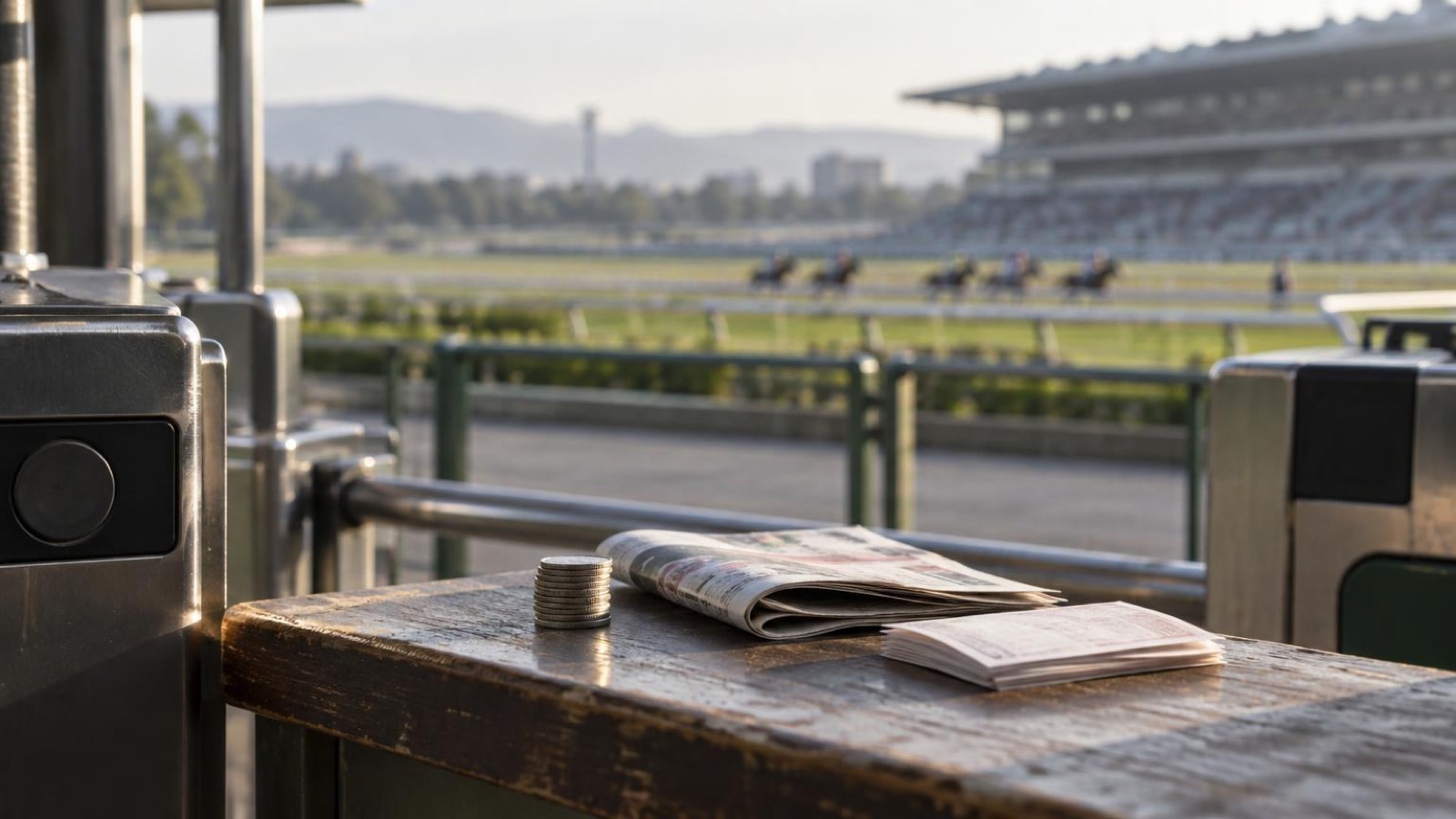
Temple money: the entry fee gamblers pay at the door
The phrase describes something simple. At the entrance to a betting venue you hand over a small sum before you are allowed in. That sum is the temple money. It is not a stake, it is not a bet, and it does not go on a horse or a number. It buys you the right to be inside the building, and once you are through the gate you spend separately on tickets.
The name comes from the older habit of leaving a coin at a temple or shrine. You gave something at the threshold, and what happened afterwards was between you and fortune. Japanese betting venues kept the shape of that transaction: a modest payment at the door, then the real business of the day inside. The amount has always been small enough that it reads as a token rather than a charge, which is part of why the old name stuck.
You can still see the two halves of the idea side by side at a racecourse. The gate fee is a few hundred yen at most, and the betting tickets you buy once inside start at 100 yen. The entrance is the cheapest thing about the day.
The legal basis for the fee: special laws and the Horse Racing Act
Japan's public sports exist because the state wanted the money they raise. Horse racing, keirin, boat racing and auto racing are run under special laws that authorize betting which would otherwise fall under the general gambling offense. The tax and revenue from those sports is directed to public purposes, and the admission fee is part of that structure rather than an afterthought.
The legal logic is worth one sentence, because it explains why the fee exists at all. Betting on horse racing would normally be the crime of gambling, but the Horse Racing Act authorizes it as a special law, and betting by any method the special law does not prescribe falls back into the crime of gambling8. The venue fee sits inside the authorized side of that line. It is a charge the operator is permitted to make, on a day the operator is permitted to run.
Other countries in the region arrived at the same arrangement from different directions. Korea's racing authority is empowered to collect admission fees from people who visit racecourses and off-course betting centers9. Singapore's Betting Act provides that where an admission fee is charged by an exempt racing club, that fee is subject to entertainment duty10. The pattern is consistent: the door charge is treated as a distinct, taxable, regulated thing, not as part of the wager.
The five legal forms of betting in Japan
Japan recognizes five forms of betting, and each has its own venues, its own minimum age and its own way of charging at the door.
Horse racing. Run by the Japan Racing Association at ten racecourses nationwide, with local racing run by regional bodies. Admission at the five main tracks is 200 yen, and at smaller tracks it drops to 100 yen1. Betting tickets start at 100 yen. Racing is held on weekends and holidays, with the biggest meetings drawing large crowds.
Keirin. Track cycling, run at velodromes across the country. Riders race behind a pacer before sprinting for the line, and the betting is on finishing order.
Boat racing. Held at 24 venues, mostly on water. Six boats per race, and the form is built around lane draw and starting technique.
Auto racing. Run at a smaller number of tracks, with motorcycles rather than cars despite the name. The regulations set out a special admission charge, the 特別入場料, expressed as a figure in yen including consumption tax11.
Sports lotteries. Toto and the sports kuji, sold through convenience stores and online, with a bet priced at 100 yen12. These have no venue and no door fee, which is why they sit apart from the other four.
| Form | Where | Typical door charge | Minimum age |
|---|---|---|---|
| Horse racing | 10 JRA racecourses plus local tracks | 200 yen at main tracks, 100 yen at smaller ones | 20 |
| Keirin | Velodromes nationwide | Small admission charge | 20 |
| Boat racing | 24 venues | Small admission charge | 20 |
| Auto racing | Dedicated tracks | Special admission charge set by regulation | 20 |
| Toto and sports kuji | Convenience stores and online | None | 19 |
What a racecourse day costs and how it works
Take a Saturday at Tokyo Racecourse as the worked example. You pay 200 yen at the gate on a live race day13. Inside, a betting ticket costs from 100 yen, and you can bet win, place, or any of the exotic combinations that link several horses in one ticket. The card usually runs through the afternoon, with races roughly half an hour apart.
The smaller tracks are cheaper and quieter. Oi Racecourse charges 100 yen admission, and Kochi Racecourse charges 100 yen as well2. At that price the door fee is barely a consideration, and the day is built around the racing rather than the entry.
A few practical notes for a first visit:
- Bring cash, since the windows and machines take it and the amounts are small.
- Arrive before the first race if you want to watch the horses in the paddock, which is where most newcomers spend their first half hour.
- Dress is casual, and there is no formal entry standard at any of the public tracks.
- Food and drink are sold inside, and outside food is generally allowed.
The minimum age is 20 for all of the public sports, and buying a horse racing ticket under 20 is prohibited by law6. Identification can be checked, so carry something with a date of birth on it.
Casino resorts: three licenses, none open yet
Japan has created a licensing framework for integrated resorts and has issued three licenses. None of the resorts has opened, so there is no casino floor in the country today and no one is paying the entry levy4.
When they do open, the fee structure is already fixed. Japanese patrons must pay admission fees of 3,000 yen each to the national government and the local government, 6,000 yen in total, and the payment is valid for 24 hours4. The law allows both levels of government to collect an admission fee from visitors to casino facilities under separate legislation14. Foreign visitors are not subject to this levy, so the charge falls on Japanese patrons only.
That split is unusual and worth understanding. The money does not go to the operator. It goes to two tiers of government, which is why the fee is described as a levy rather than a cover charge. The 24 hour validity means a single payment covers a full day of coming and going rather than one entry.
For comparison, other Asian jurisdictions charge foreign visitors at the door instead. Singapore's casino entry levy for foreign patrons is an annual S$3,000 under the current schedule15. Thailand's draft casino rules set a 1,000 baht entry fee for students and accompanying persons aged 20 and over, with a 500 baht fee for Thai nationals under 2017. Japan's design points the other way, charging its own citizens and letting visitors in without the levy.
Online casinos are prohibited for players in Japan
There are no licensed and regulated online casinos inside Japan18. Connecting from Japan to gamble on an online casino is a crime even when the operator is legally run overseas, and that applies to free versions and free point bonuses as well as real money play19. Advertising and promoting online casinos in Japan is also illegal20.

The practical risk is straightforward. Offshore operators accept players from Japan, and many of them say so openly18. Playing on one is still an offense on the player's side of the connection, and the offense is the gambling itself rather than the operator's licensing status. Repeat play can be treated more seriously than a single instance5.
If you are a visitor, the same rule applies to you while you are in the country. Being on a tourist visa does not change what happens at the point of connection.
Minimum ages: 20 for public sports, 18 for pachinko
The ages differ by product, and the differences matter if you are bringing a younger family member along.
The public sports, meaning horse racing, keirin, boat racing and auto racing, are 20 and over5. Buying a horse racing ticket under 20 is prohibited by law6. The sports lotteries are stricter in a different way: purchase or receipt by anyone under 19 is prohibited, and prizes cannot be paid to them7. Toto's own rules state that minors under 19 are not allowed to participate in the games or take prizes21.
Pachinko and pachislo are 18 and over5. These are the parlors you will see in every Japanese city, and they sit outside the public sports system entirely.
For context on how the region varies, the Philippines sets its casino and licensed gaming minimum at 21 and above22. Japan's 20 for sports and 18 for pachinko is roughly in the middle.
Common Questions
What does temple money mean in Japanese gambling?
It is the traditional name for the small fee paid at the entrance of a betting venue, separate from the money you stake. The idea is that you pay for the right to be there, the way worshippers once left a coin at a temple. In modern Japan it survives as racecourse admission and the casino entry levy.
How much is the entrance fee at a Japanese casino resort?
Japanese patrons pay 6,000 yen in total, split as 3,000 yen to the national government and 3,000 yen to the local government, and the payment covers 24 hours. Foreign visitors are not charged this levy. No casino resort has opened yet, so nobody is paying it today.
Who collects the 6,000 yen entry levy?
The national government and the local government each collect 3,000 yen, so the two halves are gathered separately rather than by the casino operator alone. The charge applies to Japanese patrons entering a casino facility, and the law allows both levels of government to levy an admission fee.
Is online casino gambling legal in Japan?
No. Connecting from Japan to gamble on an online casino is a crime even when the operator is legally run overseas, and the same applies to free versions and free point bonuses. Advertising and promoting online casinos in Japan is also illegal.
Can tourists gamble in Japan?
Visitors can bet at racecourses, velodromes and boat race tracks on the same terms as residents, and the minimum age of 20 applies to everyone. There are no casinos open yet, so the casino entry levy is not something a visitor can pay at present.
How old do you have to be to bet on horse racing in Japan?
You must be 20 or older. Buying a horse racing betting ticket under the age of 20 is prohibited by law. The same age of 20 applies across the public sports, which include horse racing, keirin, boat racing and auto racing.
Sources23 sources
- Going racing, Japan Racing Association
- Oi Racecourse, Japan Racing Association
- Kochi Racecourse, Japan Racing Association
- Specifics of the casino regulations, Japan Casino Regulatory Commission
- Gambling dependence pamphlet (PDF), Sagamihara City Gambling Addiction Support
- Reserved seat buying guide, Tokyo City Keiba
- Sports kuji 2026 (PDF), Japan Sport Council
- Research paper on gambling offences, National Tax College
- Korea Racing Authority Act, Korea Legislation Research Institute
- Betting Act, Singapore Statutes Online
- Auto racing competition implementation rules, Keirin Auto Race
- About toto, Japan Sport Council
- Going racing guide (PDF), Japan Racing Association
- Act on development of specified integrated resort areas, e-Gov
- Casino Control (Amendment) Bill 24/2024-bill-24-2024.pdf?sfvrsn=a1ba5608_1), Parliament of Singapore
- Casino Control (Amendment) Bill, Singapore Statutes Online
- Casino entry fee schedule, Royal Gazette Thailand
- Online casinos for players from Japan, Wizard of Odds
- Online casino guidance, National Police Agency
- Measures against gambling addiction, Cabinet Secretariat
- Sports Toto participation measures, Sports Toto Korea
- Regulatory exclusion, PAGCOR
- Responsible gaming, PAGCOR















