What Yasuda is and where it operates
YASUDA, also written Yasudaya, is a Japanese pachinko hall group. Its stores sit mainly in Saitama Prefecture, north of Tokyo, with branches in Yashio, Toda, Misato, Asaka, Higashi-Omiya and Tokorozawa1. Each store is a standalone pachinko and slot parlor rather than a casino resort, and each has its own address, machine mix and access notes.
That distinction matters if you are used to casino travel. There are no dealers, no tables, no baccarat or blackjack, and no cage in the casino sense. You are walking into a large, brightly lit arcade-style hall where the entire floor is pachinko and slot machines. If you want table games, you are looking at the wrong kind of venue, and you would need to look at casinos in Japan or a casino elsewhere in Asia.
The group runs several stores rather than one flagship, so the practical question is not "what is at Yasuda" but "which Yasuda." Machine counts differ a lot between branches, and so do the neighborhoods, the parking situation and the walk from the station.
Here is how the main Saitama stores compare on size and access1:
| Store | Pachinko machines | Slot machines | Access |
|---|---|---|---|
| Toda | 753 | 517 | 1-minute walk from the west exit of Toda Station on the Saikyo Line |
| Yashio | 559 | 526 | Address in Yashio, Saitama |
| Asaka | 537 | Not listed | 7-minute walk from the south exit of Asaka Station on the Tobu Tojo Line, near Asaka City Hall |
| Misato | 360 | 202 | 15-minute walk from Misato Station on the Musashino Line |
| Higashi-Omiya | Not listed | 184 | Address in Higashi-Omiya, Saitama |
| Tokorozawa | Not listed | Not listed | About 2 minutes by car from the Kan-Etsu Expressway Tokorozawa IC |
If you want the biggest floor, Toda is the one with the most machines listed. If you want the easiest train access, Toda again wins at a one-minute walk from the station. If you are driving, Tokorozawa is built around car access.
Who is allowed to enter
Pachinko in Japan is a business with an age rule, and YASUDA stores apply it. You need to be old enough to play, and stores can ask for identification to confirm your age. If you want to use DASH-pay, the store's member payment system, non-members can join on the day of their visit by presenting age-verification ID2. That is the clearest documented ID check at the counter: bring photo ID if you plan to sign up, and bring it anyway if you look young.
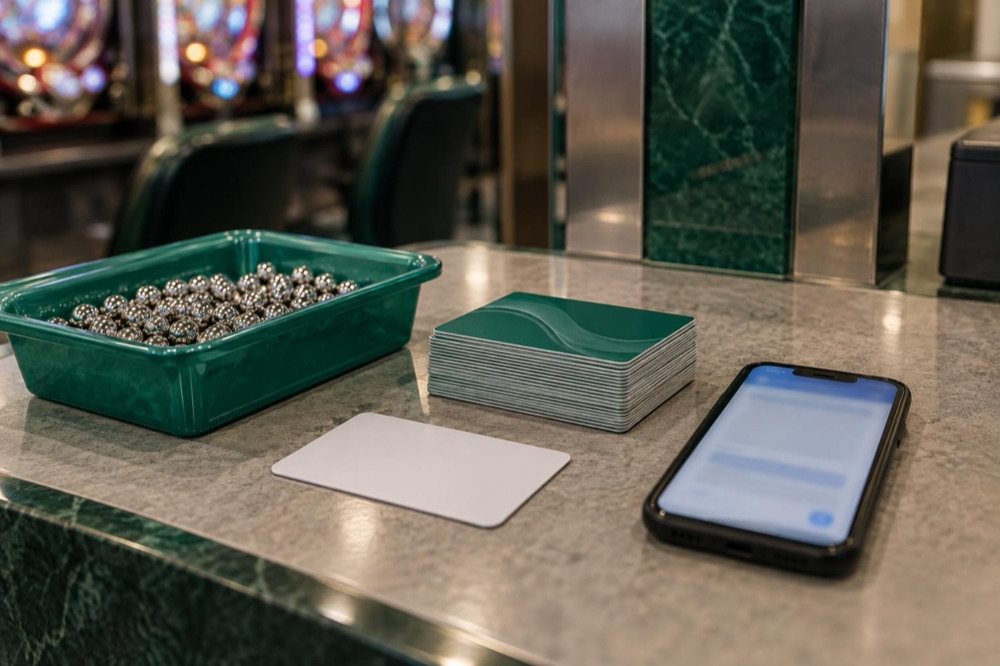
For foreign visitors, there is no separate tourist ban and no membership requirement to walk in and play. You do not need to be a Japanese citizen or resident. What you may run into is a language gap: staff at a suburban pachinko hall may not speak English, and the machines and signage are in Japanese. A translation app and a bit of patience go a long way.
The rules that apply to Japanese racecourses and casinos are a useful contrast, because they show how differently Japanese gambling venues treat entry. At JRA racecourses, entry can be refused to people without a ticket, to organized crime members, and to people whose dress or conduct causes a nuisance3. At Nagoya Racecourse, groups of 15 or more must consult the racecourse in advance to occupy seating or viewing areas4, and entry can be refused or visitors asked to leave for conduct that disrupts racing, safety or the viewing environment, or for failing to follow staff requests5. Nagoya also restricts entry based on an application from the family of the person concerned6. Japanese casino facilities, when they open, will bar anyone under 20, organized crime members, people who have not paid the entry fee, and people subject to entry number limits7. Autorace venues can bar entry for a long list of conduct and association reasons8.
None of that is a pachinko entry code, but it tells you the general shape of Japanese gambling venues: age matters, conduct matters, and staff can turn you away. At a pachinko hall the practical version is simple. Be old enough, behave normally, and have ID if asked.
Games and machines on offer
The floor is pachinko and slots, nothing else. Pachinko is a vertical pinball-style machine where you feed balls and try to land them in pockets; slots are the familiar reel machines. Both are played for balls or medals that you exchange for prizes, and the prize exchange system is what makes pachinko legally distinct from casino gambling in Japan.
Machine counts at YASUDA stores1:
- Toda: 753 pachinko machines and 517 slot machines
- Yashio: 559 pachinko machines and 526 slot machines
- Asaka: 537 pachinko machines
- Misato: 360 pachinko machines and 202 slot machines
- Higashi-Omiya: 184 slot machines
That spread tells you something practical. If you prefer slots, Yashio and Toda have the deepest slot floors. If you prefer pachinko, Toda and Yashio again lead, with Asaka close behind. Higashi-Omiya is the smallest listed store and slots only in the figures available.
What you will not find at any YASUDA store: table games, poker, sports betting counters, or a casino cage. If your trip is about roulette, blackjack or baccarat, this is not the venue. For that kind of floor in Asia you would be looking at places like Galaxy Macau or Marina Bay Sands Casino, which are a completely different category of venue with their own entry rules.
Payments and how to buy in
Pachinko is a cash-and-machines business. You buy balls or medals at the counter or from a machine on the floor, sit down, and play. There is no online account needed to walk in and play, and no credit check at the door.
Where YASUDA does touch digital payments is DASH-pay, the member card system used for things like same-day reserved seat tickets. Same-day reserved seat tickets can be bought with cash or with a DASH-pay member card's electronic money2. If you want that option, you join DASH-pay on the day of your visit with age-verification ID2.
For readers who also use Japan's official betting and lottery channels, the payment landscape there is broader and worth knowing because it is often confused with pachinko. Japan's toto online services accept a range of methods: the au PAY toto site takes au easy payment, au Jibun Bank account, au PAY card and JCB card9, while the Yahoo! toto site takes PayPay balance payment, PayPay Bank account, PayPay card and partner credit cards9. Regular Rakuraku Purchase accepts a long list of Japanese cards including JCB credit and debit, UC, Life, Saison, Jaccs, Sumitomo Mitsui, Mitsubishi UFJ NICOS, NICOS, Rakuten, Epos and AEON, plus VJA group cards10. Under the Rakuraku Purchase terms, you must keep the designated payment method valid during the registration period, and if it becomes invalid the operator may stop future purchase processing or cancel the registration11. The same validity requirement applies to Rakuraku Purchase (DUNK)12. Continuous purchase uses the registered payment method13. JRA's admission ticket and reserved seat net reservation service charges the credit card designated in the purchase request when the purchase contract completes14.
None of that is needed to play at YASUDA. It is there so you do not mix up a pachinko hall with an online betting account. At the store, bring cash.
Getting there: location and access
Access is the strongest practical detail YASUDA publishes, and it is worth planning around.
- Toda: one minute on foot from the west exit of Toda Station on the Saikyo Line1. This is the easiest store to reach without a car.
- Asaka: seven minutes on foot from the south exit of Asaka Station on the Tobu Tojo Line, near Asaka City Hall1.
- Misato: 15 minutes on foot from Misato Station on the Musashino Line1. That is a real walk, so plan for weather.
- Tokorozawa: about two minutes by car from the Kan-Etsu Expressway Tokorozawa IC, heading toward Tokorozawa, in front of the Kamegaya intersection on Route 463, the Urawa-Tokorozawa Bypass1. This one is designed for drivers.
- Yashio: address is 1135-1 Oaza Osone, Yashio, Saitama 340-08341.
- Toda: address is 750 Oaza Niizo, Toda, Saitama 335-00211.
If you are coming from central Tokyo, the Saikyo Line to Toda is the simplest trip, and the store is right at the station. If you are driving the Kan-Etsu Expressway, Tokorozawa is the natural stop.
For comparison, other Japanese gambling venues publish similar access notes. JRA racecourses are generally close to train stations, with shuttle buses where the station is far and parking lots at all racecourses, though limited15. J-PLACE Nagoya offers free parking from 8:3016. DASH Fukuyama-Ekimae sits at 30-1 Sinomaru-cho, Fukuyama, Hiroshima 720-0066, about two minutes on foot west along the elevated line from the south side of JR Sanyo Line Fukuyama Station17. DASH Yokawa publishes its own site at dash-satellite.com/yokawa18. The pattern is the same across Japan: venues publish the station, the walk time and the parking, and those notes are worth reading before a trip.
Opening hours and facilities
Normal operating days at YASUDA stores run from 10:00 to 23:00, with the game end time set slightly earlier so the floor can close down1:
- Yashio: 10:00 to 23:00, game end time 22:30
- Tokorozawa: 10:00 to 23:00, game end time 22:40
- Higashi-Omiya: 10:00 to 23:00, game end time 22:45
Those are normal operating days. Holiday hours and special days can differ, so check the store page for the branch you plan to visit before you travel. The game end time is the one that matters most: if you arrive at 22:20, you have very little time left on the machines.
On facilities, YASUDA's published store pages focus on machines, hours and access. Parking arrangements vary by store, and Tokorozawa is the branch whose access notes are built around driving1. If parking is the deciding factor for your trip, check the individual store page rather than assuming all branches are the same.
For a sense of how other Japanese venues handle hours and facilities, J-PLACE locations publish gate opening times of 9:0016, and J-PLACE Nagoya pays out 365 days a year16. JRA racecourses offer free non-reservable seating, grass seating areas and reserve seats, with reserve seats bought at the ticket counter of the entrance gate15. Japanese casino facilities, once open, will operate under a different regime entirely, including a ban on entry for anyone under 207. Pachinko sits in its own lane: long daily hours, no reservations, no dress code published, and a floor that is all machines.
If you are planning a Japan gambling trip and want to understand how pachinko fits next to the country's other options, start with Can I Gamble in Japan? and Casinos in Japan: Who Can Go In. If you are waiting on the big resort project, When Will the Osaka Casino Resort Open? covers that timeline.
Common Questions
Where is Yasuda located?
YASUDA (Yasudaya) runs pachinko and slot stores in Saitama Prefecture, including Yashio, Toda, Misato, Asaka, Higashi-Omiya and Tokorozawa. Each store has its own address and access notes, and most sit within a short walk or drive of a train station or expressway interchange.
What are Yasuda's opening hours?
Normal operating days run from 10:00 to 23:00. The game end time varies by store: 22:30 at Yashio, 22:40 at Tokorozawa and 22:45 at Higashi-Omiya. Hours can change on holidays, so check the store page before you travel.
Who owns Yasuda?
YASUDA is the Yasudaya group of pachinko halls, a Japanese operator with multiple stores in the greater Tokyo area. Store pages list machine counts, addresses and access details for each branch individually.
Do I need ID to enter Yasuda?
You need to be old enough to play, and stores may ask for age verification. If you want to use DASH-pay, non-members can join on the day of the visit by showing age-verification ID. Bring photo ID if you look young or want to sign up.
Can tourists visit Yasuda?
Foreign visitors can walk into a pachinko store the same as anyone else, as long as they meet the age rule. There is no membership requirement to enter and play. Staff may not speak English, so have your questions ready or use a translation app.
What games can I play at Yasuda?
YASUDA stores offer pachinko and slot machines. Machine counts differ by branch, from 184 slots at Higashi-Omiya up to 753 pachinko machines at Toda. There are no table games, no dealers and no casino-style betting.
Is there parking at Yasuda?
Several YASUDA stores are set up for drivers, and Tokorozawa sits about two minutes by car from the Kan-Etsu Expressway Tokorozawa interchange. Parking arrangements vary by store, so check the individual store page before you drive over.
Sources18 sources
- Yasudaya store information (Saitama), Yasudaya, 2026
- DASH seat guide, Sonoda Himeji, 2026
- JRA Racing Implementation Regulations, Japan Racing Association, 2026
- Nagoya Racecourse requests to visitors, Nagoya Keiba, 2026
- Nagoya Keiba ticket rules, Nagoya Keiba, 2026
- Nagoya Keiba dependence support, Nagoya Keiba, 2026
- Casino regulatory policy, Japan Casino Regulatory Commission, 2026
- Autorace competition implementation rules, Keirin Auto Race, 2026
- Web refund guide, toto-dream, 2026
- Rakuraku Purchase club guide, toto-dream, 2026
- Rakuraku Purchase terms, toto-dream, 2026
- Rakuraku Purchase (DUNK) terms, toto-dream, 2026
- Takarakuji auto purchase guide, Takarakuji Official, 2026
- JRA ticket terms, Japan Racing Association, 2023
- Go Racing guide, Japan Racing, 2026
- J-PLACE information, Nagoya Keiba, 2026
- DASH Fukuyama-Ekimae, Sonoda Himeji, 2026
- DASH Yokawa, Sonoda Himeji, 2026