What Pachinko Taiyo is
Pachinko Taiyo is a neighborhood pachinko parlor, the kind that anchors a small shopping street rather than a big entertainment district. It trades under the name Pachinko Tengoku, and it has the feel of a long-established local shop rather than a chain hall with hundreds of seats2. The floor holds 61 machines in total, which makes it a compact venue by Tokyo standards2. You will not find rows and rows of identical cabinets here; you will find a room you can walk end to end in a couple of minutes.
That size is part of the appeal. Big Tokyo halls can run to several floors and hundreds of machines, with loud music and a crowd. A 61-machine parlor is quieter, the staff know the regulars, and you can usually find a seat without waiting. If you have never played pachinko before, a smaller room is an easier place to learn the controls without feeling watched.
Pachinko itself is a Japanese arcade game played on a vertical machine. You buy a tray of small steel balls, feed them into the machine, and turn a handle to launch them up the right side of the playfield. The balls fall through a field of pins, and where they land decides whether you win more balls. It looks like a slot machine crossed with a pinball table, and the skill is in adjusting the launch strength so the balls enter the playfield at the right angle.
The game sits in a legal gray zone that has been stable for decades. Parlors are allowed to operate through workarounds on how balls are exchanged, and the activity has a cultural carve-out that keeps it separate from casino gambling1. For you as a player, the practical effect is simple: the parlor is a normal, licensed business, open to the public, and you will not be doing anything unusual by walking in.
Where it is and how to get there
The parlor is at Nishisugamo 3-chome 19-8 in Toshima Ward, Tokyo2. Toshima Ward sits just north of the city center, and Nishisugamo is a residential and small-commercial area rather than a nightlife district. You will find it on a street of shops and low buildings, not inside a station complex.
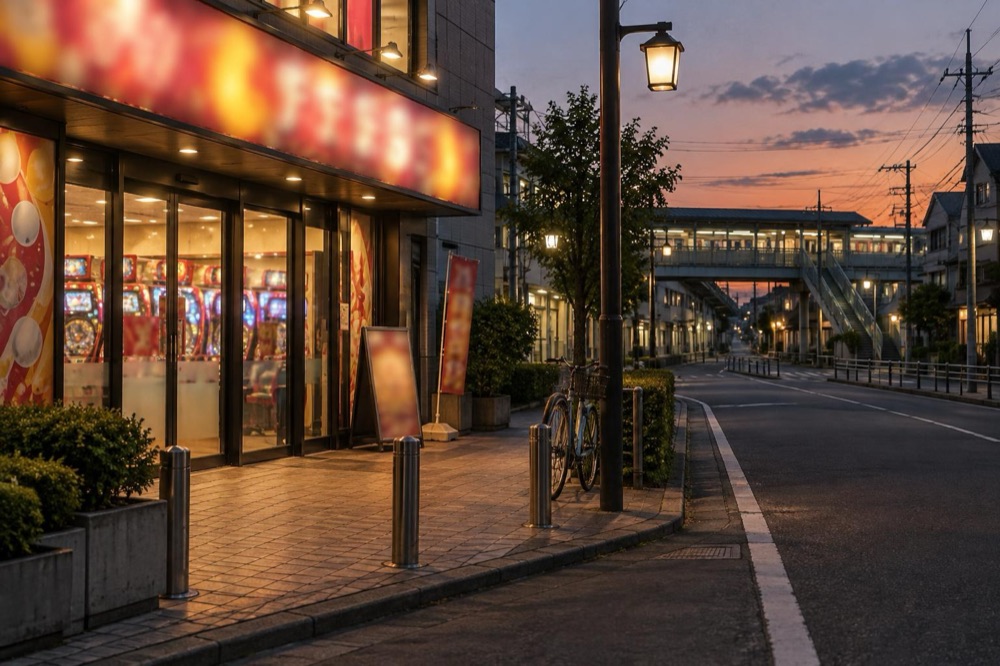
Two rail options put you within a short walk2:
- Koshinzuka stop on the Toden Arakawa Line, the last surviving tram line in Tokyo. The tram is slow and charming, and the stop is a couple of minutes from the door.
- Nishisugamo Station on the Toei Mita subway line. This is the faster option from central Tokyo and connects directly to Otemachi, Hibiya and Meguro.
If you are coming from a hotel in Shinjuku or Ikebukuro, the Mita line is the straightforward route. From Ikebukuro it is only a few stops. From further out, ride to Sugamo or Otsuka and walk, or change onto the Mita line.
The area around the parlor is worth a wander before or after you play. Sugamo, one stop away, is famous for its shopping street aimed at older shoppers, with snack stalls and tea shops. Otsuka has a cluster of inexpensive restaurants. Neither is a tourist landmark, which is exactly why a visit feels like seeing ordinary Tokyo rather than a staged version of it.
Opening hours and entry rules
There is no entry fee, no membership card and no minimum spend to walk in. You take a seat at any free machine and start. If every seat is full, wait by the machine you want or ask a staff member where there is space.
If you are used to casinos, the biggest difference is that there is no cage, no chips and no table. Everything happens at your machine, and the staff are there to help with jams and payouts rather than to deal.
Games and machines on the floor
The floor holds 61 machines2. In a parlor this size you will typically find a mix of modern digital pachinko cabinets and a few older-style machines, though the exact lineup changes as manufacturers release new titles and the shop rotates its stock. The machines are the standard Japanese type: a vertical playfield, a launch handle on the right, a tray of balls at the bottom, and a digital screen in the center that runs the payout feature.
How a session works, step by step:
- Choose a machine. Look for one with an empty seat and a tray. If you are new, pick a machine with a simple screen rather than a heavily animated one.
- Buy balls. Put a JPY 1,000 note into the machine or hand it to the staff, and a tray of balls appears. Balls are the currency of the game.
- Turn the handle. Adjust the strength so balls enter the playfield at the top right and fall through the pins. Too weak and they drop short; too strong and they fly past the scoring pockets.
- Watch for wins. When a ball lands in the right pocket, the machine pays out a run of balls and often starts a digital feature on the screen.
- Keep the tray topped up. When your balls run low, buy more. When you want to stop, call a staff member to count your remaining balls.
The legal cap on the game fee is JPY 4 per ball, plus a consumption tax equivalent, which is the ceiling set for pachinko machines under the relevant cabinet order4. In practice the price you pay per ball at the counter is set by the parlor within that limit, and you will see the rate posted at the machine or the counter.
Pachinko is not the only game that falls under this kind of regulation. Mahjong parlors, for example, are capped at JPY 600 per hour per person for a fully automatic table, or JPY 500 for other tables, with a higher per-table cap of JPY 2,400 and JPY 2,000 respectively4. That gives you a sense of how Japanese regulators treat amusement games: they allow them, but they put a hard ceiling on what a customer can be charged.
Costs, tokens and payouts
There are no tokens at Pachinko Taiyo. You play with steel balls, and the balls are both your stake and your score. A typical session starts with a JPY 1,000 note, which buys a tray of balls at the posted rate. The legal maximum is JPY 4 per ball plus tax4, so a JPY 1,000 note buys a substantial tray at the ceiling rate.
What it costs to play depends entirely on how long you stay and how the machine behaves. A short session of twenty minutes might cost a few thousand yen. A long afternoon can cost much more, because the game is designed to keep balls circulating. Set a budget before you sit down and treat the money as spent entertainment rather than an investment.
Payouts work like this. When you win, the machine releases a run of balls into your lower tray. Those balls are yours. When you finish, a staff member counts them and you take the tray to the exchange counter. In Japan, the exchange is done in two steps: you swap balls for a token or a prize, and the prize is then exchanged for cash at a separate counter nearby. This two-step process is the workaround that keeps parlors on the right side of the gambling rules1.
A few things to know about the money side:
- Payout rates vary by machine. Newer machines with big digital features tend to have lower base payout rates and bigger jackpot potential. Older, simpler machines pay more steadily.
- The house edge is real. Over a long session, the machine keeps a share of what you put in. That is how the parlor pays its staff and rent.
- Winnings are not taxed at the counter. You receive what the exchange gives you, and any tax question is between you and the Japanese tax office.
- Keep your tray visible. If you leave a machine with balls in the tray, another player may take the seat. Take your tray with you if you step away.
For comparison, other legal gambling in Japan has its own price points.
| Item | Cost |
|---|---|
| Racecourse entrance fee at Tokyo, Nakayama, Kyoto, Hanshin and Chukyo | JPY 2005 |
Pachinko sits in the same family of small-stake, high-turnover entertainment.
Rules for foreign visitors
Foreign visitors can play pachinko in Japan without any special permission. Parlors are open to the public, and there is no rule that restricts them to Japanese nationals. You do not need a Japanese address, a residence card or a membership. Walk in, take a seat and play.
A few things that help on a first visit:
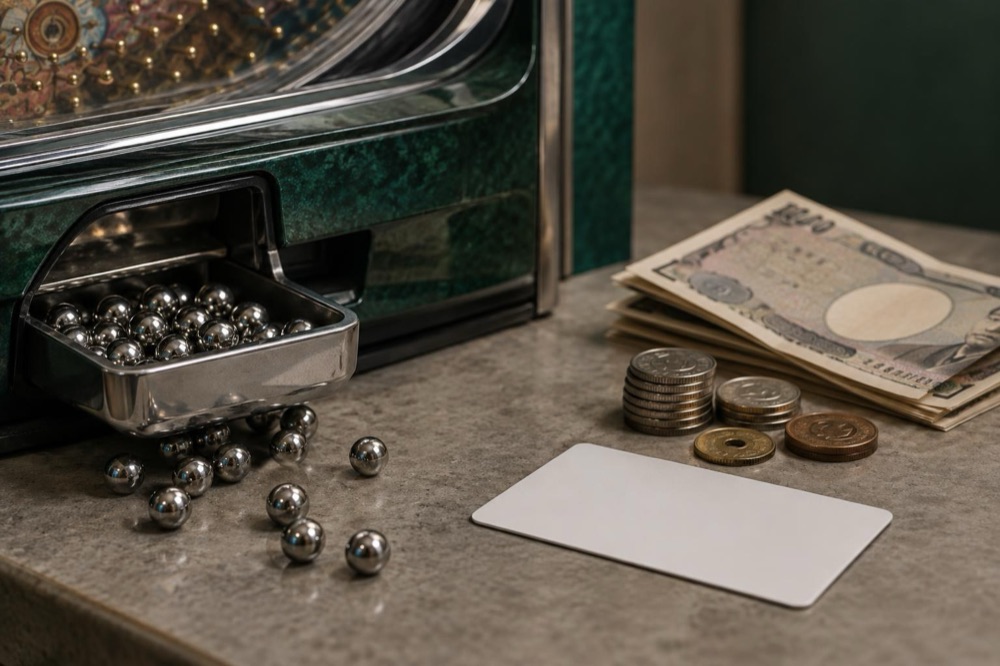
- Cash is essential. Bring yen. Machines do not take foreign cards, and there is no ATM on the floor in a parlor this size.
- Language is not a barrier. The controls are physical, and staff will help with a jam or a payout by gesture if you do not speak Japanese. Point at the tray and hold up a note if you want more balls.
- No passport needed at the door. Unlike casinos in some neighboring countries, Japanese pachinko parlors do not check passports on entry. You only need photo ID for large prize claims, and that applies to lottery tickets rather than pachinko6.
- Play for fun, not for income. The game is entertainment, and the odds favor the house over time.
If you are comparing this with casino gambling elsewhere in Asia, the contrast is sharp. In Korea, for example, most casinos are foreigner-only, and Korean nationals are barred from the foreigner-only gaming area7. In Japan, pachinko is the opposite: it is a domestic pastime that visitors are welcome to join. If you want to see how the two systems differ, our guide to casinos in Japan covers who can go in, and Can I Gamble in Japan? sets out the wider picture.
One thing to keep in mind is that pachinko is not a casino. There are no table games, no dealers and no chips. If you want that experience in Japan, it does not exist yet: the first integrated resort with a casino is planned for Osaka, and it is not open. Our page on when the Osaka casino resort will open explains the timeline.
Nearby food and amenities
Nishisugamo is a residential neighborhood, so the food options are local rather than tourist-oriented. Within a few minutes of the parlor you will find convenience stores, small ramen shops, cafés and izakaya. Sugamo, one stop away, has a longer shopping street with snack stalls and tea shops, and Otsuka has a cluster of inexpensive restaurants.
If you are planning a half day around the visit, a sensible shape is: play in the morning when the parlor is quiet, walk to Sugamo for lunch, then take the tram on the Toden Arakawa Line for a slow ride through the back streets of northern Tokyo. The tram is a attraction in itself, and Koshinzuka stop is right by the parlor2.
There is no on-site car park listed for the parlor, and the streets around it are narrow and residential. If you are driving, use a paid lot near Sugamo or Otsuka station and walk the last few minutes. Most players arrive by train or tram.
For a longer trip, Tokyo has plenty of other parlors, including large chains with hundreds of machines. If you enjoy the small-parlor experience at Pachinko Taiyo, you can compare it with a bigger hall on another day. The mechanics are the same; only the scale changes.
Common Questions
Where is Pachinko Taiyo located?
It is in Nishisugamo, in Tokyo's Toshima Ward, at Nishisugamo 3-chome 19-8. The nearest stops are Koshinzuka on the Toden Arakawa tram line and Nishisugamo Station on the Toei Mita subway line, both a short walk away.
What are Pachinko Taiyo's opening hours?
The parlor runs from 9:00 to 22:00. That is a long day by any standard, so you can drop in before lunch or after dinner. Hours can change on holidays, so it is worth a quick check before a special trip.
Is there an entry fee at Pachinko Taiyo?
No. You walk in and take a seat at a machine. You pay only for the balls you buy, and any winnings come back to you as balls you exchange at the counter. There is no cover charge and no membership.
Can tourists play at Pachinko Taiyo?
Yes. Pachinko parlors in Japan are open to anyone, including visitors, and you do not need a Japanese address or a membership card. Bring cash, since machines take notes and coins rather than foreign cards.
Does Pachinko Taiyo have parking?
The parlor sits in a dense residential part of Toshima Ward and no on-site car park is listed. Most players arrive by train or tram. If you are driving, use a paid lot nearby and walk the last few minutes.
Is smoking allowed inside Pachinko Taiyo?
Smoking rules vary from parlor to parlor and are not published for this one. Ask at the counter when you arrive, or look for the designated smoking area signs on the floor. Many Tokyo parlors now separate smoking from the main machine rows.
What ID do I need to enter Pachinko Taiyo?
None for ordinary play. You only need photo ID if you are claiming a large prize, and that rule applies to lottery tickets rather than pachinko balls. For a normal session, walk in and start playing.
Sources7 sources
- Best Online Casinos for Players from Japan, Wizard of Odds
- パチンコ天国, Wikipedia
- 南大門 大金店, P-World
- 風俗営業等の規制及び業務の適正化等に関する法律施行令, e-Gov
- Casino Implementation Act, House of Councillors
- Scratch, Takarakuji Official
- 風俗第四号営業, Wikipedia