Gambling in Thailand has a longer history than its ban does. For most of the era of the old kingdom of Siam, gambling was not merely tolerated but licensed, taxed, and run as a business relationship between the crown and gambling house operators. The story of how that world was shut down, and how the lottery and horse racing survived as the only legal outlets, explains a lot about Thai gambling culture today, from the twice-monthly lottery ritual to the vast underground lottery that still flourishes. This page walks through that history in order, and ends with the practical details: what the lottery costs and pays, how to check results, and where to go if lottery play stops being fun.
Gambling in Thailand before the ban
Before the twentieth century, gambling in Siam was an open, regulated trade. The state licensed gambling houses, known in Thai as bon, and collected taxes on them, and the revenue was significant enough to appear in the historical record. In the reign of King Rama II, the government collected 260,000 baht a year in gambling taxes. After a tax reform in the reign of King Rama IV, that figure rose to 500,000 baht a year1.
That revenue is the key to understanding why gambling lasted as long as it did. The licensed houses offered games played with cards and dice, including ancestors of games still played informally today, such as pok deng, the Thai card game that remains one of the most popular gambling pastimes in the country. Gambling was woven into everyday life: festivals, temple fairs, and market days all featured betting, and the houses were simply the fixed, taxed version of something people did everywhere anyway.
The arrangement suited the state for a long time. But as the government of Siam modernized in the late nineteenth and early twentieth centuries, the calculus changed. Gambling taxes became a smaller and smaller share of state revenue as other taxes came in, and reformers increasingly saw the licensed houses as a social problem rather than a source of income. The stage was set for a shutdown that came in stages rather than all at once.
How the gambling houses were shut down
The closure of the gambling houses was a gradual squeeze rather than a single dramatic event. Gambling was first prohibited in the southern region, and then, on April 1, 1917, in the reign that followed King Chulalongkorn's reforms, all remaining gambling venues across the country were ordered closed2. Press accounts date the effective end of legal casinos to King Rama VI's prohibition of gambling in 1916, with the final closures following in 19173.
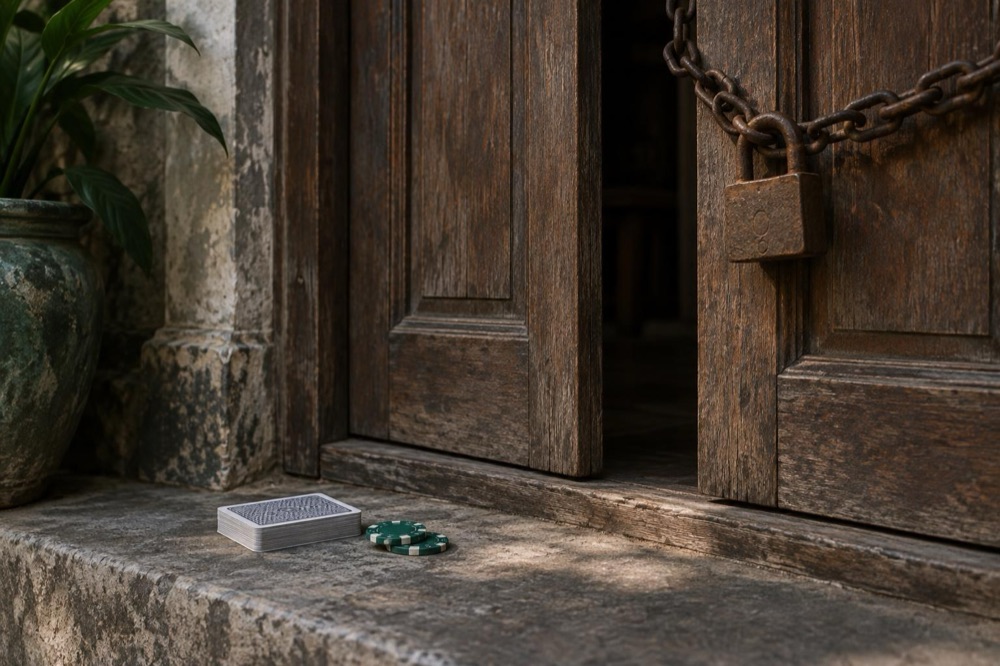
The shutdown did not end gambling in Thailand. It ended legal, above-ground gambling. The demand that had sustained the licensed houses for centuries simply moved underground, into illegal dens, informal card games, and, most consequentially for the century that followed, the underground lottery. That pattern, a ban on the surface and a thriving black market beneath it, has defined Thai gambling ever since, and you can read more about it in our page on gambling in Thailand.
The Gambling Act: what it prohibits and the penalties for players
The legal framework that governs all of this today is the Gambling Act of 1935, enacted in Thai as Phra Ratchabanyat Kan Phanan Phutthasakarat 2478 and still in force, in amended form, nearly a century later5. It was examined and passed by the Siam House of Representatives, and it made Thailand a country where gambling is strictly controlled, with only the government lottery and state-run horse racing permitted5.
What the act prohibits is nearly everything. Sports betting and slot machines are off-limits. Card games for money are off-limits, and poker in particular is still viewed as gambling rather than a mind sport, so even a friendly home game sits in a legal gray area at best7. A separate piece of legislation, the Playing Card Act of 1943, makes even the possession of more than 120 playing cards an offense, a rule aimed squarely at card gambling operations7.
The penalties for players are real, though in practice most people caught are fined rather than jailed. Players face fines of 500 to 5,000 baht and, depending on the severity of the case, up to three years in prison8. Football betting specifically carries up to two years' imprisonment or a fine of up to 2,000 baht, or both9. Being found in an underground poker room can mean a fine or up to a year in jail7. These laws apply to foreigners as well as Thai citizens, and foreigners caught gambling have been jailed while awaiting deportation, with deportation a common outcome8.
Online gambling sits in an odd corner of this framework. The 1935 act predates the internet and does not cover online gambling directly, but it bans nearly all wagering activities, and Thai law has never officially accommodated online play, so gambling online in Thailand carries genuine legal risk even though it is widespread10. Our page on online gambling in Thailand covers that world in detail.
The Government Lottery Office and the modern lottery
While the state was closing gambling houses, it was also building the one form of gambling it would keep. The Government Lottery Office (GLO) was established on April 5, 1939, when the cabinet transferred the lottery to the Ministry of Finance and appointed a committee to run it; that date is treated as the office's founding day4. Today it is a state enterprise under the Ministry of Finance, a juristic person under the Government Lottery Office Act B.E. 2517, with jurisdiction across the whole kingdom and a head office at 359 Nonthaburi 1 Road in Nonthaburi, just across the river from Bangkok4.
The lottery itself is far older than the office. The GLO counts 147 years of draws in its own history, meaning the lottery predates the office by decades13. The modern era began when the office printed its first tickets at its own printing house in April 194913. Its printing plant was later built at 9 Sukhumvit Soi 63 in Bangkok, with the foundation stone laid in 1977 and printing beginning in 197812.
The office also built an international reputation early. It joined the International Association of State Lotteries as member number 43 in 1950, became a member of the World Lottery Association when that body was formed by merger in 1999, and joined the Asia Pacific Lottery Association in 2000, the year it was founded15.
Since the draw of May 2, 2019, the office has printed two types of tickets: the government lottery and the charity lottery18. The government lottery is the main draw held twice a month; the charity lottery is a smaller draw whose proceeds support charitable causes. Both are sold through the same network of licensed vendors, and both are legal for anyone in Thailand to buy, including foreigners, as long as the tickets come from licensed vendors19.
Ticket prices and print runs over time
The price of a Thai lottery ticket tells the story of inflation, demand, and the state's changing ambitions in one number. Before 1942 (B.E. 2485), a ticket cost 1 baht. In the period 1952 to 1957 (B.E. 2495 to 2500), the price ran between 8 and 10 baht. It was 10 baht in the 1964 era, rose to between 20 and 40 baht from 1995 (B.E. 2538), and today stands at 80 baht, with a legal maximum of 100 baht20.
Print runs tell the demand side of the story. In 1939 to 1942 (B.E. 2482 to 2485), the office printed 500,000 tickets per draw, reduced to 400,000 and then 300,000. By 1949 it was 1 million per draw; 2 million in 1964, rising to 4 million in 1967; 5 million from August 1972. In the late 1980s it climbed from 8 million to 28 million per draw by 1991. Between 2006 and 2008 it reached 46 million per draw, and by 2010 it hit 50 million per draw20.
Today a single set of government lottery tickets consists of 1 million tickets at 80 baht each, carrying 14,168 prizes totaling 48 million baht per set if all tickets are sold21. The prize ladder looks like this:
| Prize | Number of winners per set | Payout |
|---|---|---|
| First prize | 1 | THB 6,000,000 |
| Second prize | 5 | THB 200,000 |
| Third prize | 10 | THB 80,000 |
| Fourth prize | 50 | THB 40,000 |
| Last three digits | 2,000 (drawn 2 times) | THB 4,000 |
| Last two digits | 10,000 (drawn 1 time) | THB 2,000 |
| First three digits | 2,000 (drawn 2 times) | THB 4,000 |
The official price is 80 baht, and the office warns against vendors selling above that price, but in practice tickets with pretty numbers or sold in curated sets go for 110 baht and up on the street22. Tickets are sold in pairs, so a standard purchase is two tickets at 80 baht each19. If you want the full picture of how the modern draw works, see our page on the Thailand lottery.
The huay bon din two- and three-digit lottery
One of the most interesting episodes in Thai lottery history is the state's own attempt to compete with the underground lottery. The underground lottery, or huay tai din, pays far better than the government game on small bets: in some southern provinces such as Phuket, it pays 500 baht per 1 baht bet on the last three digits and 70 baht per 1 baht bet on the last two digits23. The government lottery could not match those payouts, and the underground game drained money out of the legal system.
In response, the cabinet passed a resolution on July 8, 2003 (B.E. 2546) authorizing a new above-ground two- and three-digit lottery, called huay bon din. Tickets went on sale on August 1, 2003, and the game ran until November 16, 200623. Tickets cost 20, 50, or 100 baht, and each draw printed around 16 million tickets, sold in three formats, with the number of tickets varying according to agent orders23. Payouts were 400 baht per 1 baht bet on the last three digits and 55 baht per 1 baht bet on the last two digits, better than nothing but still well below the underground game23.
The project ran into a legal wall. The huay bon din operated as a lottery with pre-selected numbers, a form the Government Lottery Office had no legal power to issue under the Government Lottery Office Act B.E. 2517, and winnings were subject to gambling tax under sections 16, 16 bis and 17 of the Gambling Act23. The game was discontinued in 2006.
But the idea did not die. In the same period, from 2003 to 2006, the GLO introduced the last-three-digit and last-two-digit prizes into the main government lottery, precisely to fight the underground game, with the new prize structure first sold over the draws of November 1 to 16, 200613. Those small prizes, 4,000 baht for the last three digits and 2,000 baht for the last two, are now a fixture of every draw, and the two-digit and three-digit number market lives on in both the legal game and the underground lottery, which continues to pay far more.
Horse racing: the other permitted form of betting
Horse racing is the other half of Thailand's tiny legal gambling allowance, and it is the older of the two institutions. Racing in Thailand began in December 1897 (B.E. 2440), in the reign of King Chulalongkorn, making it well over a century old24. When the gambling houses were closed and the Gambling Act swept away everything else, racing was one of only two forms of betting the state kept alive, alongside the lottery6.
Today there are eight racecourses in Thailand: two in Bangkok and six in the regions24. Betting at the track is legal, and it remains the only place besides licensed lottery vendors where you can place a legal bet in person in Thailand. Our page on horse racing in Thailand covers the racecourses, the betting, and what a day at the track is like.
What remains legal today and what does not
The short version of Thai gambling law, a century after the Gambling Act, is this: the government lottery and horse racing are legal, and nearly everything else is not6. That includes casinos, sports betting, slot machines, poker, and online gambling of every kind10. Poker is treated as gambling, not a mind sport, so even the growth of live poker in Thailand has happened in a legal gray zone at best7.
A few practical points matter for players. The Government Lottery Office sets a minimum age of 20 for lottery buyers, a rule introduced to keep young people away from lottery play, and it also prohibits the sale of tickets in schools26. Foreigners, including visitors, can legally buy Thai lottery tickets as long as they buy from licensed vendors within Thailand, and can claim winnings by presenting a passport or government-issued ID along with the winning ticket19.
Online gambling is the great unresolved question. The 1935 act does not address it directly, Thai law does not officially accommodate it, and playing online in Thailand carries real risk, even though online gambling has grown rapidly in Thai society over the past decade and more10. For the full picture of the current rules and what they mean in practice, see gambling laws and penalties in Thailand.
Visiting and contacting the Government Lottery Office
If you win, or if you simply want to see the institution at the center of Thai legal gambling, the GLO head office is at 359 Nonthaburi Road, Tha Sai subdistrict, Mueang Nonthaburi district, Nonthaburi 11000, at Sanambin Nam28. The office handles prize claims Monday to Friday from 08.30 to 15.00, with no midday break, excluding official holidays30.

Prize claims work like this. You have two years from the draw date to claim a government lottery prize, and ten years for a charity lottery prize; after that, unclaimed money goes to state revenue17. Major prizes are claimed at the GLO office in Bangkok, while smaller prizes can be claimed at regional lottery offices or licensed lottery agents19. Prizes under 20,000 baht are paid in cash; prizes of 20,000 baht and above are paid by check, or by bank transfer, with inter-bank transfers of up to 2 million baht per transaction13.
At the G floor counter in the head office, you need to reserve a queue online in advance through the GLO website, the GLO Lottery app, or a QR code, with one queue per person and a maximum of 200 tickets per claim. Prize money there is credited to your bank account or paid as a Krung Thai Bank check31. The office processes up to 65,000 tickets a day, split between a morning window from 07.30 to 12.00 and an afternoon window from 12.01 to 15.00, Monday to Friday13. Prize money can also be claimed through the three banks representing the GLO: the Bank for Agriculture and Agricultural Cooperatives, Krung Thai Bank, and the Government Savings Bank31.
Checking results is easy. You can check them yourself in any of these ways:
- at the GLO website
- by phone at 0 2528 8899 and 1900 1900 10
- in the GLO Lottery app on Android and iOS
- via the LINE Official Account "GLO Lottery"32
The office controls and verifies the result data on its website but says errors can occur, so winners should confirm complete information with the office directly33. For general inquiries, the call center is 0 2528 999918, and for status inquiries on advance ticket purchases and bookings, the same number operates from 07.30 to 15.3029.
One quirk worth knowing: if you buy tickets through the advance purchase and booking system, you collect them via Thailand Post at post offices nationwide, with quota agents in Bangkok collecting at the GLO office at Don Mueang and provincial agents at provincial halls or provincial treasury offices34. And if you end up with non-winning tickets from a booking, you can collect them at the GLO office before the draw date of the next draw35.
Where to get help with lottery addiction
Lottery play is woven into Thai life, and for most people it stays a small twice-monthly ritual. But for some it becomes a problem, and Thailand has real support available. There are three gambling helplines in the country, all free and confidential36.
The main one is the Department of Mental Health's hotline 1323, run by the Ministry of Public Health. It is free, operates 24 hours a day, keeps no records of callers, and counselors say callers need not feel embarrassed17. The GLO itself runs a consultation line for people who feel anxiety from gambling, including family members: call 0-2528-9999 and press 929. There is also the Social Help Center hotline 1300, which offers free, confidential support and information 24 hours a day30.
The GLO treats this as part of its mission, providing channels for advice and help for people at risk of lottery addiction, working with external organizations that have expertise in the area31. If gambling is causing you or someone close to you distress, these lines are the place to start, and our page on gambling help in Thailand has more detail.
Common Questions
What is the penalty for gambling in Thailand?
Players face fines of 500 to 5,000 baht and, depending on the severity of the case, up to three years in prison. Football betting specifically carries up to two years or a fine of up to 2,000 baht. Most people caught playing are fined rather than jailed.
Can foreigners be deported for gambling in Thailand?
Yes. The gambling laws apply to foreigners as well as Thai citizens, and the authorities have been known to jail foreigners while they await deportation, alongside fines. Deportation is a common response when a foreigner is caught gambling.
How old do you have to be to buy a Thai lottery ticket?
The Government Lottery Office sets a minimum age of 20 for lottery buyers, a rule introduced to keep young people away from lottery play. There is no lower age applied to foreigners specifically; the same 20-year threshold applies to everyone buying tickets.
How much does a Thai government lottery ticket cost?
The official price is 80 baht per ticket, and tickets are sold in pairs, so you normally pay 160 baht. Tickets with popular or pretty numbers, or sold in curated sets, can go for 110 baht or more per ticket on the street.
Is online gambling legal in Thailand?
No. The Gambling Act of 1935 does not address online gambling directly, but it bans nearly all wagering, and Thai law does not officially accommodate online play. Playing online in Thailand carries real legal risk, even though many people do it.
How do I contact the Government Lottery Office?
Call the GLO call center at 0 2528 9999, or check results at glo.or.th, by phone at 0 2528 8899 or 1900 1900 10, in the GLO Lottery app, or via the LINE Official Account. The office is at 359 Nonthaburi Road, Nonthaburi.
When can I claim a lottery prize at the GLO office?
The office handles prize claims Monday to Friday from 08.30 to 15.00, excluding public holidays. You have two years from the draw date for government lottery prizes, and ten years for charity lottery prizes, before unclaimed money goes to the state.
Sources36 sources
- Research on Thai gambling history, gamblingstudy-th.org, 2011
- การพนันในประเทศไทย (Gambling in Thailand), Thai Wikipedia, 2026
- The highs and lows of illegal gambling, Bangkok Post, 2014
- About the Government Lottery Office, Government Lottery Office, 2026
- พระราชบัญญัติการพนัน พ.ศ. 2478 (Gambling Act B.E. 2478), Thai Wikipedia, 2026
- Poker guides: Asia, Thailand, Somuchpoker, 2026
- Best online casinos for players from Thailand, Wizard of Odds, 2026
- Crime prevention and suppression, Royal Thai Police, 2026
- UFA888 license verification, ufa888.express, 2025
- GLO annual report 2564 (2021), Government Lottery Office, 2021
- GLO annual report 2562 (2019), Government Lottery Office, 2019
- Thai lottery, Government Lottery Office, 2026
- GLO FAQ, Government Lottery Office, 2026
- Research on GLO history, gamblingstudy-th.org, 2011
- Check reward, Government Lottery Office, 2026
- Lottery sale conditions, PRD Region 2, 2022
- Mental Health Hotline 1323, Department of Mental Health, 2020
- Can a foreigner buy Thai lottery tickets?, Bangkok Post, 2025
- Research on the huay bon din lottery, gamblingstudy-th.org, 2011
- การแข่งม้าในประเทศไทย (Horse racing in Thailand), Thai Wikipedia, 2026
- Lottery information, Revenue Department Region 4, 2018
- Reward payment channels, Government Lottery Office, 2026
- GLO FAQ: awards, Government Lottery Office, 2026
- GLO services, Government Lottery Office, 2026
- GLO e-channel, Government Lottery Office, 2026
- Digital lottery platform news, Radio Nakhon Phanom PRD, 2022
- Gambling helplines in Thailand, Find A Helpline, 2026
- Gambling help article, 2ded, 2026
- GLO help channel, Government Lottery Office, 2026
- Social Help Center Hotline 1300, Find A Helpline, 2026
- GLO responsible gambling policy, Government Lottery Office, 2026
- GLO history news archive, Government Lottery Office, 2020
- สำนักงานสลากกินแบ่งรัฐบาล (Government Lottery Office), Thai Wikipedia, 2026
- Laws related to GLO operations, Government Lottery Office, 2026
- หวยในประเทศไทย (Lottery in Thailand), Thai Wikipedia, 2026
- Lottery sale news, PRD Sakon Nakhon, 2022