The games Singapore plays at its own tables
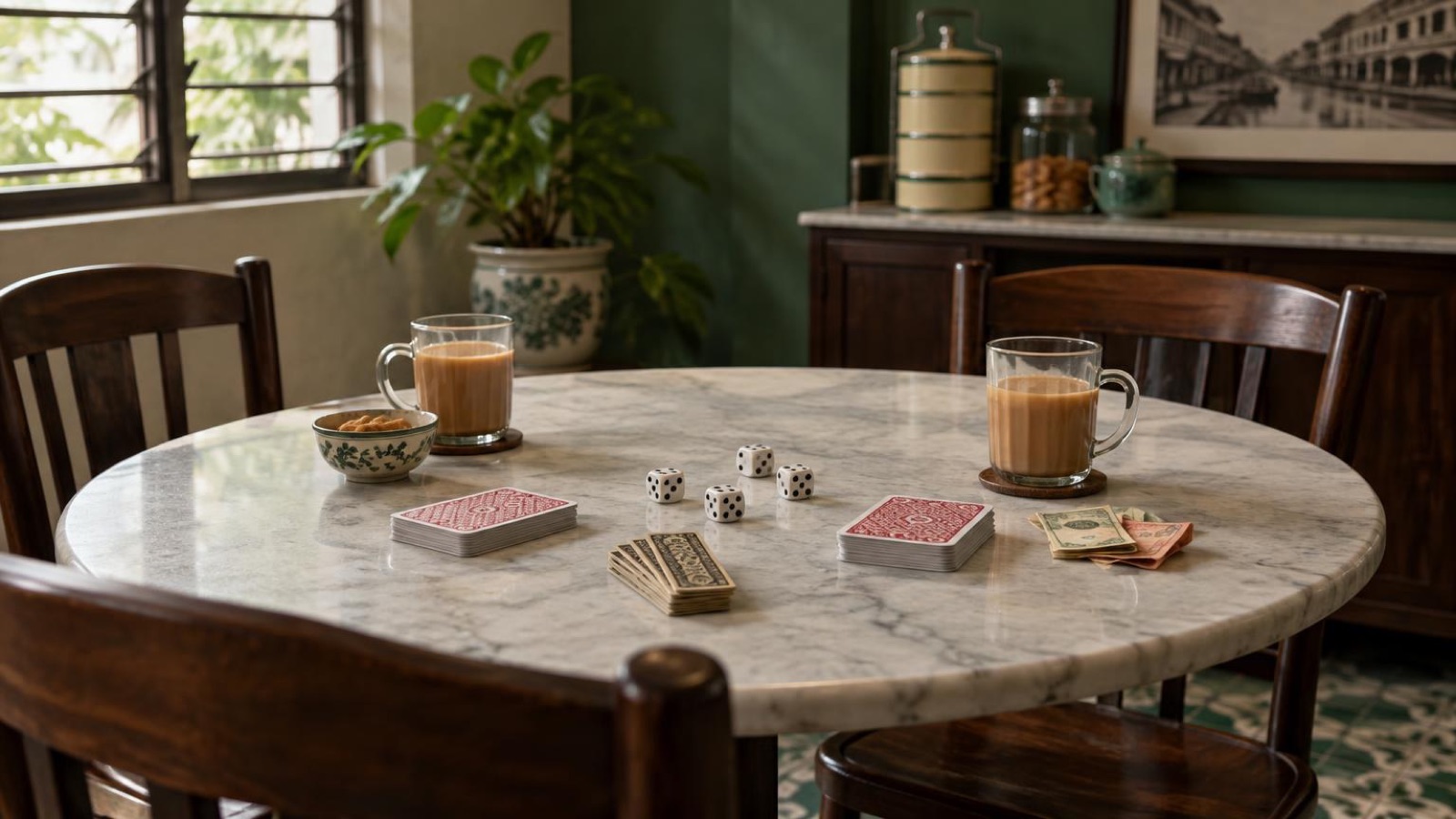
Step into a Singapore home during Chinese New Year, a family birthday or a long weekend and you may find a card table set up before the food is served. The games on it are not the ones you will see at Marina Bay Sands. They are older, smaller and more social.
Here is the lineup in one view:
| Game | What it is | Players | Equipment |
|---|---|---|---|
| Ban Luck | Local blackjack, beat the banker without passing 21 | A handful, banker rotates | Standard pack |
| Ceki | Peranakan game of building matching sets | Small group | Double pack |
| Thirteen-card Chinese poker | Arrange 13 cards into three poker hands | Two to four | Standard pack |
| Four color cards | Capture-and-collect game in the mahjong family | Small group | Narrow four-color deck |
| Balut | Dice game with a 28-round scoring sheet | Any number | Five six-sided dice |
What these games share is scale. They are built for a handful of players around one table, with stakes that are usually small and scoring that everyone can follow. Two of them, Ban Luck and Ceki, are strongly tied to Singapore's own communities: Ban Luck is a fixture of Chinese New Year gatherings, and Ceki belongs to the Peranakan tradition. The others traveled here with traders and migrants and found a permanent place in the mix.
If you want the full story on the most popular of them, we have a separate page on Ban Luck. This page covers that game in outline and gives the others their own space, ending with the one question every host quietly checks: whether playing cards for money at home is allowed. The short answer is yes, within limits, and we cover those limits once, at the end.
Ban Luck: Singapore's homegrown blackjack
Ban Luck is the game most Singaporeans think of when they think of cards. It is blackjack with local accents: the same goal of beating a banker's hand without going past 21, the same rhythm of drawing cards and deciding when to stop, but with house rules and bonus payouts that vary from family to family. The banker's seat usually rotates, and the special hands carry names of their own, which is where the game's character lives.
The core moves are the ones every blackjack player knows1:
- Hit: ask for another card.
- Stand: keep what you have.
- Split: turn a pair into two hands, at the price of a second bet equal to the first.
- Double: match your bet and take exactly one more card, a bet on a strong hand.
The local flavor sits on top of that frame. A natural 21 in the first two cards is the hand everyone wants, and in Ban Luck the special starting hands, such as the two-ace Ban-ban, pay more than an ordinary win. Because the banker is usually a player rather than a house, the payouts are agreed at the table before the first deal, and part of the fun is arguing about them.
For the full rules, the bonus hands and the dealer's side of the table, read our dedicated page on Ban Luck.
How a hand of Ban Luck is played
A hand begins with bets placed and the banker dealing. Each player gets their cards, checks the total, and then works through the standard choices in turn.
The decision that matters most is the split. A player holding two cards of the same kind can separate them into two individual hands, but the price of doing so is a second bet equal to the first. The dealer gives the first hand its extra card first, and the player plays that hand out, hitting, standing or doubling, before the second hand is touched1. This is why a split is both an opportunity and a risk: you have twice the money on the table and two hands to get right.
Around that spine, house rules fill in the rest:
- Some tables let you double on any two cards, some only on totals of 9, 10 or 11.
- Some treat five-card hands that have not busted as automatic winners.
- None of this is written anywhere official, because Ban Luck is a home game: the rules are whatever the table agrees, and the banker usually has the last word.
Ban Luck payouts and dealer bonus rules
The baseline payout is the blackjack standard. A winning natural, an ace plus a ten-value card in the first two, is traditionally paid at 3 to 2, meaning you receive three dollars for every two you bet6. Ordinary winning hands pay even money.
On top of that, Ban Luck tables add their own bonus schedule. The named hands, like Ban-ban, pay multiples of the stake, and the banker's position carries its own rules: because the banker plays against everyone at once, bonus payments usually flow to or from the banker in doubled form. Each family's version differs, so the practical habit is to settle the payout table before the shoe is opened, not after someone turns over a surprise.
If you are playing in one of Singapore's two licensed casinos instead of a living room, the game there is standard casino blackjack, not Ban Luck, and the payouts are the house's, not the table's. The casino entry levy applies to citizens and permanent residents who want to sit down at those tables.
Ceki: the Peranakan card game of sets
Ceki is the card game of the Peranakan community, and it does not look like blackjack at all. It is a game of building sets. The objective is to form three "mata", or sets, each made of three cards of the same value regardless of suit2. Where Ban Luck is about the tension of one total, Ceki is about the slow satisfaction of collecting matches.
The game uses a double pack, and each player receives eight cards, dealt two at a time clockwise, four times around2. From that hand of eight, you trade, draw and discard your way toward your three sets. The cards themselves are distinctive: the deck includes the "kaki" cards, which follow their own rules. Kaki cards only form sets of the same pattern, meaning three yu nyonya, three yu kucing or three yu lau chian together2.
The moment of drama is the call. A player who achieves two full mata and one pair shouts "ceki" while placing the pair face down, and from that point may no longer change the two completed sets2. It is a declaration that locks your hand: right or wrong, you are committed.
Ceki scoring and payouts
Scoring is arithmetic, and it rewards high-value sets. Each mata is worth the sum of its card values, so a set of three sevens, a "jit mata", is worth 21 points2. The exception is the kaki cards, which are worth only one point each, so a kaki set scores just 3 points2. That is the trade-off built into the deck: the special cards are easier to match but worth almost nothing.
Money follows the points directly. At the end of each round, the winner receives an amount equal to the points scored, paid by the opponents2. There is no fixed stake or multiplier: the table agrees what a point is worth, and the settlement is simple multiplication. A hand with three strong mata can cost the losers a great deal more than a hand scraped together from kaki cards, which is why experienced players watch the discards for high cards early and count what is still out.
Thirteen cards, three hands: Chinese poker
Thirteen-card Chinese poker, called shisan zhang in Mandarin and known in many Singapore homes simply as "thirteen", takes the poker hands you know and rearranges them into a game of arrangement rather than betting. Each player gets thirteen cards and sorts them into three hands: a top row of 3 cards, a middle row and a bottom row, each stronger than the one above it3. You are not betting or bluffing hand by hand. You are building three poker hands at once and then comparing them, row against row, with every other player.
The game is flexible about numbers. It is played with two, three or four players7, which makes it a good fit for a table that has lost or gained someone mid-afternoon. Scoring is in points, and each point has an agreed monetary value3, so the settlement at the end is a grid of comparisons: you win or lose points against each opponent in each row, and the totals are added up and paid.
Because there is no betting round, the skill is in the sorting. A hand that looks strong can be arranged badly, and a mediocre thirteen cards can be split so that every row just beats the player to your left. Big Two, or Dai Di, a cousin game that uses five-card poker hands and singles played trick by trick, shares this family resemblance: familiar poker shapes, unfamiliar rhythm. If poker itself is what you are after, our page on poker in Singapore covers where the modern game is played.
Four color cards
Four color cards, or Si Se Pai, look like nothing else on this list. The deck is small and the cards are narrow strips printed in four colors, red, green, white and yellow. There are 7 types of card, and they carry the same characters as in Chinese chess8. If you know the general or the soldier from a xiangqi board, you will recognize them here.
The game plays as a capture-and-collect game in the mahjong family rather than a poker relative. You draw, you discard, and you watch what others take. The sharp edge is the steal: you can steal a card that someone has drawn or discarded in 3 situations, namely to win, to make a Quad, which is forced, or to make a Triplet unless it is a King8. That rule gives four color cards its tactical bite. Nothing is safe on the table, and a card you draw can be taken from you before your turn ends if it completes someone else's four of a kind.
Four color cards is slower and quieter than Ban Luck and more like mahjong in temperament. It is a game for players who enjoy watching the pile, remembering what has gone, and waiting for the one card that finishes a set. Tables are usually found in the same homes and clubs where mahjong is played, and the two games often share the same cloth.
Balut: the five-dice game
Balut is the odd one out here, because it uses dice rather than cards, but it belongs at the same table. It began as a dice game among expatriates in Asia and spread widely, and it plays like a richer version of the Western game Yahtzee. The game is played with five six-sided dice4, and in each turn the dice can be rolled up to three times4, with the player setting aside the dice they want to keep between rolls.
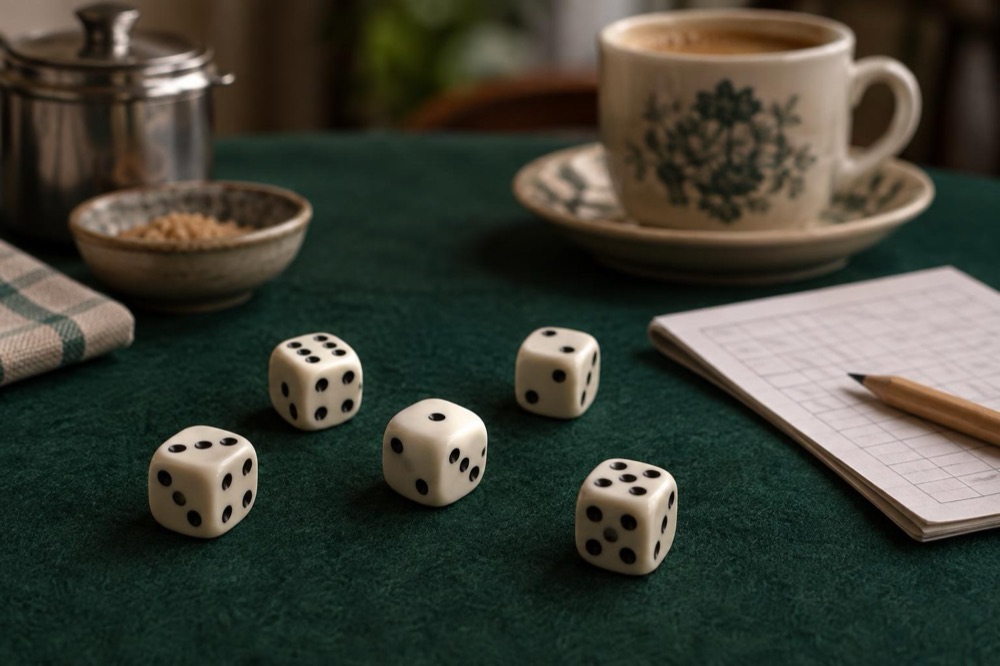
The scoring sheet is where Balut grows beyond its cousin. There are a total of 7 possible combinations, and each combination can be scored four times4, which stretches the game out: each player plays 28 rounds in all to score4. Four chances at a full house, four chances at a straight, four chances at the dice-named Balut itself, which is five of a kind. The player earning the most points wins the game4.
On top of the combination scores sit bonuses for the final total:
| Final total | Bonus points |
|---|---|
| 500 to 549 | 3 |
| Higher totals | More, in rising bands |
Those bonus points are why experienced players sometimes pass up a safe combination late in the game and gamble on a big one: the difference between finishing at 480 and finishing at 520 is not just 40 points, it is a bonus band4.
Is social card gambling legal in Singapore?
This is the one legal question worth asking about these games, and the answer is short. Gambling activities in Singapore are prohibited unless they are exempted or licensed9, but home card games among family and friends sit inside the exemption. Under the Gambling Control Act 2022, physical social gambling among family and friends is permitted, provided it takes place in person and in an individual's home, and the participants are family members or people who know each other personally5. The law spells out the same conditions: the game must be in a home in Singapore, among family or personal acquaintances, substantially spontaneous, not run for anyone's private gain or as a business, with profit coming only from winning10.
Two boundaries matter in practice:
- It is illegal to gamble in any public place in Singapore, even among family and friends, so the coffee shop table and the void deck are out5.
- Social gambling is not permitted on online platforms, so a home game moved to a video call with real stakes stops being social gambling5.
Playing on an unapproved gaming machine is a separate matter, and an individual who plays a game of chance for a prize on such a machine, knowing or reasonably ought to know it is prohibited, commits an offense11.
So the practical rule for a card evening in Singapore is simple: keep it in a home, keep it among people who actually know each other, keep it spontaneous, and keep the banker's seat rotating rather than running a business. Within that, Ban Luck, Ceki, Chinese poker, four color cards and Balut are all part of the ordinary furniture of Singapore life, and the stakes are whatever the table agrees they are. For the wider picture of what is licensed and what is not, see our page on gambling in Singapore.
Common Questions
How many players does Ceki need?
Ceki is a game for a small group around one table. Each player receives eight cards, dealt two at a time clockwise, four times around, so the game works best with enough players to use up the double pack.
What is the highest possible score in Balut?
Balut scores are banded rather than capped. A total of 500 to 549 points earns 3 bonus points, and higher totals earn more, so the highest score depends on how many top combinations you mark across your 28 rounds.
Which card starts a game of Big Two?
The player holding the lowest card leads the first trick, and that card is usually the 3. From there, play climbs toward the 2, the highest card in the game.
What does Ban-ban pay in Ban Luck?
Ban-ban is a starting hand of two aces, the luckiest two cards you can hold. Under common house rules it pays the stake several times over, more than an ordinary winning hand.
Why are two packs of cards used in Ceki?
Because every set needs three cards of the same value, a single pack would run out of matches too quickly. The double pack gives players enough matching cards to build their three sets.
Can you play Big Two with three players?
Yes. Big Two and its relatives flex from two to four players; thirteen-card Chinese poker, for example, is officially played with two, three or four players.
What happens if a die is cocked in Balut?
A cocked die, one leaning against another die or the edge of the cup, does not count. It is set straight and rolled again before the turn is scored.
Sources11 sources
- How to play blackjack, PlaySmart, 2026
- Ceki, Wikipedia (Malay), 2026
- Chinese poker, 888poker, 2026
- Balut, Play Online Dice Games, 2026
- Is social gambling allowed in Singapore?, Ministry of Home Affairs, 2026
- Rules of games, Carnegie Mellon University, 2026
- Hustler Casino poker games, California Department of Justice, 2026
- Four color cards game patent, Google Patents, 2026
- Regulating the casino and gambling industry, Ministry of Home Affairs, 2026
- Gambling Control Act 2022, Singapore Statutes Online, 2022
- Gambling Control Act 2022, supplementary, Singapore Statutes Online, 2022